The Tuxedo Budget
 Action
Updated
Synopsis
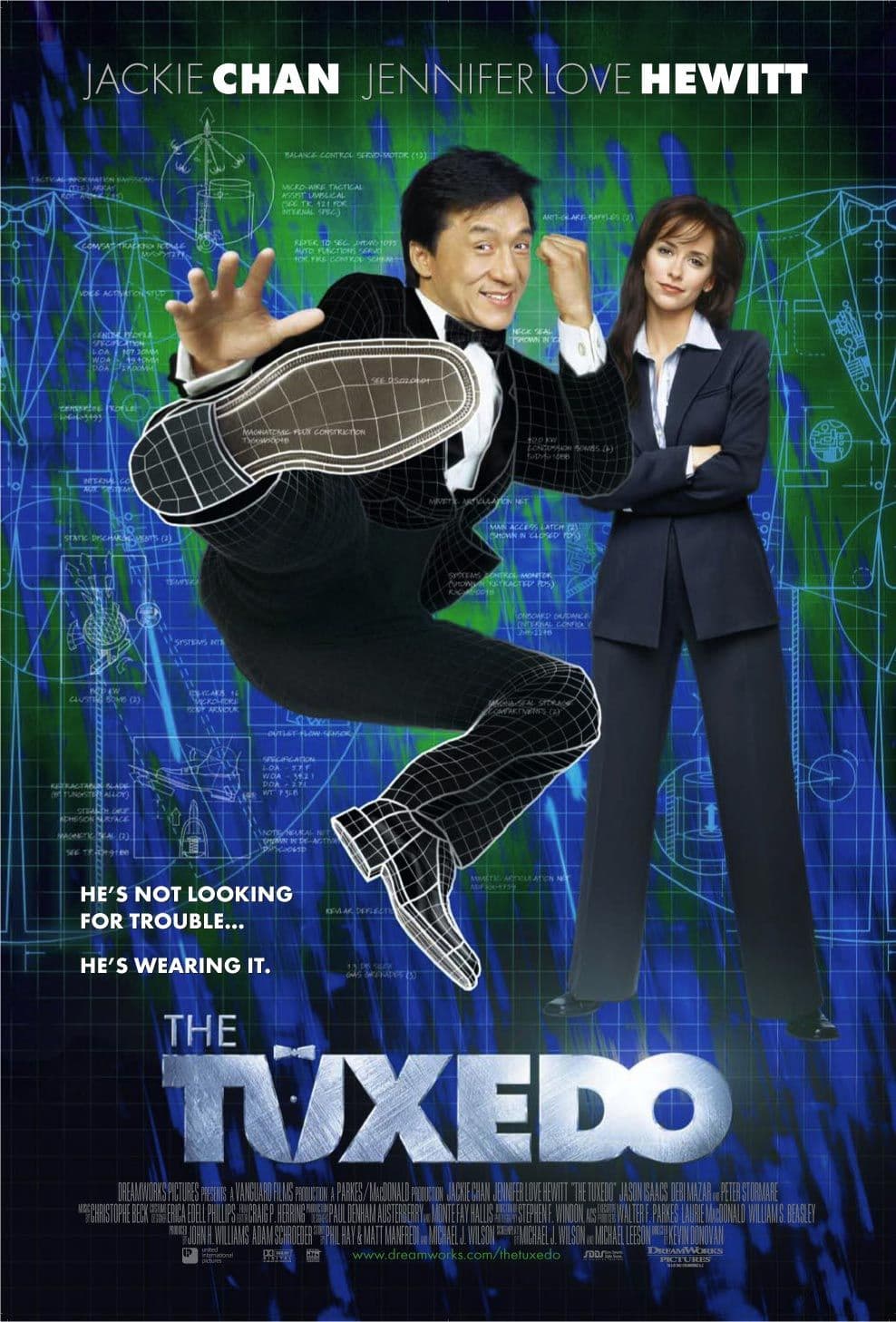
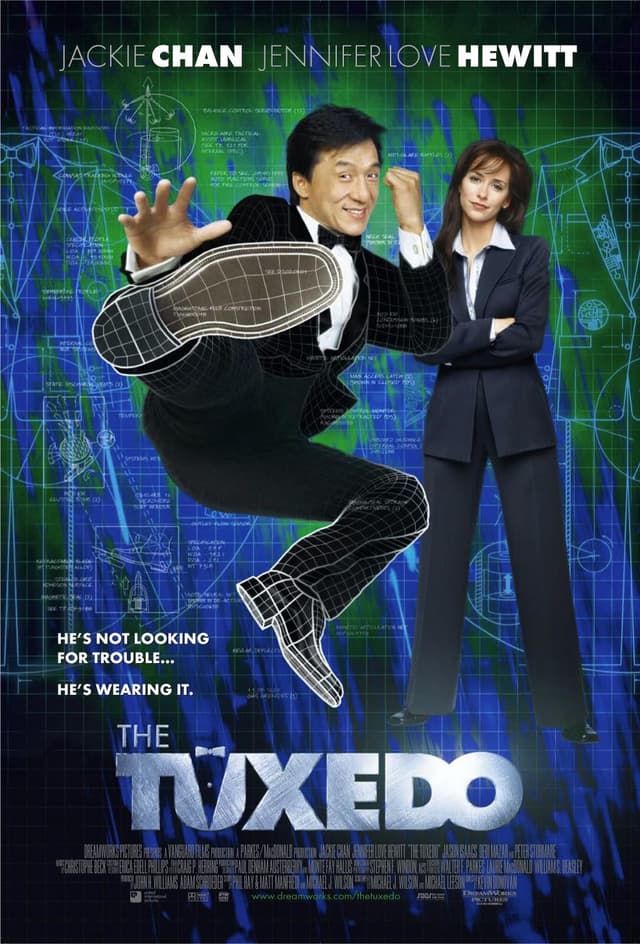
New York City cab driver Jimmy Tong takes a job as personal chauffeur to playboy millionaire Clark Devlin, but when Devlin is hospitalized after a bombing, Jimmy is forced to don the tycoon's prized tuxedo, a high-tech CIA-issued suit that grants its wearer extraordinary physical abilities. Paired with rookie agent Del Blaine, Jimmy must use the tuxedo's tech to stop a billionaire bottled-water magnate's plot to contaminate the world's drinking water supply.
What Is the Budget of The Tuxedo (2002)?
The Tuxedo (2002), directed by Kevin Donovan and distributed by DreamWorks Pictures, was produced on a reported budget of $60,000,000. The film was conceived as a vehicle to introduce Jackie Chan to a broader American family audience by pairing him with a high-concept gadget premise and a younger female co-lead. Producers Adam Schroeder and John H. Williams packaged the project at DreamWorks SKG with Phil Hay and Matt Manfredi (later the writers on Aeon Flux, Clash of the Titans, and Destroyer) handling the screenplay from a Michael J. Wilson and Michael Leeson story.
The investment reflected an ambitious mid-budget studio action comedy positioned for a fall family-friendly release. Jackie Chan took a substantial upfront fee plus back-end participation, consistent with his American film deal structure following Rush Hour and Shanghai Noon. Jennifer Love Hewitt, then transitioning from television leading-lady work (Party of Five, Time of Your Life) into theatrical features, was attached as the female co-lead at a reduced fee. Jason Isaacs played the central villain Diedrich Banning. The shoot ran across Toronto and Niagara Falls with substantial Canadian co-production tax credit support.
Key Budget Allocation Categories
The Tuxedo's $60,000,000 budget was distributed across these core production areas:
- Above-the-Line Talent: Jackie Chan commanded the largest single line item, with his upfront fee plus back-end participation accounting for a substantial share of the budget consistent with his American film deal structure following Rush Hour, Shanghai Noon, and Rush Hour 2. Jennifer Love Hewitt and Jason Isaacs took reduced fees. Director Kevin Donovan, in his feature directorial debut after a career in commercials, received first-time feature director compensation.
- Toronto Production Base: Principal photography ran from August to December 2001 across Toronto, Niagara Falls, and the surrounding Ontario geography, with the production using Canadian co-production tax credits as its primary financial anchor. The Toronto base provided stage capacity at Showline Studios and access to the extensive Ontario crew base.
- Action Choreography and Stunts: Jackie Chan brought his own stunt team from Hong Kong, including longtime collaborator Stanley Tong as second-unit director and Sammy Hung handling fight choreography. The action work, although less elaborate than Chan's Hong Kong films, required substantial pre-production rehearsal time and dedicated stunt doubles for both Chan and Hewitt.
- Visual Effects: Industrial Light & Magic and Cinesite handled the visual effects work, including the tuxedo's digital enhancement of Chan's physical capabilities, the water-contamination plot machinery, and the climactic Niagara Falls confrontation. The VFX shot count was substantial by 2002 standards for a non-superhero action comedy.
- Cinematography: Cinematographer Stephen F. Windon (xXx, The Fast and the Furious franchise) shot the film in widescreen 2.39:1 with a glossy commercial-action palette appropriate to the family-friendly studio comedy register. The Arri 535 and Panavision Platinum camera packages came in at typical mid-budget studio levels.
- Production Design: Production designer Carol Spier dressed the New York City exteriors and Devlin's Manhattan penthouse, the CIA training facility interiors, and the Banning Industries bottled-water plant. Most of the Manhattan exteriors were captured second-unit in New York, with the bulk of construction handled on Toronto stages.
- Score and Music: Composer Christophe Beck (Buffy the Vampire Slayer, the Hangover trilogy) scored the film with an orchestral-and-jazz action-comedy palette. The music budget covered original composition, full orchestra recording, and an unusually extensive licensed source-music package including a memorable James Brown homage sequence.
How Does The Tuxedo's Budget Compare to Similar Films?
At $60,000,000, The Tuxedo sits in the mid-range of early-2000s Jackie Chan-led American action comedies. The comparison set illustrates how its commercial outcome diverged from comparable releases:
- Shanghai Noon (2000): Budget $55,000,000 | Worldwide $99,300,000. Chan's Owen Wilson Western comedy cost slightly less than The Tuxedo and grossed almost identically worldwide, providing the most direct genre and star-vehicle peer.
- Rush Hour (1998): Budget $33,000,000 | Worldwide $244,400,000. Chan's first major American studio breakthrough cost roughly half of The Tuxedo and grossed nearly 2.5 times as much, demonstrating the commercial ceiling that the genre could reach with a stronger co-lead.
- Around the World in 80 Days (2004): Budget $110,000,000 | Worldwide $72,200,000. Chan's subsequent Disney comedy adventure cost nearly twice The Tuxedo and grossed two thirds as much, providing a more catastrophic peer for what could go wrong with the Chan-in-America commercial proposition.
- Spy Kids 2: Island of Lost Dreams (2002): Budget $38,000,000 | Worldwide $119,700,000. Robert Rodriguez's contemporaneous family-action comedy cost less than two thirds of The Tuxedo and grossed slightly more worldwide, providing the family-spy comedy peer reference.
- xXx (2002): Budget $70,000,000 | Worldwide $277,400,000. Rob Cohen's Vin Diesel action vehicle, released the same month as The Tuxedo, cost only marginally more and grossed nearly three times as much, illustrating the contemporaneous reference point for star-vehicle action.
The Tuxedo Box Office Performance
The Tuxedo opened domestically on September 27, 2002 across 2,939 theaters, grossing $15,109,028 over its opening weekend and finishing first at the U.S. box office. The film fell sharply in subsequent weekends and ended its domestic theatrical run with $50,206,654. International receipts added $54,200,000, for a worldwide total of $104,406,654. Here is the financial breakdown:
Box Office Breakdown
The Tuxedo

The Tuxedo returned approximately $1.10 in worldwide theatrical gross for every $1 invested when measured against the midpoint of total estimated production and marketing spend, placing the film slightly above theatrical break-even. The 52% international share of the worldwide gross was a balanced split that reflected Jackie Chan's sustained international box-office appeal, particularly in Asia and Europe, even as the U.S. theatrical reception was muted. Home-entertainment revenue on VHS and DVD throughout 2002-2003 pushed the film into modestly profitable territory for DreamWorks.
Within DreamWorks Pictures' 2002 release slate, the film registered as a mid-tier commercial piece that fell between the studio's prestige plays (Catch Me If You Can, The Ring) and its larger commercial releases (Minority Report, Road to Perdition). The result effectively closed the door on DreamWorks pursuing additional Jackie Chan vehicles, and Chan's subsequent American work moved to other studios. Director Kevin Donovan never directed another theatrical feature, returning primarily to commercial work.
The Tuxedo Production History
The Tuxedo originated as a screenplay package developed at DreamWorks SKG in the late 1990s, with Phil Hay and Matt Manfredi handling the script from a Michael J. Wilson and Michael Leeson story. Jackie Chan attached as the lead in early 2001 following the commercial success of Shanghai Noon and Rush Hour 2, with Jennifer Love Hewitt joining in mid-2001. Director Kevin Donovan, in his feature debut after a career in commercials, attached on the strength of his commercial reel.
Principal photography ran from August to December 2001 across Toronto, Niagara Falls, and the surrounding Ontario geography in Canada, with the production using Showline Studios in Toronto as its primary stage base. Canadian co-production tax credits provided the production's primary financial anchor. Second-unit work captured the New York City exteriors during shorter pickup blocks in October and November 2001.
Jackie Chan brought his own stunt team from Hong Kong, with second-unit director Stanley Tong (Police Story 3: Super Cop, Rumble in the Bronx) handling the action setpieces and fight choreographer Sammy Hung managing the day-to-day stunt work. Chan, then 47, performed most of his own stunts as had become his international trademark, though the production used digital wirework removal more extensively than his Hong Kong films had typically required. The film was DreamWorks' second Jackie Chan project after the studio's distribution deal on the Shanghai Noon franchise.
Awards and Recognition
The Tuxedo received minimal awards recognition. The film received Razzie Award nominations at the 23rd Golden Raspberry Awards in March 2003 (Worst Actress for Jennifer Love Hewitt and Worst Screen Combo for Chan and Hewitt) but did not win any. It received a Golden Trailer Award nomination for its marketing. The film received no nominations at the Academy Awards, BAFTAs, Golden Globes, Saturn Awards, or Critics' Choice Awards.
Within Jackie Chan's American film career, The Tuxedo is generally considered alongside The Medallion (2003) and Around the World in 80 Days (2004) as part of a less commercially-positioned mid-decade phase that bracketed his more successful Rush Hour and Shanghai Noon franchises. The film also marked Jennifer Love Hewitt's last major theatrical lead role before her transition primarily to television work (Ghost Whisperer began in 2005).
Critical Reception
The Tuxedo received predominantly negative reviews on release. The film holds a 21% approval rating on Rotten Tomatoes based on 144 critic reviews, with the consensus calling it "a high-concept comedy that wastes Jackie Chan's gifts on lazy gadget gags." On Metacritic, the film scored 33 out of 100, indicating generally unfavorable reviews. Audiences gave the film a B CinemaScore.
Roger Ebert gave the film one and a half out of four stars, writing that "the central premise robs Jackie Chan of the one thing he is incomparable at: doing his own stunts." A.O. Scott at The New York Times described the film as "a movie that uses computer-generated effects to do what Chan has spent thirty years doing in real life, and the result is correspondingly dispiriting." Owen Gleiberman at Entertainment Weekly gave the film a C-, noting that the central premise undermined Chan's appeal by attributing his physical capabilities to a magical suit rather than his actual skill.
Positive reviews were minimal but generally singled out the Chan-Hewitt chemistry and the James Brown impersonation sequence. The film has not undergone meaningful critical reappraisal in the years since release and remains one of the lowest-rated entries in Jackie Chan's post-Rush Hour American filmography. The picture occupies a clear position as the moment when DreamWorks abandoned the strategy of pursuing additional Chan-led mid-budget action comedies.
Frequently Asked Questions
How much did it cost to make The Tuxedo (2002)?
The reported production budget was $60,000,000. DreamWorks Pictures financed the production with Vanguard Films, anchored by Canadian co-production tax credits during the August-to-December 2001 shoot across Toronto and Niagara Falls.
How much did The Tuxedo (2002) earn at the box office?
The film grossed $50,206,654 domestically and $54,200,000 internationally, for a worldwide total of $104,406,654. It opened to $15,109,028 across 2,939 theaters on September 27, 2002, finishing first at the U.S. box office that weekend.
Was The Tuxedo (2002) a box office success?
The film performed slightly above theatrical break-even, returning approximately $1.10 in worldwide gross for every $1 invested when measured against total estimated production and marketing spend. The result effectively closed the door on DreamWorks pursuing additional Jackie Chan-led mid-budget action comedies.
Who directed The Tuxedo (2002)?
Kevin Donovan directed the film, his feature directorial debut after a career in commercials. Donovan never directed another theatrical feature following The Tuxedo, returning primarily to commercial work.
Where was The Tuxedo (2002) filmed?
Principal photography ran from August to December 2001 across Toronto, Niagara Falls, and the surrounding Ontario geography in Canada, with the production using Showline Studios in Toronto as its primary stage base. Canadian co-production tax credits provided the production's primary financial anchor.
Who stars in The Tuxedo (2002)?
Jackie Chan stars as cab driver Jimmy Tong, with Jennifer Love Hewitt as rookie CIA agent Del Blaine. Supporting roles went to Jason Isaacs as billionaire villain Diedrich Banning, Debi Mazar, Peter Stormare, Daniel Kash, and Romany Malco.
Does Jackie Chan do his own stunts in The Tuxedo?
Yes, partially. Chan brought his own stunt team from Hong Kong, including second-unit director Stanley Tong and fight choreographer Sammy Hung, and performed most of his own stunts. However, several critics noted that the central premise of the film (a high-tech tuxedo that grants its wearer extraordinary physical abilities) undermined Chan's appeal by attributing his physical capabilities to a magical suit rather than his actual skill.
What did critics think of The Tuxedo (2002)?
The film received predominantly negative reviews, with a 21% Rotten Tomatoes approval (144 reviews), a 33 out of 100 Metacritic score, and a B CinemaScore from audiences. Roger Ebert gave it one and a half out of four stars, and A.O. Scott called it "correspondingly dispiriting." The film remains one of the lowest-rated entries in Jackie Chan's post-Rush Hour American filmography.
Did The Tuxedo (2002) win any awards?
No. The film received Razzie Award nominations at the 23rd Golden Raspberry Awards (Worst Actress for Jennifer Love Hewitt and Worst Screen Combo for Chan and Hewitt) but did not win any. It received no nominations at the Academy Awards, BAFTAs, Golden Globes, Saturn Awards, or Critics' Choice Awards.
Is there a Tuxedo 2?
No. The Tuxedo did not receive a theatrical sequel. The film's mid-tier commercial result and harsh critical reception effectively closed the door on DreamWorks pursuing additional Jackie Chan-led mid-budget action comedies, and no sequel has been developed in the more than two decades since the original release.
Filmmakers
The Tuxedo

Build budgets like this one in Saturation
Start from an industry-standard feature film template, import the schedule and rates you already have, and let the cost report keep itself current as you spend. Real-time collaboration, no spreadsheets.