The Transporter Budget
 Action
Updated
Synopsis
Frank Martin is a former special forces operator turned professional driver in the South of France who lives by three strict rules: never change the deal, no names, never look in the package. When the package on his latest job turns out to be a kidnapped young woman, Frank breaks his own code, drawing the wrath of a human-trafficking network and triggering a series of explosive showdowns across the Riviera.
What Is the Budget of The Transporter (2002)?
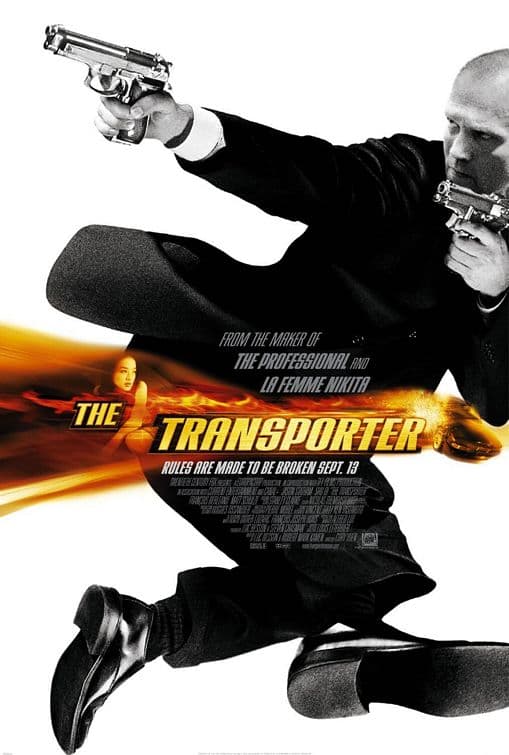
The Transporter (2002), directed by Louis Leterrier and Corey Yuen and distributed by 20th Century Fox, was produced on a reported budget of $21,000,000. The Luc Besson-produced French-American action thriller was financed through EuropaCorp (Besson's production banner) in partnership with TF1 Films Production, Current Entertainment, and Canal+, with Fox handling United States and most international distribution.
The relatively modest budget reflected the standard EuropaCorp action template Besson had refined through The Professional (1994), Taxi (1998), and Kiss of the Dragon (2001). Above-the-line costs centered on Jason Statham (then transitioning from Guy Ritchie ensemble pieces to leading-man status) at a scaled rate, with Hong Kong veteran Corey Yuen co-directing the action sequences and Louis Leterrier (Besson's former assistant) handling dramatic coverage in his feature debut.
Key Budget Allocation Categories
The Transporter's $21,000,000 budget was distributed across several core production areas:
- Lead Cast: Jason Statham starred as Frank Martin in his first leading-man role, with Shu Qi as Lai, the trafficked young woman, Matt Schulze as the antagonist Wall Street, and Francois Berleand as Inspector Tarconi. Statham was cast at a pre-Transporter rate appropriate to his post-Snatch but pre-franchise visibility.
- South of France Location Shoot: Principal photography took place primarily in Nice, Cannes, Antibes, Monaco, and Marseille along the Cote d'Azur in France. The Mediterranean coastline provided a visually distinctive backdrop that became one of the franchise's signature aesthetic elements. EuropaCorp's French production base anchored the cost structure through French tax credits.
- Corey Yuen Action Choreography: Hong Kong action veteran Corey Yuen (Romeo Must Die, Kiss of the Dragon) co-directed and choreographed the film's hand-to-hand and vehicular sequences. Yuen brought a Hong Kong wire-fu and martial-arts vocabulary to the European setting, and the choreography pre-production block was a significant component of the schedule.
- Vehicle Stunts and Practical Effects: Stunt coordinator Tony Munafo oversaw the film's extensive vehicular work, centered on the BMW 735i (E38) that became Frank Martin's signature car. Multiple vehicles were destroyed across the film's opening bank-heist getaway, the bus chase, the truck-and-jet-ski sequence, and the climactic confrontation.
- Cinematography: French cinematographer Pierre Morel (who would later direct Taken for Besson) shot the film in 2.35:1 anamorphic, lighting the Riviera locations to maximize their commercial-iconography appeal. Morel's gritty action photography became one of the film's most-praised technical elements.
- Score and Music: Composer Stanley Clarke scored the film with a hip-hop and electronica-inflected soundtrack supplemented by needle-drop licensing for key montages.
How Does The Transporter's Budget Compare to Similar Films?
At $21,000,000, The Transporter sits at the lower end of the early-2000s action thriller bracket, an explicit mid-budget bet by EuropaCorp:
- The Bourne Identity (2002): Budget $60,000,000 | Worldwide $214,034,224. Universal's contemporary action thriller cost nearly 3x The Transporter and grossed 4.9x more worldwide, illustrating the studio-financed prestige-action tier that EuropaCorp deliberately undercut.
- Kiss of the Dragon (2001): Budget $25,000,000 | Worldwide $64,829,449. Besson's previous EuropaCorp action vehicle with Jet Li cost 20% more than The Transporter and grossed 1.5x worldwide, the template the producers refined for the Statham project.
- Cradle 2 the Grave (2003): Budget $25,000,000 | Worldwide $46,317,791. Andrzej Bartkowiak's Warner Bros. action film starring Jet Li and DMX cost 20% more and grossed slightly more than The Transporter, a close commercial peer.
- XXX (2002): Budget $70,000,000 | Worldwide $277,448,382. Rob Cohen's Vin Diesel action thriller cost more than 3x The Transporter and grossed 6.3x worldwide, the broader Hollywood action ceiling for the period.
- Taken (2008): Budget $25,000,000 | Worldwide $226,830,568. The later Besson-EuropaCorp Pierre Morel-directed action film cost 20% more than The Transporter and grossed more than 5x worldwide, validating the EuropaCorp model The Transporter pioneered.
The Transporter Box Office Performance
The Transporter opened on October 11, 2002 to $9,072,072 across 2,573 theaters, finishing third on a weekend won by Red Dragon. The film held respectably against the autumn release schedule but did not break into the upper tier of October 2002 commercial outcomes. International release rolled out across Europe through the winter and into early 2003.
Against a $21,000,000 production budget, the film needed approximately $50,000,000 worldwide to break even when accounting for marketing and distribution costs. Here is the financial breakdown:
Box Office Breakdown
The Transporter (2002)

The Transporter returned approximately $1.00 in theatrical revenue for every $1 invested when measured against total estimated production and marketing spend, a near-break-even result that initially disappointed Fox but proved transformative when home entertainment, cable licensing, and the launch of Jason Statham as a leading-man franchise property delivered compounding long-tail revenue across the decade that followed.
The film's commercial legacy is dominated by what came next: Transporter 2 (2005) earned $85,166,131 worldwide on a $32M budget, Transporter 3 (2008) earned $108,138,047 on a $40M budget, and the franchise's reboot The Transporter Refueled (2015) earned $72,036,712 on a $22M budget. The original launched the franchise that became one of EuropaCorp's most reliably profitable export properties of the 2000s.
The Transporter Production History
Luc Besson developed The Transporter through his EuropaCorp production banner in the late 1990s and early 2000s as a continuation of the Hong Kong-meets-French-action template he had pioneered with Kiss of the Dragon. Besson co-wrote the screenplay with Robert Mark Kamen (The Karate Kid, Lethal Weapon 3), with the lead role explicitly conceived for Jason Statham after Besson's producers identified him from the Guy Ritchie ensembles.
Louis Leterrier was attached to direct as his feature debut after working as Besson's assistant on multiple prior productions. Hong Kong veteran Corey Yuen joined as co-director specifically to choreograph and stage the action sequences, with Leterrier handling dramatic coverage. The split-director structure had been used previously by EuropaCorp for action films integrating Hong Kong choreography with European production.
Principal photography ran from October 2001 through February 2002 in France, primarily along the Cote d'Azur, with the South of France locations becoming one of the film's signature visual elements. The BMW 735i (E38) was cast as Frank Martin's signature vehicle, with multiple units destroyed across the production. Post-production through summer 2002 prepared the film for an October Fox release.
Awards and Recognition
The Transporter received no significant industry awards recognition on its initial release. The film was not nominated at the major Hollywood industry ceremonies, the Saturn Awards, or the Critics' Choice Awards, reflecting the standard genre-action ceiling for European-financed mid-budget thrillers of the period.
In the years since release, the film has appeared on numerous best-action-films-of-the-2000s lists and best-Jason-Statham-films retrospectives, with critics identifying the original Transporter as the property that defined the Statham leading-man template through the subsequent two decades. The film has no awards-related home-media reissues but is widely recognized as a genre-defining mid-budget action film.
Critical Reception
The Transporter received mixed reviews on initial release. The film holds a 55% approval rating on Rotten Tomatoes based on 152 critic reviews, with a critical consensus that called it stylish and energetic in its action sequences but thin on character development. On Metacritic, the film scored 52 out of 100, indicating mixed or average reviews. Audiences surveyed by CinemaScore gave the film a B+, a strong result for the genre that drove the film's solid theatrical legs.
Critics broadly praised Corey Yuen's action choreography, Pierre Morel's cinematography of the South of France, and Jason Statham's commitment to the lead role. The Hollywood Reporter's Frank Scheck wrote that the film "introduces Statham as a wholly credible action lead with all the necessary physical credentials," while Variety's David Rooney called the film "a sleekly mounted action vehicle that knows exactly what genre it is operating in." Roger Ebert gave the film three stars out of four, writing that "Statham has a face that suggests he's thinking; in an action movie this is a rare and valuable thing."
Detractors objected to the screenplay's thin plotting and the broad strokes of the human-trafficking villain construction, with The New York Times' Stephen Holden arguing that the film "delivers expert action sequences but cannot decide whether it wants to be a serious thriller or a comic-book action picture." The mixed-to-positive critical reception combined with strong audience reaction to Jason Statham's screen presence laid the groundwork for the franchise extensions that ultimately defined the film's commercial legacy.
Frequently Asked Questions
How much did it cost to make The Transporter (2002)?
The reported production budget was $21,000,000. EuropaCorp (Luc Besson's production banner) financed the film in partnership with TF1 Films Production, Current Entertainment, and Canal+, with 20th Century Fox handling United States and most international distribution.
How much did The Transporter earn at the box office?
The film grossed $25,296,447 domestically and $18,415,928 internationally, for a worldwide total of $43,712,375. It opened to $9,072,072 across 2,573 theaters on October 11, 2002, finishing third behind Red Dragon and Sweet Home Alabama.
Was The Transporter profitable?
Theatrically, the film essentially broke even, returning approximately $1.00 in worldwide gross for every $1 invested against the total estimated production and marketing spend. However, home entertainment, cable licensing, and the launch of three sequels (and a 2015 reboot) made the original a foundational long-tail asset for EuropaCorp.
Who directed The Transporter?
The film was co-directed by Louis Leterrier (in his feature debut after working as Luc Besson's assistant) and Hong Kong action veteran Corey Yuen, who specifically choreographed and staged the action sequences. The split-director structure allowed Yuen to focus on action while Leterrier handled dramatic coverage.
Who stars in The Transporter?
Jason Statham stars as Frank Martin in his first leading-man role, with Shu Qi as Lai, Matt Schulze as the antagonist Wall Street, and Francois Berleand as Inspector Tarconi. The cast was assembled to support Statham's transition from Guy Ritchie ensembles to franchise lead.
Where was The Transporter filmed?
Principal photography took place primarily in the South of France, with locations in Nice, Cannes, Antibes, Monaco, and Marseille along the Cote d'Azur. EuropaCorp's French production base anchored the cost structure through French production tax credits.
What car does Jason Statham drive in The Transporter?
Frank Martin drives a black BMW 735i (E38) in the original film. The vehicle became one of the franchise's signature elements, with multiple units destroyed across the principal photography. Subsequent sequels switched to the Audi A8 (Transporter 2) and another BMW in later installments.
How does The Transporter compare to other EuropaCorp action films?
At $21,000,000 it cost slightly less than Kiss of the Dragon (2001, $25M, grossed $64.8M) and Taken (2008, $25M, grossed $226.8M). The original Transporter's near-break-even theatrical result was the lowest of the EuropaCorp leading-man action template, but its franchise extensions ultimately made it the most commercially significant.
What did critics think of The Transporter?
The film received mixed reviews, with a 55% approval rating on Rotten Tomatoes (152 critics) and a 52 out of 100 on Metacritic. Audiences gave it a B+ CinemaScore. Critics praised Corey Yuen's action choreography, Pierre Morel's cinematography, and Jason Statham's screen presence but objected to the thin plotting and broad villain strokes.
How many sequels does The Transporter have?
The original spawned two direct sequels with Jason Statham (Transporter 2 in 2005, Transporter 3 in 2008) and a 2015 franchise reboot (The Transporter Refueled) with Ed Skrein. There was also a brief 2012 television series. The franchise has earned more than $300M worldwide across all theatrical entries combined.
Filmmakers
The Transporter (2002)

Build budgets like this one in Saturation
Start from an industry-standard feature film template, import the schedule and rates you already have, and let the cost report keep itself current as you spend. Real-time collaboration, no spreadsheets.