The Thing
Synopsis
A US research station, Antarctica, early-winter 1982. The base is suddenly buzzed by a helicopter from the nearby Norwegian research station. They are trying to kill a dog that has escaped from their base. After the destruction of the Norwegian chopper the members of the US team fly to the Norwegian base, only to discover them all dead or missing. They do find the remains of a strange creature the Norwegians burned. The Americans take it to their base and deduce that it is an alien life form. After a while it is apparent that the alien can take over and assimilate into other life forms, including humans, and can spread like a virus. This means that anyone at the base could be inhabited by The Thing, and tensions escalate.
Production Budget Analysis
What was the production budget for The Thing?
Directed by John Carpenter, with Kurt Russell, Wilford Brimley, T.K. Carter leading the cast, The Thing was produced by Universal Pictures with a confirmed budget of $15,000,000, placing it in the low-budget category for horror films as part of the The Thing Collection.
At $15,000,000, The Thing was produced on a modest budget. Lower-budget films benefit from reduced break-even thresholds, with profitability achievable at approximately $37,500,000.
Budget Comparison — Similar Productions
• A Dangerous Method (2011): Budget $15,000,000 | Gross $27,462,041 → ROI: 83% • Ben-Hur (1959): Budget $15,000,000 | Gross $164,000,000 → ROI: 993% • Land of the Dead (2005): Budget $15,000,000 | Gross $47,074,133 → ROI: 214% • Into the Wild (2007): Budget $15,000,000 | Gross $56,255,142 → ROI: 275% • King's Ransom (2005): Budget $15,000,000 | Gross $4,139,856 → ROI: -72%
Key Budget Allocation Categories
▸ Practical Effects, Prosthetics & Makeup Horror productions invest disproportionately in practical effects — prosthetic applications, animatronics, blood and gore effects, and creature suits. A single hero creature suit can cost $50,000–200,000.
▸ Atmospheric Production Design & Cinematography Creating dread through environment is essential. Abandoned locations must be secured and dressed, lighting rigs designed for shadow and tension, and sets built to enable specific camera movements and reveals.
▸ Sound Design & Score Horror is arguably the most sound-dependent genre. Foley work, ambient textures, frequency manipulation, and jump-scare stingers require specialized sound designers working with unconventional techniques.
Key Production Personnel
CAST: Kurt Russell, Wilford Brimley, T.K. Carter, David Clennon, Keith David Key roles: Kurt Russell as MacReady; Wilford Brimley as Blair; T.K. Carter as Nauls; David Clennon as Palmer
DIRECTOR: John Carpenter CINEMATOGRAPHY: Dean Cundey MUSIC: Ennio Morricone, John Carpenter EDITING: Todd C. Ramsay PRODUCTION: Universal Pictures, The Turman-Foster Company FILMED IN: United States of America
Box Office Performance
The Thing earned $19,629,760 domestically, for a worldwide total of $19,629,760. The film skewed heavily domestic (100%), suggesting strong North American appeal.
Break-Even Analysis
Using the industry-standard 2.5x multiplier (P&A + exhibitor shares of 40–50% + distribution fees), The Thing needed approximately $37,500,000 to break even. The film fell $17,870,240 short in theatrical revenue. Ancillary streams (home media, streaming, TV) may have bridged the gap.
Return on Investment (ROI)
Revenue: $19,629,760 Budget: $15,000,000 Net: $4,629,760 ROI: 30.9%
Profitability Assessment
VERDICT: Modestly Profitable
The Thing earned $19,629,760 against a $15,000,000 budget (31% ROI). Full profitability was likely achieved through ancillary revenue streams.
INDUSTRY IMPACT
Franchise: The Thing is part of the The Thing Collection.
PRODUCTION NOTES
▸ Writing
Several writers developed drafts for The Thing before Carpenter became involved, including Logan's Run (1967) writer William F. Nolan, novelist David Wiltse, and Hooper and Henkel, whose draft was set at least partially underwater, and which Cohen described as a Moby-Dick-like story in which "The Captain" did battle with a large, non-shapeshifting creature. As Carpenter said in a 2014 interview, "they were just trying to make it work". The writers left before Carpenter joined the project. He said the scripts were "awful", as they changed the story into something it was not, and ignored the chameleon-like aspect of the Thing. Carpenter did not want to write the project, after recently completing work on Escape from New York (1981) and having struggled to complete a screenplay for The Philadelphia Experiment (1984). He was wary of taking on writing duties, preferring to let someone else do it. Once Carpenter was confirmed as the director, several writers were asked to script The Thing, including Richard Matheson, Nigel Kneale, and Deric Washburn.
Bill Lancaster initially met with Turman, Foster and Cohen in 1977, but he was given the impression that they wanted to closely replicate The Thing from Another World, and he did not want to remake the film. In August 1979, Lancaster was contacted again. By this time he had read the original Who Goes There? novella, and Carpenter had become involved in the project. Lancaster was hired to write the script after describing his vision for the film, and his intention to stick closely to the original story, to Carpenter, who was a fan of Lancaster's work on The Bad News Bears (1976). Lancaster conceived several key scenes in the film, including the Norris-Thing biting Dr. Copper, and the use of blood tests to identify the Thing, which Carpenter cited as the reason he wanted to work on the film. Lancaster said he found some difficulty in translating Who Goes There? to film, as it features very little action.
▸ Casting
Anita Dann served as casting director. Kurt Russell had worked with Carpenter twice before and was involved in the production before being cast, helping Carpenter develop his ideas. Russell was the last actor to be cast, in June 1981, by which point second unit filming was starting in Juneau, Alaska. Carpenter wanted to keep his options open for the lead R. J. MacReady, and discussions with the studio considered Christopher Walken, Jeff Bridges, and Nick Nolte, who were either unavailable or declined, and Sam Shepard, who showed interest but was never pursued. Tom Atkins and Jack Thompson were strong early and late contenders for the role of MacReady but Russell got the part. In part, Carpenter cited the practicality of choosing someone he had found reliable before, and who would not baulk at the difficult filming conditions. It took Russell about a year to grow his hair and beard for the role. At various points, the producers also met with Brian Dennehy, Kris Kristofferson, John Heard, Ed Harris, Tom Berenger, Jack Thompson, Scott Glenn, Fred Ward, Peter Coyote, Tom Atkins, and Tim McIntire. Some passed on the idea of starring in a monster film, while Dennehy became the choice to play Copper. Each actor was to be paid $50,000, but after the more-established Russell was cast, his salary increased to $400,000.
Geoffrey Holder, Carl Weathers, and Bernie Casey were considered for the role of mechanic Childs, and Carpenter also looked at Isaac Hayes, having worked with him on Escape from New York. Ernie Hudson was the front-runner and was almost cast until they met with Keith David. The Thing was David's first significant film role, and coming from a theater background, he had to learn on set how to hold himself back and not show every emotion his character was feeling, with guidance from Richard Masur and Donald Moffat in particular. Masur (dog handler Clark) and David discussed their characters in rehearsals and decided that they would not like each other.
▸ Filming & Locations
The Thing was storyboarded extensively by Mike Ploog and Mentor Huebner before filming began. Their work was so detailed that many of the film's shots replicate the image layout. Cundey pushed for the use of anamorphic format aspect ratio, believing that it allowed for placing several actors in an environment, and making use of the scenic vistas available, while still creating a sense of confinement within the image. It also enabled the use of negative space around the actors to imply something may be lurking just offscreen.
Principal photography began on August 24, 1981, in Juneau, Alaska. Filming lasted about twelve weeks. Carpenter insisted on two weeks of rehearsals before filming as he wanted to see how scenes would play out. This was unusual at the time because of the expense involved. Filming then moved to the Universal lot, where the outside heat was over . The internal sets were climate-controlled to to facilitate their work. The team considered building the sets inside an existing refrigerated structure but were unable to find one large enough. Instead, they collected as many portable air conditioners as they could, closed off the stage, and used humidifiers and misters to add moisture to the air. After watching a roughly assembled cut of filming to date, Carpenter was unhappy that the film seemed to feature too many scenes of men standing around talking. He rewrote some completed scenes to take place outdoors to be shot on location when principal photography moved to Stewart, British Columbia.
Carpenter was determined to use authentic locations instead of studio sets, and his successes on Halloween and The Fog (1980) gave him the credibility to take on the much bigger-budget production of The Thing. A film scout located an area just outside Stewart, along the Canadian coast, which offered the project both ease of access and scenic value during the day.
▸ Post-Production
Several scenes in the script were omitted from the film, sometimes because there was too much dialogue that slowed the pace and undermined the suspense. Carpenter blamed some of the issues on his directorial method, noting that several scenes appeared to be repeating events or information. Another scene featuring a snowmobile chase pursuing dogs was removed from the shooting script as it would have been too expensive to film. One scene present in the film, but not the script, features a monologue by MacReady. Carpenter added this partly to establish what was happening in the story and because he wanted to highlight Russell's heroic character after taking over the camp. Carpenter said that Lancaster's experience writing ensemble pieces did not emphasize single characters. Since Halloween, several horror films had replicated many of the scare elements of that film, something Carpenter wanted to move away from for The Thing. He removed scenes from Lancaster's script that had been filmed, such as a body suddenly falling into view at the Norwegian camp, which he felt were too clichéd. About three minutes of scenes were filmed from Lancaster's script that elaborated on the characters' backgrounds.
A scene with MacReady absentmindedly inflating a blow-up doll while watching the Norwegian tapes was filmed but was not used in the finished film. The doll would later appear as a jump scare with Nauls. Other scenes featured expanded or alternate deaths for various characters. In the finished film, Fuchs' charred bones are discovered, revealing he has died off-screen, but another take sees his corpse impaled on a wall with a shovel. Nauls was scripted to appear in the finale as a partly assimilated mass of tentacles but in the film he disappears. Carpenter struggled with a method of conveying to the audience what assimilation by the creature meant.
▸ Music & Score
Ennio Morricone composed the film's score, as Carpenter wanted The Thing to have a European musical approach. Carpenter flew to Rome to speak with Morricone to convince him to take the job. By the time Morricone flew to Los Angeles to record the score, he had already developed a tape filled with an array of synthesizer music because he was unsure what type of score Carpenter wanted. Morricone wrote complete separate orchestral and synthesizer scores and a combined score, which he knew was Carpenter's preference. Carpenter picked a piece, closely resembling his own scores, that became the main theme used throughout the film. He also played the score from Escape from New York for Morricone as an example. Morricone made several more attempts, bringing the score closer to Carpenter's own style of music. In total, Morricone produced a score of approximately one hour that remained largely unused but was later released as part of the film's soundtrack. Carpenter and his longtime collaborator Alan Howarth separately developed some synth-styled pieces used in the film. In 2012, Morricone recalled,
I've asked [Carpenter], as he was preparing some electronic music with an assistant to edit on the film, "Why did you call me, if you want to do it on your own?" He surprised me, he said"I got married to your music. This is why I've called you."... Then when he showed me the film, later when I wrote the music, we didn't exchange ideas. He ran away, nearly ashamed of showing it to me. I wrote the music on my own without his advice. Naturally, as I had become quite clever since 1982, I've written several scores relating to my life. And I had written one, which was electronic music. And [Carpenter] took the electronic score.
Carpenter said, [Morricone] did all the orchestrations and recorded for me 20 minutes of music I could use wherever I wished but without seeing any footage.
▸ Marketing & Release
The lack of information about the film's special effects drew the attention of film exhibitors in early 1982. They wanted reassurance that The Thing was a first-rate production capable of attracting audiences. Cohen and Foster, with a specially employed editor and Universal's archive of music, put together a 20-minute showreel emphasizing action and suspense. They used available footage, including alternate and extended scenes not in the finished film, but avoided revealing the special effects as much as possible. The reaction from the exclusively male exhibitors was generally positive, and Universal executive Robert Rehme told Cohen that the studio was counting on The Things success, as they expected E.T. the Extra-Terrestrial to appeal only to children. While finalizing the film, Universal sent Carpenter a demographic study showing that the audience appeal of horror films had declined by seventy percent over the previous six months. Carpenter considered this a suggestion that he lower his expectations of the film's performance. After one market research screening, Carpenter queried the audience on their thoughts, and one audience member asked, "Well what happened in the very end? Which one was the Thing...?" When Carpenter responded that it was up to their imagination, the audience member responded, "Oh, God. I hate that."
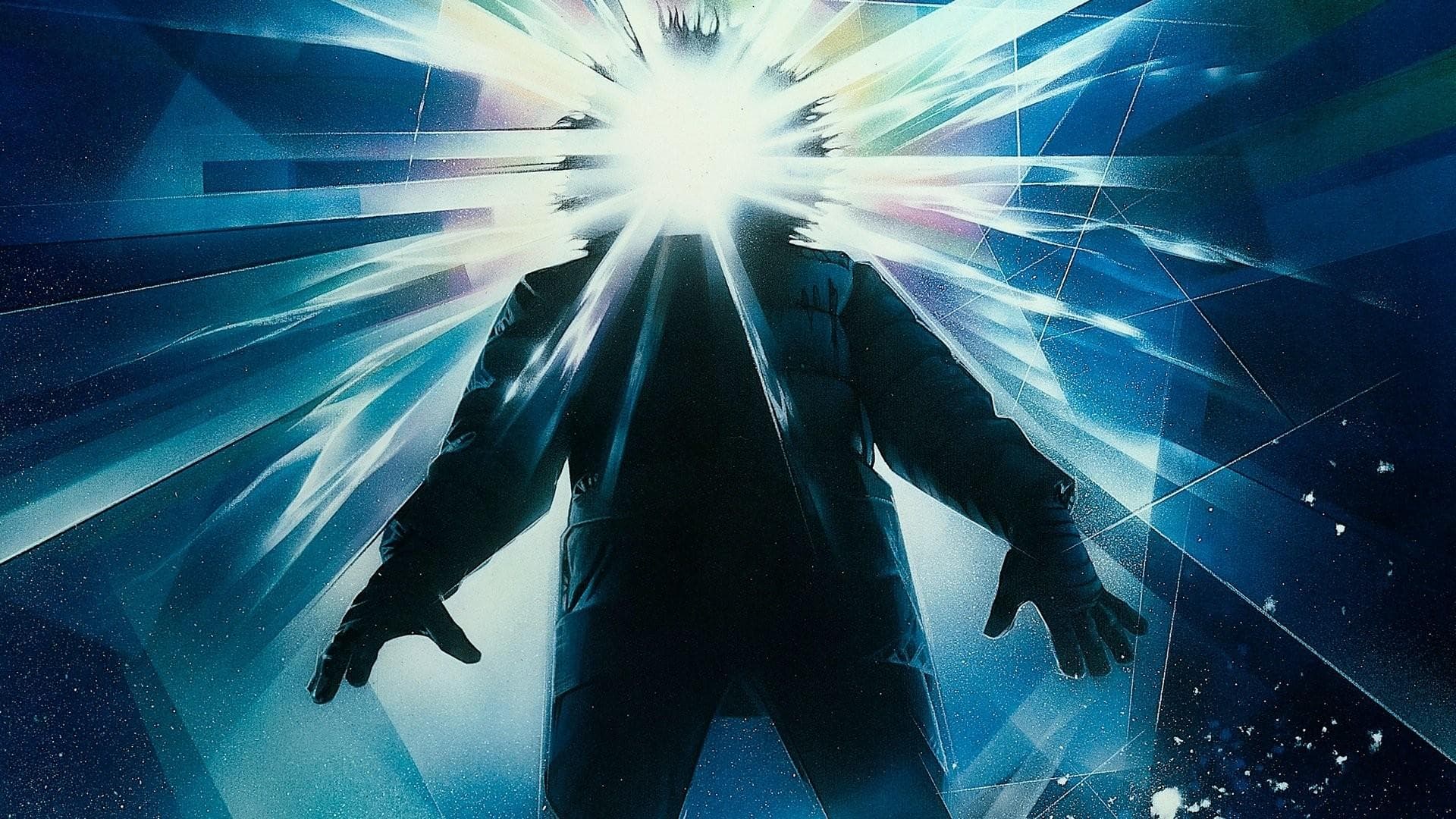
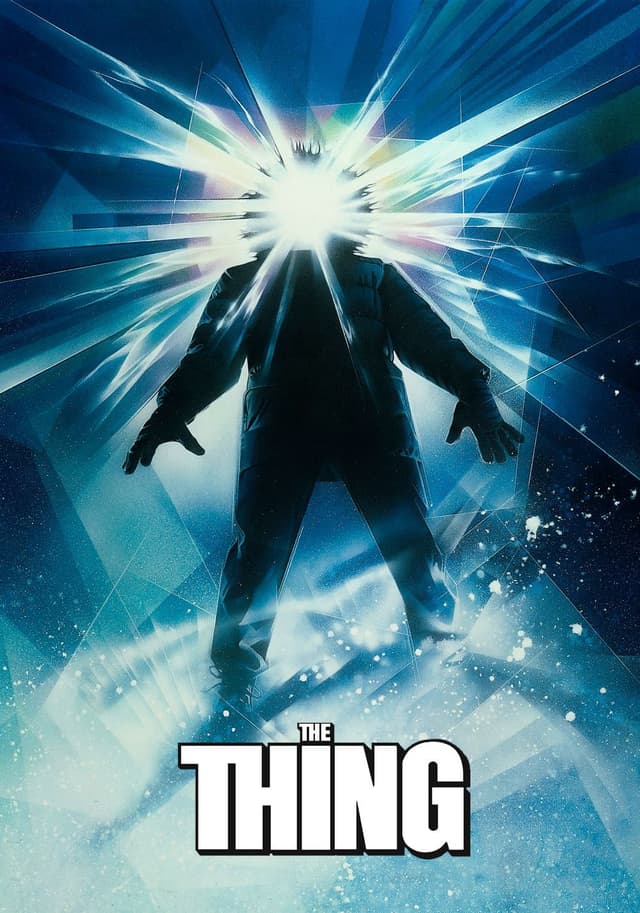
After returning from a screening of E.T. the Extra-Terrestrial, the audience's silence at a trailer of The Thing caused Foster to remark, "We're dead". The response to public pre-screenings of The Thing resulted in the studio changing the somber, black-and-white advertising approved by the producers to a color image of a person with a glowing face. The tagline was also changed from "Man is the warmest place to hide"written by Stephen Frankfort, who wrote the Alien tagline, "In space, no one can hear you scream"to "The ultimate in alien terror", trying to capitalize on Aliens audience.
AWARDS & RECOGNITION
Summary: 1 win & 5 nominations total
Nominations: ○ Saturn Award for Best Special Effects ○ Golden Raspberry Award for Worst Musical Score (3rd Golden Raspberry Awards) ○ Saturn Award for Best Horror Film
Additional Recognition: The Thing received nominations from the Academy of Science Fiction, Fantasy and Horror Films for Best Horror Film and Best Special Effects, but lost to Poltergeist and E.T. the Extra-Terrestrial, respectively. The film was nominated at the Razzie Awards for Worst Musical Score.
CRITICAL RECEPTION
The film received negative reviews on its release, and hostility for its cynical, anti-authoritarian tone and graphic special effects. Some reviewers were dismissive of the film, calling it the "quintessential moron movie of the 80's", "instant junk", and a "wretched excess". Starlogs Alan Spencer called it a "cold and sterile" horror movie attempting to cash in on the genre audience, against the "optimism of E.T., the reassuring return of Star Trek II, the technical perfection of Tron, and the sheer integrity of Blade Runner".
The plot was criticized as "boring", and undermined by the special effects. The Los Angeles Times Linda Gross said that The Thing was "bereft, despairing, and nihilistic", and lacking in feeling, meaning the characters' deaths did not matter. Spencer said it featured sloppy continuity, lacked pacing, and was devoid of warmth or humanity. David Ansen of Newsweek felt the film confused the use of effects with creating suspense, and that it lacked drama by "sacrificing everything at the altar of gore". The Chicago Readers Dave Kehr considered the dialogue to be banal and interchangeable, making the characters seem and sound alike. The Washington Posts Gary Arnold said it was a witty touch to open with the Thing having already overcome the Norwegian base, defeating the type of traps seen in the 1951 version, while New Yorks David Denby lamented that the Thing's threat is shown only externally, without focusing on what it is like for someone who thinks they have been taken over. Roger Ebert considered the film to be scary, but offering nothing original beyond the special effects, while The New York Times Vincent Canby said it was entertaining only if the viewer needed to see spider-legged heads and dog autopsies.
Reviews of the actors' performances were generally positive, while criticizing the depictions of the characters they portrayed.


Budget Templates
Build your own production budget
Create professional budgets with industry-standard feature film templates. Real-time collaboration, no spreadsheets.

Start Budgeting Free