The Quiet American Budget
 Drama
DramaUpdated
Synopsis
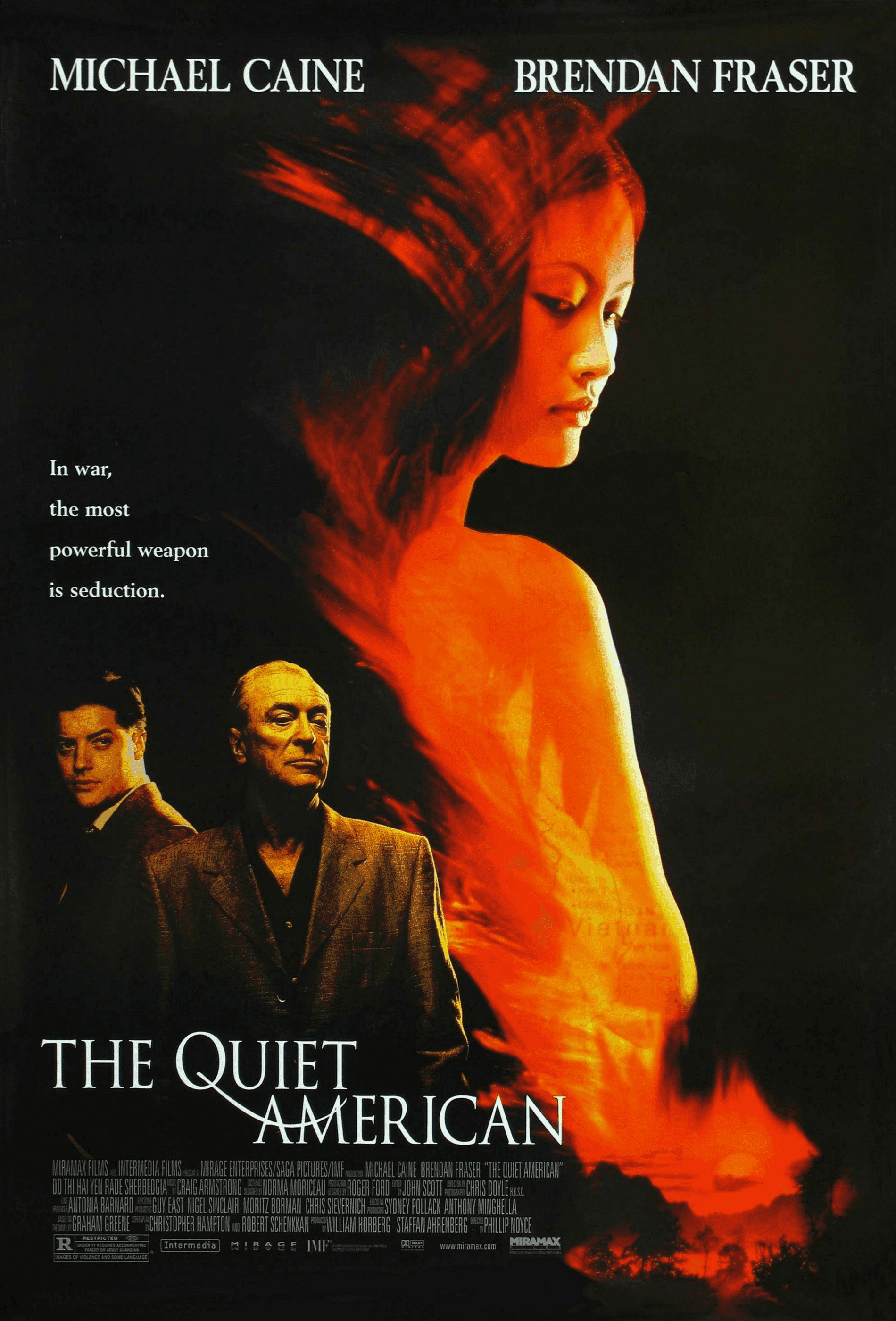
In 1952 Vietnam, aging British journalist Thomas Fowler covers the waning days of French colonial rule from his comfortable Saigon perch. When an idealistic young American aid worker named Alden Pyle arrives with a clandestine mission and an interest in Fowler's young Vietnamese mistress Phuong, the journalist is drawn into a moral reckoning that will mark the dawn of American involvement in Indochina.
What Is the Budget of The Quiet American (2002)?
The Quiet American (2002), directed by Phillip Noyce and distributed by Miramax Films, was produced on a reported budget of $20,000,000. The Graham Greene adaptation, set in 1952 Saigon during the waning days of French Indochina, was financed by Miramax in partnership with Mirage Enterprises (Sydney Pollack's production company), Saga Films, IMF Internationale Medien und Film GmbH, and Vietnam Film Studios. The $20,000,000 commitment was modest for an Asian-set period production but reflected the historic decision to shoot extensively in Vietnam itself, the first major Western feature granted such access by the Vietnamese government.
The financial structure was built around the unprecedented Vietnamese government cooperation that allowed shooting in actual Saigon (now Ho Chi Minh City), Hanoi, and the surrounding Mekong Delta regions. Producer Sydney Pollack, who had been pursuing the project as a director-producer for decades before stepping back to producer-only when Phillip Noyce came aboard, anchored the diplomatic effort through international film organizations. The bulk of the budget went to Michael Caine's lead compensation, the Vietnamese location footprint, period production design recreating 1952 Saigon, and Craig Armstrong's atmospheric score.
Key Budget Allocation Categories
The $20,000,000 budget for The Quiet American was distributed across several core production areas:
- Above-the-Line Talent: Michael Caine led the cast as Thomas Fowler at a feature-lead rate reflective of his late-career prestige positioning, taking a compensation package weighted toward backend participation rather than full upfront fees. Brendan Fraser played Alden Pyle in a deliberate against-type casting that drew on Fraser's earlier dramatic work in Gods and Monsters. Vietnamese actress Do Thi Hai Yen played Phuong. Director Phillip Noyce commanded a feature-director rate appropriate to his post-Patriot Games and Salt commercial stature.
- Vietnamese Location Shooting: The single most distinctive line item. The film shot extensively in Vietnam itself, with locations in Ho Chi Minh City (the actual 1950s Saigon settings), Hanoi (additional period exteriors), and the Mekong Delta (for the riverboat and rural-conflict sequences). The Vietnamese government granted unprecedented production access, with the production paying location and protocol fees, using Vietnamese coordinated crew, and operating under translation and liaison support across the production schedule.
- Period Production Design: Production designer Roger Ford dressed 1952 Saigon's colonial-era settings including the Continental Hotel, the Rue Catinat shopping district, the French-period government buildings, and the surrounding Mekong rural settings. The art-department work involved substantial period research, vehicle work, and signage to align the contemporary Vietnamese settings with their 1952 period appearance.
- Craig Armstrong Score: Composer Craig Armstrong, then transitioning from electronica scoring on Romeo + Juliet and Plunkett & Macleane into more orchestral territory, delivered an atmospheric chamber-orchestral score incorporating traditional Vietnamese instrumentation including the dan tranh and dan bau alongside Western strings. The soundtrack budget covered original composition, recording sessions, and licensing of period French pop and Vietnamese folk needle drops.
- Australian Co-Production Support: The film operated under a partial Australian co-production structure, with post-production handled in Australia and additional financing from Saga Films channeled through the production. The Australian connection allowed access to Australian production-services discounts.
- Marketing and Theatrical Release: Miramax's release of the film was delayed substantially. The film was completed in 2001 and initially scheduled for a 2001 release, but Miramax delayed the opening following the September 11 attacks because of concerns about audience response to its anti-American thematic content. The film ultimately opened in extremely limited release on November 22, 2002, expanding through the Academy Awards campaign window in early 2003 following Michael Caine's Best Actor nomination announcement.
How Does The Quiet American's Budget Compare to Similar Films?
At $20,000,000, The Quiet American sits in the typical range for early-2000s prestige-literary adaptations. The comparison set illustrates how its commercial outcome compared with peers:
- The End of the Affair (1999): Budget $23,000,000 | Worldwide $20,000,000. Neil Jordan's previous Graham Greene adaptation cost slightly more than The Quiet American and grossed slightly less worldwide, providing a near-direct apples-to-apples comparison for the Graham Greene category.
- The Hours (2002): Budget $25,000,000 | Worldwide $108,175,994. Stephen Daldry's contemporaneous prestige-literary triptych cost 25% more than The Quiet American and grossed roughly four times worldwide, illustrating how an Academy Award sweep could transform commercial outcomes for a budget-adjacent prestige film.
- The Constant Gardener (2005): Budget $25,000,000 | Worldwide $82,466,670. Fernando Meirelles's John le Carré adaptation cost 25% more than The Quiet American and grossed three times worldwide, providing a comparison for the politically-charged literary thriller category.
- In the Bedroom (2001): Budget $1,800,000 | Worldwide $44,919,973. Todd Field's prior literary-prestige drama cost a tiny fraction of The Quiet American and grossed nearly twice worldwide, showing what an art-house literary release could deliver at a much lower price point.
- Cold Mountain (2003): Budget $79,000,000 | Worldwide $173,015,360. Anthony Minghella's subsequent Miramax literary-historical epic cost roughly four times The Quiet American and grossed roughly six times worldwide, illustrating the Miramax house style at higher budget tiers.
The Quiet American Box Office Performance
The Quiet American opened in extremely limited release on November 22, 2002, expanding gradually through December 2002 and January 2003. The expansion accelerated substantially following Michael Caine's Academy Award nomination for Best Actor in February 2003, ultimately reaching approximately 269 theaters at the film's widest U.S. point. The film's gradual platform release was a deliberate Miramax strategy to extend the awards-season campaign window across the late-2002 and early-2003 release calendar.
Against a $20,000,000 production budget, the film needed approximately $40,000,000 worldwide to reach profitability after marketing. Here is the financial breakdown:
Box Office Breakdown
The Quiet American (2002)

The Quiet American returned approximately $0.85 in worldwide theatrical revenue for every $1 invested when measured against total estimated production and marketing spend, falling just short of theatrical break-even. The international share of $14,737,693 against a domestic share of $12,988,801 was a 53/47 split that suggested the Graham Greene-source material and Vietnamese-set premise traveled reasonably well to European markets, particularly in France, the United Kingdom, and Germany.
The theatrical short-fall was substantially recouped through home video, pay-television licensing, and DVD release through 2003 and 2004, with the Michael Caine Academy Award Best Actor nomination providing the marketing hook for the second-window release. The film has retained ongoing visibility in prestige-literary streaming catalogs and frequently appears in retrospective discussions of Graham Greene adaptations and Phillip Noyce's 2000s prestige output.
The Quiet American Production History
Development began in the late 1990s when producer Sydney Pollack, who had been pursuing a screen version of Graham Greene's 1955 novel since the 1980s, brought the project to Miramax. Pollack had originally intended to direct, but stepped back to producer-only when Phillip Noyce came aboard. Christopher Hampton, the Academy Award winning screenwriter of Dangerous Liaisons, was attached to write the screenplay, with subsequent revisions by Robert Schenkkan to align Hampton's draft with Noyce's directorial approach.
The negotiation with the Vietnamese government for production access extended across 1999, 2000, and early 2001, ultimately securing the first-of-its-kind permission to shoot major Western feature production inside Vietnam in actual 1950s Saigon settings. Casting Michael Caine as Thomas Fowler in 2000 anchored the project on the strength of his late-career prestige positioning, with Caine taking a feature-lead rate reflective of the modest budget. Brendan Fraser was cast as Alden Pyle in a deliberate against-type casting in early 2001.
Principal photography ran from January to April 2001 primarily in Vietnam, with locations in Ho Chi Minh City (the actual 1950s Saigon settings), Hanoi (additional period exteriors), and the Mekong Delta (for the riverboat and rural-conflict sequences). The Vietnamese government granted unprecedented production access, with the production using Vietnamese coordinated crew alongside the Australian and British creative team. Additional sequences were shot in Australia for post-production.
Craig Armstrong recorded the atmospheric score in late 2001, and the film was completed in early 2001 for an initially planned 2001 release. Miramax delayed the opening following the September 11 attacks because of concerns about audience response to its anti-American thematic content. The film ultimately opened in extremely limited release on November 22, 2002, expanding gradually through the Academy Awards campaign window in early 2003 following Michael Caine's Best Actor nomination announcement.
Awards and Recognition
Michael Caine received an Academy Award nomination for Best Actor at the 75th Academy Awards for his performance as Thomas Fowler. The nomination was widely cited as one of the more competitive in a strong Best Actor field that year, with the eventual winner being Adrien Brody for The Pianist. Caine also received a Golden Globe nomination for Best Actor in a Motion Picture Drama, a Screen Actors Guild Award nomination for Outstanding Performance by a Male Actor in a Leading Role, and a BAFTA nomination for Best Actor in a Leading Role.
Christopher Hampton and Robert Schenkkan received a Writers Guild of America Award nomination for Best Adapted Screenplay. Craig Armstrong's score earned no major industry recognition, though it received Australian Film Institute recognition in the Best Music category. The film also received Australian Film Institute Awards including Best Film. The film has retained ongoing visibility in prestige-literary catalogs and is frequently cited in retrospective discussions of Graham Greene adaptations and Phillip Noyce's prestige output.
Critical Reception
The Quiet American received generally positive reviews. The film holds an 87% approval rating on Rotten Tomatoes based on 168 critic reviews, with a critical consensus that called Michael Caine extraordinary and the production a faithful and atmospheric Graham Greene adaptation. On Metacritic, the film scored 75 out of 100, indicating generally favorable reviews. Audiences responded positively in the limited art-house theatrical release, although the gradual platform expansion limited audience-survey data.
Critics broadly praised Michael Caine's lead performance, Christopher Hampton and Robert Schenkkan's screenplay adaptation, Phillip Noyce's direction, Christopher Doyle's cinematography, and the historic Vietnamese location work. Roger Ebert in the Chicago Sun-Times gave the film four stars and wrote that "Caine is at the top of his career here, in a performance of complexity and subtlety," ranking the film on his 2002 best-of list. A.O. Scott in The New York Times called the film "a melancholy masterpiece that has the patience and sadness of late-period Graham Greene."
Literary and international-press response was particularly enthusiastic. The Guardian's Peter Bradshaw praised Caine's performance as "the finest of his career," and Le Monde's Jacques Mandelbaum recognized the film as one of the more successful Graham Greene screen adaptations in decades. The strongly positive critical reception combined with the modest but respectable commercial performance has positioned The Quiet American as one of the most-respected late-period Michael Caine performances and a landmark Western co-production filmed inside post-war Vietnam.
Frequently Asked Questions
How much did The Quiet American (2002) cost to make?
The reported production budget was $20,000,000. Miramax Films financed the film in partnership with Sydney Pollack's Mirage Enterprises, Saga Films, IMF Internationale Medien und Film GmbH, and Vietnam Film Studios. The budget covered Michael Caine's lead compensation, the unprecedented Vietnamese location footprint, the period production design recreating 1952 Saigon, and Craig Armstrong's atmospheric score.
How much did The Quiet American earn at the box office?
The film grossed $12,988,801 domestically and $14,737,693 internationally, for a worldwide total of $27,726,494. It opened in extremely limited release on November 22, 2002 and expanded gradually through the Academy Awards campaign window in early 2003 following Michael Caine's Best Actor nomination announcement, ultimately reaching approximately 269 theaters at its widest U.S. point.
Was The Quiet American a box office success?
Modestly. Against a $20,000,000 production budget and an estimated $10,000,000 to $15,000,000 in marketing spend, the film returned approximately $0.85 in worldwide gross for every $1 invested, falling just short of theatrical break-even. Home video, pay-television licensing, and DVD release through 2003 and 2004 substantially recouped the theatrical short-fall, with the Michael Caine Academy Award nomination providing the marketing hook for the second-window release.
Who directed The Quiet American?
Phillip Noyce directed the film, working from a screenplay by Christopher Hampton with revisions by Robert Schenkkan. The screenplay was adapted from Graham Greene's 1955 novel of the same name. Producer Sydney Pollack had been pursuing the project as a director-producer for decades before stepping back to producer-only when Noyce came aboard.
Where was The Quiet American filmed?
Principal photography took place from January to April 2001 primarily in Vietnam, with locations in Ho Chi Minh City (the actual 1950s Saigon settings), Hanoi (additional period exteriors), and the Mekong Delta (for the riverboat and rural-conflict sequences). The Vietnamese government granted unprecedented production access, the first major Western feature to film extensively inside Vietnam in the post-war period. Additional sequences were shot in Australia for post-production.
Why was The Quiet American's release delayed?
Miramax delayed the film's release following the September 11, 2001 terrorist attacks because of concerns about audience response to its anti-American thematic content. The film had been completed in 2001 for an initially planned 2001 release. The film ultimately opened in extremely limited release on November 22, 2002, more than a year after its initial planned release. The delay drew public criticism from director Phillip Noyce and lead Michael Caine, who argued that the film's historical themes about American intervention in Indochina were more rather than less relevant in the post-9/11 landscape.
Who plays Thomas Fowler in The Quiet American?
Michael Caine plays Thomas Fowler, the aging British journalist covering the waning days of French colonial rule in 1952 Saigon. The performance earned Caine an Academy Award nomination for Best Actor at the 75th Academy Awards. Brendan Fraser plays the idealistic young American aid worker Alden Pyle in a deliberate against-type casting that drew on Fraser's earlier dramatic work in Gods and Monsters.
Is The Quiet American based on a book?
Yes. The film is adapted from Graham Greene's 1955 novel of the same name, which was based in part on Greene's own experiences as a journalist in Vietnam during the early 1950s. The novel is widely considered one of the first major Western literary works to anticipate American involvement in Indochina, and was previously adapted by Joseph L. Mankiewicz as a 1958 film starring Audie Murphy that significantly altered the novel's political content.
What did critics think of The Quiet American?
The film received generally positive reviews, with an 87% approval rating on Rotten Tomatoes and a 75 out of 100 score on Metacritic. Roger Ebert gave it four stars and ranked it on his 2002 best-of list, writing that Michael Caine was "at the top of his career here, in a performance of complexity and subtlety." The Guardian's Peter Bradshaw praised Caine's performance as "the finest of his career."
Did The Quiet American win any awards?
Michael Caine received nominations for Best Actor at the 75th Academy Awards, the Golden Globe Awards, the Screen Actors Guild Awards, and the BAFTA Awards, losing in each major U.S. category to Adrien Brody for The Pianist. The film won Best Film at the Australian Film Institute Awards. Christopher Hampton and Robert Schenkkan received a Writers Guild of America Award nomination for Best Adapted Screenplay.
Filmmakers
The Quiet American (2002)

Build budgets like this one in Saturation
Start from an industry-standard feature film template, import the schedule and rates you already have, and let the cost report keep itself current as you spend. Real-time collaboration, no spreadsheets.