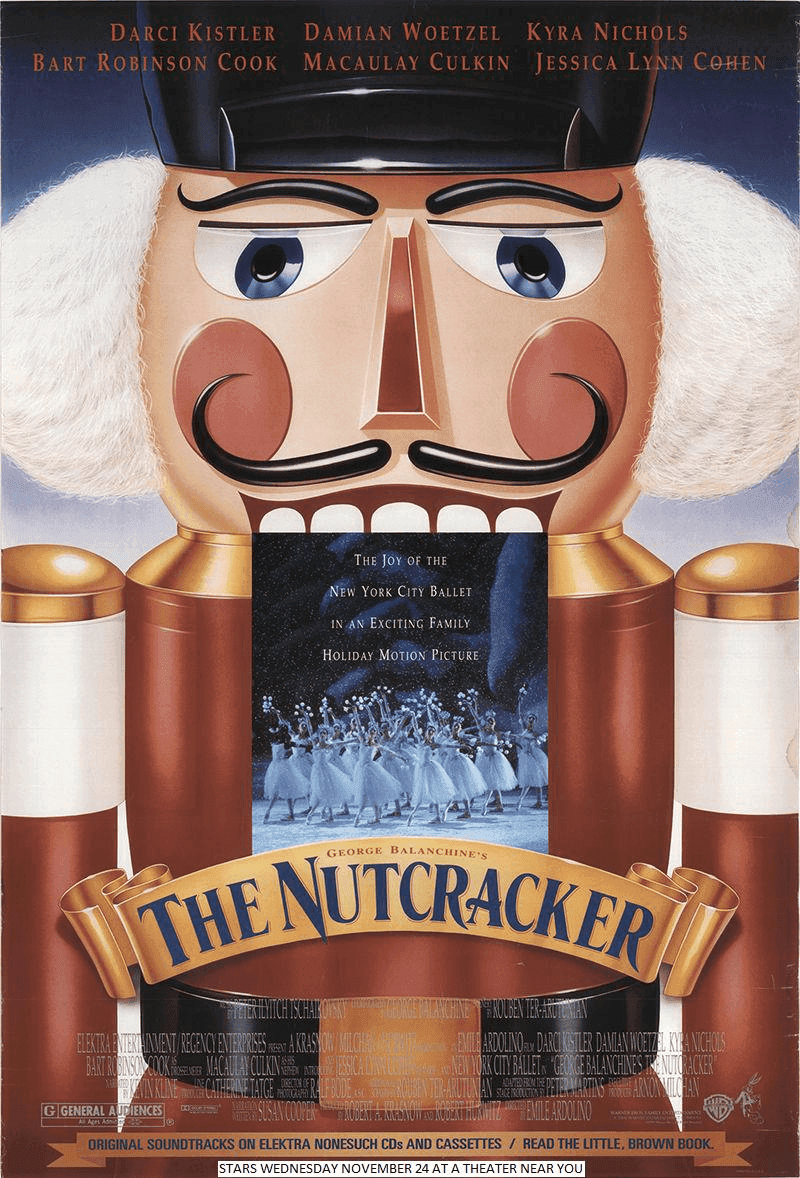
The Nutcracker Budget
 Musical
Updated
Synopsis
A young girl named Marie receives a wooden nutcracker as a Christmas gift from her enigmatic godfather Drosselmeier, and that night she is swept into a dreamlike kingdom where the toy comes to life as a prince. Drawing on George Balanchine's 1954 New York City Ballet staging, the film preserves the choreography that has defined the holiday classic for generations of American audiences.
What Is the Budget of The Nutcracker (1993)?
The Nutcracker (1993), directed by Emile Ardolino and distributed by Warner Bros., was produced on a reported budget of approximately $19,000,000. The film preserved George Balanchine's landmark 1954 New York City Ballet staging of The Nutcracker on film, with Tchaikovsky's original score performed by the New York City Ballet Orchestra under David Zinman and a cast that paired NYCB principals with Hollywood star Macaulay Culkin in the role of the Nutcracker Prince. Robert A. Krasnow, Robert Hurwitz, and the Elektra Nonesuch label co-produced through a partnership designed to bring high-art ballet to a mass theatrical audience.
The budget reflected an unusual hybrid scale. Filmed ballet adaptations are typically PBS-budget television productions; The Nutcracker's wide theatrical ambition pushed the production into feature-film territory, with star compensation for Culkin (then in the middle of his Home Alone box office peak), a 35mm cinematography setup designed for theatrical projection, and a full Lincoln Center stage rebuild on a New York soundstage to allow for camera coverage impossible on the actual NYCB stage. The result was the most expensive U.S. ballet film of its era.
Key Budget Allocation Categories
The Nutcracker's reported $19,000,000 budget was distributed across the following core production areas:
- Above-the-Line Talent: Macaulay Culkin, fresh off Home Alone and Home Alone 2, commanded a star fee in the low seven figures, with additional compensation tied to his agreement to undergo ballet training and perform the role without dance double assistance. George Balanchine's choreography rights, controlled by the Balanchine Trust, required a substantial license fee, and director Emile Ardolino, an Oscar winner for the documentary He Makes Me Feel Like Dancin' and director of Dirty Dancing, was paid a feature director rate.
- NYCB Cast and Crew: Principal ballerina Darci Kistler, principal dancer Damian Woetzel, Wendy Whelan, and Kyra Nichols led a New York City Ballet cast of more than 70 dancers, all paid at scale for film work that fell outside their regular company contracts. The corps de ballet required additional rehearsal time for camera-friendly staging modifications.
- Lincoln Center Stage Rebuild: The production rebuilt the David H. Koch Theater (then the New York State Theater) stage on a New York soundstage to allow for elevated camera angles, crane shots, and lighting setups impossible on the working Lincoln Center stage. Karinska's original 1954 costume designs were reconstructed faithfully, and Rouben Ter-Arutunian's original set designs were rebuilt to film-grade specifications.
- Orchestra and Music Recording: The New York City Ballet Orchestra, conducted by David Zinman, recorded the full Tchaikovsky score across multiple sessions at Manhattan Center Studios. Elektra Nonesuch, the classical music label that co-produced the film, handled the soundtrack album as an integrated revenue stream.
- Cinematography and Post: Cinematographer Ralf D. Bode shot the film on 35mm with a camera package designed for both close-up dancer coverage and wide-stage compositions. Editor Girish Bhargava cut the film for a 92-minute runtime, with the technical challenge of maintaining musical synchronization across multiple takes of the same choreographed sequences.
- Marketing and Distribution: Warner Bros. positioned the film for a Thanksgiving weekend 1993 release, targeting holiday family audiences. The marketing campaign emphasized Macaulay Culkin's star power over the ballet credentials, a choice that drew criticism from dance critics and arguably misled the audience the film ultimately attracted.
How Does The Nutcracker (1993)'s Budget Compare to Similar Films?
At a reported $19,000,000, The Nutcracker sits in an unusual cross-category position between filmed performance and feature film. The comparison set illustrates how its commercial outcome differed from both adjacent categories:
- The Turning Point (1977): Budget $8,000,000 | Worldwide $35,000,000. Herbert Ross's ballet drama with Mikhail Baryshnikov earned more than four times its budget and demonstrated that ballet-themed films could find a mainstream audience when wrapped in narrative drama rather than direct performance preservation.
- White Nights (1985): Budget $20,000,000 | Worldwide $42,000,000. The Mikhail Baryshnikov dance feature cost effectively the same as The Nutcracker and earned 20 times its worldwide gross, illustrating the audience preference for dance films with narrative scaffolding.
- Center Stage (2000): Budget $18,000,000 | Worldwide $26,055,193. The teen-dance-drama hybrid released seven years after The Nutcracker at the same cost cleared modest profitability by anchoring the dance content in a competition narrative.
- Save the Last Dance (2001): Budget $13,000,000 | Worldwide $131,711,346. The Julia Stiles dance film cost two-thirds of The Nutcracker and earned more than 60 times the worldwide gross, demonstrating the chasm between filmed performance and narrative dance cinema in commercial terms.
- Dirty Dancing (1987): Budget $5,000,000 | Worldwide $214,577,154. Ardolino's previous dance film cost a quarter of The Nutcracker and earned more than 100 times the worldwide gross, illustrating the box office potential the director could not replicate in the prestige preservation format.
The Nutcracker (1993) Box Office Performance
The Nutcracker opened on November 24, 1993, the Wednesday before Thanksgiving, in approximately 1,335 North American theaters. The film performed well below pre-release expectations, finishing with $886,232 over its three-day opening weekend and closing its theatrical run at $2,119,994 domestically. Warner Bros. did not pursue significant international theatrical distribution.
Against a reported production budget of $19,000,000, the film fell well short of break-even on theatrical alone. Here is the financial breakdown:
Box Office Breakdown
The Nutcracker (1993)

The Nutcracker returned approximately $0.06 in theatrical revenue for every $1 invested in production and marketing, placing it among the clearer commercial misses of the 1993 holiday slate. Home video sales, the Elektra Nonesuch soundtrack album, and decades of annual television broadcast on PBS and other public-television outlets eventually closed a substantial share of the theatrical loss, but the initial theatrical recoupment was minimal.
The film has nonetheless become a holiday-season perennial through television and home video, and Warner Bros. continues to license it for cable, streaming, and educational use. The misalignment between marketing positioning (a Macaulay Culkin family film) and content delivery (a faithful preservation of Balanchine's ballet) is the most-cited reason for the theatrical underperformance.
The Nutcracker (1993) Production History
The project originated as a joint effort between Robert A. Krasnow of Elektra Records, the Balanchine Trust, and director Emile Ardolino, who had a long history of dance documentation including his Oscar-winning 1983 documentary He Makes Me Feel Like Dancin'. The Trust, which controls licensing of all George Balanchine choreography after the choreographer's 1983 death, had been guarded with film rights for The Nutcracker, and the production required extensive negotiation to ensure faithful reproduction of the 1954 staging.
Casting Macaulay Culkin as the Nutcracker Prince came late in development. The role had originally been imagined for a young NYCB dancer-actor, but Warner Bros. attached to the project on the condition that a recognizable star anchor the marketing. Culkin underwent several months of ballet training in 1992 and early 1993, and his performance in the role drew mixed responses from dance critics who acknowledged his commitment but questioned the casting logic.
Principal photography ran in spring 1993 at a New York soundstage where the Lincoln Center David H. Koch Theater stage was rebuilt to allow for the elevated camera angles and crane shots required for cinematic coverage. The NYCB orchestra recorded the score under David Zinman across multiple sessions at Manhattan Center Studios. Director Emile Ardolino completed production while battling AIDS, and he died on November 20, 1993, four days before the film's wide theatrical release; The Nutcracker was his final completed feature.
The film premiered at the Toronto International Film Festival in September 1993 before its November theatrical wide release. Warner Bros. and the Balanchine Trust co-produced a making-of television special that aired in the lead-up to release, and the Elektra Nonesuch soundtrack album was released to coincide with the theatrical opening.
Awards and Recognition
The Nutcracker received limited industry awards recognition. The film earned a nomination at the Young Artist Awards for Macaulay Culkin in 1994 and was a finalist for the Christopher Award for its preservation of the Balanchine choreography. The Elektra Nonesuch soundtrack album received a Grammy nomination for Best Classical Album.
The film did not register at the major industry ceremonies, with no nominations at the Academy Awards, the Golden Globes, or the BAFTAs. Director Emile Ardolino's posthumous contribution was recognized at the Directors Guild of America's in memoriam segment in 1994, and the film has been preserved by the New York Public Library for the Performing Arts as a primary document of late-twentieth-century Balanchine staging.
Critical Reception
The Nutcracker received mixed reviews. The film holds a 47 percent approval rating on Rotten Tomatoes based on a limited sample of contemporaneous critic reviews. Major-paper critics split sharply along category lines, with dance critics generally praising the choreography preservation and film critics objecting to the static framing and the Culkin casting.
Roger Ebert gave the film three out of four stars and wrote that "what we get with The Nutcracker is a film of a ballet, not a film. That is a distinction, but not a complaint." Anna Kisselgoff, dance critic of The New York Times, praised the film for "preserving Balanchine's 1954 vision with admirable fidelity," while Vincent Canby, the paper's film critic, called it "a beautiful but stilted record of a great American ballet."
The film has settled into its role as the canonical English-language Balanchine Nutcracker on film. Annual television broadcasts in the United States, particularly on PBS during the holiday season, have given the production a long-tail cultural presence that vastly exceeds its 1993 theatrical footprint. It remains the primary filmed reference for Balanchine's choreography and is widely used in dance education programs.
Frequently Asked Questions
How much did it cost to make The Nutcracker (1993)?
The reported production budget was approximately $19,000,000. The figure reflected the unusual hybrid scale of a filmed ballet executed at feature-film production values, with Macaulay Culkin star compensation, a soundstage Lincoln Center stage rebuild, full 35mm cinematography, and a New York City Ballet orchestra recording.
How much did The Nutcracker (1993) earn at the box office?
The film grossed $2,119,994 domestically. Warner Bros. did not pursue significant international theatrical distribution. The film opened to $886,232 on its November 24, 1993 wide opening, well below pre-release tracking expectations.
Was The Nutcracker (1993) profitable?
Not theatrically. Against a $19,000,000 production budget and an estimated $12,000,000 to $18,000,000 in marketing spend, the film returned approximately $0.06 in worldwide theatrical gross for every $1 invested. Home video sales, the Elektra Nonesuch soundtrack album, and decades of annual television broadcast eventually closed a substantial share of the theatrical loss.
Who directed The Nutcracker (1993)?
Emile Ardolino directed the film, his final completed feature. Ardolino was an Oscar winner for the 1983 documentary He Makes Me Feel Like Dancin' and had previously directed Dirty Dancing (1987) and Sister Act (1992). He died on November 20, 1993, four days before The Nutcracker's wide theatrical release.
Whose choreography is used in The Nutcracker (1993)?
The film preserves George Balanchine's landmark 1954 staging of The Nutcracker for the New York City Ballet. The Balanchine Trust, which controls licensing of all Balanchine choreography after the choreographer's 1983 death, supervised the production to ensure faithful reproduction of the original staging.
Why is Macaulay Culkin in The Nutcracker?
Warner Bros. attached to the project on the condition that a recognizable star anchor the marketing. Culkin, fresh off Home Alone (1990) and Home Alone 2 (1992), was at the peak of his box office draw and underwent several months of ballet training in 1992 and early 1993 to perform the role of the Nutcracker Prince.
Where was The Nutcracker (1993) filmed?
Principal photography took place on a New York soundstage where the Lincoln Center David H. Koch Theater (then the New York State Theater) stage was rebuilt to allow for the elevated camera angles, crane shots, and lighting setups impossible on the working Lincoln Center stage. The orchestral score was recorded at Manhattan Center Studios.
How does it compare to other ballet films?
The Nutcracker cost $19,000,000 and grossed $2,119,994 worldwide. Herbert Ross's The Turning Point (1977) cost $8,000,000 and earned $35,000,000. White Nights (1985) cost $20,000,000 and earned $42,000,000. The Nutcracker's underperformance is widely attributed to its faithful preservation format rather than the narrative-driven structure of more commercially successful dance films.
What did critics think of The Nutcracker (1993)?
The film received mixed reviews, with a 47 percent approval rating on Rotten Tomatoes. Roger Ebert gave it three out of four stars and wrote, "what we get with The Nutcracker is a film of a ballet, not a film." Dance critics generally praised the choreography preservation, while film critics objected to the static framing and the Culkin casting.
Did The Nutcracker (1993) win any awards?
The film received limited awards recognition. Macaulay Culkin earned a Young Artist Award nomination in 1994, and the Elektra Nonesuch soundtrack album was nominated for a Grammy for Best Classical Album. The film did not register at the Academy Awards, the Golden Globes, or the BAFTAs.
Filmmakers
The Nutcracker (1993)

Build budgets like this one in Saturation
Start from an industry-standard feature film template, import the schedule and rates you already have, and let the cost report keep itself current as you spend. Real-time collaboration, no spreadsheets.