South Park: Bigger, Longer & Uncut Budget
 Musical
Updated
Synopsis
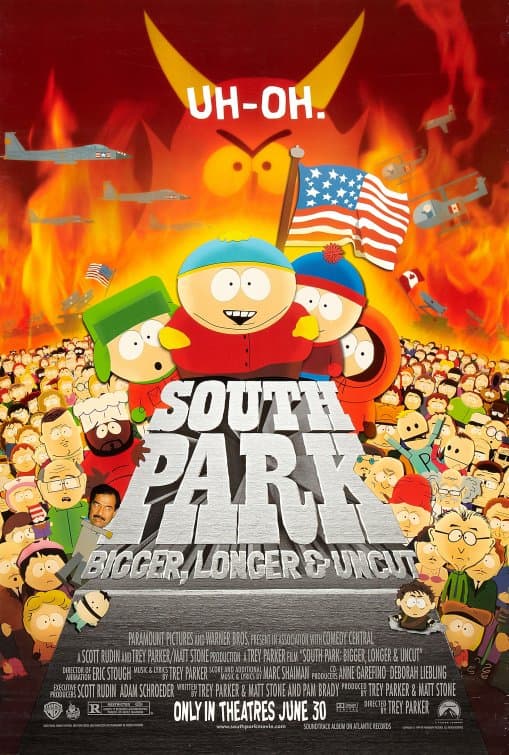
When the boys of South Park sneak into a vulgar R-rated Terrance and Phillip movie, their newly profane vocabulary triggers a moral panic that escalates into all-out war between the United States and Canada. As executions, an underworld pact between Saddam Hussein and Satan, and a Broadway-scale slate of musical numbers all unfold simultaneously, the boys mount a resistance movement to save their idols and the world.
What Is the Budget of South Park: Bigger, Longer & Uncut (1999)?
South Park: Bigger, Longer & Uncut (1999), directed by Trey Parker and distributed by Paramount Pictures, was produced on a reported budget of $21,000,000. The animated musical-comedy was financed through Paramount in partnership with Comedy Central Films and Scott Rudin Productions, with Trey Parker and Matt Stone co-producing through their newly established Braniff company. The budget reflected the rapid greenlight that followed the breakout success of the South Park television series during its first two Comedy Central seasons.
Above-the-line costs were anchored by Parker and Stone's creative-and-producer compensation, with the bulk of the budget flowing to the unprecedented animation production scale. The film required a roughly 1,200-shot animated feature delivered on an extraordinarily compressed roughly nine-month schedule, with multiple animation houses contributing to hit Paramount's June 30, 1999 release date. Animation supervisor Eric Stough oversaw the studio expansion required to meet the deadline.
Key Budget Allocation Categories
South Park: Bigger, Longer & Uncut's $21,000,000 budget was distributed across several core production areas:
- Animation Production: The traditional cutout-style animation, executed digitally rather than the photographed-construction-paper technique used for the TV pilot, required a massive expansion of South Park's production capacity. Multiple computer animation systems at Production Reality Check and various subcontracted studios were brought online to meet the feature's shot count on a roughly nine-month schedule.
- Music and Musical Numbers: The film functions as a full-scale Broadway-style musical with more than a dozen original songs co-written by Trey Parker and Marc Shaiman (Hairspray, When Harry Met Sally...). Orchestral arrangement, vocal recording (including with cast members and additional vocalists for the chorus and ensemble numbers), and licensing costs constituted a significant share of the budget.
- Voice Cast: Trey Parker and Matt Stone voiced the bulk of the cast (Stan, Kyle, Cartman, Kenny, Mr. Garrison, Mr. Mackey, Saddam Hussein, Satan, and numerous adults). Mary Kay Bergman (Liane Cartman, Sheila Broflovski, and numerous female roles), Isaac Hayes (Chef), and George Clooney (Doctor Gouache) joined the principal cast at scaled rates.
- Music Supervision and Licensing: Marc Shaiman's music supervision and original score work was supplemented by needle-drop licensing of Les Miserables references and other Broadway pastiches threaded through the musical numbers, particularly the "La Resistance" extended sequence built directly on Boublil and Schonberg's "One Day More" template.
- MPAA Negotiations and Multiple Cuts: The production endured an extensive MPAA ratings battle that required Parker and Stone to deliver six separate cuts of the film before securing an R rating. The legal, editorial, and reshoot costs of the ratings process added significant unbudgeted incremental cost across the post-production schedule.
- Marketing and Promotion: Paramount's marketing campaign emphasized the R-rated content and the musical-comedy hybrid premise to position the film as a young-adult counter-program against the family animation summer slate. Promotional partnerships and the South Park television series tie-in drove additional incremental marketing spend above standard mid-budget animated comedy norms.
How Does South Park: Bigger, Longer & Uncut's Budget Compare to Similar Films?
At $21,000,000, the film sits at the lower end of the late-1990s feature animation bracket, dramatically below traditional studio-animation peers:
- Tarzan (1999): Budget $130,000,000 | Worldwide $448,191,819. Disney's contemporary traditional-animated summer release cost more than 6x South Park: BL&U and grossed 5.4x worldwide, illustrating the gap between studio-tier animation and the South Park independent-production model.
- Toy Story 2 (1999): Budget $90,000,000 | Worldwide $497,375,254. Pixar's contemporary CG-animated sequel cost more than 4x South Park: BL&U and grossed 6x worldwide.
- Beavis and Butt-Head Do America (1996): Budget $12,000,000 | Worldwide $63,118,386. Mike Judge's previous MTV-spinoff animated feature offers the closest production analog and cost roughly 60% of South Park: BL&U, grossing about 76% of the South Park gross.
- Anastasia (1997): Budget $53,000,000 | Worldwide $139,804,348. Fox's previous non-Disney studio animated musical cost 2.5x South Park: BL&U and grossed 1.7x worldwide.
- The Iron Giant (1999): Budget $70,000,000 | Worldwide $31,331,166. Brad Bird's contemporary Warner Bros. animated feature cost more than 3x South Park: BL&U and grossed less than half worldwide, illustrating the financial peril of animation at the higher budget tier without theatrical traction.
South Park: Bigger, Longer & Uncut Box Office Performance
South Park: Bigger, Longer & Uncut opened on June 30, 1999 to $11,484,945 across 2,128 theaters, finishing third on a Wednesday-open weekend won by Wild Wild West and Tarzan. The film held strongly through its first three weeks against the summer competition, with strong word-of-mouth from teen and young-adult audiences driving the picture's legs.
Against a $21,000,000 production budget, the film needed approximately $55,000,000 worldwide to break even when accounting for marketing and distribution costs. Here is the financial breakdown:
Box Office Breakdown
South Park: Bigger, Longer & Uncut (1999)

South Park: BL&U returned approximately $1.59 in theatrical revenue for every $1 invested when measured against total estimated production and marketing spend, a clear commercial win for Paramount and Comedy Central Films. Domestic gross of $52,037,603 against an international share of $31,100,000 reflected a release pattern that translated reasonably well to overseas English-speaking and major European markets despite the United States-specific political-satire content.
Home entertainment, cable-television licensing, and continuous availability on Comedy Central and subsequent streaming services have compounded long-tail revenue across the more than two decades since release. The film is widely regarded as one of the most commercially successful theatrical extensions of a basic-cable animated series and laid the groundwork for the ongoing South Park theatrical and streaming-special pipeline that continues with the Paramount+ specials of the 2020s.
South Park: Bigger, Longer & Uncut Production History
Trey Parker and Matt Stone began developing a South Park feature film during the second season of the television series in 1998, by which point the show had become Comedy Central's breakout hit and a defining piece of Generation X and Generation Y comedy programming. Paramount Pictures, Comedy Central Films, and producer Scott Rudin moved aggressively to fast-track a feature production while the show's cultural moment was at its peak.
Parker and Stone co-wrote the screenplay with Pam Brady, deliberately choosing a musical structure as both a creative challenge and a way to differentiate the feature from the television episodes. Marc Shaiman (Hairspray) was brought in to co-write the musical numbers and arrange the orchestral score. The musical premise allowed the picture to be a feature-scale event rather than an extended television episode.
Animation production took place primarily at South Park Studios in Los Angeles, with computer-based cutout animation replacing the photographed-construction-paper technique used on the television pilot. The compressed roughly nine-month schedule required multiple animation systems, additional staff, and round-the-clock production through late 1998 and the first half of 1999. The MPAA ratings battle, which consumed significant post-production resources, required Parker and Stone to deliver six separate cuts before securing the R rating that allowed for the film's full-bore profanity and content.
Awards and Recognition
South Park: Bigger, Longer & Uncut received one Academy Award nomination for Best Original Song for "Blame Canada" by Trey Parker and Marc Shaiman, losing to Phil Collins's "You'll Be in My Heart" from Tarzan. The film also received a Golden Globe nomination for Best Original Song for the same track and won the MTV Movie Award for Best Musical Performance for the same song.
Beyond its initial awards run, the film has been retroactively included in the Guinness Book of World Records for "Most Swearing in an Animated Film," with 399 profanities, 128 offensive gestures, and 221 acts of violence catalogued by Guinness statisticians. The film has appeared on numerous best-animated-films-of-all-time critic polls and is regularly cited as one of the most influential adult animation features of the past three decades.
Critical Reception
South Park: Bigger, Longer & Uncut received broadly positive reviews on initial release. The film holds a 81% approval rating on Rotten Tomatoes based on 130 critic reviews, with a critical consensus that called it sharp, fearlessly profane, and genuinely subversive in its political satire. On Metacritic, the film scored 73 out of 100, indicating "generally favorable reviews." Audiences surveyed by CinemaScore gave the film a B+, a typical result for the genre and content rating.
Critics praised the film's commitment to its R-rated content, the Marc Shaiman musical numbers, and the subversive political satire targeting MPAA censorship, knee-jerk parental moral panics, and United States-Canada relations. Roger Ebert gave the film three-and-a-half stars out of four, writing that "the film vibrates with energy, intelligence, and the absolute determination of South Park to push the envelope as far as the MPAA will allow." Variety's Todd McCarthy called it "a wickedly entertaining bait-and-switch that turns its own bad taste into its central thematic concern."
A few critics objected to the relentlessness of the profane and scatological content, with The Hollywood Reporter's Kirk Honeycutt writing that "the film's commitment to crude humor occasionally drowns out its smarter political ambitions." The dominant critical view, however, identified the picture as a watershed for adult animation and a defining piece of late-1990s comedy filmmaking. The film's reputation has only grown in subsequent decades and is now widely regarded as one of the most influential animated features of its era.
Frequently Asked Questions
How much did it cost to make South Park: Bigger, Longer & Uncut (1999)?
The reported production budget was $21,000,000. Paramount Pictures financed the film in partnership with Comedy Central Films and Scott Rudin Productions, with Trey Parker and Matt Stone co-producing through their newly established Braniff company. The budget reflected the rapid greenlight that followed the breakout success of the South Park television series.
How much did South Park: BL&U earn at the box office?
The film grossed $52,037,603 domestically and approximately $31,100,000 internationally, for a worldwide total of $83,137,603. It opened to $11,484,945 across 2,128 theaters on June 30, 1999, finishing third on a Wednesday-open weekend won by Wild Wild West and Tarzan.
Was South Park: Bigger, Longer & Uncut profitable?
Yes. Against a $21,000,000 production budget and an estimated $30,000,000 to $35,000,000 in marketing spend, the $83.1M worldwide gross returned approximately $1.59 in revenue for every $1 invested. Home entertainment, cable licensing, and continuous Comedy Central and streaming availability have compounded long-tail revenue across the past two decades.
Who directed South Park: Bigger, Longer & Uncut?
Trey Parker directed the film. He also co-wrote the screenplay with Matt Stone and Pam Brady, voiced the bulk of the principal cast (including Stan, Cartman, Mr. Garrison, and Satan), and co-wrote the original musical numbers with Marc Shaiman.
Who voices the characters in South Park: BL&U?
Trey Parker and Matt Stone voice the bulk of the cast, including Stan, Kyle, Cartman, Kenny, Mr. Garrison, Mr. Mackey, Saddam Hussein, and Satan. Mary Kay Bergman voices Liane Cartman, Sheila Broflovski, and numerous female roles, while Isaac Hayes returns as Chef. George Clooney appears as Doctor Gouache.
Did South Park: BL&U win an Oscar?
No, but it was nominated. The song "Blame Canada" by Trey Parker and Marc Shaiman received a Best Original Song Academy Award nomination, losing to Phil Collins's "You'll Be in My Heart" from Tarzan. The same song received a Golden Globe nomination and won the MTV Movie Award for Best Musical Performance.
How did the MPAA ratings battle affect the film?
Trey Parker and Matt Stone were required to deliver six separate cuts of the film before securing an R rating from the MPAA. The ratings battle consumed significant post-production resources and added unbudgeted incremental cost, and the dispute itself became a central thematic concern of the finished film's satire of censorship.
How does South Park: BL&U compare to other animated features of 1999?
At $21,000,000 it cost a fraction of contemporary studio-animation peers like Tarzan ($130M budget, $448M worldwide gross) and Toy Story 2 ($90M budget, $497M worldwide). Its $83.1M worldwide gross was one of the most efficient animated theatrical performances of the year on a return-on-investment basis.
What did critics think of South Park: Bigger, Longer & Uncut?
The film received broadly positive reviews, with an 81% approval rating on Rotten Tomatoes (130 critics) and a 73 out of 100 on Metacritic. Audiences gave it a B+ CinemaScore. Roger Ebert gave the film three-and-a-half stars, writing that "the film vibrates with energy, intelligence, and the absolute determination of South Park to push the envelope."
How much profanity is in South Park: Bigger, Longer & Uncut?
The film entered the Guinness Book of World Records for "Most Swearing in an Animated Film," with 399 profanities, 128 offensive gestures, and 221 acts of violence catalogued by Guinness statisticians. The dense profanity is a central thematic concern of the film's satire of MPAA censorship and parental moral panic.
Filmmakers
South Park: Bigger, Longer & Uncut (1999)

Build budgets like this one in Saturation
Start from an industry-standard feature film template, import the schedule and rates you already have, and let the cost report keep itself current as you spend. Real-time collaboration, no spreadsheets.