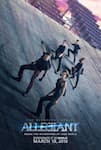
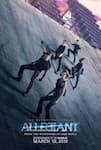
The Divergent Series: Allegiant Budget
 Action
Updated
Synopsis
After overthrowing the faction system and escaping the walled remnants of post-apocalyptic Chicago, Tris Prior and her allies discover that their entire society has been a generations-long social-engineering experiment conducted by the Bureau of Genetic Welfare. Recruited by the Bureau's director David, Tris must decide whether to trust the new authority watching over her city, even as her boyfriend Four uncovers evidence that the Bureau may be a far greater threat than the regime Tris already toppled.
What Is the Budget of The Divergent Series: Allegiant (2016)?
The Divergent Series: Allegiant (2016), directed by Robert Schwentke and distributed by Summit Entertainment (a subsidiary of Lionsgate), was produced on a reported budget of $110,000,000. The film was the third installment in the Divergent film series adapted from Veronica Roth's young-adult dystopian novels and the first of two planned films covering Roth's third novel, Allegiant, which Lionsgate had decided to split for theatrical release in the manner of the Hunger Games and Twilight franchise conclusions. Red Wagon Entertainment, Lionsgate, and Summit co-produced.
The $110,000,000 budget was a modest reduction from the $142,000,000 reported for Insurgent (2015), reflecting Lionsgate's budget discipline as the franchise approached its conclusion. Costs were driven by lead actor Shailene Woodley's compensation (which had increased substantially across the franchise), the expanded principal cast including Jeff Daniels as the new villain David, extensive visual effects work for the post-Chicago environments outside the city's wall, and Atlanta-based principal photography. The split decision proved disastrous: Allegiant's underperformance led Lionsgate to scrap the planned second film, Ascendant, entirely.
Key Budget Allocation Categories
The reported $110,000,000 budget was distributed across several core production areas:
- Above-the-Line Talent: Lead actor Shailene Woodley's compensation had escalated significantly across the franchise, with industry reports placing her Allegiant fee plus back-end at approximately $5-8 million. Theo James returned as Four, with new additions Jeff Daniels (as David, head of the Bureau of Genetic Welfare), Naomi Watts continuing as Evelyn from Insurgent, and supporting roles for Miles Teller, Zoë Kravitz, Ansel Elgort, Octavia Spencer, Ray Stevenson, and Mekhi Phifer. Director Robert Schwentke commanded a feature-director rate appropriate to a $110-million tentpole.
- Atlanta-Based Production: Principal photography took place in and around Atlanta, Georgia, taking advantage of Georgia's 30% film tax credit. Studio work at EUE/Screen Gems Studios Atlanta and location shooting in surrounding industrial and natural environments stretched the budget further than a comparable Los Angeles or Vancouver shoot would have allowed.
- Visual Effects: The film required extensive visual effects work for the climb over Chicago's wall, the orange-toxic post-apocalyptic Wasteland exterior environments, the gleaming Bureau of Genetic Welfare interiors, and the climactic Chicago surveillance and combat sequences. Visual effects were distributed across multiple houses, with Method Studios handling the majority of the Wasteland and Bureau environments.
- Production Design: Production designer Alec Hammond built the Bureau interior at Atlanta soundstages, alongside redressed Insurgent sets for the Chicago-faction sequences. The Bureau's sterile, retro-futuristic aesthetic required significant set construction and prop design distinct from the steampunk-dystopian look established in the first two films.
- Music and Sound: Composer Joseph Trapanese, returning from Insurgent, wrote the score, blending electronic and orchestral textures with thematic continuity to the previous installments. The mix schedule extended through early 2016 to accommodate the action set pieces and the introductions of the Bureau environment.
- Marketing Tier: Lionsgate's marketing investment was substantial, with an estimated $100,000,000 to $130,000,000 in worldwide P&A spend, reflecting the studio's ambition to set up the franchise conclusion with adequate runway. The marketing emphasized the world-expansion beyond Chicago's walls as a new chapter for the franchise.
How Does The Divergent Series: Allegiant's Budget Compare to Similar Films?
At $110,000,000, Allegiant sat at the higher end of YA franchise sequels. Comparing it with peers:
- Insurgent (2015): Budget $142,000,000 | Worldwide $297,250,538. The previous Divergent installment cost 29% more and grossed roughly 66% more, the direct franchise-prior benchmark that illustrated steep audience erosion across the trilogy's middle and final films.
- The Hunger Games: Mockingjay - Part 1 (2014): Budget $125,000,000 | Worldwide $755,356,711. The Hunger Games franchise's split-finale Part 1 cost 14% more and grossed more than four times as much, a structural benchmark for what Lionsgate had hoped Allegiant could deliver as the lead-in to a planned Part 2.
- The Maze Runner: The Scorch Trials (2015): Budget $61,000,000 | Worldwide $312,326,759. Fox's middle Maze Runner installment cost 45% less and grossed more than 74% more than Allegiant, the cleanest contemporary comparison of YA dystopian sequels and the most damning relative-value indictment of Allegiant's commercial performance.
- Divergent (2014): Budget $85,000,000 | Worldwide $288,886,939. The franchise launcher cost 23% less and grossed 61% more, showing how decisively audience appetite had fallen from the first film to the third.
- The 5th Wave (2016): Budget $38,000,000 | Worldwide $109,889,425. Sony's same-year YA alien-invasion misfire cost 65% less and grossed only 61% as much, both films illustrating how thoroughly YA dystopian audience appetite had collapsed by 2016.
The Divergent Series: Allegiant Box Office Performance
Allegiant opened domestically on March 18, 2016, earning $29,030,367 in its opening weekend and finishing second at the U.S. box office behind Zootopia's third weekend. That figure was 44% below Insurgent's opening of $52,263,464 and well below Lionsgate's pre-release tracking projections. Word of mouth was tepid, and the film fell sharply in subsequent weeks, ultimately becoming the lowest-grossing Divergent installment by a wide margin.
Against a $110,000,000 production budget, the film required approximately $260,000,000 in worldwide gross to reach profitability after marketing and distribution costs. The financial breakdown:
Box Office Breakdown
The Divergent Series: Allegiant (2016)

Allegiant returned approximately $0.75 to $0.85 in theatrical revenue for every $1 invested when measured against total estimated production and marketing spend, placing it as a clear theatrical loss for Lionsgate. The domestic share of the gross was $66,184,737 against an international share of $113,062,131, a 37/63 split that confirmed the franchise had become slightly more dependent on overseas markets across its run.
The collapse killed the planned Ascendant final installment. Lionsgate initially pivoted the conclusion to a television movie that would have launched a spin-off series, but the cast (particularly Shailene Woodley) declined to participate, and the project was eventually shelved entirely. The Divergent Series joined Mortal Engines, Eragon, The Golden Compass, and The Mortal Instruments: City of Bones in Hollywood's long catalog of YA franchises that failed to complete their planned arcs.
The Divergent Series: Allegiant Production History
Lionsgate announced in mid-2014 that the third Divergent novel would be split across two films, following the established YA-franchise template of Twilight's Breaking Dawn and the Hunger Games' Mockingjay. Allegiant would cover the first half of Roth's third novel, ending on a cliffhanger leading into Ascendant. Robert Schwentke, returning from Insurgent (2015), was confirmed to direct the third installment in November 2014. Noah Oppenheim and Adam Cooper wrote the adapted screenplay, with Bill Collage joining the writing team late in development.
Principal photography ran from May to August 2015 in and around Atlanta, Georgia, leveraging Georgia's 30% film tax credit. Studio work took place at EUE/Screen Gems Studios Atlanta, with location work in surrounding industrial and natural environments standing in for the Wasteland and the Bureau of Genetic Welfare exteriors. Shailene Woodley and Theo James completed their work over the three-month shoot, with the production using extensive visual effects pre-visualization for the climb over Chicago's wall and the orange-toxic Wasteland sequences.
Post-production stretched across roughly seven months, with visual effects work concentrated at Method Studios for the Wasteland and Bureau environments. The film was completed in early 2016, with Lionsgate positioning a March 18, 2016 release date one week before Easter to capture the family-friendly youth audience window. The marketing emphasized the world-expansion beyond Chicago's walls as a new chapter for the franchise.
Test screenings reportedly revealed audience confusion about the Bureau-of-Genetic-Welfare reveal and the franchise's pivot from coming-of-age dystopia to genetic-engineering science fiction. Reshoots took place in early 2016 to add clarifying exposition. The opening weekend confirmed the worst-case projections, and trade press in the weeks following the release identified Allegiant as a likely franchise-killer. Lionsgate announced in summer 2016 that Ascendant would pivot to a television-movie format, a plan that was ultimately abandoned when the cast declined to return.
Awards and Recognition
Allegiant received minimal awards recognition. The film was largely absent from year-end critics' lists and the major industry awards circuit. It received Teen Choice Award nominations in 2016 for Choice Sci-Fi/Fantasy Movie and Choice Sci-Fi/Fantasy Movie Actor (Theo James), neither of which it won. The film also received Razzie attention in 2017, drawing a Worst Prequel, Remake, Rip-off or Sequel nomination, which it did not win.
On the technical side, the visual effects work received industry recognition from Method Studios trade publications for the Wasteland and Bureau environments, but no Visual Effects Society or Academy nominations followed. The film's commercial collapse and mixed reception largely defined its industry reputation rather than any awards momentum.
Critical Reception
Allegiant received mixed-to-negative reviews. The film holds an 11% approval rating on Rotten Tomatoes based on 209 critic reviews, with a critical consensus that called it "a tedious franchise installment that strands its talented cast in a confusing, derivative plot." On Metacritic, the film scored 33 out of 100, indicating generally unfavorable reviews. Audiences surveyed by CinemaScore gave the film a B, the lowest CinemaScore in the franchise and a notable warning signal even from the loyal fan base.
Critics broadly objected to the screenplay's confused exposition, the franchise's pivot from coming-of-age dystopia to genetic-engineering science fiction, and what reviewers characterized as a tired payoff after three films of accumulating world-building. Manohla Dargis in The New York Times wrote that "Allegiant feels less like the start of a culminating two-parter than the third movie in a series running on fumes." Variety's Andrew Barker called the film "an exhausted franchise installment that adds little to the underlying premise and does even less to set up the planned conclusion."
Defenders pointed to Shailene Woodley's committed performance, the visual design of the Bureau environments, and the kinetic action choreography of the Wasteland sequences. The A.V. Club's Ignatiy Vishnevetsky offered a measured assessment that praised individual sequences while concluding that "the franchise's underlying ideas have collapsed under their own weight." The film has not undergone significant critical reappraisal and remains best known as the installment that ended the Divergent franchise prematurely.
Frequently Asked Questions
How much did it cost to make The Divergent Series: Allegiant (2016)?
The reported production budget was $110,000,000, a modest reduction from the $142,000,000 reported for Insurgent (2015). Costs were driven by Shailene Woodley's escalated compensation, the expanded principal cast including Jeff Daniels as the new villain, extensive visual effects work for the Wasteland and Bureau environments, and Atlanta-based principal photography that leveraged Georgia's 30% film tax credit.
How much did Allegiant earn at the box office?
The film grossed $66,184,737 domestically and $113,062,131 internationally, for a worldwide total of $179,246,868. It opened to $29,030,367 in the United States, finishing second on its March 18, 2016 opening weekend behind Zootopia's third weekend and 44% below Insurgent's opening.
Was Allegiant a box office bomb?
Yes. Against a $110,000,000 production budget and an estimated $100-130 million in marketing, the film returned approximately $0.75 in worldwide gross for every $1 invested. The disappointing performance killed the planned Ascendant final installment, joining a long catalog of YA franchises that failed to complete their arcs.
Who directed The Divergent Series: Allegiant?
Robert Schwentke directed the film, returning from Insurgent (2015). Schwentke, a German filmmaker previously known for RED (2010) and Flightplan (2005), was attached to direct the planned Ascendant conclusion as well before the project was scrapped.
Where was Allegiant filmed?
Principal photography took place from May to August 2015 in and around Atlanta, Georgia, leveraging Georgia's 30% film tax credit. Studio work took place at EUE/Screen Gems Studios Atlanta, with location work in surrounding industrial and natural environments standing in for the Wasteland and the Bureau of Genetic Welfare exteriors.
Why was the planned Ascendant film cancelled?
Allegiant's box office underperformance prompted Lionsgate to scrap the planned theatrical Ascendant conclusion. The studio initially pivoted the conclusion to a television movie that would have launched a spin-off series, but the cast (particularly Shailene Woodley) declined to participate, and the project was eventually shelved entirely.
How does Allegiant compare to other Divergent films?
Allegiant grossed $179 million worldwide on a $110 million budget. By comparison, Divergent (2014) earned $289 million on an $85 million budget, and Insurgent (2015) earned $297 million on a $142 million budget. Allegiant's $179 million worldwide gross was the lowest in the trilogy by a wide margin, confirming a steep audience-erosion curve.
Is Allegiant based on a book?
Yes. The film adapts the first half of Veronica Roth's 2013 novel Allegiant, the third book in the Divergent trilogy. Lionsgate had originally announced the novel would be split across two films, with the second half to be adapted in a planned 2017 release titled The Divergent Series: Ascendant, but the second film was cancelled after Allegiant's underperformance.
What did critics think of Allegiant?
The film received mixed-to-negative reviews, with an 11% approval rating on Rotten Tomatoes (209 critics) and a 33 score on Metacritic. Audiences gave it a B CinemaScore, the lowest in the franchise. Critics objected to the confused exposition and the franchise's pivot from coming-of-age dystopia to genetic-engineering science fiction.
How does Allegiant compare to The Hunger Games: Mockingjay - Part 1?
Allegiant grossed $179 million worldwide on a $110 million budget, while Mockingjay - Part 1 (2014), the structural template Lionsgate had hoped to emulate, grossed $755 million worldwide on a $125 million budget. The comparison illustrates how thoroughly the Divergent franchise had collapsed at the audience level compared with the Hunger Games at the equivalent point in its arc.
Filmmakers
The Divergent Series: Allegiant (2016)

Build budgets like this one in Saturation
Start from an industry-standard feature film template, import the schedule and rates you already have, and let the cost report keep itself current as you spend. Real-time collaboration, no spreadsheets.