The Deep Budget
 Adventure
Updated
Synopsis
On vacation in Bermuda, amateur divers David and Gail Berke discover two competing wrecks on the same reef, a World War II American ship sitting atop the sunken 17th century Spanish galleon Grifon. As they uncover morphine ampules and Spanish gold treasure, a Haitian drug ring led by a local crime lord forces them into a dangerous race for what lies in the deep.
What Is the Budget of The Deep (1977)?
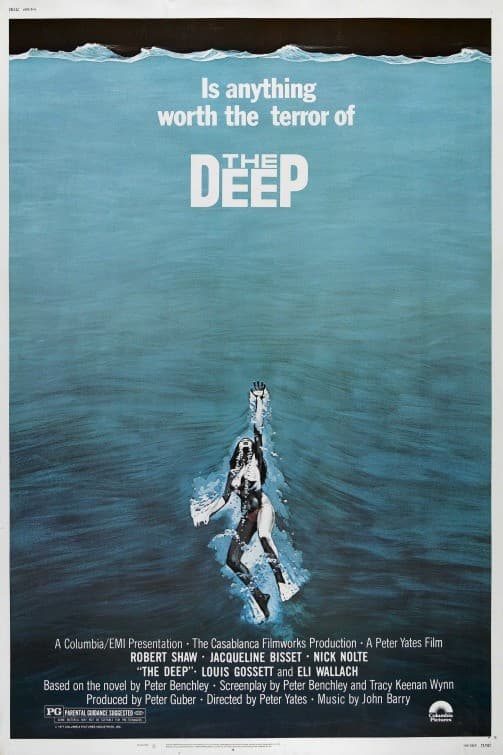
The Deep (1977), directed by Peter Yates and distributed by Columbia Pictures, was produced on a reported budget of $9,000,000. The underwater treasure-and-drugs thriller, adapted by Peter Benchley from his own bestselling novel, was financed by Columbia in partnership with producer Peter Guber's Casablanca FilmWorks. The $9,000,000 commitment was substantial for a 1977 underwater thriller, reflecting the extensive sub-surface photography required across multiple Bermuda diving locations and the post-Jaws expectations that Benchley adaptations carried.
The financial structure was built around the Peter Benchley brand and the post-Jaws underwater-thriller wave that Columbia and Universal had identified as a growth category. Star Nick Nolte, fresh off the Rich Man, Poor Man television miniseries, took the lead at a feature-launch rate, with Jacqueline Bisset, Robert Shaw (also fresh from Jaws), Eli Wallach, and Lou Gossett Jr. headlining the supporting ensemble. The bulk of the budget went to underwater cinematography, two months of Bermuda location shooting, an extensive practical wreck-construction effort, and a John Barry orchestral score.
Key Budget Allocation Categories
The $9,000,000 budget for The Deep was distributed across several core production areas:
- Above-the-Line Talent: Nick Nolte led the cast as David Berke, his first major feature role following the breakout success of Rich Man, Poor Man on ABC. Jacqueline Bisset played his girlfriend Gail Berke, anchoring the project's sex-symbol marketing with her iconic wet-T-shirt diving sequences. Robert Shaw played the eccentric treasure hunter Romer Treece, bringing immediate post-Jaws recognition. Director Peter Yates commanded a fee appropriate to his Bullitt and The Friends of Eddie Coyle stature.
- Bermuda Location Shooting: Principal photography took place over approximately two months in Bermuda, with extensive underwater work across multiple dive sites including the actual Constellation wreck. The production based out of Tucker's Town and operated dive boats, on-board recompression chambers, and surface support across the production schedule. Location, freight, and travel costs across the Bermuda block were substantial.
- Underwater Cinematography: Director of photography Christopher Challis and underwater unit director Al Giddings shot extensive sub-surface sequences using modified Panavision underwater housings and natural-light photography supplemented by HMI rigs in deeper environments. The underwater unit operated separately from the surface unit, requiring duplicate camera and crew investments.
- Practical Wreck and Set Construction: While the production exploited several real wrecks, the climactic sequences required built sets, including practical mock-ups of the Goliath cargo holds, the Spanish galleon Grifon's gold-treasure chamber, and the underwater morphine-cache sequences. Set construction was a meaningful below-the-line line item.
- John Barry Score: Composer John Barry, known for the James Bond theme work and his subsequent Out of Africa Academy Award win, scored the film with a full orchestral approach featuring a Donna Summer theme song collaboration ("Down, Deep Inside") that was released as a separate single.
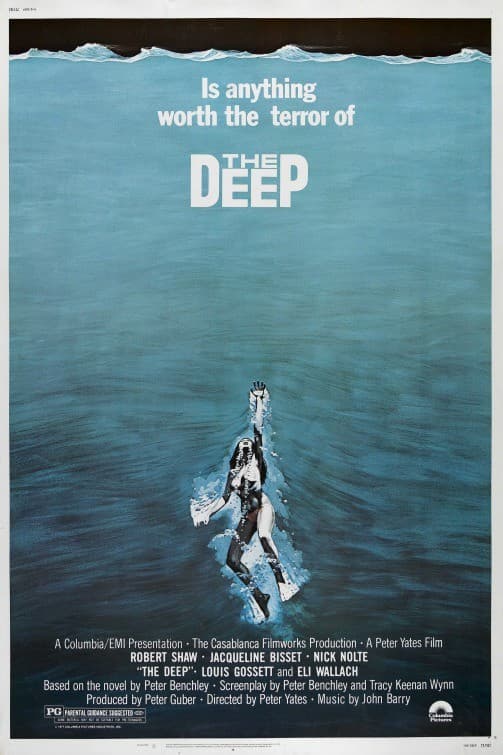
- Marketing and Theatrical Release: Columbia opened the film wide on June 17, 1977, with an extensive print-and-advertising spend in the $5,000,000 to $7,000,000 range to support a summer 1977 release positioning. The marketing campaign leaned heavily into Jacqueline Bisset's underwater imagery and the post-Jaws audience expectations from a Benchley adaptation.
How Does The Deep's Budget Compare to Similar Films?
At $9,000,000, The Deep sits in the upper-mid range for 1977 studio productions. The comparison set illustrates how its commercial outcome compared with its peers:
- Jaws (1975): Budget $9,000,000 | Worldwide $470,653,000. Steven Spielberg's previous Peter Benchley adaptation cost essentially the same as The Deep and grossed roughly ten times worldwide, demonstrating just how unrepeatable the Jaws phenomenon was even within the same author's adapted-novel category.
- Orca (1977): Budget $6,000,000 | Worldwide $14,748,000. Dino De Laurentiis's contemporaneous Jaws-knockoff killer-whale thriller cost two-thirds of The Deep and grossed less than a third, illustrating the ceiling for derivative underwater thrillers without the Benchley name.
- Close Encounters of the Third Kind (1977): Budget $20,000,000 | Worldwide $303,788,635. The Spielberg blockbuster, released in November 1977 the same year as The Deep, cost more than twice as much and demonstrated what an event film could deliver in the 1977 summer-fall window.
- Smokey and the Bandit (1977): Budget $4,300,000 | Worldwide $300,000,000. The Burt Reynolds road comedy released the same Memorial Day weekend cost less than half of The Deep and grossed several times more, illustrating the gap between an underwater-thriller summer entry and the summer's actual breakout.
- A Bridge Too Far (1977): Budget $25,000,000 | Worldwide $50,800,000. The Joseph E. Levine WWII epic, released the same summer, cost almost three times as much as The Deep and grossed essentially the same worldwide, showing how heavy the summer 1977 box office landscape was.
The Deep Box Office Performance
The Deep opened wide on June 17, 1977, finishing first at the domestic box office and holding the top position against Smokey and the Bandit, which had opened a month earlier and was still drawing strong audiences. The film grossed an estimated $7,000,000 in its opening weekend and remained in the top 10 domestically for more than ten weeks, with sustained word of mouth driven by Jacqueline Bisset's underwater sequences and the dual treasure-and-drugs plot.
Against a $9,000,000 production budget, the film needed approximately $25,000,000 worldwide to reach profitability after marketing. Here is the financial breakdown:
Box Office Breakdown
The Deep (1977)

The Deep returned approximately $2.94 in domestic theatrical revenue for every $1 invested when measured against total estimated production and marketing spend, making it one of the most profitable films of summer 1977 on a percentage basis. International box office is not consolidated in the publicly available Box Office Mojo data, but the film performed strongly in European territories and Japan, with subsequent estimates placing the international add at $20,000,000 to $40,000,000.
The film's commercial success extended Peter Guber's producing momentum that would later carry through Midnight Express and Flashdance and consolidated Nick Nolte's feature-film leading-man positioning. The home video and pay-television performance through the late 1970s and 1980s further multiplied the film's eventual return on Columbia's initial investment.
The Deep Production History
Development began at Columbia in 1976 immediately following the publication of Peter Benchley's second novel, which had been pre-sold to the studio for $500,000 before publication. Producer Peter Guber, then running Casablanca FilmWorks in partnership with Neil Bogart's music label, optioned the property and brought in Benchley to adapt his own screenplay, with subsequent revisions by Tracy Keenan Wynn. Peter Yates was attached to direct on the strength of Bullitt and The Friends of Eddie Coyle.
Casting Nick Nolte as David Berke in late 1976 was a deliberate launch decision; Nolte had broken through with Rich Man, Poor Man on ABC and was being positioned by Columbia as a feature-film leading man. Jacqueline Bisset, an established international star, was cast as Gail Berke, with Robert Shaw, fresh from Jaws and The Sting, joining as the eccentric treasure hunter Romer Treece. Eli Wallach and Lou Gossett Jr. rounded out the principal cast.
Principal photography ran from late 1976 through early 1977 in Bermuda, with the production basing out of Tucker's Town and operating dive boats and on-board recompression chambers across multiple sites including the actual Constellation wreck. The underwater unit, led by director of photography Christopher Challis and underwater specialist Al Giddings, shot extensive sub-surface sequences using modified Panavision underwater housings. Jacqueline Bisset trained for several weeks before production to allow her to perform extensive on-camera diving without doubles.
John Barry recorded the orchestral score in early 1977, with Donna Summer recording the "Down, Deep Inside" theme song as a separate single release tied to the soundtrack album. The film was completed for a June 17, 1977 release. Marketing was built around the Jacqueline Bisset underwater imagery and the post-Jaws Peter Benchley brand, with extensive television spots and print advertising across the summer 1977 window.
Awards and Recognition
The Deep received no major awards nominations. The film failed to register at the Academy Awards, Golden Globes, BAFTA Awards, or any of the major industry honors that year. The 50th Academy Awards in spring 1978 were dominated by Annie Hall, Star Wars, Close Encounters of the Third Kind, and The Goodbye Girl, and The Deep was not in serious contention for any technical or above-the-line category.
Underwater cinematography work by Christopher Challis and Al Giddings was widely praised in trade press but did not generate an Academy Award nomination, in part because the cinematography branch did not break out an underwater category and the film's narrative did not align with the prestige profiles of the major nominees. John Barry's score and the Donna Summer theme song similarly missed Golden Globe consideration. The film has retained ongoing visibility primarily through home video and pay-television play of the Bisset diving sequences and as a footnote in the post-Jaws underwater-thriller wave.
Critical Reception
The Deep received mixed reviews. The film holds a 32% approval rating on Rotten Tomatoes based on 19 critic reviews retrospectively logged, with a critical consensus that called it a commercial post-Jaws cash-in carried by underwater photography rather than story or character. Contemporary 1977 reviews ranged from cautiously positive on the technical accomplishment to harshly negative on the screenplay structure. Audiences responded strongly, with the film holding the top of the domestic chart for several weeks during the summer.
Critics broadly praised the underwater cinematography by Christopher Challis and Al Giddings, Jacqueline Bisset's screen presence, John Barry's score, and Robert Shaw's eccentric supporting performance, but objected to Peter Benchley's screenplay structure, the underwritten relationship between Nick Nolte and Jacqueline Bisset, and the inert pacing of the dual-plot treasure-and-drugs material. Roger Ebert in the Chicago Sun-Times gave the film two stars and wrote that "the underwater photography is gorgeous and the people are dull as church mice." Vincent Canby in The New York Times called it "a 130-minute screen test for a Cousteau special."
Genre and trade press were more favorable. Variety called the underwater unit work "first-class" and praised the box office prospects. The mixed-to-positive contemporary reception combined with the strong commercial performance has positioned The Deep as a commercially successful but critically modest 1977 release, a film better remembered for its iconic Jacqueline Bisset imagery and as a footnote in the post-Jaws Peter Benchley screen-rights wave than as a major creative work of its decade.
Frequently Asked Questions
How much did The Deep (1977) cost to make?
The reported production budget was $9,000,000. Columbia Pictures financed the film in partnership with Peter Guber's Casablanca FilmWorks. The substantial budget for a 1977 underwater thriller reflected the extensive sub-surface photography required across multiple Bermuda diving locations and the post-Jaws expectations that Peter Benchley adaptations carried.
How much did The Deep earn at the box office?
The film grossed $47,346,365 in the United States, holding the top domestic position for several weeks during summer 1977. Comprehensive international box office figures are not consolidated in publicly available Box Office Mojo data, although the film performed strongly in European territories and Japan, with subsequent estimates placing the international add in the $20,000,000 to $40,000,000 range.
Was The Deep a box office success?
Yes. Against a $9,000,000 production budget and an estimated $5,000,000 to $7,000,000 in marketing spend, the film returned approximately $2.94 in domestic gross alone for every $1 invested. It is one of the most commercially successful underwater thrillers of the decade and helped extend Peter Guber's producing momentum that would later carry through Midnight Express and Flashdance.
Who directed The Deep?
Peter Yates directed the film. Yates was attached on the strength of his earlier work on Bullitt (1968) and The Friends of Eddie Coyle (1973). The screenplay was adapted by Peter Benchley from his own novel, with revisions by Tracy Keenan Wynn.
Where was The Deep filmed?
Principal photography took place from late 1976 through early 1977 in Bermuda, with the production basing out of Tucker's Town and operating dive boats, on-board recompression chambers, and surface support across multiple sites including the actual Constellation wreck. The underwater unit, led by cinematographer Al Giddings, shot extensive sub-surface sequences across the production schedule.
Is The Deep based on a book?
Yes. The film is adapted from Peter Benchley's 1976 second novel of the same name, which followed his bestselling 1974 novel Jaws. Columbia Pictures had pre-sold the screen rights to the book before publication for $500,000, anticipating another major adaptation in the wake of Steven Spielberg's 1975 Jaws film.
Who plays the lead role in The Deep?
Nick Nolte plays David Berke, his first major feature role following the breakout success of Rich Man, Poor Man on ABC. Jacqueline Bisset plays his girlfriend Gail Berke, anchoring the project's marketing with her iconic underwater diving sequences. Robert Shaw, fresh off Jaws, plays the eccentric treasure hunter Romer Treece.
Who scored The Deep?
John Barry, the longtime James Bond composer and later Academy Award winner for Out of Africa, scored the film with a full orchestral approach. Donna Summer recorded the theme song "Down, Deep Inside" as a separate single release tied to the soundtrack album.
What did critics think of The Deep?
The film received mixed reviews, with a 32% approval rating on Rotten Tomatoes retrospectively. Roger Ebert gave it two stars, writing that "the underwater photography is gorgeous and the people are dull as church mice." Critics praised Christopher Challis and Al Giddings' underwater cinematography but objected to Peter Benchley's screenplay structure and the inert pacing.
Did The Deep get a sequel?
No. Despite its commercial success, the film never received a direct sequel. Peter Benchley wrote additional novels but did not return to the David and Gail Berke characters, and Columbia did not pursue further screen extensions of the property. The post-Jaws underwater-thriller wave continued briefly through Orca (1977) and a handful of imitators before fading by the early 1980s.
Filmmakers
The Deep (1977)

Build budgets like this one in Saturation
Start from an industry-standard feature film template, import the schedule and rates you already have, and let the cost report keep itself current as you spend. Real-time collaboration, no spreadsheets.