The Country Bears Budget
 Adventure
Updated
Synopsis
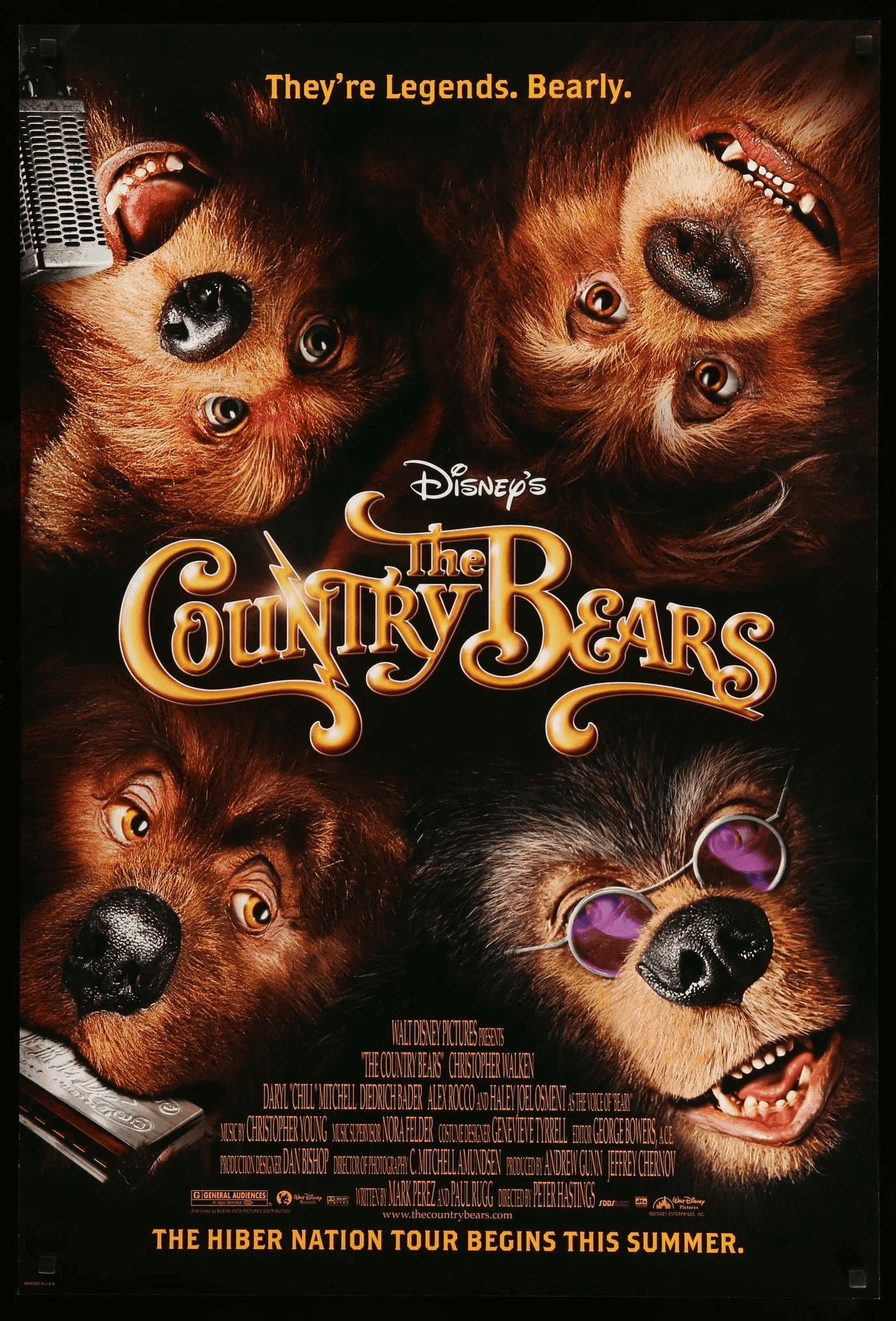
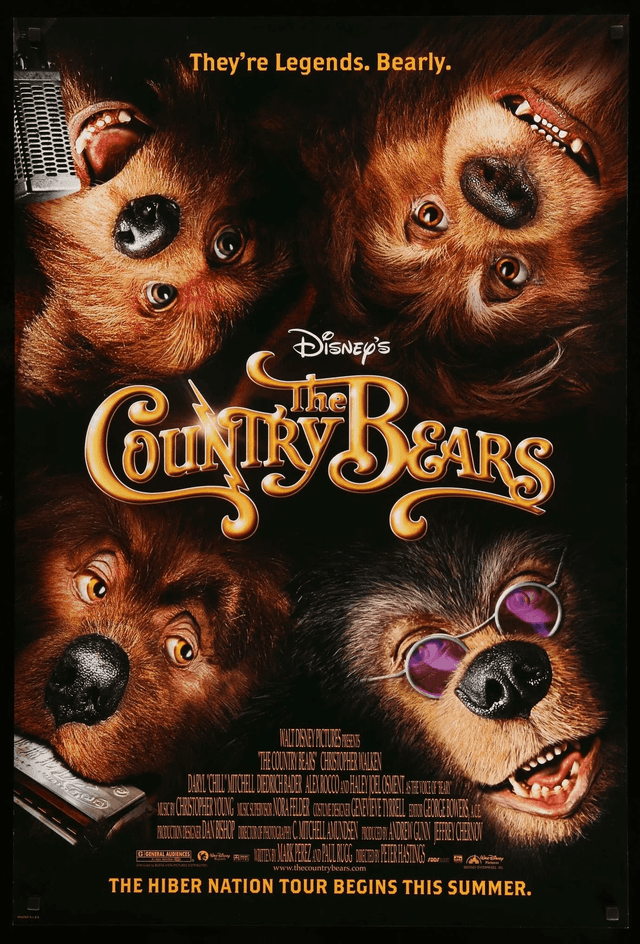
Beary Barrington, an adopted bear cub living with a human family in suburbia, runs away to find the broken-up legendary Country Bear Band. Beary sets out on a cross-country journey with the surviving members to reunite the group for one final concert that could save Country Bear Hall from demolition by a corrupt banker.
What Is the Budget of The Country Bears (2002)?
The Country Bears (2002), directed by Peter Hastings and distributed by Walt Disney Pictures, was produced on a reported budget of $35,000,000. The musical comedy, adapted from the Country Bear Jamboree animatronic stage show that had been a fixture at Disneyland and Walt Disney World since 1971, was financed by Walt Disney Pictures and produced by Andrew Gunn and Birnbaum/Barber Productions. The film was Disney's most aggressive attempt to convert a theme-park attraction into a feature franchise before the launch of the Pirates of the Caribbean theatrical strategy.
The investment reflected the studio's confidence that the Country Bear Jamboree's three-decade theme-park brand recognition would translate to family theatrical audiences, even though the underlying attraction was not a narrative property. The math required the film to earn roughly $80,000,000 worldwide to clear breakeven after marketing, a target it missed by a wide margin in what became one of the worst-performing studio family releases of the early 2000s.
Key Budget Allocation Categories
The Country Bears' $35,000,000 budget was distributed across several core production areas:
- Animatronic and Practical Bear Costumes: The single largest budget item was the development and operation of full-body animatronic bear suits and animated facial mechanics for the seven principal bear characters. Jim Henson's Creature Shop built the suits and on-set puppeteering rigs, with each bear requiring multiple performers, including a costume actor inside the body, separate radio-controlled facial puppeteers, and a vocal performer in dubbing. The technical infrastructure represented a meaningful share of the total production budget.
- Above-the-Line Talent: Director Peter Hastings, a Disney television animation veteran, worked at debut feature-director rates. Voice talent including Christopher Walken (as the antagonist Reed Thimple), Stephen Tobolowsky, Daryl 'Chill' Mitchell, M.C. Gainey, and Diedrich Bader brought ensemble character-actor profiles. The Country Bear vocal cast included Don Henley, John Hiatt, Bonnie Raitt, Brian Setzer, Willie Nelson, and Krystal Harris in the supporting musical roles. Real-life kid lead Haley Joel Osment voiced the bear cub Beary Barrington while in his post-Sixth Sense commercial peak.
- Music and Songs: Composer Christopher Young scored the film, with original songs written by John Hiatt, Don Henley, John Sebastian, and Robert Lopez (later of Frozen and Coco fame). The country-rock soundtrack required substantial in-studio recording sessions with the named musical guests, plus the Country Bear Band concert sequences. Music production and licensing was a meaningful budget line item.
- Tennessee Location Shoot: Principal photography took place from June to August 2001 across Nashville and surrounding Tennessee locations, with the Country Bear Hall concert venue built as a practical exterior and interior set. The production took advantage of Tennessee's then-emerging film incentive program and the local musical infrastructure that supported the soundtrack recording sessions.
- Visual Effects and CG Augmentation: Industrial Light & Magic and other VFX vendors handled selective CG augmentation of the animatronic bear facial performances, mouth movements during musical numbers, and environmental enhancements. The hybrid practical-CG approach was an attempt to maintain the puppet aesthetic while smoothing the limitations of pure animatronics, and added meaningful post-production cost.
- Theme Park Cross-Promotion: Disney built marketing around cross-promotion with the still-operating Country Bear Jamboree attractions at Walt Disney World (the Disneyland version had closed in 2001), with theme-park tie-in merchandise, attraction signage, and brand integration. Domestic P&A spend was estimated at $30,000,000 to $40,000,000.
How Does The Country Bears' Budget Compare to Similar Films?
At $35,000,000, The Country Bears sat at the low-mid range of the early-2000s Disney live-action family bracket:
- The Haunted Mansion (2003): Budget $90,000,000 | Worldwide $182,343,360. Disney's contemporary theme-park-attraction adaptation cost 2.6x The Country Bears and earned 9x worldwide, illustrating both the inflated budget for the Eddie Murphy vehicle and the gulf in commercial outcome.
- Pirates of the Caribbean: The Curse of the Black Pearl (2003): Budget $140,000,000 | Worldwide $654,264,015. Disney's other contemporary theme-park-attraction film cost 4x The Country Bears and earned 32x worldwide, an outcome that effectively reframed the studio's entire theme-park-to-film strategy.
- Snow Dogs (2002): Budget $33,000,000 | Worldwide $115,217,425. Disney's contemporary family comedy cost roughly the same as The Country Bears and earned 5.7x its worldwide gross.
- Cats Don't Dance (1997): Budget $32,000,000 | Worldwide $3,566,637. Warner Bros' earlier talking-animal musical earned just 11% of The Country Bears worldwide, an even more catastrophic outcome that frames the genre risk profile.
- Like Mike (2002): Budget $30,000,000 | Worldwide $62,053,036. Fox's contemporary family sports comedy cost 14% less than The Country Bears and earned 3x its worldwide gross.
The Country Bears Box Office Performance
The Country Bears opened on July 26, 2002 to $5,002,070 across 2,278 theaters, finishing fifth for the weekend behind Stuart Little 2, Country Bears competitor Austin Powers in Goldmember, Signs, and Spy Kids 2: The Island of Lost Dreams. The opening fell well below Disney's projections and the film never recovered as word-of-mouth failed to materialize. Subsequent weeks saw steep drops as the film closed with a domestic total of $16,994,166.
Against a $35,000,000 production budget the film needed approximately $80,000,000 worldwide to clear breakeven after marketing. Here is the financial breakdown:
Box Office Breakdown
The Country Bears (2002)

The Country Bears returned approximately $0.28 in theatrical revenue for every $1 invested when measured against total estimated production and marketing spend, placing it among the most decisive Disney family-film losses of the early 2000s. The domestic share was $16,994,166 against an international share of just $3,171,637, an 84/16 split heavily weighted toward North America and a clear signal that the theme-park property held no overseas equity.
The commercial collapse effectively ended Disney's plan to fast-track multiple theme-park-attraction adaptations on the Country Bears template, with subsequent productions including The Haunted Mansion (2003) and Pirates of the Caribbean: The Curse of the Black Pearl (2003) representing more cautious budget structures (or much larger investments with bigger star talent) until the surprise success of Pirates rewrote the entire approach. Home video and television revenue eventually closed a small fraction of the theatrical gap, but the property was effectively retired from theatrical consideration.
The Country Bears Production History
Development on The Country Bears began at Walt Disney Pictures in 1999 when producers Andrew Gunn and Roger Birnbaum acquired internal approval to adapt the Country Bear Jamboree attraction into a feature. Screenwriter Mark Perez delivered the screenplay, structured around a heist-and-music road movie that gave the bears a narrative arc the original animatronic attraction lacked. Peter Hastings, a veteran of Disney television animation including the Pinky and the Brain segments of Animaniacs, attached to direct in 2000 in what was his feature directorial debut.
Pre-production stretched through 2000 and into 2001, with Jim Henson's Creature Shop building the animatronic bear suits and on-set puppeteering rigs. The suits required multi-person operation: a costume performer inside the body, separate radio-controlled facial puppeteers behind monitors, and vocal performers who would record dialogue in post-production. The technical complexity of the practical-puppet approach drove most of the elevated budget compared with a simpler family comedy structure.
Casting solidified through spring 2001. Haley Joel Osment, then 13 years old and still in his post-Sixth Sense commercial peak, voiced the bear cub Beary Barrington as a lead character. Christopher Walken brought his signature menace to the antagonist Reed Thimple in his second contemporary family-film role of the season (after Catch Me If You Can the same year). Musical guest cast members including Don Henley, John Hiatt, Bonnie Raitt, Brian Setzer, and Willie Nelson appeared as themselves in concert sequences.
Principal photography ran from June to August 2001 across Nashville and surrounding Tennessee locations, with the Country Bear Hall concert venue built as a practical exterior and interior set. The production took advantage of Tennessee's emerging film incentive program. Post-production extended through late 2001 and into early 2002, with selective CG augmentation of the animatronic bear performances handled by Industrial Light & Magic. Composer Christopher Young delivered the score in spring 2002 ahead of the July 26, 2002 theatrical release.
Awards and Recognition
The Country Bears received no major awards recognition. The film failed to register at the Academy Awards, Golden Globes, or major guild ceremonies. The Razzie Awards nominated the film for Worst Original Song ("Where Nobody Knows My Name"), capturing the broader industry assessment that placed the film among the year's lesser studio productions.
The film also received attention from family-film advocacy organizations including the Heartland Family Film Festival, which gave the film a screening as part of its family-programming slate. The targeted family-film recognition was a marketing asset for home video and theme-park brand tie-ins rather than a mainstream awards-conversation footprint.
Critical Reception
The Country Bears received largely negative reviews. The film holds a 30% approval rating on Rotten Tomatoes based on 124 critic reviews, with a critical consensus that called it "a tedious adaptation that even the cute bears can't save." On Metacritic, the film scored 36 out of 100, indicating generally unfavorable reviews. Audiences surveyed by CinemaScore gave the film a B-, a soft response that reflected the disconnect between theme-park brand recognition and theatrical audience interest.
Critics praised the production design, the musical numbers featuring real artists like Don Henley and Brian Setzer, and the costume work by Jim Henson's Creature Shop, but objected to the thin screenplay, the unclear target audience, and what The Hollywood Reporter's Kirk Honeycutt called "a misjudged attempt to wring a story from an attraction that has no story." Roger Ebert awarded the film 2.5 stars and wrote that the film "isn't a disaster, just a curiosity."
Family-film press received the film more enthusiastically, with several publications praising the practical-puppet performances and the soundtrack that mixed real country and country-rock musicians with original songs. The gap between mainstream criticism and family-press reception captured the broader marketing challenge: the film was neither sufficiently kid-driven to overcome a thin story nor sufficiently sophisticated to appeal to the nostalgic adult audience that the theme-park attraction drew. Subsequent industry discussion of The Country Bears framed it as a foundational lesson in what theme-park-to-film adaptation could and could not transfer.
Frequently Asked Questions
How much did it cost to make The Country Bears (2002)?
The reported production budget was $35,000,000. The film was financed by Walt Disney Pictures and produced by Andrew Gunn and Birnbaum/Barber Productions. The single largest budget item was the development and operation of full-body animatronic bear suits and facial mechanics built by Jim Henson's Creature Shop.
How much did The Country Bears earn at the box office?
The film grossed $16,994,166 domestically and $3,171,637 internationally, for a worldwide total of $20,165,803. It opened to $5,002,070 in the United States, finishing fifth on its July 26, 2002 opening weekend behind Stuart Little 2, Austin Powers in Goldmember, Signs, and Spy Kids 2.
Was The Country Bears a box office bomb?
Yes, decisively. Against a $35,000,000 production budget and an estimated $30,000,000 to $40,000,000 in marketing spend, the film returned approximately $0.28 in worldwide gross for every $1 invested. It is among the most decisive Disney family-film losses of the early 2000s and effectively ended the studio's plan to fast-track multiple theme-park-attraction adaptations on the Country Bears template.
Who directed The Country Bears?
Peter Hastings directed the film, his feature directorial debut. Hastings was a veteran of Disney television animation, including the Pinky and the Brain segments of Animaniacs. Screenwriter Mark Perez wrote the screenplay, structured as a heist-and-music road movie that gave the bears a narrative arc the original animatronic attraction lacked.
Where was The Country Bears filmed?
Principal photography ran from June to August 2001 across Nashville and surrounding Tennessee locations, with the Country Bear Hall concert venue built as a practical exterior and interior set. The production took advantage of Tennessee's emerging film incentive program and the local musical infrastructure that supported the soundtrack recording sessions.
Is The Country Bears based on the Disney theme-park attraction?
Yes. The film is adapted from the Country Bear Jamboree, an animatronic stage show that had been a fixture at Disneyland and Walt Disney World since 1971. The Disneyland version had closed in 2001 ahead of the film's release, while the Walt Disney World version remains in operation. The film gave the bears a narrative arc the original attraction lacked.
Who voices the bears in The Country Bears?
The vocal cast includes real country and country-rock musicians as the band members: Don Henley as Tennessee, John Hiatt as Zeb, Bonnie Raitt as Trixie, Brian Setzer as Beary's adoptive father, Willie Nelson as himself in a concert cameo, and Krystal Harris as Cha-Cha. Haley Joel Osment voiced the bear cub Beary Barrington while in his post-Sixth Sense commercial peak.
How does The Country Bears compare to Pirates of the Caribbean and The Haunted Mansion?
All three are Disney theme-park-attraction adaptations. The Country Bears (2002) cost $35M and earned $20M worldwide, a decisive loss. The Haunted Mansion (2003) cost $90M and earned $182M worldwide. Pirates of the Caribbean: The Curse of the Black Pearl (2003) cost $140M and earned $654M worldwide. The Country Bears' failure pushed Disney toward larger investments with bigger star talent on subsequent attraction adaptations.
What did critics think of The Country Bears?
The film received largely negative reviews, with a 30% approval rating on Rotten Tomatoes (based on 124 critics) and a 36 out of 100 score on Metacritic. Audiences gave it a B- CinemaScore. Critics praised the production design and musical numbers but objected to the thin screenplay and unclear target audience. Roger Ebert awarded the film 2.5 stars and called it "a curiosity rather than a disaster."
Did The Country Bears win any awards?
No major awards recognition. The Razzie Awards nominated the film for Worst Original Song ("Where Nobody Knows My Name"), capturing the industry assessment that placed the film among the year's lesser studio productions. The film failed to register at the Academy Awards, Golden Globes, or major guild ceremonies.
Filmmakers
The Country Bears (2002)

Build budgets like this one in Saturation
Start from an industry-standard feature film template, import the schedule and rates you already have, and let the cost report keep itself current as you spend. Real-time collaboration, no spreadsheets.