The Black Hole Budget
 Action
Updated
Synopsis
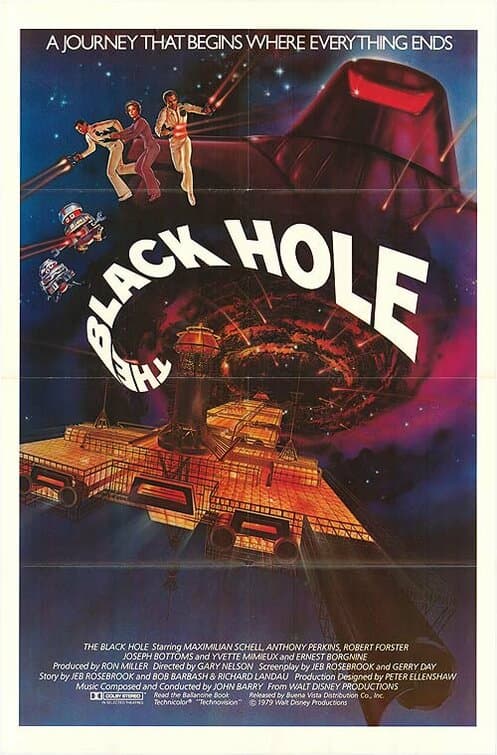
The crew of a deep-space exploratory vessel discovers a long-lost ship hovering at the edge of a massive black hole, captained by a disturbed scientist who has built a crew of automaton drones and intends to fly directly into the void. Disney's most ambitious live-action production to that point, released into the post-Star Wars science fiction boom.
What Is the Budget of The Black Hole (1979)?
The Black Hole was produced on a budget of approximately $26 million, the largest production budget in Walt Disney Productions' history at the time. The film was Disney's deliberate response to Star Wars, with the studio expanding the budget and visual effects ambition substantially during pre-production to position itself in the newly hot science fiction market.
Key Budget Allocation Categories
Visual Effects, extensive miniature effects work for the deep-space vessels and the black hole itself required new effects stages at the Disney Burbank lot and substantial additional staffing.
Set Construction, detailed interior sets for the Cygnus and the Palomino spacecraft, plus the eerie automaton crew sequences, occupied multiple Disney soundstages for an extended shoot.
Cast Salaries, Maximilian Schell, Anthony Perkins, Robert Forster, Joseph Bottoms, Yvette Mimieux, and Ernest Borgnine made up an unusually star-studded ensemble for a Disney production of the era.
Animatronic Robots, the V.I.N.CENT, B.O.B., and Maximilian robot characters required practical animatronic and remote-controlled builds plus operator coordination on set.
Score, John Barry composed an orchestral score with one of the longest overtures in Disney history, recorded with full symphony orchestra.
Marketing Push, Disney mounted its largest marketing campaign to date for a live-action release, positioning the film as a post-Star Wars tentpole.
How Does The Black Hole's Budget Compare to Similar Films?
Star Wars (1977), Budget $11,000,000 | Worldwide $775,000,000. The film The Black Hole was effectively built to compete with, made for 42 percent less and grossing over twenty times as much.
Star Trek: The Motion Picture (1979), Budget $46,000,000 | Worldwide $139,000,000. A direct competitor released the same Christmas season at nearly double the budget that significantly outperformed The Black Hole.
Alien (1979), Budget $11,000,000 | Worldwide $203,000,000. A drastically cheaper science fiction film released earlier the same year that vastly outperformed Disney's entry.
Tron (1982), Budget $17,000,000 | Worldwide $33,000,000. Disney's subsequent science fiction effort produced for substantially less that also underperformed expectations.
The Black Hole Box Office Performance
The Black Hole opened at the Christmas 1979 holiday corridor against Star Trek: The Motion Picture and family fare. Initial openings were respectable but the film never built into a major commercial event.
Box Office Breakdown
The Black Hole

On theatrical revenue alone the film returned roughly $1.38 for every $1 invested at the production-budget level. After marketing the film posted a meaningful theatrical loss, though merchandising and long-tail home video performance through the 1980s improved overall economics.
Comprehensive international theatrical figures are not consistently available for the era, but the film performed modestly outside North America. Disney concluded that the production scale was excessive relative to returns and stepped back from comparably ambitious live-action science fiction projects for several years.
The Black Hole Production History
Disney began developing The Black Hole in the mid-1970s under producer Ron Miller as a science fiction project intended to expand Walt Disney Productions' adult-skewing live-action slate. The release of Star Wars in May 1977 accelerated the project significantly, with Disney expanding the budget and effects ambition to compete in the newly hot science fiction market.
Gary Nelson was hired to direct, working from a screenplay developed by Jeb Rosebrook, Gerry Day, Bob Barbash, and Richard H. Landau. The production cast Maximilian Schell as the disturbed Captain Reinhardt and assembled an unusually star-studded ensemble for a Disney film of the era.
Principal photography took place at the Walt Disney Studios in Burbank across 1978 and into 1979, with new effects stages constructed to support the extensive miniature work. The animatronic robots V.I.N.CENT, B.O.B., and Maximilian were among the most ambitious practical robot effects of the era.
John Barry composed the score, including a notably long overture before the title sequence. The film became the first Walt Disney Productions release to receive a PG rating, reflecting the darker tone and the famously surreal black hole sequence that concludes the film. Disney placed the picture into the Christmas 1979 release window opposite Star Trek: The Motion Picture.
Awards and Recognition
The Black Hole received two Academy Award nominations, for Best Cinematography (Frank V. Phillips) and Best Visual Effects, though it did not win either category. The film lost the Visual Effects Oscar to Alien.
John Barry received a Saturn Award nomination for Best Music. The film also received Saturn nominations for Best Science Fiction Film and Best Special Effects, but did not win.
Industry retrospectives have generally framed The Black Hole as a fascinating misstep in Disney's post-Star Wars strategy, with several critics praising its ambition while acknowledging the screenplay's weaknesses. The film has developed a meaningful cult following over the decades and is frequently cited as a transitional moment for Disney live-action programming.
Critical Reception
Critical reception in 1979 was mixed. Reviewers consistently praised the visual effects, the production design, and John Barry's score while criticizing the screenplay as thin and the famously surreal ending as confused. Rotten Tomatoes settled at 43 percent positive reviews on retrospective coverage.
Roger Ebert awarded the film three and a half stars and praised the "spectacular special effects" while questioning the pacing. Vincent Canby at The New York Times was more skeptical, calling the film "a special effects feature with a story attached as an afterthought."
Audience reception was modest. The film never achieved the cultural footprint of Star Wars or Alien, though it has developed steady cult status over the following decades, with retrospective evaluations particularly drawn to the ambitious robot designs, the John Barry score, and the unresolved metaphysical questions of the ending sequence.
Frequently Asked Questions
What is the budget of The Black Hole?
The film was produced on a budget of approximately $26 million, the largest in Walt Disney Productions' history at the time.
Who directed The Black Hole?
Gary Nelson directed the film, having previously helmed Disney's Freaky Friday in 1976.
When was The Black Hole released?
Buena Vista Distribution released the film in North America on December 21, 1979.
Where was The Black Hole filmed?
Principal photography took place entirely at the Walt Disney Studios in Burbank, California, with extensive use of newly built effects stages.
How much did The Black Hole earn?
The film grossed approximately $35.8 million domestically. International theatrical revenue figures from the era are not consistently reported.
Was The Black Hole profitable?
On a $26 million budget plus roughly $15 million in marketing, the $36 million domestic gross was a soft commercial result. The film recouped through home video, television, and merchandising over the following years.
Was The Black Hole Disney's response to Star Wars?
Yes. Disney accelerated development of The Black Hole following the May 1977 release of Star Wars, expanding the budget and effects ambition to compete in the new science fiction market.
Was The Black Hole the first PG-rated Disney film?
Yes. The Black Hole was the first Walt Disney Productions film to receive a PG rating from the MPAA, reflecting darker thematic content and a more adult tone than prior Disney live-action releases.
What is the controversial ending?
The film concludes with a famously surreal sequence in which the ship passes through the black hole and the surviving characters experience what appears to be a Dante-inspired vision of heaven and hell. The ending divided critics and audiences and remains widely debated.
Did The Black Hole win any Academy Awards?
The film received two Academy Award nominations, for Cinematography and Visual Effects, though it did not win either category.
Filmmakers
The Black Hole

Build budgets like this one in Saturation
Start from an industry-standard feature film template, import the schedule and rates you already have, and let the cost report keep itself current as you spend. Real-time collaboration, no spreadsheets.