Teenage Mutant Ninja Turtles III Budget
 Adventure
Updated
Synopsis
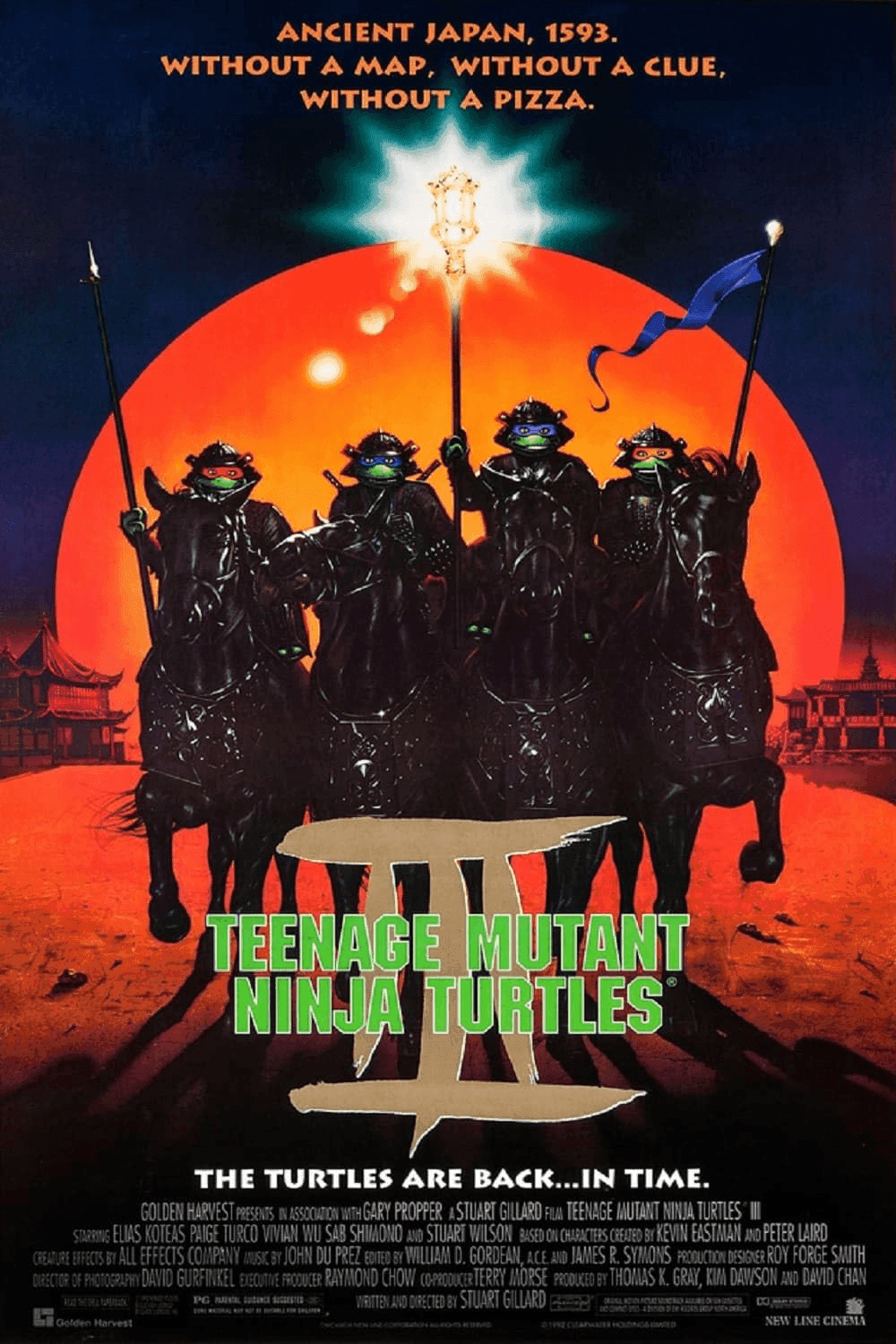
The Turtles travel back to feudal Japan to rescue April O'Neil from the time-displaced reign of a 17th-century daimyo, swapping bodies with the era's warriors in the process. The third entry in the live-action TMNT trilogy abandons the New York setting and the Henson Creature Shop puppets that defined the first two films.
What Is the Budget of Teenage Mutant Ninja Turtles III (1993)?
Teenage Mutant Ninja Turtles III was produced on a budget of approximately $21 million, slightly higher than the $13.5 million original and $25 million second installment. New Line Cinema and Hong Kong-based Golden Harvest co-financed the project, with the budget covering new Turtle costume construction, soundstage period sets, and a smaller-scale practical effects package than the prior films.
Key Budget Allocation Categories
New Turtle Costume Construction, with Jim Henson's Creature Shop unavailable, the production built entirely new animatronic Turtle suits with reduced articulation, a significant cost driver that nevertheless yielded weaker results than the Henson originals.
Feudal Japan Sets, extensive period set construction representing a 17th-century Japanese village, palace interiors, and battle settings made up the largest below-the-line cost on the production.
Period Costumes and Props, samurai armor, weapons, and authentic period-style civilian dress for an extensive Japanese cast significantly increased costume and props budget over the New York-set prior films.
Stunt and Action Choreography, sword fights and large-scale battle sequences with samurai required choreography and stunt performer fees, though scaled down from the prior film's combat coverage.
Cast Salaries, Paige Turco returned as April O'Neil at modest cost, with Stuart Wilson taking the lead villain role of Walker. The cast was less expensive than the previous film's ensemble.
Music and Sound, John Du Prez returned as composer, recording the orchestral score on a tighter budget than the prior films.
How Does Teenage Mutant Ninja Turtles III's Budget Compare to Similar Films?
Teenage Mutant Ninja Turtles (1990), Budget $13,500,000 | Worldwide $202,000,000. The original live-action film made on roughly 65 percent the budget that grossed nearly four times as much globally.
Teenage Mutant Ninja Turtles II: The Secret of the Ooze (1991), Budget $25,000,000 | Worldwide $78,656,813. The immediate prior entry, modestly more expensive and 45 percent more successful theatrically.
Surf Ninjas (1993), Budget $25,000,000 | Worldwide $5,000,000. A direct mid-90s family-action competitor that performed even worse, indicating soft market conditions for the subgenre.
Three Ninjas (1992), Budget $5,000,000 | Worldwide $29,000,000. A drastically cheaper kid-ninja film from the prior year that returned a stronger budget multiple.
Teenage Mutant Ninja Turtles III Box Office Performance
TMNT III opened to $12.4 million in North America over its first three days in March 1993, a noticeable drop from the openings of the first two films and the steepest decline in the franchise to that point.
Box Office Breakdown
Teenage Mutant Ninja Turtles III

On theatrical revenue alone the film returned roughly $2.58 for every $1 invested at the production-budget level. After marketing the picture posted a theatrical loss, partially recovered through home video and television performance.
International performance at roughly $12 million was significantly weaker than the prior two films, reflecting fading global enthusiasm for the franchise after the merchandising peak of 1990. The result effectively closed out the live-action trilogy era.
Teenage Mutant Ninja Turtles III Production History
Teenage Mutant Ninja Turtles III entered development immediately after the strong domestic performance of TMNT II in 1991. New Line and Golden Harvest greenlit the third film with the intent of completing a trilogy, though the precise time-travel concept emerged late in script development as a way to differentiate the entry visually.
A critical setback came when Jim Henson's Creature Shop declined to return for the third film, citing creative and scheduling differences. The production built new animatronic Turtle costumes independently using a smaller effects team. The new suits had significantly reduced facial articulation, particularly in the mouth and eyes, and the difference was immediately visible to audiences familiar with the Henson originals.
Principal photography took place in 1992 across Astoria, Oregon and adjacent Pacific Northwest locations, with feudal Japan recreated through soundstage construction and exterior dressing. Director Stuart Gillard worked from his own screenplay, which scaled down combat sequences relative to the prior film in part because the new Turtle suits could not support the same range of stunt action.
Post-production proceeded through late 1992 with John Du Prez returning to compose the score. The film was rushed into a March 1993 release window, with New Line's marketing campaign emphasizing the time-travel premise and family-friendly tone in an attempt to recapture the 1990 audience.
Awards and Recognition
TMNT III received no major industry awards. It was nominated for a Razzie Award for Worst Original Song for "Tarzan Boy" by Baltimora, which played over the end credits.
The film was nominated at the 1994 Young Artist Awards for Best Family Motion Picture (Comedy), though it did not win in the category.
Industry retrospectives have consistently rated TMNT III as the weakest of the original live-action trilogy and one of the more notable creative declines in early 1990s family franchise filmmaking, often cited in case studies of why losing key creative partners (in this case the Henson Creature Shop) can break a franchise.
Critical Reception
Critical reception was sharply negative, with Rotten Tomatoes registering 23 percent positive reviews. Reviewers focused on the inexpressive new Turtle costumes, the limited fight choreography, the absence of Shredder and the Foot Clan, and the leaden execution of the time-travel premise. CinemaScore audiences gave the film a B minus, the lowest in the franchise.
Roger Ebert awarded the film one and a half stars and wrote that "the Turtles look more like guys in costumes than ever before," while Janet Maslin at The New York Times called the film "a tired and joyless installment" lacking the energy of the original.
Audience reception was a notable step down from the prior films. The B minus CinemaScore was the lowest in the trilogy, and word of mouth dropped sharply through the run, with second weekend declines exceeding 50 percent.
Frequently Asked Questions
What is the budget of TMNT III?
Teenage Mutant Ninja Turtles III was produced on a budget of approximately $21 million, slightly higher than the previous two films in the live-action trilogy.
Who directed TMNT III?
Stuart Gillard directed the film, taking over the franchise from prior directors Steve Barron (TMNT 1) and Michael Pressman (TMNT II).
When was TMNT III released?
New Line Cinema released the film on March 19, 1993 in North America.
Where was TMNT III filmed?
Principal photography took place largely on soundstages and outdoor sets representing feudal Japan, with construction handled in Astoria, Oregon and adjacent Pacific Northwest locations rather than the New York settings of the prior films.
How much did TMNT III earn?
The film grossed approximately $42.3 million domestically and roughly $12 million internationally for a worldwide total of about $54.3 million.
Did Jim Henson's Creature Shop work on TMNT III?
No. The Henson Creature Shop costumes from the first two films were not used. New animatronic Turtle suits were built independently, resulting in significantly less expressive facial articulation that drew widespread criticism.
Why is TMNT III considered the weakest of the trilogy?
Critics and fans cite the abandonment of the Henson costumes, the limited time-travel premise, the absence of Shredder and the Foot Clan, and reduced fight choreography as the main factors.
Was TMNT III profitable?
On a $21 million budget and roughly $20 million in marketing, the $54.3 million worldwide gross delivered a soft theatrical result. The film made back its production cost domestically but underperformed franchise expectations sharply.
Did TMNT III kill the live-action franchise?
The film's underperformance led New Line to pause the live-action series. The next live-action TMNT film did not appear until 2007's animated TMNT, with a full live-action return delayed to 2014 under Platinum Dunes.
Who plays April O'Neil in TMNT III?
Paige Turco reprises the role of April O'Neil from TMNT II, replacing Judith Hoag from the original film.
Filmmakers
Teenage Mutant Ninja Turtles III

Build budgets like this one in Saturation
Start from an industry-standard feature film template, import the schedule and rates you already have, and let the cost report keep itself current as you spend. Real-time collaboration, no spreadsheets.