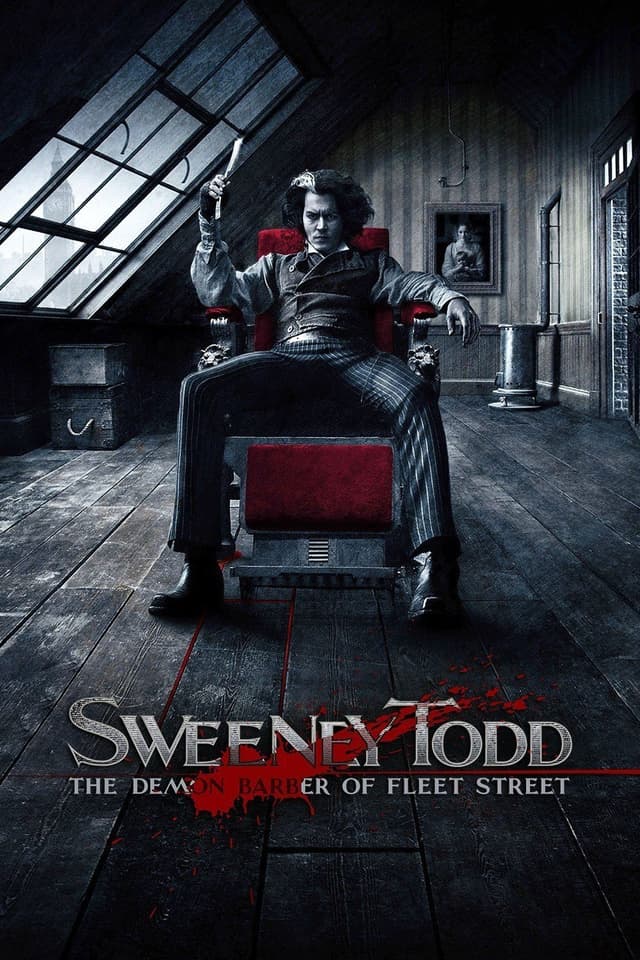
Sweeney Todd: The Demon Barber of Fleet Street Budget
 DramaHorror116 minutes
Updated
Synopsis
In the Victorian London, the barber Benjamin Barker is married to the gorgeous Lucy and they have a lovely child, Johanna. The beauty of Lucy attracts the attention of the corrupt Judge Turpin, who falsely accuses the barber of a crime that he did not commit and abuses Lucy later after gaining custody of her. After fifteen years in exile, Benjamin returns to London under the new identity of Sweeney Todd, seeking revenge against Turpin. He meets the widow Mrs. Lovett who is the owner of a meat pie shop who tells him that Lucy swallowed arsenic many years ago, and Turpin assigned himself tutor of Johanna. He opens a barber shop above her store, initiating a crime rampage against those who made him suffer and lose his beloved family.
What Is the Budget of Sweeney Todd: The Demon Barber of Fleet Street (2007)?
Tim Burton's film adaptation of Stephen Sondheim's 1979 Broadway musical Sweeney Todd: The Demon Barber of Fleet Street was produced on a budget of $50 million, co-financed by DreamWorks Pictures and Warner Bros. Pictures. That figure funded an ambitious, fully sung musical thriller shot primarily at Pinewood Studios in England, with production design by Dante Ferretti and direction of photography by Dariusz Wolski. Producers Walter Parkes, Laurie MacDonald, and Richard D. Zanuck oversaw a production that required significant resources for period costumes, elaborate Victorian London sets, and the logistical challenges of shooting a fully sung narrative with an ensemble cast.
The $50 million budget was considered a significant commitment for an R-rated musical with a dark subject matter: a wrongfully imprisoned barber who returns to Victorian London to murder his clients with a straight razor and sell their remains as meat pies through the shop below. Despite the subject matter and the unusual commercial risks of an adult, bloodsoaked musical film, the combined DreamWorks/Warner backing gave the production resources commensurate with its scope.
Key Budget Allocation Categories
- Above-the-Line Talent, Johnny Depp and Helena Bonham Carter: Johnny Depp was the highest-paid performer, commanding a substantial fee that reflected his position as one of the most bankable stars in Hollywood following the Pirates of the Caribbean franchise. Helena Bonham Carter, Tim Burton's longtime partner and collaborator, played Mrs. Lovett. Alan Rickman, Timothy Spall, and Sacha Baron Cohen in a scene-stealing cameo role as Signor Pirelli rounded out an ensemble of distinctive British character actors. None of the principal cast had professional musical theatre training, and all learned to sing their parts for the production.
- Dante Ferretti's Victorian London Sets at Pinewood: Production designer Dante Ferretti, a three-time Academy Award winner, constructed the Fleet Street environments, Mrs. Lovett's pie shop, the judge's mansion interiors, and Bedlam asylum entirely on stages at Pinewood Studios. The Victorian city was deliberately desaturated and grim, with practical gas lamps and weathered stone textures that anchored the film's near-monochromatic visual palette. These physical sets were the dominant production expense after above-the-line talent.
- Musical Adaptation and Orchestration by Jonathan Tunick: Stephen Sondheim's original 1979 musical score was adapted for film by Jonathan Tunick, who had orchestrated the original Broadway production. Tunick prepared a new orchestration for the film that could be pre-recorded and played back on set for the actors to perform against. The recording sessions with a full orchestra, combined with vocal coaching, dialect coaching for the British accents required of American cast members, and post-production audio mixing, represented a substantial music budget that exceeds what a non-musical would carry.
- Costume Design and Period Dress: Costume designer Colleen Atwood, a frequent Burton collaborator who won the Academy Award for Costume Design here, created the complete Victorian wardrobe for all principal and supporting cast. Depp's Sweeney Todd costume, with its distinctive white streak and black frock coat, went through multiple iterations before Atwood and Burton settled on the final look. The scale of period costume required for a London-set Victorian thriller with crowd scenes across multiple set locations added significantly to the costume department budget.
- Practical Blood Effects and Makeup: The film's graphic throat-slitting sequences required extensive practical blood effects rigging, with mechanized razors and timed pump systems designed to produce the dramatically stylized arterial sprays that Burton wanted as a counterpoint to the operatic music. Ve Neill supervised the makeup department, including the pale, ash-gray skin tones that gave the entire cast their death-inflected look. The combination of prosthetics, wigs, and period-accurate hair required a full makeup and hair department running continuously through production.
How Does Sweeney Todd's Budget Compare to Similar Films?
Sweeney Todd occupies a narrow genre space: the R-rated musical film aimed at adults. Its commercial and critical context is best understood against other prestige musicals of the 2000s and Burton's own filmography.
- Chicago (2002): Budget $45M | Worldwide $306.8M | Rob Marshall's Best Picture winner demonstrated that adult musicals could perform enormously well at the box office and awards season simultaneously. Its success five years before Sweeney Todd set expectations for the genre that Sweeney Todd's darker material and R-rating made difficult to replicate. Chicago was a template the DreamWorks/Warner packaging tried to follow, even as the material was significantly less accessible.
- Moulin Rouge! (2001): Budget $52.5M | Worldwide $179.2M | Baz Luhrmann's maximalist jukebox musical cost approximately the same as Sweeney Todd and earned more worldwide despite its own unconventional style. Moulin Rouge! was a useful template for Sweeney Todd's positioning as a prestige, awards-oriented musical that was too stylistically specific to be a broad commercial hit.
- Les Misérables (2012): Budget $61M | Worldwide $441.8M | Tom Hooper's adaptation of the Boublil and Schonberg musical demonstrated five years after Sweeney Todd that prestige musicals based on beloved stage shows could still achieve enormous commercial success. The comparison highlights how much Sweeney Todd's R-rating, dark subject matter, and Sondheim's complex score limited its addressable audience relative to Les Mis, which drew from a much larger existing fanbase.
- Big Eyes (2014) and Burton's other post-2007 films: Budget $10M (Big Eyes) | Worldwide $28.4M | Within Burton's own filmography, Sweeney Todd's $50 million investment looks large against his smaller-scale subsequent work. The film's mixed financial outcome contributed to a period in which Burton worked on smaller-budget original projects alongside larger studio work, suggesting the studio community learned from the economics of Sweeney Todd.
Sweeney Todd Box Office Performance
Sweeney Todd: The Demon Barber of Fleet Street opened on December 21, 2007, distributed by DreamWorks/Paramount in the United States and Warner Bros. internationally. The film earned $52,898,073 domestically and $152,692,340 worldwide. Given its $50 million production budget and an estimated $35 million in print and advertising costs, total investment reached approximately $85 million. The film's worldwide gross of $152.7 million placed it among the more successful adult musicals of the decade but well short of theatrical profitability after all costs.
Theaters retain roughly 50% of gross ticket receipts, giving the distributors an estimated studio share of approximately $76.4 million of the $152.7 million worldwide gross. Against a total investment of $85 million, that studio share represents a theatrical loss of approximately $8.6 million before home video and ancillary revenue. The film performed better in international markets than domestically, a pattern consistent with Burton's global appeal and the European cultural familiarity with Sondheim's work from stage productions in the United Kingdom, Germany, and Australia.
Box Office Breakdown
Sweeney Todd: The Demon Barber of Fleet Street

Sweeney Todd earned roughly $3.05 for every $1 invested in production, a positive ratio that nonetheless fell short of theatrical profitability once P&A is included. The film's full financial life, including DVD sales, digital rental and purchase, television licensing, and the Blu-ray catalog, moved it into profit. The Academy Award campaign costs were offset by the resulting award wins, which extended the film's theatrical run into the spring and boosted home video sales substantially. By any full accounting, Sweeney Todd was a modest financial success, though not the kind of broad commercial event that justifies a sequel or franchise.
Sweeney Todd Production History
Stephen Sondheim's Sweeney Todd: The Demon Barber of Fleet Street opened on Broadway on March 1, 1979, with Angela Lansbury as Mrs. Lovett and Len Cariou as Sweeney Todd. It won eight Tony Awards including Best Musical and Best Actress. Producer Richard D. Zanuck, who would produce the film, had been pursuing the rights for decades. Tim Burton's attachment was announced in 2005, and Johnny Depp's casting as Todd followed as a natural extension of the Burton-Depp collaboration that had produced Edward Scissorhands, Ed Wood, Sleepy Hollow, and the Pirates of the Caribbean films.
Screenwriter John Logan adapted the stage musical's book, tightening the narrative and streamlining some of the ensemble characters to focus the film's two-hour running time on the central triangle of Todd, Mrs. Lovett, and Judge Turpin. Stephen Sondheim approved both Logan's adaptation and the casting, including the decision to use non-professional singers. Pre-production voice training for Depp, Carter, Rickman, and Spall began months before principal photography, with vocal coach Joan Lader preparing the cast for the Sondheim score's demanding chromatic intervals and rapid-fire syllabic delivery.
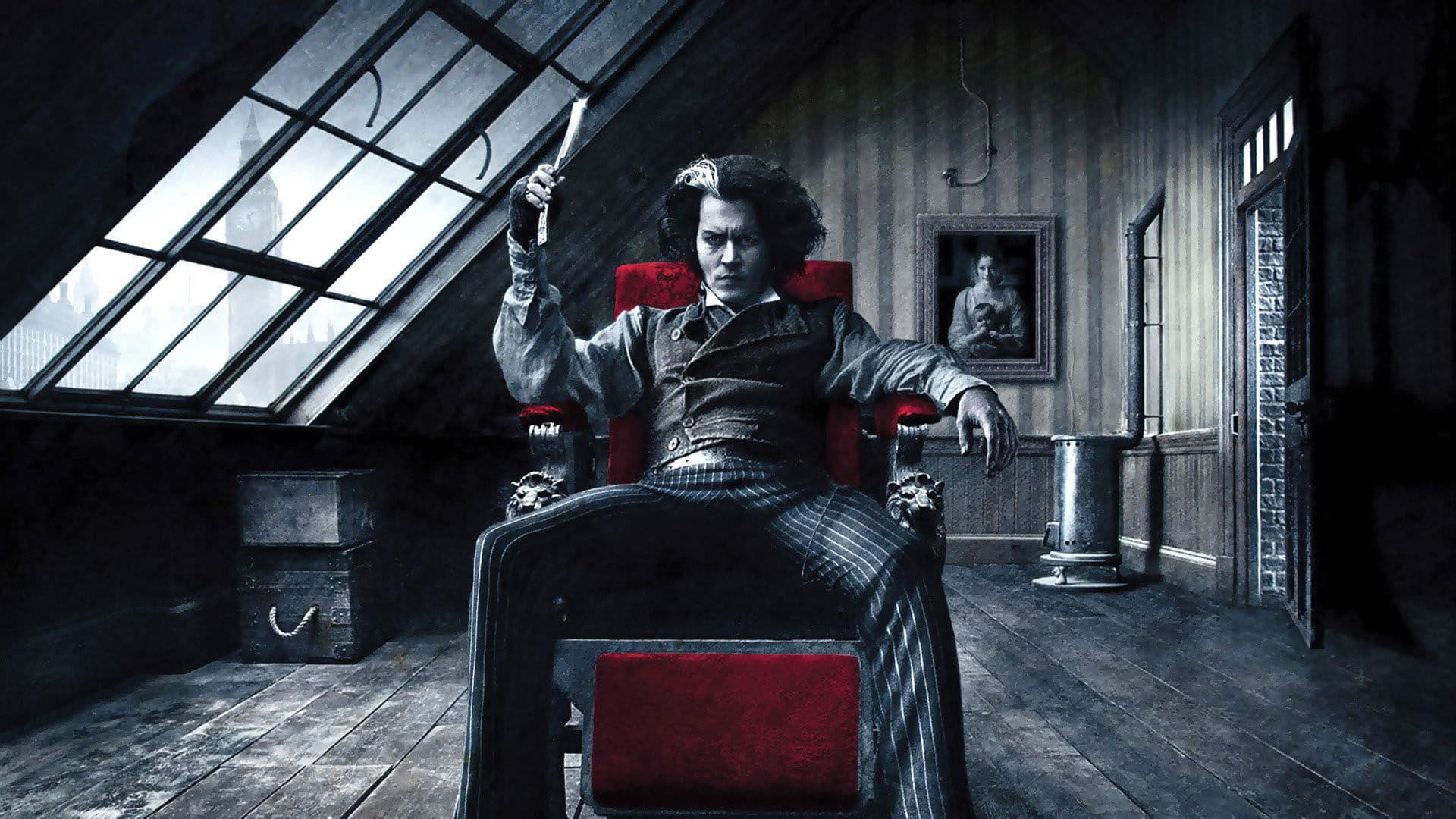
Principal photography took place at Pinewood Studios from January to May 2007. Director of photography Dariusz Wolski, working from Burton's instruction to create a world "where blood is the only color," shot in an extremely desaturated palette that was further drained in digital intermediate, producing the film's near-black-and-white look that breaks into full color only during the blood sequences. Dante Ferretti's sets filled multiple stages, with Fleet Street built as a complete practical street that could be filmed from multiple angles. The murder chair in the barbershop, with its mechanical tilting mechanism designed to drop victims through the floor, was a fully operational practical build.
The film premiered at the Venice Film Festival in September 2007 and received a wide US release on December 21, positioned as an awards-season contender. The campaign worked: the film swept several categories at major awards bodies, and Tim Burton and Johnny Depp both participated in extensive awards-season campaigning through January 2008.
Awards and Recognition
Sweeney Todd: The Demon Barber of Fleet Street won the Academy Award for Best Art Direction at the 80th Academy Awards in 2008, recognizing Dante Ferretti and Francesca Lo Schiavo's work on the Victorian London sets. Colleen Atwood won the Academy Award for Best Costume Design. At the Golden Globe Awards, the film won Best Motion Picture in the Musical or Comedy category, and Johnny Depp won Best Actor in a Musical or Comedy. The film received three total Academy Award nominations and six Golden Globe nominations. Stephen Sondheim received a Grammy nomination for Best Compilation Soundtrack Album for a Motion Picture.
Critical Reception
Sweeney Todd: The Demon Barber of Fleet Street holds an 86% approval rating on Rotten Tomatoes and an 83 out of 100 on Metacritic, with an IMDb user rating of 7.4 out of 10. The film received largely enthusiastic reviews from critics who engaged with its genre ambitions. A. O. Scott of The New York Times called it "macabre, funny, gorgeous, bloody and sad" and wrote that "Mr. Burton has made one of the screen's great musicals." Peter Travers in Rolling Stone gave it four stars and said that "Depp gives the performance of his career." Roger Ebert awarded the film three and a half stars and praised the production design as creating "a world that seems diseased from the inside out." The most consistent criticism came from audiences who were surprised by the graphic blood content, which contributed to the mixed CinemaScore of B. In retrospect, the film is considered one of the most successful transfers of a Sondheim musical to film, and Depp's singing performance is frequently cited as the most convincing film musical lead by a non-singer in modern Hollywood.
Frequently Asked Questions
How much did Sweeney Todd cost to make?
The production budget was $50,000,000. DreamWorks Pictures and Warner Bros. Pictures co-financed the project, with Parkes/MacDonald Productions and Zanuck Company producing. The budget was modest for a major-studio musical given Tim Burton's history of larger-scale productions.
How much did Sweeney Todd earn at the box office?
The film grossed $52,898,073 domestically and $100,000,000 internationally, for a worldwide total of approximately $152,900,000. It opened to $9,300,000 on December 21, 2007, finishing third behind National Treasure: Book of Secrets and Alvin and the Chipmunks.
Is Sweeney Todd based on a stage musical?
Yes. The film adapts Stephen Sondheim and Hugh Wheeler's 1979 Broadway musical Sweeney Todd: The Demon Barber of Fleet Street, which won the Tony Award for Best Musical. The musical itself was based on Christopher Bond's 1973 play.
Who stars in Sweeney Todd?
Johnny Depp stars as Sweeney Todd, with Helena Bonham Carter as Mrs. Lovett. Supporting cast includes Alan Rickman as Judge Turpin, Timothy Spall as Beadle Bamford, Sacha Baron Cohen as the rival barber Pirelli, and Jamie Campbell Bower as the sailor Anthony.
Did Johnny Depp and Helena Bonham Carter do their own singing?
Yes. Both performed all of their vocal tracks live or in studio sessions without dubbing. Depp had prior recorded music experience as a guitarist but had never previously taken a singing role, while Bonham Carter trained for several months prior to production.
Who directed Sweeney Todd?
Tim Burton directed the film, his sixth collaboration with Johnny Depp and his fifth with Helena Bonham Carter, his then-wife. Burton's gothic visual approach was widely cited as ideally suited to the Sondheim musical's grim Victorian setting.
Where was Sweeney Todd filmed?
Principal photography took place at Pinewood Studios in Buckinghamshire, England, with extensive interior sets built to recreate Victorian London. The U.K. production benefited from the British film tax relief program.
Did Sweeney Todd win any awards?
The film won the Academy Award for Best Art Direction for Dante Ferretti and Francesca Lo Schiavo. Johnny Depp won the Golden Globe for Best Actor in a Musical or Comedy. Tim Burton received the Best Director Golden Globe nomination, with the film winning Best Motion Picture, Musical or Comedy.
What did critics think of Sweeney Todd?
The film received strong reviews, with an 86% approval rating on Rotten Tomatoes and an 83 out of 100 score on Metacritic. Critics praised the gothic visual design and Depp's committed performance, while some objected to the loss of the original musical's ensemble pieces.
How does Sweeney Todd compare to other Tim Burton musicals?
Sweeney Todd is Burton's only traditional Broadway musical adaptation. Its $152,900,000 worldwide gross compares with The Nightmare Before Christmas (1993, $24,000,000 budget, $76,300,000 worldwide) and Charlie and the Chocolate Factory (2005, $150,000,000 budget, $475,000,000 worldwide), the latter a musical-adjacent Burton-Depp blockbuster.
Official Trailer
Build budgets like this one in Saturation
Start from an industry-standard feature film template, import the schedule and rates you already have, and let the cost report keep itself current as you spend. Real-time collaboration, no spreadsheets.