Super Size Me Budget
 Documentary100 minutes
Updated
Synopsis
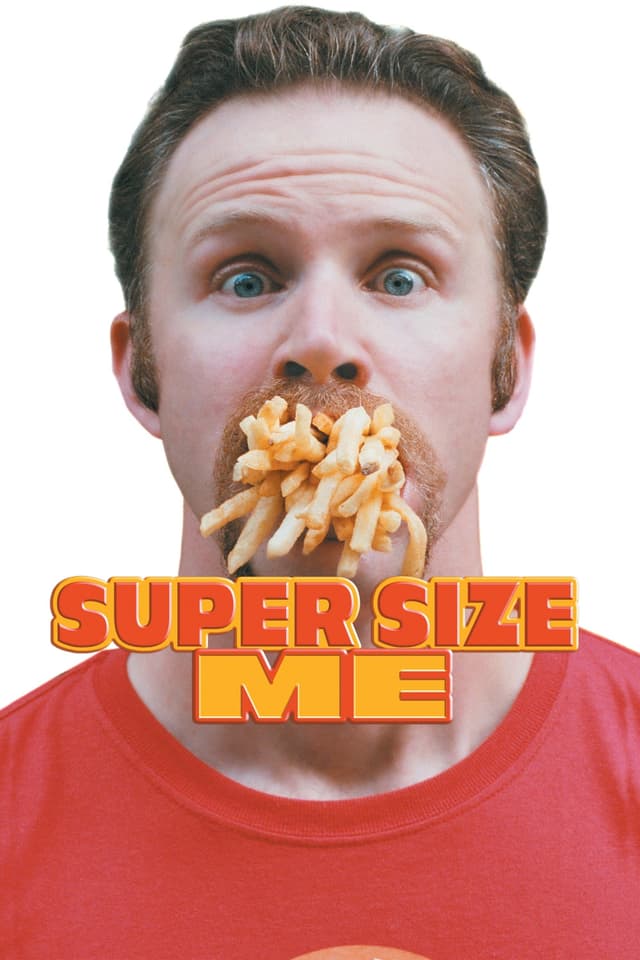
Several legal suits have been brought against McDonald's Restaurants that they are knowingly selling food that is unhealthy. Some of the court decisions have stated that the plaintiffs would have a claim if they could prove that eating the food every day for every meal is dangerous. As such, documentarian Morgan Spurlock conducts an unscientific experiment using himself as the guinea pig: eat only McDonald's for thirty days, three meals a day. If he is asked by the clerk if he would like the meal super sized, he has to say yes. And by the end of the thirty days, he will have had to have eaten every single menu item at least once. Before starting the experiment, he is tested by three doctors - a general practitioner, a cardiologist and a gastroenterologist - who pronounce his general health to be outstanding. They will also monitor him over the thirty days to ensure that he is not placing his health into irreparable damage. He also consults with a dietitian/nutritionist and an exercise physiologist, the latter who also deems him to be above average fitness. As it mimics the lifestyle of those who eat fast food, he will also do no exercise for the thirty days, limiting himself to under 5,000 steps per day (the approximate equivalent of 2½ miles). These health and medical experts have some predictions about his general health and wellness by the end of the experiment. His vegan chef girlfriend also has some predictions about how this experiment will affect his mood and therefore their relationship. As he goes through the experiment, he speaks to a number of people - many experts in their respective fields - on the pros and cons of the fast food lifestyle. Just over halfway through the experiment, it is evident that even the experts can be wrong, and not in a good way.
What Is the Budget of Super Size Me?
Super Size Me was produced on a budget of approximately $65,000, self-funded by director and subject Morgan Spurlock with contributions from co-producer and girlfriend Alexandra Jamieson. The film documented Spurlock eating only McDonald's food for 30 consecutive days in February and March 2003, recording the deterioration of his health under physician supervision and investigating the fast food industry's relationship to the American obesity epidemic.
The $65,000 budget is one of the lowest in the history of widely distributed documentary film. Spurlock shot on a consumer digital camera, relied on a small crew, and used personal connections to secure the medical monitoring that gave the experiment clinical credibility. The film's commercial performance, earning $22.2 million worldwide against a $65,000 production cost, represents one of the highest ROI ratios in documentary history.
Key Budget Allocation Categories
- Production Equipment and McDonald's Food Budget: Spurlock shot on a Sony PD150 miniDV camera. The 30-day McDonald's food budget, at three meals per day, was minimal by documentary standards but required documentation. The production was deliberately lean, with Spurlock, Jamieson, and a small crew handling multiple roles simultaneously.
- Medical Monitoring and Physician Consultations: The experiment required pre-study and ongoing medical supervision from a gastroenterologist, a cardiologist, and a nutritionist. These consultations documented Spurlock's weight gain of 24.5 pounds, his elevated cholesterol, his liver abnormalities, and his mood changes over the 30 days. The medical documentation gave the film its scientific legitimacy and became central to its legal and press narrative.
- Interview Production and Expert Access: Super Size Me includes interviews with fast food executives, nutritionists, school lunch program administrators, and public health researchers. Securing access to reluctant corporate subjects and traveling to interview locations in multiple cities was a production cost relative to the tiny budget.
- Sundance Festival Submission and Distribution: Spurlock submitted the completed film to the Sundance Film Festival, where it premiered in January 2004 and won Best Documentary Director. Samuel Goldwyn Films acquired distribution rights at Sundance for an undisclosed sum. The distribution deal meant Spurlock did not carry P&A costs from his own budget.
- Post-Production: Editing, sound mixing, and finishing were completed on a consumer-grade nonlinear editing system. The animated segments, including a title sequence using a cartoon McDonald's motif, were produced at minimal cost. The total post-production expenditure was a fraction of what a professionally produced documentary of comparable length would typically require.
How Does Super Size Me's Budget Compare to Similar Films?
Super Size Me occupies a singular position in documentary economics: a $65,000 film that generated $22.2 million worldwide. Its closest comparisons are other micro-budget advocacy documentaries that found outsized theatrical audiences through topical relevance and festival momentum.
- Roger & Me (1989): Budget ~$160K | Worldwide $6.7M. Michael Moore's debut documentary, which documented the human cost of General Motors' plant closures in Flint, Michigan, was the template for the single-director advocacy documentary. Super Size Me spent less than half as much and earned more than three times as much worldwide.
- An Inconvenient Truth (2006): Budget ~$1M | Worldwide $49.8M. Participant Media's climate documentary spent 15 times as much as Super Size Me and earned roughly twice as much worldwide. Al Gore's established political brand and Participant's professional distribution infrastructure explain the gap.
- Food, Inc. (2008): Budget ~$2M | Domestic $4.4M. Robert Kenner's food industry documentary, produced on a budget 30 times that of Super Size Me, earned less than half of Spurlock's domestic gross. Super Size Me's lower production budget and Spurlock's personal-journey format proved more commercially effective than a more conventional investigative approach.
- Bowling for Columbine (2002): Budget ~$4M | Worldwide $58.0M. The highest-grossing documentary at the time of Super Size Me's release. Moore spent 60 times as much and earned approximately 2.6 times as much. Super Size Me's extraordinary efficiency demonstrates that topic and timing mattered more than production investment in early 2000s documentary exhibition.
Super Size Me Box Office Performance
Super Size Me opened May 7, 2004, distributed by Samuel Goldwyn Films in partnership with Roadside Attractions and IFC Films. The film expanded from a limited platform release in major markets to over 900 theaters at its widest point, an exceptional footprint for an independently produced documentary. The domestic total reached $11.5 million. International markets added $10.7 million for a worldwide total of $22.2 million.
Against a production budget of approximately $65,000 and an estimated $1 million in prints and advertising funded by the distributor, the total investment in the film was approximately $1.1 million. With theaters retaining roughly 50 percent of gross, the studio's share of the worldwide theatrical gross was approximately $11.1 million, covering the total investment more than ten times over.
Box Office Breakdown
Super Size Me

For every dollar invested in production, Super Size Me returned approximately $341 at the worldwide box office. Even measured against total investment including P&A, the film returned more than $10 for every dollar spent. Six weeks after the film's Sundance premiere, McDonald's announced the discontinuation of its Supersize option. The company denied a connection to the film, but the timing was widely noted. The resulting media coverage generated additional publicity that sustained the film's theatrical run.
Super Size Me Production History
Spurlock's concept for the film was sparked by a news story about two teenagers who had filed a lawsuit against McDonald's, alleging that the company's food had caused their obesity. The lawsuit was dismissed, but Spurlock was struck by McDonald's defense that their food could be part of a healthy diet when eaten in moderation. He decided to test that claim by eating McDonald's food exclusively for 30 days, choosing a period that coincided with Americans' New Year health resolutions.
The rules of the experiment were straightforward: Spurlock would eat only food from McDonald's menus, including water and beverages, for 30 consecutive days. If a McDonald's employee offered to supersize his meal, he had to accept. He would eat every item on the McDonald's menu at least once. Before beginning, he established baseline health metrics with three physicians, a gastroenterologist named Daryl Isaacs, a cardiologist, and a general practitioner, plus a nutritionist.
Filming took place between February 1 and March 2, 2003, in New York City and during road trips to other American cities. Jamieson, a vegan chef, served as producer and appeared in the film documenting Spurlock's deteriorating health and their relationship's strain. By day 12, Spurlock's physicians were advising him to stop. He completed the 30 days. His liver, which the physicians described as turning to foie gras, showed abnormal enzyme levels that concerned his gastroenterologist enough that he made multiple on-camera statements urging Spurlock to stop.
Post-production was completed in time for a Sundance Film Festival submission. The film premiered at Sundance on January 22, 2004, where it won the Best Documentary Director award. Samuel Goldwyn Films acquired the film and coordinated with IFC and Roadside Attractions for the May theatrical release. The Supersize elimination announcement by McDonald's on March 3, 2004, six weeks before the theatrical opening, produced a wave of media coverage that functioned as free marketing.
Awards and Recognition
Super Size Me won the Best Documentary Director award at the Sundance Film Festival in January 2004, Spurlock's first major recognition as a filmmaker. The film was nominated for the Academy Award for Best Documentary Feature at the 77th Academy Awards in 2005, losing to Born into Brothels, but the nomination placed it among the most-seen documentary Oscar contenders of the year.
The film won the Audience Award at the Tribeca Film Festival and was nominated for multiple critics' and independent film awards. Its cultural impact extended well beyond awards recognition: Super Size Me directly contributed to the mainstream conversation about fast food marketing to children, school lunch programs, and restaurant calorie disclosure laws. New York City's mandatory calorie-posting requirements, implemented in 2008, are frequently cited alongside the film as part of the policy environment that changed restaurant menu labeling in the United States.
Critical Reception
Super Size Me holds a 93% approval rating on Rotten Tomatoes based on 193 reviews, with critics overwhelmingly praising its accessible format, Spurlock's charisma as an on-screen subject, and the visceral clarity of its evidence. Metacritic scored it 63 out of 100, reflecting more mixed critical opinion among reviewers who found the film's conclusions overstated relative to a 30-day experiment that no nutritionist would recommend as a sustainable diet.
The film's detractors noted methodological limitations: the experiment exceeded any recommendation for daily caloric intake, required Spurlock to accept supersizing whenever offered, and drew conclusions about fast food broadly from conditions of extreme overconsumption. A Swedish filmmaker, Stina Dabrowski, later made a rebuttal documentary. McDonald's produced a series of responses. Spurlock's persuasive structure was compared favorably to Michael Moore's approach, though more skeptical critics found the advocacy framing compromised the documentary credibility.
The IMDb user rating of 7.3 out of 10 reflects broad audience appreciation for the film's entertainment value and accessible argument. Among food policy and public health researchers, Super Size Me is cited as a rare example of documentary film that contributed to measurable regulatory change, regardless of its methodological simplifications. As a commercial and cultural event, it remains one of the most efficient documentary productions ever made.
Frequently Asked Questions
How much did Super Size Me cost to make?
The production budget was approximately $65,000, an extraordinarily modest figure even for an independent documentary. Morgan Spurlock financed the experiment-driven film through his Con Artists production company, with Roadside Attractions and Samuel Goldwyn Films later acquiring distribution rights.
How much did Super Size Me earn at the box office?
Super Size Me grossed $11,529,368 domestically and $10,500,000 internationally, for a worldwide total of approximately $22,000,000. The result represented a return of approximately 338x the production budget, one of the most profitable documentaries in history on a budget-to-gross basis.
What is Super Size Me about?
The documentary follows director Morgan Spurlock as he eats only McDonald's food for 30 consecutive days, with the rule that if a McDonald's employee offers to "super size" his meal, he must accept. The film tracks the resulting effects on his weight, cholesterol, liver function, and overall health.
Did Super Size Me win an Oscar?
The film was nominated for an Academy Award for Best Documentary Feature at the 77th Academy Awards but lost to Born into Brothels: Calcutta's Red Light Kids. Super Size Me did win the Directing Award for U.S. Documentary at the 2004 Sundance Film Festival.
Did McDonald's respond to Super Size Me?
Yes. McDonald's discontinued its Super Size portion option approximately six weeks after the film's January 2004 Sundance premiere, although the company maintained the timing was unrelated. McDonald's also launched a series of healthier menu items and salads in the months following the film's wider release.
How much weight did Morgan Spurlock gain?
Spurlock gained approximately 24 pounds during the 30-day experiment, his cholesterol rose 65 points, his liver became significantly fatty, and he experienced mood swings, depression, and reduced libido. Recovery to baseline took over a year of supervised diet and exercise.
What did critics think of Super Size Me?
The film received strong reviews, with a 93% approval rating on Rotten Tomatoes and a 79 out of 100 score on Metacritic. Critics praised the inventive framing, the strong personal storytelling, and the broader public health discussion the experiment triggered.
Was Super Size Me's methodology challenged?
Yes. Several nutritionists and a 2010 academic paper challenged the calorie estimates and methodology, noting Spurlock had not publicly released his food logs. Spurlock's 2017 admission of long-term alcohol use also raised retrospective questions about confounding factors in his liver-function results.
Where can I watch Super Size Me?
The film is available for digital purchase and rental on Amazon Prime Video, Apple TV, and Google Play. It has periodically rotated through Hulu and Tubi on the subscription tier and remains widely available through educational and library streaming services.
Did Super Size Me get a sequel?
Yes. Super Size Me 2: Holy Chicken! (2017) examined the marketing of "healthier" fast-food chicken offerings. The sequel was completed in 2017 but its release was delayed when Morgan Spurlock publicly acknowledged a history of sexual misconduct, with YouTube Premium eventually releasing it in 2019.
Build budgets like this one in Saturation
Start from an industry-standard feature film template, import the schedule and rates you already have, and let the cost report keep itself current as you spend. Real-time collaboration, no spreadsheets.