Staying Alive Budget
 Drama
DramaUpdated
Synopsis
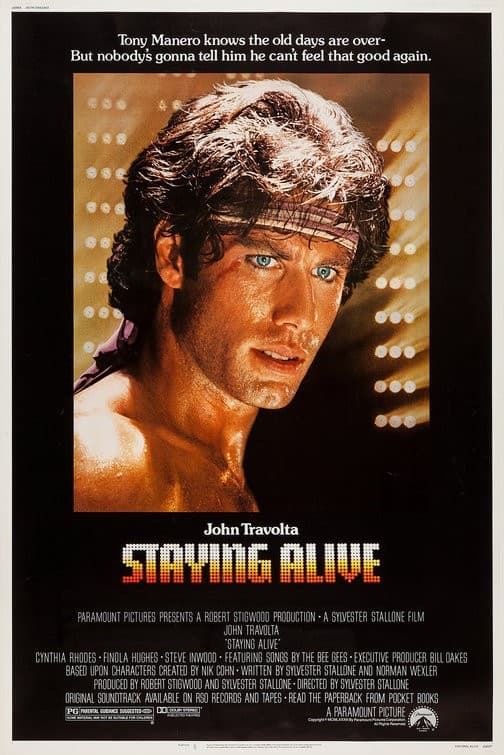
"Staying Alive" (1983) serves as a sequel to the iconic "Saturday Night Fever." The film follows Tony Manero, portrayed by John Travolta, as he navigates the vibrant yet challenging world of New York City in pursuit of his dreams. Now a struggling dancer, Tony is determined to make a name for himself on Broadway. As he faces the pressures of the dance scene, he encounters a mix of new friends and old rivals, all while grappling with his past and the expectations of those around him. The film captures the essence of ambition, resilience, and the relentless pursuit of success, all set against a backdrop of pulsating disco music and electrifying dance sequences. Ultimately, "Staying Alive" is a story of self-discovery and the quest for personal fulfillment in a city that never sleeps.
What Is the Budget of Staying Alive?
Staying Alive (1983) was produced on a budget of $22 million, a substantial commitment from Paramount Pictures for a dance-driven sequel. Sylvester Stallone, fresh off the Rocky and Rambo franchises, was brought in to direct the follow-up to Saturday Night Fever (1977), giving the project a high-profile stamp that justified the investment. The budget covered extensive Broadway-district location shooting in New York City, elaborate dance production design, and the costs of assembling a cast led by John Travolta reprising his Tony Manero role.
The $22 million figure placed Staying Alive comfortably in mid-range studio territory for 1983. A musical or dance film requiring choreographed production numbers, real New York locations, and marquee talent would typically land in this range. Paramount and producers Robert Stigwood and Stallone kept costs controlled despite the film's ambition.
Key Budget Allocation Categories
- Cast and Above-the-Line Talent: John Travolta's return as Tony Manero was the commercial engine of the film. Travolta, a major star following Saturday Night Fever and Grease, commanded a significant salary. Co-stars Cynthia Rhodes and Finola Hughes, both trained dancers, rounded out the above-the-line package alongside director-producer Stallone. Above-the-line costs likely accounted for $6 to $9 million of the total budget.
- Location Shooting in New York City: Staying Alive filmed across the Broadway theater district, Times Square, and surrounding Manhattan neighborhoods. New York City location permits, production infrastructure in a working theater environment, and logistics costs associated with blocking off streets and stages pushed location costs well above what a controlled studio shoot would have required.
- Choreography and Dance Production: The film's climactic Broadway musical sequence, Satan's Alley, required original choreography, elaborate costumes, a full stage set, and weeks of rehearsal time for Travolta and the ensemble cast. Travolta underwent a radical physical transformation for the role, building significant muscle mass under Stallone's direction, which extended pre-production training costs.
- Soundtrack and Music Licensing: The Saturday Night Fever soundtrack (1977) was one of the best-selling albums in history, and the Bee Gees were central to that success. For Staying Alive, the Bee Gees declined to produce the soundtrack. Barry Gibb contributed songs, Robin Gibb contributed others, and Frank Stallone (Sylvester's brother) wrote and performed the film's key track, Far from Over. Music production and licensing for a sequel to a disco landmark required careful investment.
- Cinematography and Post-Production: Cinematographer Nick McLean brought a glossy, high-energy visual style to the film. The Broadway-set finale sequences required sophisticated lighting rigs and camera work to capture the theatrical atmosphere. Post-production sound mixing and color timing for a film built around dance performance added to the overall cost.
How Does Staying Alive's Budget Compare to Similar Films?
Staying Alive sits at the intersection of 1980s dance films and big-studio sequels. Comparing it to contemporaries and its predecessor reveals both the scale of the investment and the expectations Paramount carried into the project.
- Saturday Night Fever (1977): Budget $3.5M | Worldwide $237M. The original film was made for a fraction of Staying Alive's budget, benefiting from the Bee Gees soundtrack and a cultural moment in disco that amplified its reach. The sequel's $22M budget reflected six years of inflation, Travolta's elevated star status, and Stallone's above-the-line cost.
- Flashdance (1983): Budget $7M | Worldwide $201M. Released the same year, Flashdance was made for less than a third of Staying Alive's budget and outperformed it significantly. Its success demonstrated that audiences would pay for dance-driven films in 1983, but the comparison also highlights Staying Alive's higher cost base.
- Footloose (1984): Budget $8M | Worldwide $80M. The following year's major dance film cost considerably less while matching Staying Alive's worldwide performance. Both films appealed to similar demographic audiences, though Footloose earned better critical reception.
- Rocky III (1982): Budget $18M | Worldwide $270M. Stallone's own franchise entry the year prior gives the most direct directorial comparison. Rocky III cost slightly less and earned substantially more, reinforcing what strong critical reception and audience goodwill can add to a film's commercial ceiling.
Staying Alive Box Office Performance
Staying Alive opened on July 11, 1983, distributed by Paramount Pictures. The film performed strongly at the domestic box office, earning $64,892,670 in North America. International markets contributed approximately $23 million, bringing the worldwide total to approximately $88 million.
Against a $22 million production budget and an estimated $12 million in print and advertising costs, Paramount's total investment was approximately $34 million. Theatrical distributors typically retain around 50 percent of box office gross, meaning Paramount's share of the $88 million worldwide total was approximately $44 million. On that basis, the film returned roughly $10 million above its total investment from theatrical alone, before home video and ancillary revenues. Staying Alive cleared its break-even threshold and delivered a profitable theatrical run despite its famously poor critical reception.
Box Office Breakdown
Staying Alive (1983)

Staying Alive earned roughly $4 for every $1 invested in production, though the P&A spend and theatrical split mean actual profitability was significantly tighter than the headline multiple suggests. Home video revenues in the mid-1980s VHS market would have contributed additional returns, pushing the film well into the black for Paramount over its full release lifecycle.
Staying Alive Production History
Development on a Saturday Night Fever sequel began after the original film's massive commercial success. Producer Robert Stigwood, who had produced Saturday Night Fever, retained the rights and approached various filmmakers over the years about a follow-up. The project gained momentum when Sylvester Stallone expressed interest not just in acting but in directing. Stallone, at the peak of his commercial power following Rocky III (1982) and First Blood (1982), co-wrote the screenplay with Norman Wexler and took the director's chair.
Casting John Travolta's return as Tony Manero required significant negotiation given Travolta's star status, but both Stigwood and Paramount saw the sequel as a major commercial opportunity. Before cameras rolled, Stallone imposed a rigorous physical training regimen on Travolta, requiring him to drop body fat and build significant muscle mass. The result was a dramatically different physique from Saturday Night Fever, with Travolta arriving on set looking like a competitive bodybuilder. Principal photography took place across New York City, with location work in the Broadway theater district, Times Square, and surrounding Manhattan blocks, along with additional shooting in New Jersey and Los Angeles.
One of the most consequential production decisions was the absence of the Bee Gees as producers. The Bee Gees' Saturday Night Fever double album had sold tens of millions of copies and was inseparable from the original film's cultural identity. For Staying Alive, the Bee Gees declined to produce the soundtrack in the same capacity. Barry Gibb contributed songs, Robin Gibb contributed others, but the unified sound that had defined Saturday Night Fever was not replicated. Frank Stallone, Sylvester's brother, wrote and performed Far from Over, which became one of the film's signature tracks. The different sonic direction contributed to the sequel feeling tonally distinct from its predecessor.
The climactic Broadway production sequence, a fictional musical called Satan's Alley, was designed to showcase Travolta's transformed physique and newly developed dance capabilities. Choreography by Sylvester and his team created an elaborate theatrical spectacle for the finale. The film was cut to a tight 96 minutes and released on July 11, 1983, three weeks before the start of the traditional summer box office peak.
Awards and Recognition
Staying Alive received no mainstream award nominations for achievement in film. Critics were uniformly hostile from opening weekend, and the film's critical standing has never recovered. The 0 percent rating on Rotten Tomatoes makes it one of the lowest-scored wide releases from a major studio in the aggregator's database.
The Razzie Awards, which honor the worst in film, gave Staying Alive significant attention. Sylvester Stallone won the Razzie Award for Worst Director. The film received additional Razzie nominations including Worst Picture and Worst Actress. For Stallone, who the same year was winning plaudits for Rocky III and building the Rambo franchise, the Razzie recognition for Staying Alive marked an unusual bifurcation of his critical profile.
Despite the lack of any critical recognition, the film's commercial performance attracted attention from the industry. A film that grosses nearly $65 million domestically on a $22 million budget while receiving essentially no positive press is an anomaly in Hollywood, and Staying Alive has been studied in that context. John Travolta's physical transformation for the role was widely discussed in entertainment press at the time, earning him coverage for athletic achievement if not for the film itself.
Critical Reception
Staying Alive opened to near-unanimous critical rejection in the summer of 1983. Roger Ebert famously described the film as a vanity production that prioritized showcasing John Travolta's physique over coherent storytelling or character development. Most contemporary reviews focused on the thin script, the departure from the gritty Brooklyn realism of Saturday Night Fever, and the replacement of that film's sociological depth with glossy 1980s excess.
The 0 percent score on Rotten Tomatoes, based on reviews aggregated over decades, places Staying Alive in historically rare company among major studio releases. The absence of any critics giving the film a positive rating is a statistical extreme. For comparison, most widely panned films of the era retain a handful of positive notices from regional critics or genre enthusiasts. Staying Alive does not.
Over the decades, critical opinion has shifted in one specific direction: camp appreciation. Staying Alive is now frequently cited as an exemplary artifact of 1980s excess, a film so committed to its vision of sculpted bodies, theatrical lighting, and operatic dance sequences that it achieves a kind of unintentional grandeur. Travolta's performance, Stallone's direction, and the Satan's Alley climax are regularly cited in lists of so-bad-it's-good cinema. Film writers at publications including The A.V. Club and Vulture have revisited the film in this context, framing its failures as features rather than bugs. Staying Alive has found a durable second audience through this lens, one that sustains its cultural presence 40 years after its release.
Frequently Asked Questions
How much did Staying Alive cost to make?
The production budget was approximately $22,000,000. Paramount Pictures and RKO Pictures co-produced the sequel to Saturday Night Fever (1977), a significant increase over the $3,500,000 budget of the original.
How much did Staying Alive earn at the box office?
Staying Alive grossed $64,892,670 domestically and $62,400,000 internationally, for a worldwide total of approximately $127,300,000. It opened to $12,146,143 on July 15, 1983, finishing first at the box office that weekend.
Who directed Staying Alive?
Sylvester Stallone directed the film, his second feature as director following Paradise Alley (1978) and Rocky II (1979). Stallone also co-wrote the screenplay with Norman Wexler, who had written the original Saturday Night Fever.
Who stars in Staying Alive?
John Travolta reprises his Tony Manero role from Saturday Night Fever (1977). Cynthia Rhodes plays his girlfriend Jackie, Finola Hughes plays the antagonistic dancer Laura, and Frank Stallone has a supporting role and contributed multiple songs to the soundtrack.
How is Staying Alive different from Saturday Night Fever?
Staying Alive is set six years after the original, with Tony Manero having moved from Brooklyn to Manhattan to pursue a professional Broadway dance career. The PG-rated sequel softened the original's R-rated street drama into a more accessible musical built around the climactic Broadway show Satan's Alley.
Did Staying Alive get nominated for any awards?
Yes, although primarily negative recognition. The film received three Razzie nominations at the 4th Golden Raspberry Awards, including Worst Director for Sylvester Stallone and Worst Supporting Actress for Finola Hughes.
What did critics think of Staying Alive?
Reviews were sharply negative, with a 0% approval rating on Rotten Tomatoes from professional reviewers. Critics objected to the Broadway-dance climax, the broad characterization, and what they viewed as a betrayal of the original film's gritty social realism.
Where was Staying Alive filmed?
Principal photography took place in New York City and on Paramount soundstages in Hollywood. The Broadway dance sequences were extensively rehearsed and choreographed by Dennon Rawles, with John Travolta training for several months to deliver the climactic Satan's Alley number.
Was Staying Alive profitable?
Yes. Against the $22,000,000 production budget and an estimated $15,000,000 to $20,000,000 in marketing spend, the worldwide gross of $127,300,000 produced a substantial theatrical profit despite hostile critical reception. Audience demand for a Travolta reunion overrode review-driven negativity.
How does Staying Alive compare to Saturday Night Fever?
Saturday Night Fever (1977) grossed $237,100,000 worldwide on a $3,500,000 budget, making it one of the most profitable films of the 1970s. Staying Alive's $127,300,000 worldwide gross represented a clear commercial step down despite the substantially larger marketing campaign.
Filmmakers
Staying Alive (1983)

Build budgets like this one in Saturation
Start from an industry-standard feature film template, import the schedule and rates you already have, and let the cost report keep itself current as you spend. Real-time collaboration, no spreadsheets.