State of Play Budget
 Thriller/Suspense
Updated
Synopsis
A veteran Washington, D.C. newspaper reporter and his ambitious blog-side colleague investigate the suspicious death of the mistress of an old college friend, now a rising congressman leading a high-profile committee investigation of a private-military contractor. As the story expands from a tabloid sex scandal into a conspiracy involving war profiteering and political assassination, the reporter must weigh his loyalty to his old friend against the responsibility of breaking the truth in print.
What Is the Budget of State of Play (2009)?
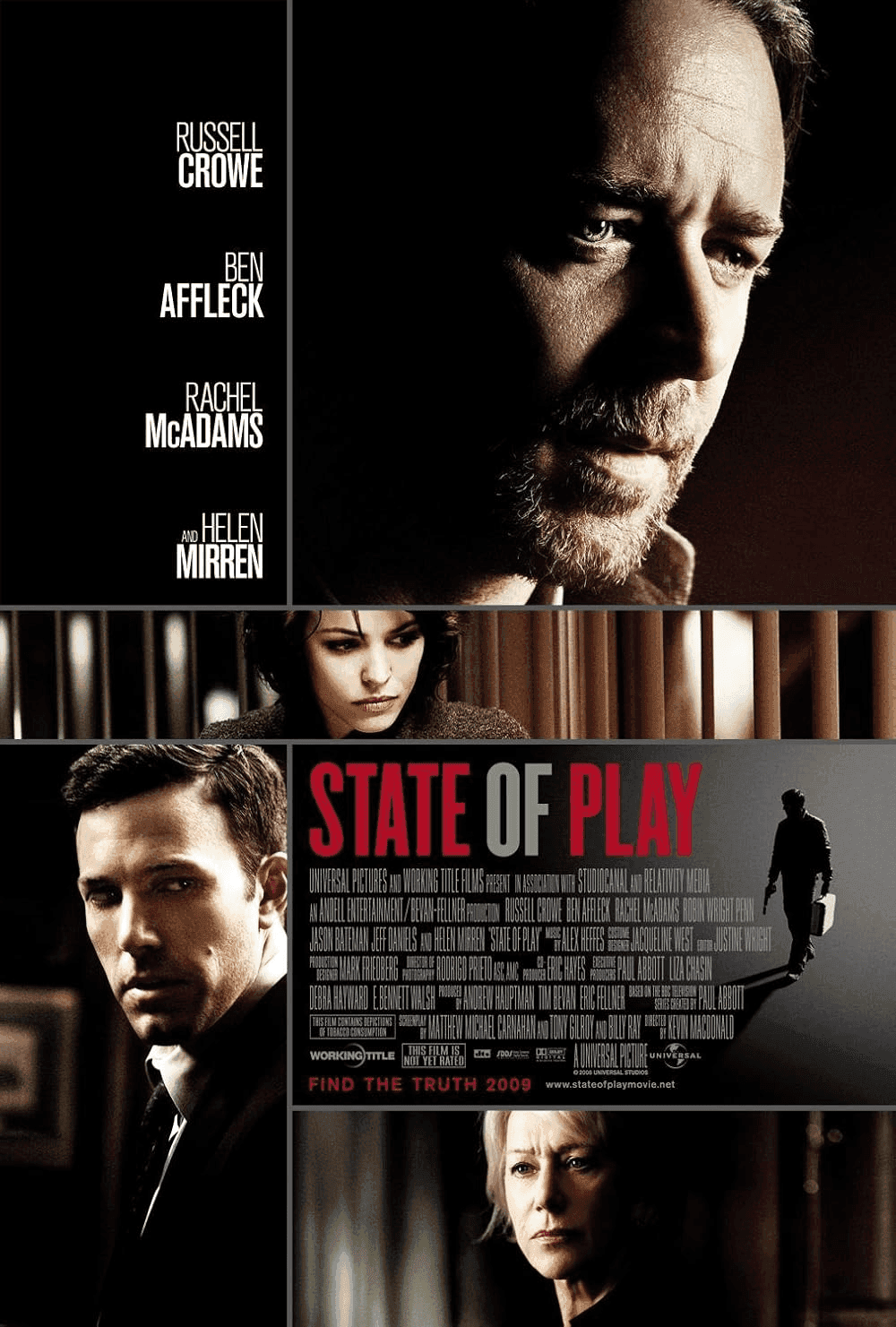
State of Play (2009), directed by Kevin Macdonald and distributed by Universal Pictures, was produced on a budget of $60,000,000. Andrew Hauptman, Tim Bevan, and Eric Fellner produced through Andell Entertainment and Working Title Films, with Universal providing studio finance and full marketing support. The film was a feature adaptation of the acclaimed 2003 six-hour BBC miniseries created by Paul Abbott, repositioned from London to Washington, D.C. and compressed into a feature-length political thriller.
The budget reflected the cost of assembling a top-tier ensemble around a journalism subject matter that was, by 2008-2009, increasingly difficult to greenlight at studio scale. Russell Crowe came aboard after Brad Pitt departed the project in late 2007 over a screenplay dispute, with the production absorbing significant rebuilding costs and a casting reset. Universal priced the film below the action-tentpole tier while still committing meaningfully to Washington location work, a multi-week shoot, and an A-list supporting cast including Ben Affleck, Helen Mirren, Rachel McAdams, Robin Wright, and Jason Bateman. The math required the film to clear roughly $130,000,000 worldwide to break even after marketing, a target the film missed.
Key Budget Allocation Categories
State of Play's $60,000,000 budget was distributed across several core production areas:
- Above-the-Line Talent: Russell Crowe took the lead role of investigative reporter Cal McAffrey at his standard mid-2000s rate. Ben Affleck signed as Congressman Stephen Collins, with Helen Mirren as the Washington Globe's hard-nosed editor Cameron Lynne. Rachel McAdams, Robin Wright, Jason Bateman, Jeff Daniels, and Viola Davis filled out the principal ensemble at significant secondary fees, with veteran character actors absorbing additional ATL spend.
- Pre-Production Reset: After Brad Pitt departed the project in October 2007 over disagreements about Matthew Michael Carnahan's screenplay, the production absorbed several million dollars in pre-production sunk costs (set construction, location holds, crew commitments) and entered an extended development pause while Tony Gilroy and Billy Ray rewrote the script. The reset added meaningfully to the final budget figure.
- Washington, D.C. Location Shoot: Production filmed extensively on Washington, D.C. locations including the Capitol grounds, K Street corridor, Georgetown, the Watergate, and numerous government building exteriors. D.C. permitting and security costs combined with extended location holds during the production reset to inflate the below-the-line budget significantly.
- Newspaper Production Design: Production designer Mark Friedberg created the Washington Globe newsroom set, dressed with period-accurate computers, telephones, and journalism artifacts. The set required custom newspaper props, character desks, and dressing for multiple scenes covering the editorial floor, including the climactic press run that closed the film.
- Score and Music: Composer Alex Heffes wrote the original score with a contemporary urban-thriller palette. The closing-credits press-run sequence required licensing of editorial-rhythm music that paid off the film's journalism theme.
- Editing and Post-Production: Editor Justine Wright assembled the dense conspiracy plot under significant studio pressure, with Macdonald and Wright making structural choices designed to clarify the political maneuvering for American audiences less familiar with the original BBC miniseries's procedural detail. The post timeline extended into late 2008.
How Does State of Play's Budget Compare to Similar Films?
At $60,000,000, State of Play sits in the typical range of late-2000s adult-skewing political thrillers. The comparison set illustrates how the cycle's commercial outcomes diverged:
- Michael Clayton (2007): Budget $25,000,000 | Worldwide $93,135,627. Tony Gilroy's directorial debut political-legal thriller cost less than half what State of Play cost and earned slightly more worldwide, the kind of efficient cycle outcome that justified Universal's broader investment in adult-skewing thriller programming.
- The Good Shepherd (2006): Budget $90,000,000 | Worldwide $99,480,000. Robert De Niro's CIA-themed political thriller cost 50% more than State of Play and earned slightly more worldwide, suggesting the cycle's commercial ceiling around the $90M to $100M worldwide mark for serious adult thrillers.
- All the President's Men (1976): Budget $8,500,000 | Worldwide $70,600,000. Alan J. Pakula's Robert Redford-Dustin Hoffman Watergate journalism thriller was the canonical reference point for State of Play; in 1976 dollars, the original cost roughly $39M and earned more than 80% of State of Play's 2009 worldwide gross.
- Body of Lies (2008): Budget $70,000,000 | Worldwide $115,098,761. Ridley Scott's Leonardo DiCaprio-Russell Crowe pairing from the prior year cost 17% more than State of Play and earned 31% more worldwide, the closest cycle comparison.
- Frost/Nixon (2008): Budget $25,000,000 | Worldwide $27,425,090. Ron Howard's interview drama cost less than half what State of Play cost and earned less than a third of its worldwide gross, illustrating that prestige political material remained difficult to scale.
State of Play Box Office Performance
State of Play opened on April 17, 2009, debuting to $14,093,290 in its opening weekend across 2,803 theaters, finishing second on the chart behind 17 Again. The film modestly underperformed Universal's pre-release tracking, which had projected an $18M to $20M opening. Adult audiences responded to the Russell Crowe-Ben Affleck pairing, but the dense conspiracy plot and journalism-procedural subject matter limited broader appeal in a competitive April marketplace.
Against a $60,000,000 production budget, State of Play needed roughly $130,000,000 in worldwide gross to reach profitability when accounting for marketing and distribution costs. Here is the financial breakdown:
Box Office Breakdown
State of Play

State of Play returned approximately $0.80 in theatrical revenue for every $1 invested when measured against total estimated production and marketing spend. The domestic share of the gross was $37,016,278 against an international share of $50,802,115, a 42/58 split that confirmed the political thriller's somewhat stronger reception in international markets where Washington-and-the-press subject matter was less culturally specific.
Universal recouped a meaningful portion of the loss through home entertainment, television licensing, and streaming windows over subsequent decades. Macdonald, Crowe, and the ensemble received generally positive critical coverage that extended the film's library value, and State of Play has since been treated as a representative case study of the difficulty of adapting prestige British television to American theatrical scale.
State of Play Production History
Development began at Universal in 2004, with the studio acquiring rights to Paul Abbott's 2003 BBC miniseries State of Play. Matthew Michael Carnahan was hired to adapt the six-hour British political conspiracy into a feature, transplanting the action from London to Washington, D.C. and compressing the procedural detail into a thriller structure. Andell Entertainment and Working Title Films co-produced with the Tim Bevan-Eric Fellner team that had carried multiple prestige adaptations through Universal.
Casting was initially built around Brad Pitt and Edward Norton, with Pitt attached as the lead investigative reporter and Norton as the congressman. Pre-production proceeded through 2007 with location holds, set construction, and crew commitments. In October 2007, Pitt withdrew from the project over disagreements with Carnahan's screenplay, prompting a production reset that saw Norton also exit. The studio absorbed several million dollars in sunk costs and entered an extended development pause.
Tony Gilroy and Billy Ray were brought in to rewrite the screenplay during late 2007 and early 2008. Russell Crowe attached as the lead in early 2008, with Ben Affleck joining as the congressman shortly after. Helen Mirren, Rachel McAdams, Robin Wright, Jason Bateman, Jeff Daniels, and Viola Davis filled out the supporting cast across 2008. Director Kevin Macdonald, who had previously directed The Last King of Scotland (2006), brought his documentary background to the journalism procedural sequences.
Principal photography ran from October 2008 through January 2009, primarily on Washington, D.C. locations including the Capitol grounds, K Street, Georgetown, and government building exteriors. The unit also shot extensively in Baltimore, Maryland and on Los Angeles soundstages for the Washington Globe newsroom interior. Maryland's film production tax credits offset a portion of the Baltimore work, while the D.C. exterior coverage carried direct permitting and security costs.
Awards and Recognition
State of Play received limited industry awards recognition. It was not nominated at the Academy Awards, Golden Globes, BAFTAs, or SAG Awards.
At the BAFTAs, the film received a nomination for Outstanding British Film, reflecting its Working Title production credits and Kevin Macdonald's British nationality. Helen Mirren received a Satellite Award nomination for her supporting performance as the Washington Globe editor, and the Casting Society of America recognized the ensemble work with a nomination for Outstanding Achievement in Casting for a Big Budget Drama. Trade press extensively covered the film's release as a representative example of late-2000s journalism-focused thrillers releasing into a marketplace increasingly skeptical of complex political subject matter.
Critical Reception
State of Play received broadly positive reviews. The film holds an 84% approval rating on Rotten Tomatoes based on 240 critic reviews, with a critical consensus that called it an intelligent, fast-moving political thriller that updates Watergate-era journalism cinema for the contemporary era. On Metacritic, the film scored 64 out of 100, indicating generally favorable reviews. Audiences surveyed by CinemaScore gave the film a B+, slightly below the A- that typically signals strong word-of-mouth potential.
Critics broadly praised the Crowe-Affleck-Mirren ensemble, Kevin Macdonald's direction, and the screenplay's ability to compress six hours of British television into a coherent two-hour American feature. Roger Ebert awarded the film three and a half stars, writing that "this is a thriller that respects the audience's intelligence, and there are very few of those." The New York Times' A.O. Scott called Russell Crowe "perfect for the role of the rumpled, principled reporter," and Variety's Todd McCarthy noted that "Macdonald's direction is tight and confident, and the ensemble carries the dense conspiracy material with assurance."
A minority of critics, particularly fans of the original BBC miniseries, objected to the compression of the source material's political detail and the shift away from the British production's class-and-class-tension subtext. Critical retrospectives have generally treated State of Play as a respectable journalism thriller that adapted demanding source material into accessible theatrical form without losing the original's commitment to procedural accuracy. The film remains a regular reference point in discussions of late-2000s political thrillers and the broader cycle of newspaper-and-investigative-reporting cinema that includes Spotlight (2015) and The Post (2017).
Frequently Asked Questions
How much did it cost to make State of Play (2009)?
The production budget was $60,000,000. The film was produced by Working Title Films and Andell Entertainment in association with Relativity Media, and distributed worldwide by Universal Pictures. The cost included several million dollars in sunk pre-production expenses after Brad Pitt withdrew in October 2007.
How much did State of Play earn at the box office?
The film grossed $37,016,278 domestically and $50,802,115 internationally, for a worldwide total of $87,818,393. It opened to $14,093,290 across 2,803 theaters on April 17, 2009, finishing second behind 17 Again.
Was State of Play profitable?
No. Against a $60M production budget and an estimated $45M to $55M in marketing spend, the film returned approximately $0.80 in worldwide gross for every $1 invested, generating roughly $17M to $27M in theatrical loss. Home entertainment, television, and library revenue recouped a meaningful portion over subsequent decades.
Who directed State of Play?
Kevin Macdonald directed the film. Macdonald had previously directed The Last King of Scotland (2006) which won Forest Whitaker the Best Actor Oscar, and his documentary background informed the journalism-procedural sequences of State of Play.
Where was State of Play filmed?
Principal photography ran from October 2008 through January 2009, primarily on Washington, D.C. locations including the Capitol grounds, K Street, Georgetown, the Watergate, and government building exteriors. The unit also shot extensively in Baltimore, Maryland and on Los Angeles soundstages for the Washington Globe newsroom interior.
Why did Brad Pitt leave State of Play?
Pitt withdrew in October 2007 over disagreements about Matthew Michael Carnahan's screenplay. The studio absorbed several million dollars in sunk pre-production costs (location holds, set construction, crew commitments) and entered an extended development pause while Tony Gilroy and Billy Ray rewrote the script. Russell Crowe attached as the lead in early 2008.
Is State of Play based on a TV show?
Yes. The film is adapted from the 2003 six-hour BBC miniseries State of Play, created by Paul Abbott. The adaptation transplanted the action from London to Washington, D.C. and compressed the procedural detail into a feature-length political thriller. Fans of the original miniseries had mixed reactions to the compression.
Who stars in State of Play?
Russell Crowe stars as veteran investigative reporter Cal McAffrey, with Ben Affleck as Congressman Stephen Collins, Helen Mirren as the Washington Globe editor Cameron Lynne, Rachel McAdams as the young blog reporter Della Frye, Robin Wright as Collins's wife Anne, and Jason Bateman in a memorable supporting role as the publicist Dominic Foy.
How does State of Play compare to other 2009 political thrillers?
State of Play earned $87.8M worldwide on a $60M budget. Body of Lies (2008) earned $115.1M on $70M. The Good Shepherd (2006) earned $99.5M on $90M. Michael Clayton (2007) earned $93.1M on $25M, making it the cycle's most commercially efficient prestige thriller.
What did critics think of State of Play?
The film holds an 84% approval rating on Rotten Tomatoes (240 reviews) and scored 64 out of 100 on Metacritic. Audiences gave it a B+ CinemaScore. Roger Ebert awarded three and a half stars, calling it "a thriller that respects the audience's intelligence." A.O. Scott of The New York Times called Russell Crowe "perfect for the role of the rumpled, principled reporter."
Filmmakers
State of Play

Build budgets like this one in Saturation
Start from an industry-standard feature film template, import the schedule and rates you already have, and let the cost report keep itself current as you spend. Real-time collaboration, no spreadsheets.