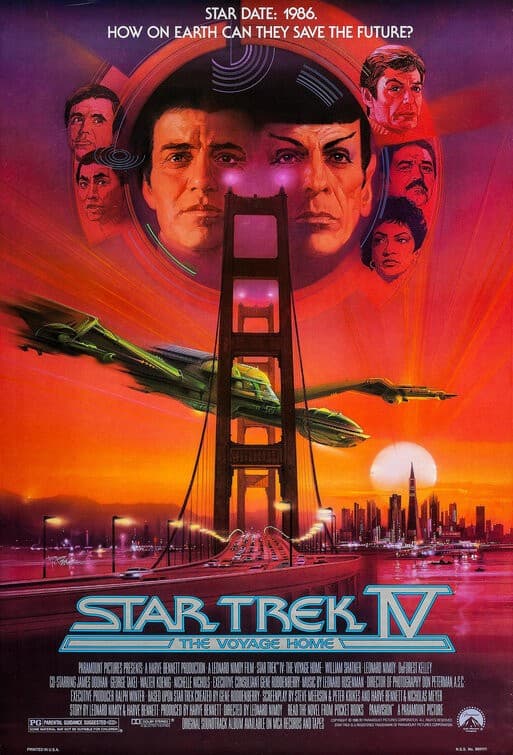
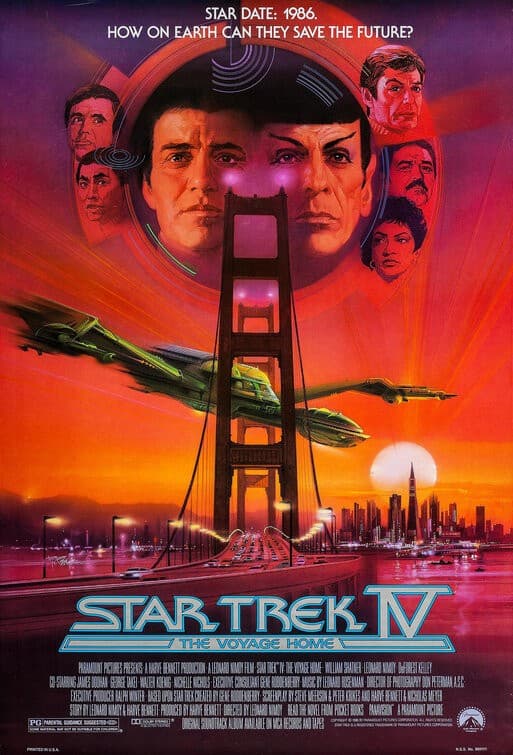
Star Trek IV: The Voyage Home Budget
 Adventure
Updated
Synopsis
"Star Trek IV: The Voyage Home" takes audiences on a thrilling journey as the crew of the USS Enterprise embarks on a mission unlike any other. After the events of "Star Trek III: The Search for Spock," Captain James T. Kirk and his team find themselves in a precarious situation. They must travel back in time to 20th-century Earth to save the planet from an alien probe that threatens to destroy it.
The probe, which emits a powerful signal, is searching for humpback whales—an extinct species in the 23rd century. To communicate with the probe and avert disaster, Kirk and his crew must locate and bring back these whales. Their time-traveling adventure leads them to San Francisco, where they navigate the complexities of 20th-century life, all while evading authorities and dealing with the challenges of fitting in.
With humor, heart, and a strong environmental message, "The Voyage Home" showcases the crew's resourcefulness and camaraderie. As they race against time to save Earth, the film highlights themes of conservation and the importance of protecting our planet's natural resources. Ultimately, this installment of the Star Trek franchise combines science fiction with a poignant message, making it a beloved classic among fans.
What Is the Budget of Star Trek IV: The Voyage Home?
Star Trek IV: The Voyage Home was produced on a budget of $21 million, a figure that reflected Paramount Pictures' confidence in the franchise after the moderate but costly Star Trek III: The Search for Spock. That film's darker tone and $16 million budget had performed respectably, but the studio saw an opportunity to broaden the audience with a lighter entry. The $21 million figure covered an ensemble cast of eight returning principals, practical location work across the San Francisco Bay Area, large-scale time travel and whale-rescue sequences, and a full orchestral score by Leonard Rosenman.
Compared to the franchise's trajectory, the budget represented a measured step up. Star Trek II: The Wrath of Khan (1982) cost $11.2 million after the original film's bloated $46 million expenditure shocked Paramount into austerity. By the fourth film, the studio had found a sustainable production model: experienced cast with negotiated ensemble rates, practical locations over elaborate sets, and a director, Leonard Nimoy, who had already proven he could bring the project in on schedule with Star Trek III.
Key Budget Allocation Categories
- Cast and Above-the-Line Talent: All seven original series regulars returned, with William Shatner (Kirk) and Leonard Nimoy (Spock/director) commanding the largest fees. Catherine Hicks joined as Dr. Gillian Taylor, the only major new character. The full ensemble above-the-line package likely accounted for $6 to $8 million of the total budget.
- San Francisco Location Production: Principal photography took place across multiple Bay Area locations, including the Sausalito waterfront, Golden Gate Park, Chinatown, and Mercy Street. The USS Ranger aircraft carrier sequences required coordination with the US Navy. Location days in San Francisco added logistical costs that a studio-bound production would have avoided.
- Underwater and Whale Tank Sequences: Filming at the Monterey Bay Aquarium for the whale tank scenes required specialized underwater camera equipment, dive crews, and extended facility access. Director of photography Don Peterman (Footloose, Cocoon) orchestrated these technically demanding sequences.
- Visual Effects: ILM handled the film's visual effects, including the Klingon Bird-of-Prey exterior shots, the alien probe sequences, and the time travel vortex. Given ILM's rates in the mid-1980s and the number of effects shots, this likely consumed $3 to $5 million.
- Score by Leonard Rosenman: Academy Award nominee Leonard Rosenman (Barry Lyndon, Bound for Glory) composed an entirely original score, departing from Jerry Goldsmith's established Star Trek themes. A full orchestra recording added to the post-production budget, and his work earned a Best Original Score Oscar nomination.
How Does Star Trek IV's Budget Compare to Similar Films?
Star Trek IV sat in the middle tier of 1986 science fiction blockbusters. It was more expensive than lean genre films like Aliens ($18.5 million) but a fraction of the budget of Top Gun ($15 million with heavy Navy cooperation and eventual $356 million gross). Within the Trek franchise, it represented a disciplined production after the lessons learned from the $46 million first film.
- Star Trek II: The Wrath of Khan (1982): Budget $11.2M | Worldwide $97M. The film that rescued the franchise after the first film's budget disaster. Khan proved audiences would accept a lower-budget Trek if the story was strong, setting the template Voyage Home would refine.
- Star Trek III: The Search for Spock (1984): Budget $16M | Worldwide $87M. The direct predecessor, also directed by Nimoy. Darker in tone and slightly less commercially successful, it set up the whale-rescue mission that The Voyage Home resolved.
- Aliens (1986): Budget $18.5M | Worldwide $183M. James Cameron's sequel released the same year. A comparable sci-fi ensemble action film on a similar budget, but with a different studio model and substantially higher worldwide return, partly from stronger international performance.
- Crocodile Dundee (1986): Budget $8.5M | Worldwide $328M. The year's surprise blockbuster demonstrated that 1986 audiences rewarded comedies with fish-out-of-water setups. The Voyage Home's similar comedic premise connected with the same audience appetite.
Star Trek IV: The Voyage Home Box Office Performance
Star Trek IV: The Voyage Home opened on November 26, 1986, distributed by Paramount Pictures. It earned $16 million in its opening weekend and expanded rapidly on strong audience word of mouth. The domestic run totaled $109,713,132, making it the highest-grossing Star Trek film up to that point and the only entry in the original series to top $100 million domestically. International markets added another $23.3 million, bringing the worldwide total to $133 million.
Against a $21 million production budget and an estimated $15 million in prints and advertising, Paramount's total investment was approximately $36 million. Theaters retained roughly 50% of gross receipts, meaning the studio's share of worldwide box office was approximately $66.5 million. The film cleared break-even comfortably and generated meaningful profit for the studio, validating the decision to lean into comedy and broaden the Trek audience beyond the core fanbase.
Box Office Breakdown
Star Trek IV: The Voyage Home (1986)

The film earned roughly $6.33 for every $1 invested in production. Even accounting for the P&A spend and the theatrical split, The Voyage Home delivered a return that made it the franchise's most commercially successful chapter through the original-cast era. Its performance directly led Paramount to greenlight Star Trek V: The Final Frontier and to give William Shatner the director's chair he had lobbied for.
Star Trek IV: The Voyage Home Production History
Development on Star Trek IV began almost immediately after the release of Star Trek III: The Search for Spock in June 1984. Producer Harve Bennett and Leonard Nimoy agreed the franchise needed a tonal corrective: after two consecutively dark films (the death of Spock in II, the destruction of the Enterprise in III), a lighter adventure would both satisfy audiences and expand the potential viewer base. Nimoy proposed the time travel premise and the environmental hook, and the two brought the concept to Paramount in late 1984.
The screenplay went through an unusual collaborative process. Steve Meerson and Peter Krikes, writers with limited feature credits, were hired to develop the whale-rescue concept. Their draft was then substantially rewritten by Nicholas Meyer, who had directed Star Trek II, working alongside Harve Bennett. Leonard Nimoy and Bennett share the original story credit. The final script balanced comedy with genuine environmental advocacy, a pairing that was unusual for a Hollywood blockbuster in 1986.
Principal photography ran from February to June 1986, centered primarily in the San Francisco Bay Area. Production designer Jack T. Collis built the interior sets at Paramount Studios in Hollywood, but the film's signature sequences were captured on location. The Sausalito waterfront stood in for the 23rd century Vulcan coastline. The Monterey Bay Aquarium provided access to its whale tank for the key scenes with Gracie and George. The USS Ranger, a Forrestal-class aircraft carrier, hosted the nuclear reactor confrontation sequence, and the US Navy provided cooperation in exchange for standard Hollywood naval liaison arrangements. One of the film's most celebrated scenes, the 'nuclear wessels' exchange with passersby on a San Francisco street, was reportedly filmed guerrilla-style without location permits.
Post-production and editing were completed in late 1986. Leonard Rosenman's score was recorded at the Paramount scoring stage and delivered in October. ILM completed visual effects work in parallel. The film premiered on November 26, 1986, the day before Thanksgiving, a release window that proved strategically ideal for a family-friendly, broadly appealing film. Paramount's marketing leaned into the comedy and the whale rescue rather than the franchise's science fiction elements, attracting audiences who would not normally attend a Star Trek film.
Awards and Recognition
Star Trek IV: The Voyage Home received four Academy Award nominations at the 59th Academy Awards ceremony in 1987, the strongest showing of any film in the original Star Trek series. The nominations recognized the technical craftsmanship of the production across both visual and audio disciplines.
Don Peterman received a nomination for Best Cinematography. His work on the film required coordinating dramatically different visual environments: the cold, monochrome Klingon Bird-of-Prey interiors, the practical San Francisco locations, and the technically demanding underwater whale tank sequences at the Monterey Bay Aquarium. The nomination acknowledged the consistency and quality Peterman maintained across those varied conditions.
Leonard Rosenman was nominated for Best Original Score. His departure from the established Goldsmith and Horner Star Trek themes was a creative risk, but the Academy responded to his work's melodic character and its ability to serve both the film's comedic and earnest emotional registers.
The remaining two nominations were for Best Sound (Terry Porter, Dave Hudson, Mel Metcalfe, Gene S. Cantamessa) and Best Sound Editing (Mark Mangini). The film did not win in any category, but the four nominations collectively positioned it as the most technically recognized chapter in the franchise through the original-cast era.
Critical Reception
Star Trek IV: The Voyage Home holds an 85% approval rating on Rotten Tomatoes, with critics consistently praising its comedic tone, ensemble chemistry, and genuine environmental message. Roger Ebert gave the film three and a half stars out of four, calling it 'the most elegant and satisfying Star Trek film' and noting that it 'works not just as entertainment, but as a statement about mankind's relationship to the other creatures who share the planet.' Ebert specifically praised the San Francisco fish-out-of-water comedy as both funny and character-consistent.
Vincent Canby of The New York Times described it as 'the most engaging Star Trek film since the second,' crediting Nimoy's direction for finding the right comedic register without sacrificing the cast's long-established character dynamics. Critics broadly agreed that the film succeeded precisely because it treated its own time-travel premise with humor rather than po-faced solemnity.
The environmental message drew more divided response. Some critics praised the film for bringing genuine ecological urgency to a mass-audience blockbuster, at a moment when humpback whale populations were still severely depleted and the anti-whaling movement was active. Others found the advocacy overstated for a film also selling a toy line and a sequel franchise. In retrospect, the balance has generally been viewed charitably: the film did not pretend its concerns were anything less than real, and its advocacy was consistent with the humanist values the franchise had maintained since the 1960s television series.
Among Star Trek films, The Voyage Home is routinely ranked in the top tier alongside The Wrath of Khan. Its reputation has, if anything, improved in the decades since release: the whale-rescue premise and the guerrilla-style San Francisco photography have acquired a documentary quality that the more studio-bound entries lack. It remains the only Trek film to have crossed $100 million domestically without the benefit of modern franchise infrastructure, recognizable IP synergy with a wider cinematic universe, or IMAX premium pricing.
Frequently Asked Questions
How much did Star Trek IV cost to make?
The production budget was $24,000,000. Paramount Pictures produced the film, expanding modestly from the $16,000,000 budget of Star Trek III: The Search for Spock (1984) and the $11,200,000 budget of Star Trek II: The Wrath of Khan (1982).
How much did Star Trek IV earn at the box office?
Star Trek IV grossed $109,713,132 domestically and $23,000,000 internationally, for a worldwide total of approximately $133,000,000. It opened to $16,881,000 on November 26, 1986, finishing first at the Thanksgiving weekend box office.
Who directed Star Trek IV?
Leonard Nimoy directed the film, his second consecutive Star Trek directorial assignment after Star Trek III: The Search for Spock (1984). Nimoy also reprised his role as Spock, marking his return to the character after the Spock-resurrection arc of the previous film.
Who wrote Star Trek IV?
Steve Meerson, Peter Krikes, Harve Bennett, and Nicholas Meyer share screenplay credit. Meyer, who had directed Star Trek II: The Wrath of Khan (1982), wrote the 20th-century San Francisco material that gives the film its comedic identity.
What is the plot of Star Trek IV?
The crew of the former USS Enterprise travels back in time from the 23rd century to 1986 San Francisco to retrieve two humpback whales, whose extinct-in-the-future species is the only entity capable of responding to an alien probe threatening to destroy Earth.
Where was Star Trek IV filmed?
Principal photography took place in San Francisco, with extensive location work at the Monterey Bay Aquarium and the Steinhart Aquarium. Whales were modeled through a combination of animatronic puppetry by ILM and contained underwater photography.
What did critics think of Star Trek IV?
The film received strong reviews, with an 82% approval rating on Rotten Tomatoes and a 71 out of 100 score on Metacritic. Critics praised the comedic departure from the series' typically more serious tone and the time-travel premise that made the film accessible to non-Trek audiences.
Was Star Trek IV profitable?
Yes. Against the $24,000,000 production budget and an estimated $15,000,000 to $20,000,000 in marketing spend, the worldwide gross of $133,000,000 produced an enormous theatrical profit. The film remains the highest-grossing Star Trek film of the original-cast era when adjusted for inflation.
How does Star Trek IV compare to other Star Trek films?
Star Trek IV remains the highest-grossing entry in the original-cast Star Trek film series, outperforming Star Trek: The Motion Picture (1979, $46,000,000 budget, $139,000,000 worldwide), Star Trek II: The Wrath of Khan (1982, $11,200,000 budget, $97,000,000 worldwide), and Star Trek VI: The Undiscovered Country (1991, $30,000,000 budget, $96,900,000 worldwide).
Did Star Trek IV win any awards?
The film received four Academy Award nominations for Best Cinematography, Best Sound, Best Sound Editing, and Best Original Score by Leonard Rosenman. It did not win in any category but remains the most-nominated Star Trek theatrical film.
Build budgets like this one in Saturation
Start from an industry-standard feature film template, import the schedule and rates you already have, and let the cost report keep itself current as you spend. Real-time collaboration, no spreadsheets.