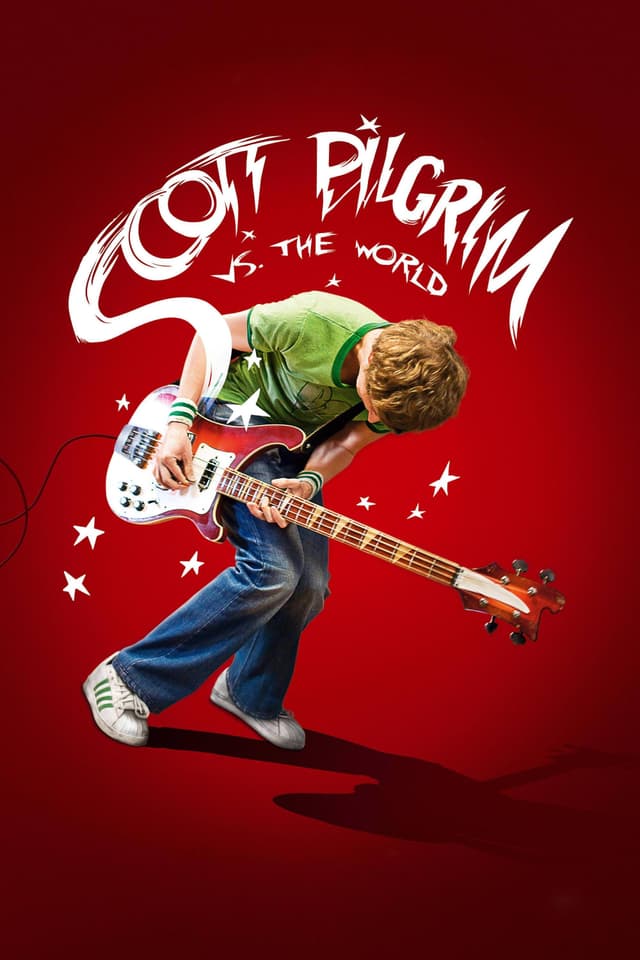
Scott Pilgrim vs. the World Budget
 ActionComedyRomance1h 53m
Updated
Synopsis
Twenty-three-year-old Toronto slacker Scott Pilgrim falls for American delivery girl Ramona Flowers and discovers he must defeat her seven evil exes in video-game-style battles to win the right to date her. Across rock-band gigs, snowy Toronto streets, and increasingly surreal combat sequences, Scott confronts not only the exes but his own track record of treating his past relationships carelessly.
What Is the Budget of Scott Pilgrim vs. the World (2010)?
Scott Pilgrim vs. the World (2010), directed by Edgar Wright and distributed by Universal Pictures, was produced on a reported budget of $60,000,000 to $90,000,000, with the $85,000,000 figure most consistently cited in trade reporting after the film's release. Universal financed the production alongside Relativity Media and Marc Platt Productions, with Big Talk Films (Wright's long-time UK shingle) and Closed on Mondays Entertainment carrying production credits. The film adapted the first six volumes of Bryan Lee O'Malley's Oni Press graphic novel series, a property that had built a strong indie-comic following but no mainstream pop-cultural footprint, which made the eight-figure investment a notable gamble for a music-comedy-action hybrid with no built-in four-quadrant appeal.
The mid-range budget reflected Universal's confidence in Wright after the cult success of Shaun of the Dead (2004) and Hot Fuzz (2007), the marketability of Michael Cera coming off Superbad and Juno, and the visual ambition of a script that called for video-game-styled fight sequences, on-screen text effects, comic-panel transitions, and elaborate practical and digital VFX. The math assumed Scott Pilgrim would clear approximately $150,000,000 to $170,000,000 worldwide to recoup once marketing was accounted for. That target was missed by a wide margin in theaters, although the film's post-theatrical afterlife on home video, streaming, and a 2023 animated Netflix continuation has retroactively justified the investment several times over.
Key Budget Allocation Categories
Scott Pilgrim vs. the World's reported $85,000,000 budget was distributed across several core production areas:
- Above-the-Line Talent: Director Edgar Wright commanded a feature-director rate appropriate to his post-Hot Fuzz standing, and Michael Cera was cast as Scott Pilgrim coming off Juno (2007) and Superbad (2007). The deep ensemble, including Mary Elizabeth Winstead as Ramona Flowers, Kieran Culkin as Wallace Wells, Anna Kendrick, Aubrey Plaza, Alison Pill, Brie Larson, Chris Evans, Brandon Routh, Mae Whitman, Jason Schwartzman, and a pre-Captain America Chris Evans as Lucas Lee, represented a remarkable concentration of rising talent and added meaningful costs to the cast budget despite many of the seven evil exes occupying only a single scene each.
- Toronto Production Shoot: Principal photography took place almost entirely in Toronto from March to August 2009, with the city playing itself rather than doubling for an American setting, a rare creative and financial choice for a Universal release. The production made extensive use of Ontario provincial and federal tax credits, but local crew rates, multiple practical Toronto locations (Honest Ed's, Casa Loma, Lee's Palace, the Toronto Reference Library, Pizza Pizza), and a long shoot necessary to capture the film's elaborate visual style still consumed a significant share of the budget.
- Visual Effects: Double Negative handled the bulk of the film's 700 plus visual effects shots, encompassing the on-screen text effects, the coin-burst defeats of each evil ex, fireballs, the Vegan Police laser arrows, the giant bass-battle dragons, and the Subspace Highway. The blending of comic-book panel layouts, 8-bit video-game iconography, and live-action photography required custom shot design rather than off-the-shelf compositing, and consumed an estimated $20,000,000 to $25,000,000 of the budget.
- Music Rights and Original Score: Nigel Godrich (longtime Radiohead producer) composed the score and oversaw the soundtrack, with Beck writing the songs performed by Cera's in-film band Sex Bob-Omb, Brian LeBarton, Dan the Automator, and Cornelius contributing original recordings, and licensing for tracks by The Rolling Stones, T. Rex, The Black Lips, Frank Black, Plumtree, Brian Eno, Beachwood Sparks, and others. Music clearance for an indie-rock-heavy soundtrack with both diegetic band performances and needle drops was a substantial line item.
- Stunts and Fight Choreography: Stunt coordinator Brad Allan, a Jackie Chan Stunt Team alum, designed the seven evil-ex battles to read as both manga-influenced wire-fu and music-video kineticism. Cera, Routh, Evans, Satya Bhabha, Schwartzman, and the Katayanagi twin doubles all underwent extended fight training, and the choreography required precise multi-pass photography integrated with the visual effects plates.
- Production Design: Marcus Rowland's production design built or dressed the snowy Toronto exteriors, Scott's shared basement apartment with Wallace, Stephen Stills' rehearsal space, the Chaos Theatre finale set, and Gideon Graves' towering subspace lair. The look balanced grounded Toronto realism with the heightened comic-panel-meets-arcade visual register the script demanded.
- Marketing and Distribution: Universal mounted a global marketing push estimated at $50,000,000 to $60,000,000, including a Comic-Con presence, an extensive trailer campaign aimed at the gamer and comics demographics, video-game tie-ins (a downloadable beat-em-up from Ubisoft), and viral content built around the seven evil exes. The campaign was widely praised for its creativity, but it failed to translate to mainstream awareness ahead of the August 13, 2010 release.
How Does Scott Pilgrim vs. the World's Budget Compare to Similar Films?
At a reported $85,000,000, Scott Pilgrim sits in the upper-mid-range of music-driven comic-book adaptations and Edgar Wright's own filmography. The comparison set illustrates how its theatrical outcome diverged from its eventual cultural footprint:
- Shaun of the Dead (2004): Budget $4,000,000 | Worldwide $30,039,392. Edgar Wright's breakthrough zombie-comedy was made for less than 5% of Scott Pilgrim's budget and returned roughly 7.5x its cost, the financial template that earned Wright the latitude to swing for a tentpole.
- Hot Fuzz (2007): Budget $16,000,000 | Worldwide $80,572,150. Wright's second feature scaled up the budget by 4x and the worldwide gross by 2.7x, reinforcing the case for handing him a true studio production on Scott Pilgrim.
- Baby Driver (2017): Budget $34,000,000 | Worldwide $226,949,733. Wright's eventual mid-budget hit, made seven years after Scott Pilgrim with a music-and-action concept also rooted in needle drops and choreography, returned more than 6.5x its cost, suggesting that the formula worked once the audience caught up.
- Hot Tub Time Machine (2010): Budget $36,000,000 | Worldwide $64,571,365. Another 2010 release built around mid-budget genre comedy with a cult sensibility, it returned 1.8x its budget theatrically and developed an enduring afterlife on cable and streaming much like Scott Pilgrim.
- Kick-Ass (2010): Budget $30,000,000 | Worldwide $96,188,903. Released four months before Scott Pilgrim, this irreverent comic-book adaptation cost roughly one third as much and out-grossed it worldwide, an outcome that complicates the narrative that 2010 audiences could not handle a hyper-stylized graphic novel adaptation.
- The Worlds End (2013): Budget $20,000,000 | Worldwide $46,065,952. The third entry in Wright's Cornetto Trilogy, made after Scott Pilgrim's theatrical underperformance, returned to a more disciplined budget tier where Wright's economics consistently work.
Scott Pilgrim vs. the World Box Office Performance
Scott Pilgrim vs. the World opened on August 13, 2010 to $10,609,795 across 2,818 North American screens, finishing fifth at the domestic box office in a weekend won by The Expendables ($34,825,135) and also beaten by Eat Pray Love and the second weekend of The Other Guys. The opening was significantly below the $20,000,000 to $25,000,000 industry projections and never recovered, with subsequent weekend drops of 53%, 47%, and 51% pushing the film out of the top ten by Labor Day.
Against a reported production budget of $85,000,000, the film needed approximately $170,000,000 in worldwide gross to reach profitability when accounting for marketing and distribution costs. Here is the financial breakdown:
Box Office Breakdown
Scott Pilgrim vs. the World

Scott Pilgrim returned approximately $0.33 in theatrical revenue for every $1 invested, placing it firmly in box office bomb territory at release. The domestic share was $31,524,275 against an international share of $16,140,284, a 66/34 split that reflected the film's very North American (and specifically Toronto-coded) cultural register. Music-licensing-heavy films also faced extra friction in some overseas territories where soundtrack rights had to be renegotiated.
The film's afterlife transformed the financial picture. Home video sales on DVD and Blu-ray exceeded studio projections, the soundtrack album charted independently, the Ubisoft beat-em-up tie-in remained in active demand long enough to be re-released as Scott Pilgrim vs. the World: The Game Complete Edition in 2021, and the property became a perennial repertory and streaming staple. Universal eventually greenlit Scott Pilgrim Takes Off (2023), an animated Netflix continuation reuniting nearly the entire original live-action cast, an outcome that explicitly cited the cult audience the original film cultivated in the decade after its theatrical run.
Scott Pilgrim vs. the World Production History
Development began in 2005 when producer Marc Platt optioned the rights to the first Scott Pilgrim graphic novel, with only one of the eventual six volumes published. Edgar Wright signed on in early 2005 after meeting with Bryan Lee O'Malley, and Michael Bacall (later of 21 Jump Street) was hired to co-write the screenplay with Wright. The script went through multiple drafts in parallel with O'Malley's continuing publication of the source comics, an unusual circumstance that allowed Wright and Bacall to incorporate plot points from later volumes before the comic was finished. The final volume of the graphic novel series was published in July 2010, one month before the film's release.
Casting Michael Cera in 2008 anchored the picture, and Wright assembled the supporting ensemble through 2008 and early 2009. Mary Elizabeth Winstead won the role of Ramona Flowers, with Chris Evans cast as skateboarder-turned-action-star Lucas Lee before he was officially attached to Marvel's Captain America: The First Avenger, Brandon Routh as bass-powered vegan Todd Ingram (post-Superman Returns), Jason Schwartzman as final boss Gideon Graves, and Anna Kendrick as Stacey Pilgrim, cast before Up in the Air made her an Academy Award nominee. Brie Larson played Envy Adams in one of her earliest major-studio roles, Aubrey Plaza took the role of Julie Powers, and Alison Pill played Kim Pine.
Principal photography ran from March 30 to August 19, 2009, almost entirely in Toronto, Ontario. The production used the province's production tax credits and stayed faithful to O'Malley's very specific Toronto geography, shooting at real city landmarks including Casa Loma (the Chaos Theatre finale), Honest Ed's, the Toronto Reference Library, Lee's Palace and the Rockit (the venue battles), Pizza Pizza, the Second Cup at Bloor and Brunswick, and Sneaky Dee's. Bill Pope (The Matrix, Spider-Man 2) shot the film, blending grounded Toronto winter exteriors with the heightened comic-panel visual register.
Post-production ran from late 2009 through mid 2010 at Double Negative in London, with the 700 plus visual effects shots requiring extensive iteration to balance the manga-anime-game references with photographic plausibility. Nigel Godrich (Radiohead, Beck) composed the original score and produced the soundtrack, with Beck writing the Sex Bob-Omb songs (recording with the in-film band members performing on the tracks where possible), and additional contributions from Brian LeBarton, Dan the Automator, Cornelius, Broken Social Scene's Brendan Canning, and Metric. Wright shot, edited, and assembled the film with cinematographer Pope and editors Jonathan Amos and Paul Machliss across a deliberately compressed post-production schedule to hit the August 2010 release.
The film premiered out of competition at the San Diego Comic-Con on July 22, 2010 to euphoric reaction, and held additional fan screenings across North America in the weeks before release. Despite the festival-style enthusiasm, the marketing campaign struggled to communicate the film's genre hybrid to general audiences, with surveys ahead of release showing strong awareness in the gamer and comics demographics but flat awareness among broader 18 to 34 moviegoers, the exact problem that surfaced on opening weekend.
Awards and Recognition
Scott Pilgrim vs. the World was nominated for the Hugo Award for Best Dramatic Presentation, Long Form at the 2011 Worldcon, alongside Inception, Toy Story 3, How to Train Your Dragon, and the Doctor Who two-parter The Pandorica Opens / The Big Bang. The film won the Empire Award for Best Comedy in 2011 and the Saturn Award for Best Music (Nigel Godrich) at the 37th Saturn Awards, with additional Saturn nominations for Best Fantasy Film and Best Director (Edgar Wright). The Saturn ensemble also recognized the film's VFX work and editing.
At the Critics' Choice Movie Awards the film was nominated for Best Action Movie. The Visual Effects Society Awards nominated Double Negative's work in the Outstanding Created Environment category, and the film won the 2011 Online Film Critics Society Award for Best Editing. Industry recognition outside the genre circuit was limited by the box office performance, but Scott Pilgrim's music supervision and sound design became frequent reference points in subsequent music-driven action films, including Wright's own Baby Driver seven years later.
Critical Reception
Scott Pilgrim vs. the World received broadly positive reviews on release, with a 81% approval rating on Rotten Tomatoes based on 273 critic reviews and a critical consensus that called it visually arresting, fast-paced, and stylistically inventive. On Metacritic the film scored 69 out of 100, indicating generally favorable reviews. Audiences surveyed by CinemaScore gave the film a B, a relatively soft grade that became one of several explanations cited for the disconnect between the strong critical reception and the soft opening weekend.
Critics widely praised Wright's direction, the editing rhythm, the visual-effects integration, the supporting performances (Kieran Culkin as roommate Wallace Wells, Ellen Wong as Knives Chau, and Anna Kendrick as Stacey Pilgrim drew particular acclaim), and the soundtrack. Roger Ebert gave the film three out of four stars and wrote that it "is a movie that doesn't quite know what it wants to be," but praised its energy and inventiveness. A.O. Scott in The New York Times called it "a manic, hilarious genre blender." Manohla Dargis was more reserved, criticizing the film's emotional thinness even as she praised the craft.
Some reviewers and audiences objected to Michael Cera's muted performance, the film's self-consciously hipster register, or the perceived passivity of Ramona Flowers as a character defined by male attachment to her, critiques that have followed the film into its decade-long afterlife. The film's reputation has steadily climbed since 2010, with major retrospective reassessments in 2015, 2020, and 2023 placing it on multiple "best films of the decade" lists, including The Ringer, Vulture, and IndieWire. The 2023 animated Netflix continuation Scott Pilgrim Takes Off reunited the original cast and was widely interpreted as a cultural vindication of the film's long-undervalued initial release.
Frequently Asked Questions
How much did it cost to make Scott Pilgrim vs. the World (2010)?
The reported production budget was approximately $85,000,000, with industry estimates ranging from $60,000,000 to $90,000,000. Universal Pictures financed the production alongside Relativity Media and Marc Platt Productions, with UK shingle Big Talk Films also producing.
How much did Scott Pilgrim vs. the World earn at the box office?
The film grossed $31,524,275 domestically and $16,140,284 internationally, for a worldwide total of $47,664,559. It opened to $10,609,795 over its August 13, 2010 opening weekend, finishing fifth in a weekend won by The Expendables.
Was Scott Pilgrim vs. the World a box office bomb?
Yes, at release. Against an $85,000,000 production budget and an estimated $50,000,000 to $60,000,000 in marketing spend, the film returned approximately $0.33 in worldwide theatrical revenue for every $1 invested. Home video, streaming, soundtrack sales, video-game tie-ins, and the 2023 Netflix animated continuation have since recouped the investment many times over and cemented its status as one of the era's defining cult hits.
Who directed Scott Pilgrim vs. the World?
Edgar Wright directed the film, working from a screenplay he co-wrote with Michael Bacall. Wright had previously directed Shaun of the Dead (2004) and Hot Fuzz (2007). Scott Pilgrim was his first studio production and his first feature shot outside the United Kingdom.
Where was Scott Pilgrim filmed?
Principal photography took place almost entirely in Toronto, Ontario from March 30 to August 19, 2009, with the city playing itself rather than doubling for another setting. Locations included Casa Loma (the Chaos Theatre finale), Honest Ed's, the Toronto Reference Library, Lee's Palace and the Rockit, Pizza Pizza, the Second Cup at Bloor and Brunswick, and Sneaky Dee's. The production used Ontario's film and television tax credits.
Who composed the score for Scott Pilgrim vs. the World?
Nigel Godrich, the longtime Radiohead producer, composed the original score and oversaw the soundtrack. Beck wrote the Sex Bob-Omb songs performed in the film by Michael Cera's in-film band, and Brian LeBarton, Dan the Automator, Cornelius, Broken Social Scene's Brendan Canning, and Metric also contributed original recordings. Licensed needle drops included tracks by The Rolling Stones, T. Rex, Frank Black, Plumtree, and Beachwood Sparks.
Is Scott Pilgrim vs. the World based on a book?
Yes. The film adapts the six-volume Scott Pilgrim graphic novel series by Bryan Lee O'Malley, published by Oni Press between 2004 and 2010. The final volume was released in July 2010, one month before the film opened. Edgar Wright signed on to direct in early 2005 after the first volume was published, and the script was written in parallel with O'Malley's ongoing comics.
How does Scott Pilgrim compare to other Edgar Wright films?
Scott Pilgrim cost roughly 21x what Shaun of the Dead (2004) cost ($4,000,000 budget, $30,039,392 worldwide) and 5x what Hot Fuzz (2007) cost ($16,000,000 budget, $80,572,150 worldwide). Wright's subsequent music-driven action film Baby Driver (2017) cost $34,000,000 and grossed $226,949,733 worldwide, returning more than 6.5x its budget. Scott Pilgrim remains Wright's highest budget and largest theatrical loss but is also his most enduring cult title.
What did critics think of Scott Pilgrim vs. the World?
The film received broadly positive reviews on release, with an 81% approval rating on Rotten Tomatoes (based on 273 critics) and a 69 out of 100 score on Metacritic. Audiences gave it a B CinemaScore. Critics praised Wright's direction, the editing rhythm, the visual-effects integration, the supporting performances by Kieran Culkin, Ellen Wong, and Anna Kendrick, and the soundtrack. Some reviewers objected to Michael Cera's muted performance and Ramona Flowers being defined largely by male attachment to her.
Is there a sequel to Scott Pilgrim vs. the World?
There is no live-action sequel. In November 2023, Netflix released Scott Pilgrim Takes Off, an eight-episode animated continuation produced by Science SARU with the original live-action cast reprising their roles, Bryan Lee O'Malley and BenDavid Grabinski as showrunners, and Edgar Wright executive producing. The series reframes the original story by sidelining Scott early on and following Ramona as she investigates his disappearance, treating the live-action film as canonical backstory.
Filmmakers
Scott Pilgrim vs. the World

Official Trailer
Build budgets like this one in Saturation
Start from an industry-standard feature film template, import the schedule and rates you already have, and let the cost report keep itself current as you spend. Real-time collaboration, no spreadsheets.