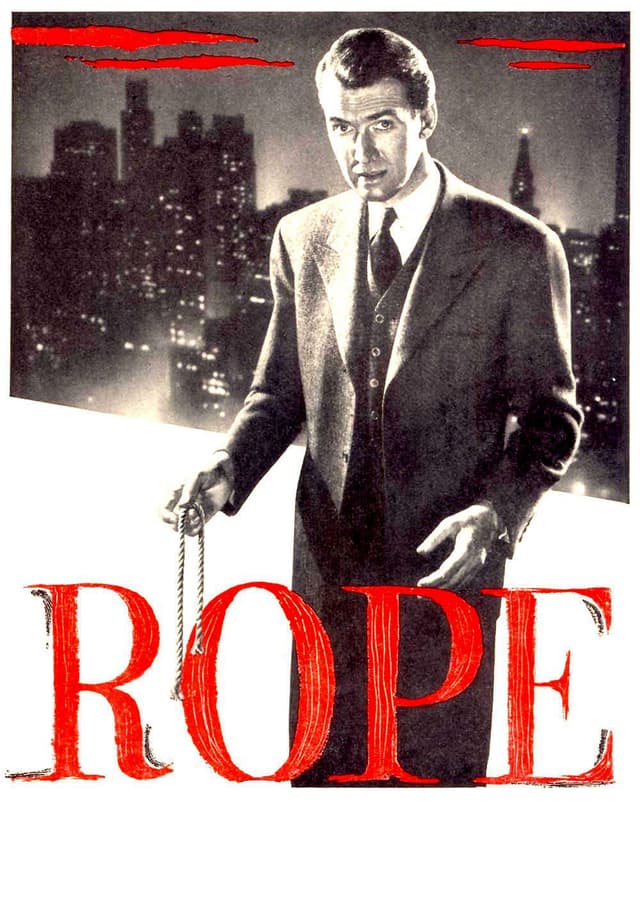
Rope Budget
 ThrillerCrimeDrama1h 21m
Updated
Synopsis
Brandon and Philip are two young men who share a New York City apartment. They consider themselves intellectually superior to their friend David Kentley, and as a consequence, decide to murder him. Together they strangle David with a rope and placing the body in an old chest, they proceed to hold a small party. The guests include David's father, his fiancée Janet, and their old schoolteacher Rupert, from whom they mistakenly took their ideas. As Brandon becomes increasingly more daring, Rupert begins to suspect.
What is the budget of Rope?
"Rope," a thriller released in 1948, was directed by Alfred Hitchcock and stars James Stewart, John Dall. The production budget was $1,500,000, placing it in the micro-budget range for thriller productions of the 1940s.
Key Budget Allocation Categories
While specific budget breakdowns are not publicly available, typical cost drivers for a thriller production like this include:
- Talent & Director Compensation: Thrillers depend on compelling lead performances to sustain tension, making cast compensation a primary budget concern. Directors with proven thriller credentials command premium fees.
- Cinematography & Location Photography: Thriller aesthetics demand specific visual languages , surveillance-style photography, claustrophobic framing, or expansive location work across multiple cities or countries.
- Editorial & Sound Post-Production: Precision editing , controlling information flow, building suspense through pacing, and orchestrating reveals , requires extended post-production schedules.
- Production: The film is one of Hitchcock's most experimental and "one of the most interesting experiments ever attempted by a major director working with big box-office names", abandoning many standard film techniques to allow for the long unbroken scenes.
What were the major cost factors in Rope?
Several factors contributed to the overall production costs of "Rope."
- Talent: Talent & Director Compensation is one of the primary cost drivers in thriller productions of this scale.
- Cinematography: Cinematography & Location Photography is one of the primary cost drivers in thriller productions of this scale.
- Editorial: Editorial & Sound Post-Production is one of the primary cost drivers in thriller productions of this scale.
How Does Rope's Budget Compare to Similar Films?
At $1,500,000, Rope sits in the micro-budget range. Here is how it compares to productions with a similar budget:
- Satantango (1994): Budget $1,500,000
- City Lights (1931): Budget $1,500,000, Worldwide Gross $4,250,000
- Tampopo (1985): Budget $1,500,000
- Modern Times (1936): Budget $1,500,000, Worldwide Gross $1,800,000
- Roman Holiday (1953): Budget $1,500,000, Worldwide Gross $12,000,000
The median budget for wide-release thriller films in the era ranges from $30 to 80M for mid-budget to $150M+ for tentpoles.
Rope Box Office Performance
"Rope" earned $2,200,000 worldwide at the box office. Against a production budget of $1,500,000, the film showed modest profitability in theatrical release.
A film typically needs to earn approximately twice its production budget to cover marketing and distribution costs. For "Rope," that break-even threshold was roughly $3,000,000. With worldwide earnings of $2,200,000, the film fell short of that threshold but recouped its production costs in theatrical release.
Box Office Breakdown
Rope

At 46.7%, "Rope" returned its production investment but margin was tight after marketing and distribution costs.
Awards and Recognition
4 wins & 3 nominations total
Frequently Asked Questions
How much did it cost to make Rope (1948)?
The production budget was $1,500,000, covering principal photography, cast and crew salaries, locations, sets, post-production, and music. Marketing and distribution (P&A) costs are estimated at an additional $750,000 - $1,200,000, bringing the total studio investment to approximately $2,250,000 - $2,700,000.
How much did Rope (1948) earn at the box office?
Rope grossed $2,200,000 worldwide.
Was Rope (1948) profitable?
The film did not break even theatrically, earning $2,200,000 against an estimated $3,750,000 needed. Ancillary revenue may have improved the picture.
What were the biggest costs in producing Rope?
The primary cost drivers were above-the-line talent (James Stewart, John Dall, Farley Granger); talent compensation, location cinematography, and tension-driven editorial.
How does Rope's budget compare to similar thriller films?
At $1,500,000, Rope is classified as a micro-budget production. The median budget for wide-release thriller films in the era ranges from $30 - 80M for mid-budget to $150M+ for tentpoles. Comparable budgets: Satantango (1994, $1,500,000); City Lights (1931, $1,500,000); Tampopo (1985, $1,500,000).
Did Rope (1948) go over budget?
There are no widely reported accounts of significant budget overruns for this production. However, studios rarely disclose precise budget overrun figures publicly. The reported production budget reflects the final estimated cost.
What was the return on investment (ROI) for Rope?
The theatrical ROI was 46.7%, calculated as ($2,200,000 − $1,500,000) ÷ $1,500,000 × 100. This measures gross revenue against production budget only - it does not account for P&A or exhibitor shares.
What awards did Rope (1948) win?
4 wins & 3 nominations total.
Who directed Rope and who were the key crew members?
Directed by Alfred Hitchcock, written by Arthur Laurents, shot by Joseph A. Valentine, William V. Skall, edited by William H. Ziegler.
Where was Rope filmed?
Rope was filmed in United States of America.
Filmmakers
Rope

Official Trailer
Build budgets like this one in Saturation
Start from an industry-standard feature film template, import the schedule and rates you already have, and let the cost report keep itself current as you spend. Real-time collaboration, no spreadsheets.