Pokémon Detective Pikachu Budget
 Comedy
Updated
Synopsis
When 21-year-old Tim Goodman learns that his estranged father, ace detective Harry Goodman, has gone missing, he travels to Ryme City to investigate. He discovers his father's former Pokémon partner, a wisecracking Pikachu only he can understand, and together they uncover a conspiracy that threatens the peaceful coexistence between humans and Pokémon.
What Is the Budget of Pokémon Detective Pikachu (2019)?
Pokémon Detective Pikachu (2019), the first live-action Pokémon feature film, was produced on a reported budget of $150,000,000. Legendary Entertainment financed the production after winning a competitive 2016 rights auction against Warner Bros., Sony, and Universal, and Warner Bros. Pictures distributed the film internationally outside Japan, where Toho handled theatrical release. The film represented the first major Hollywood adaptation of the Pokémon brand, which had previously been confined to anime features under The Pokémon Company's direct control.
The $150,000,000 figure reflected the visual ambition of bringing more than 60 different Pokémon species to live-action photography for the first time. Each creature required individual design, fur and skin simulation, animation rigging, and integration into plate photography shot on London stages and exterior locations. Ryan Reynolds, fresh off the success of Deadpool 2 (2018), provided the voice and motion-capture performance for Pikachu, with the production capturing his on-set work for the animators at MPC and Framestore to reference.
Key Budget Allocation Categories
The $150,000,000 budget was distributed across several core production areas:
- Above-the-Line Talent: Ryan Reynolds received a substantial fee plus producing credit for the voice and motion-capture performance of Pikachu, his most expensive non-Deadpool deal at the time. Justice Smith, coming off Jurassic World: Fallen Kingdom and The Get Down, was cast as the human lead Tim Goodman. Supporting cast Bill Nighy and Ken Watanabe joined at established featured-player rates, with Kathryn Newton (Big Little Lies) cast as the reporter ally. Director Rob Letterman commanded an established blockbuster directing fee following Goosebumps.
- Visual Effects: More than 60 Pokémon species required individual design and animation, anchored by Pikachu but extending to Mr. Mime, Charizard, Mewtwo, Bulbasaur, Charmander, Squirtle, Snorlax, Jigglypuff, Psyduck, and dozens of background creatures. MPC handled the bulk of the lead Pokémon work, with Framestore on environments and secondary creatures. The VFX team designed each Pokémon with realistic fur, skin, scales, and feather simulations while preserving the recognizable cartoon silhouettes.
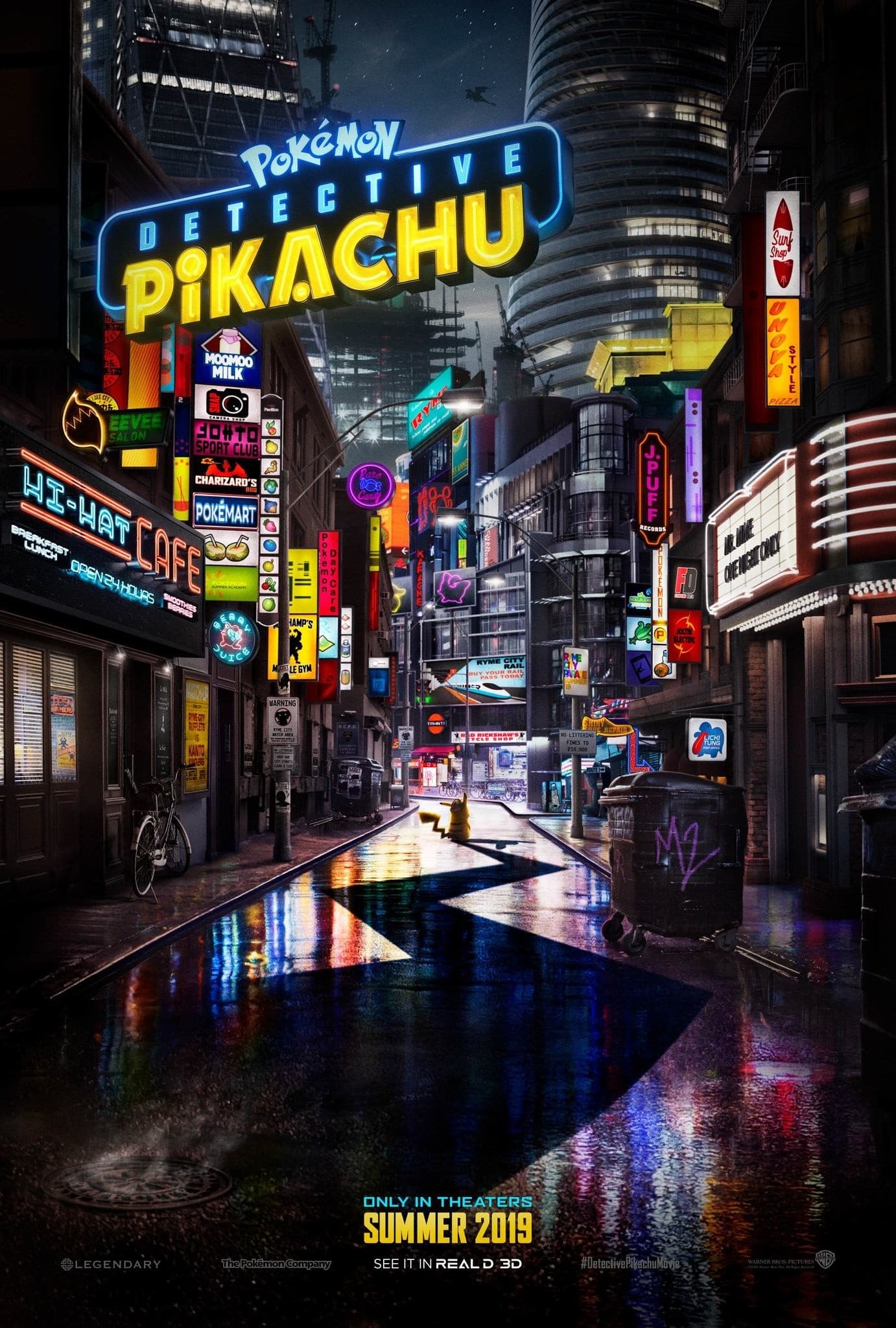
- Production Design: Production designer Nigel Phelps built Ryme City as a contemporary Tokyo-and-London hybrid metropolis, with Pokémon and human coexistence visible in transit, retail, and street-level signage. Hundreds of detail-rich Pokémon-themed set elements (billboards, vending machines, shop fronts, vehicle livery) populated the city, requiring extensive set decoration and modular reuse across multiple shoot locations.
- London Stage and Location Photography: Principal photography ran from January to May 2018 at Warner Bros. Studios Leavesden outside London and on exterior locations across the city, including Tower Bridge and various Westminster streets. The UK production tax credit applied to a majority of the spend, contributing meaningfully to the production economics.
- Cinematography and Lighting: Cinematographer John Mathieson (Gladiator, Logan) shot the film on Arri Alexa cameras with a stylized neon-noir palette designed to evoke Blade Runner and classic detective films while supporting the heavy CG integration that would be added in post.
- Score and Music: Composer Henry Jackman recorded the orchestral score with the London Studio Orchestra at AIR Studios. The soundtrack also incorporated re-arranged versions of classic Pokémon anime themes, requiring licensing coordination with The Pokémon Company's Japanese composers.
- Marketing and Brand Coordination: The Pokémon Company maintained tight creative oversight on Pokémon design, behavior, and branding, requiring continuous review of design assets and a parallel approval pipeline that added production-management overhead beyond a typical studio tentpole.
How Does Detective Pikachu's Budget Compare to Similar Films?
At $150,000,000, Pokémon Detective Pikachu sat in the mid-range of recent video-game and toy adaptations. The comparison set illustrates how its commercial outcome stacked up:
- Sonic the Hedgehog (2020): Budget $90,000,000 | Worldwide $319,715,683. Paramount's contemporaneous SEGA adaptation cost 40% less than Detective Pikachu and earned roughly 71% of the worldwide gross, with a profitable redesign-rescue story that confirmed the viability of live-action video-game adaptations.
- Warcraft (2016): Budget $160,000,000 | Worldwide $439,048,914. Legendary's previous video-game adaptation cost a comparable amount and earned within 2% of Detective Pikachu's worldwide total, but Warcraft was widely viewed as a commercial disappointment because of its weak domestic share.
- Sonic the Hedgehog 2 (2022): Budget $90,000,000 | Worldwide $405,421,518. Paramount's sequel cost 40% less and earned only 10% less worldwide than Detective Pikachu, demonstrating the strong fundamentals of the rebooted video-game adaptation category.
- Jumanji: Welcome to the Jungle (2017): Budget $90,000,000 | Worldwide $962,508,792. Sony's board-game adaptation cost 40% less than Detective Pikachu and earned more than twice the worldwide gross, the most successful comparable IP-adaptation of the same era.
- Transformers: The Last Knight (2017): Budget $217,000,000 | Worldwide $605,425,157. Paramount's Hasbro adaptation cost 45% more than Detective Pikachu and earned 35% more worldwide, the closest tentpole comparison from the toy-franchise tier.
Pokémon Detective Pikachu Box Office Performance
Pokémon Detective Pikachu opened on May 10, 2019, in 4,202 theaters and earned $54,365,242 over its opening weekend, the largest opening for a video-game adaptation in North American box office history at the time (a record subsequently broken by Sonic the Hedgehog 2 in 2022). The film finished second on its opening weekend behind Avengers: Endgame, which was in its third week of release.
Against a $150,000,000 production budget, the film needed approximately $350,000,000 in worldwide gross to reach profitability after marketing and distribution costs. Here is the financial breakdown:
Box Office Breakdown
Pokémon Detective Pikachu

Pokémon Detective Pikachu returned approximately $1.85 in worldwide theatrical revenue for every $1 invested when measured against total estimated production and marketing spend. The domestic share of the gross was $144,105,346 against an international share of $305,834,948, a 32/68 split that confirmed the franchise's exceptional pull in Japan and other Asian markets, where Pokémon's brand recognition was strongest.
Japan alone contributed approximately $26,800,000 in opening-week gross, the largest Japanese launch for a Warner Bros.-distributed live-action film at the time. China added approximately $37,400,000 over the opening weekend. The strong international performance triggered Legendary to greenlight a sequel in 2019 with director Jonathan Krisk attached, but development stalled and as of 2025 the follow-up has not entered production.
Pokémon Detective Pikachu Production History
Development on a live-action Pokémon film began in earnest in 2016 when Legendary Entertainment won a competitive rights auction against Warner Bros., Sony, and Universal Pictures. The Pokémon Company, which had previously controlled all theatrical Pokémon output through Japanese anime features, agreed to the deal under terms that required tight creative oversight and approval rights over Pokémon design and behavior. The studio chose Detective Pikachu, a 2016 Nintendo 3DS spin-off game from Creatures Inc. starring a wisecracking talking Pikachu, as the source rather than the mainline Pokémon RPG series.
Rob Letterman, coming off the family blockbuster Goosebumps (2015) at Sony, was attached as director in late 2016. The screenplay was developed by Dan Hernandez, Benji Samit, Letterman, and Derek Connolly, expanding the Nintendo game's skeletal noir premise into a feature-length mystery with a human lead (Tim Goodman) and his missing detective father at the center. Casting Ryan Reynolds as the voice of Pikachu in September 2017 reframed the project; Reynolds' Deadpool-derived comedic sensibility set the film's tonal register, with the screenplay subsequently tailored to his performance.
Principal photography ran from January 15, 2018 to May 22, 2018 at Warner Bros. Studios Leavesden in the United Kingdom and on exterior locations across London. The UK production tax credit applied to the substantial majority of the spend. Ryan Reynolds performed his Pikachu voice work both in dedicated London recording sessions and on set during principal photography, with motion-capture references shot in conjunction with the live-action sequences for use by the MPC animation team.
Post-production stretched across the back half of 2018 and into early 2019, with more than 60 individual Pokémon species requiring final design, animation, and integration into plate photography. The Pokémon Company maintained an active approval process throughout, with Japanese stakeholders reviewing each Pokémon's appearance, behavior, and dialogue (where applicable). Composer Henry Jackman recorded the score at AIR Studios in London. The film opened wide on May 10, 2019, positioned as the family-friendly counterprogram to Avengers: Endgame's ongoing third week.
Awards and Recognition
Pokémon Detective Pikachu received primarily genre-press and visual-effects industry recognition. The film won the Empire Award for Best Comedy and was nominated for the Saturn Award for Best Fantasy Film, Best Costume, and Best Visual Effects from the Academy of Science Fiction, Fantasy and Horror Films. The Visual Effects Society honored the film with a VES Award nomination for Outstanding Animated Character in a Live Action Motion Picture for Pikachu.
The film received Teen Choice Award nominations for Choice Sci-Fi/Fantasy Movie and Choice Sci-Fi/Fantasy Movie Actor (Justice Smith), with Ryan Reynolds receiving a People's Choice Awards nomination for Favorite Voice from an Animated Movie. At the Kids' Choice Awards, the film was nominated for Favorite Animated Movie, an unusual category placement reflecting its hybrid live-action and CG-character status.
Critical Reception
Pokémon Detective Pikachu received generally positive reviews and is widely regarded as one of the most successful live-action video-game adaptations to date. The film holds a 68% approval rating on Rotten Tomatoes based on 326 critic reviews, with a critical consensus that praised its visual design, Ryan Reynolds' performance, and faithfulness to the Pokémon brand. On Metacritic, the film scored 53 out of 100, indicating mixed-to-positive reviews. Audiences surveyed by CinemaScore gave the film a B+, a strong score for a family genre title.
Critics praised the photorealistic Pokémon designs, Ryan Reynolds' comedic voice work as Pikachu, Bill Nighy's antagonist performance, and the deliberate Blade Runner-inflected production design of Ryme City. Variety's Owen Gleiberman wrote that the film "captures the spirit of Pokémon while delivering a real story for newcomers," while The Hollywood Reporter's Frank Scheck called it "the best live-action video-game adaptation since Mortal Kombat."
Detractors flagged the mystery-plot mechanics, which several critics called formulaic, and the limited dramatic range of the human lead performances. Some long-time Pokémon fans objected to certain design choices (notably Mr. Mime's uncanny-valley face), but the broader response from the franchise's fanbase was overwhelmingly positive. Pokémon Detective Pikachu's reception cleared the path for the Sonic the Hedgehog franchise's 2020 launch and the Super Mario Bros. Movie (2023), and it remains the benchmark against which subsequent live-action video-game adaptations are measured.
Frequently Asked Questions
How much did it cost to make Pokémon Detective Pikachu (2019)?
The reported production budget was $150,000,000. Legendary Entertainment financed the production after winning a competitive 2016 rights auction against Warner Bros., Sony, and Universal Pictures. Warner Bros. Pictures distributed internationally outside Japan, where Toho handled theatrical release.
How much did Detective Pikachu earn at the box office?
The film grossed $144,105,346 domestically and $305,834,948 internationally, for a worldwide total of $449,940,294. It opened to $54,365,242 over its May 10, 2019 weekend, the largest opening for a video-game adaptation in North American box office history at the time.
Was Detective Pikachu profitable?
Yes. Against an estimated $230,000,000 to $250,000,000 total investment (production plus marketing), the film returned approximately $1.85 in worldwide gross for every $1 invested. The strong international performance triggered Legendary to greenlight a sequel in 2019, though development has since stalled.
Who voiced Pikachu in Detective Pikachu?
Ryan Reynolds voiced and provided motion-capture reference for Pikachu, receiving a substantial fee plus producing credit. Reynolds' Deadpool-derived comedic sensibility set the film's tonal register, with the screenplay tailored to his performance after he was cast in September 2017.
Who directed Detective Pikachu?
Rob Letterman directed the film, attached in late 2016 coming off the family blockbuster Goosebumps (2015) at Sony. The screenplay was developed by Dan Hernandez, Benji Samit, Letterman, and Derek Connolly, expanding the 2016 Nintendo 3DS spin-off game from Creatures Inc. into a feature-length mystery.
Where was Detective Pikachu filmed?
Principal photography ran from January 15, 2018 to May 22, 2018 at Warner Bros. Studios Leavesden in the United Kingdom and on exterior locations across London. The UK production tax credit applied to the substantial majority of the spend, contributing meaningfully to the production economics.
How many Pokémon are in Detective Pikachu?
More than 60 different Pokémon species appear in the film, anchored by Pikachu but extending to Mr. Mime, Charizard, Mewtwo, Bulbasaur, Charmander, Squirtle, Snorlax, Jigglypuff, Psyduck, and dozens of background creatures. MPC handled the bulk of the lead Pokémon work, with Framestore on environments and secondary creatures.
How does Detective Pikachu compare to other video-game movies?
Detective Pikachu cost $150M and earned $449M worldwide, more than Sonic the Hedgehog ($319M on $90M budget) and Warcraft ($439M on $160M budget) but less than Sonic the Hedgehog 2 from the same era. It is widely regarded as one of the most successful live-action video-game adaptations to date and cleared the path for the Sonic franchise and The Super Mario Bros. Movie.
What did critics think of Detective Pikachu?
The film received generally positive reviews, with a 68% approval rating on Rotten Tomatoes (based on 326 critics) and a 53 out of 100 Metacritic score. Audiences gave it a B+ CinemaScore. Critics praised the photorealistic Pokémon designs, Ryan Reynolds' comedic voice work as Pikachu, and the Blade Runner-inflected production design of Ryme City.
Will there be a Detective Pikachu 2?
A sequel was greenlit by Legendary in 2019 with director Jonathan Krisk (PEN15) attached, but development has since stalled. As of 2025, the follow-up has not entered production. The Pokémon Company has continued to release Pokémon anime features in Japan in the interim.
Filmmakers
Pokémon Detective Pikachu

Build budgets like this one in Saturation
Start from an industry-standard feature film template, import the schedule and rates you already have, and let the cost report keep itself current as you spend. Real-time collaboration, no spreadsheets.