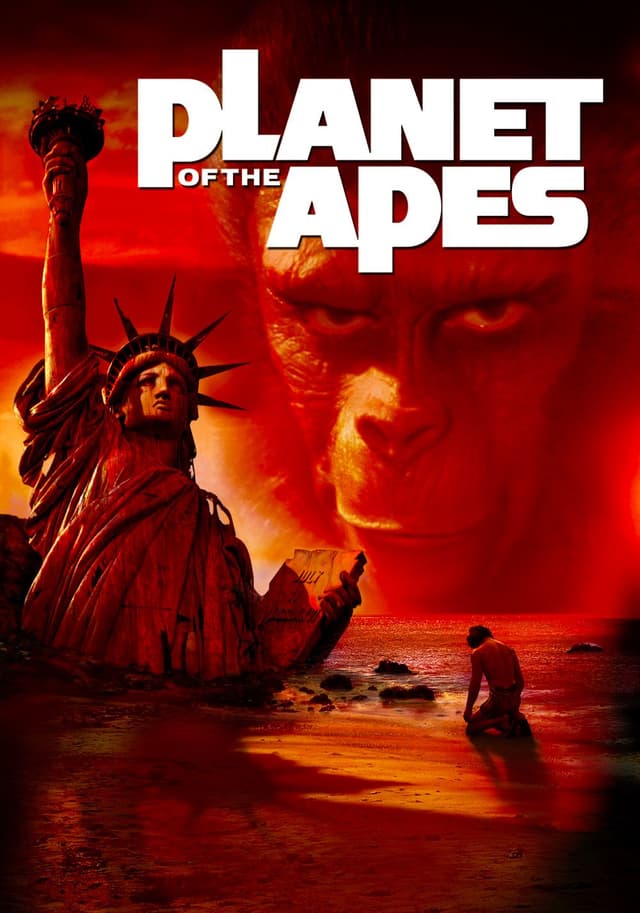
Planet of the Apes Budget
 Science FictionAdventureDramaAction1h 52m
Updated
Synopsis
In the year 2029, astronaut Leo Davidson embarks on a mission aboard a space station orbiting Earth. During a routine test of an experimental spacecraft, he is unexpectedly pulled through a wormhole and crash-lands on a mysterious planet. This world is dominated by intelligent apes who have evolved to become the ruling species, while humans are treated as primitive beings. As Leo navigates this strange society, he encounters a group of human rebels and forms an alliance with a sympathetic chimpanzee named Ari. Together, they strive to challenge the oppressive regime of the apes, led by the ruthless General Thade. As Leo uncovers the truth about the planet's history and his own fate, he must confront the moral implications of his actions and find a way to escape before it's too late. The film explores themes of evolution, freedom, and the consequences of humanity's choices.
What is the budget of Planet of the Apes?
"Planet of the Apes," a science fiction released in 2001, was directed by Franklin J. Schaffner and stars Charlton Heston, Roddy McDowall. The production budget was $5,800,000, placing it in the low-budget range for science fiction productions of its era.
Key Budget Allocation Categories
While specific budget breakdowns are not publicly available, typical cost drivers for a science fiction production like this include:
- Visual Effects & CGI Pipeline: Sci-fi films are among the most VFX-intensive productions in Hollywood.
- Production Design & World-Building: Creating a believable sci-fi world required significant investment in set construction, prop fabrication, and conceptual design , from physical environments through LED volume stages and virtual production technology.
- Technology & Camera Systems: Cutting-edge camera rigs, motion capture stages, LED volume stages (virtual production), and proprietary rendering technology often push the technical budget far beyond conventional filming costs.
- Filming & Locations: Filming began on May 21, 1967, and wrapped on August 10.
What were the major cost factors in Planet of the Apes?
Several factors contributed to the overall production costs of "Planet of the Apes."
- Visual Effects: Visual Effects & CGI Pipeline is one of the primary cost drivers in science fiction productions of this scale.
- Production Design: Production Design & World-Building is one of the primary cost drivers in science fiction productions of this scale.
- Technology: Technology & Camera Systems is one of the primary cost drivers in science fiction productions of this scale.
How Does Planet of the Apes's Budget Compare to Similar Films?
At $5,800,000, Planet of the Apes sits in the low-budget range. Here is how it compares to productions with a similar budget:
- Capote (2005): Budget $7,000,000, Worldwide Gross $49,327,405
- Norm of the North (2016): Budget $7,000,000, Worldwide Gross $17,062,499
- Peter Pan (1953): Budget $4,000,000, Worldwide Gross $87,400,000
- Mutant Chronicles (2008): Budget $8,000,000, Worldwide Gross $2,131,057
The median budget for wide-release science fiction films in the era ranges from $30 to 80M for mid-budget to $150M+ for tentpoles.
Planet of the Apes Box Office Performance
"Planet of the Apes" earned $32,589,624 worldwide at the box office. Against a production budget of $5,800,000, the film performed strongly at the box office.
A film typically needs to earn approximately twice its production budget to cover marketing and distribution costs. For "Planet of the Apes," that break-even threshold was roughly $11,600,000. With worldwide earnings of $32,589,624, the film cleared that threshold comfortably.
Box Office Breakdown
Planet of the Apes

At 461.9%, "Planet of the Apes" earned roughly $5.62 for every $1 invested in production.
Planet of the Apes Production History
Filming began on May 21, 1967, and wrapped on August 10. Most of the early scenes of a desert-like terrain were shot in northern Arizona near the Grand Canyon, the Colorado River, Lake Powell, As noted in the documentary Behind the Planet of the Apes, Lou Wagner said that the makeup was particularly heavy in the area of the mouth and made it difficult to drink anything. At one point, Nova was decided to be pregnant, and scenes were filmed around the Page locations revealing Nova's pregnancy.
Awards and Recognition
Nominated for 2 Oscars. 6 wins & 5 nominations total
- National Board of Review: Top Ten Films
Frequently Asked Questions
How much did it cost to make Planet of the Apes (1968)?
The production budget was $5,800,000, covering principal photography, visual effects, cast and crew salaries, locations, sets, post-production, and music. Marketing and distribution (P&A) costs are estimated at an additional $2,900,000 - $4,640,000, bringing the total studio investment to approximately $8,700,000 - $10,440,000.
How much did Planet of the Apes (1968) earn at the box office?
Planet of the Apes grossed $32,589,624 domestic, totaling $32,589,624 worldwide.
Was Planet of the Apes (1968) profitable?
Yes. Against a production budget of $5,800,000 and estimated total costs of ~$14,500,000, the film earned $32,589,624 theatrically - a 462% ROI on production costs alone.
What were the biggest costs in producing Planet of the Apes?
The primary cost drivers were above-the-line talent (Charlton Heston, Roddy McDowall, Kim Hunter); visual effects pipelines, virtual production technology, and speculative world-building.
How does Planet of the Apes's budget compare to similar science fiction films?
At $5,800,000, Planet of the Apes is classified as a micro-budget production. The median budget for wide-release science fiction films in the era ranges from $30 - 80M for mid-budget to $150M+ for tentpoles. Comparable budgets: Capote (2005, $7,000,000); Norm of the North (2016, $7,000,000); Peter Pan (1953, $4,000,000).
Did Planet of the Apes (1968) go over budget?
There are no widely reported accounts of significant budget overruns for this production. However, studios rarely disclose precise budget overrun figures publicly. The reported production budget reflects the final estimated cost.
What was the return on investment (ROI) for Planet of the Apes?
The theatrical ROI was 461.9%, calculated as ($32,589,624 − $5,800,000) ÷ $5,800,000 × 100. This measures gross revenue against production budget only - it does not account for P&A or exhibitor shares.
What awards did Planet of the Apes (1968) win?
Nominated for 2 Oscars. 6 wins & 5 nominations total.
Who directed Planet of the Apes and who were the key crew members?
Directed by Franklin J. Schaffner, written by Michael Wilson, Rod Serling, shot by Leon Shamroy, with music by Jerry Goldsmith, edited by Hugh S. Fowler.
Where was Planet of the Apes filmed?
Planet of the Apes was filmed in United States of America. Filming began on May 21, 1967, and wrapped on August 10. Most of the early scenes of a desert-like terrain were shot in northern Arizona near the Grand Canyon, the Colorado River, Lake Powell, As noted in the documentary Behind the Planet of the Apes, Lou Wagner said that the makeup was particularly heavy in the area of the mouth and made it difficult to drink anything. At one point, Nova was decided to be pregnant, and scenes were filmed around the Page locations revealing Nova's pregnancy.
Filmmakers
Planet of the Apes

Official Trailer
Build budgets like this one in Saturation
Start from an industry-standard feature film template, import the schedule and rates you already have, and let the cost report keep itself current as you spend. Real-time collaboration, no spreadsheets.