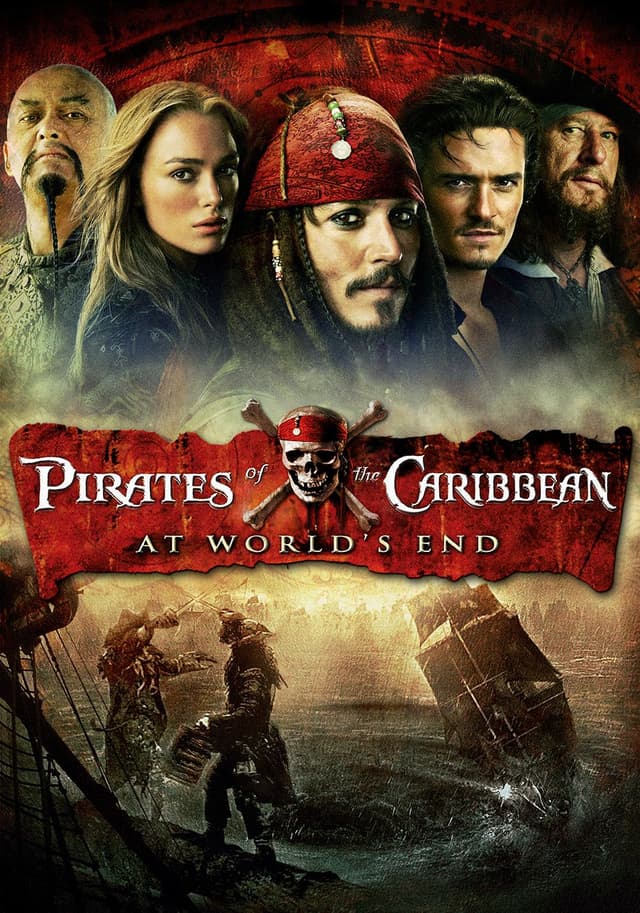
Pirates of the Caribbean: At World’s End Budget
 AdventureFantasyAction2h 49m
Updated
Synopsis
With Jack Sparrow trapped in Davy Jones' Locker, Will Turner, Elizabeth Swann, and Captain Barbossa embark on a desperate mission to rescue him, navigating the supernatural waters at the edge of the world. Upon their return, the pirates must unite against the East India Trading Company and Lord Cutler Beckett, who has seized control of the Flying Dutchman and Davy Jones, threatening to eliminate piracy forever. The conflict culminates in a massive battle inside a swirling maelstrom, where alliances are tested, sacrifices are made, and the fate of the seas is decided.
What Is the Budget of Pirates of the Caribbean: At World's End?
Pirates of the Caribbean: At World's End (2007), directed by Gore Verbinski and released by Walt Disney Pictures, was produced on a budget of $300 million. At the time of its release, it was the most expensive film ever made, a record that would stand until the same franchise's On Stranger Tides surpassed it four years later. The third installment in the original Pirates trilogy was shot back-to-back with Dead Man's Chest (2006), a production strategy that aimed to reduce costs through shared infrastructure but ultimately resulted in one of the most complex and expensive shoots in cinema history.
The $300 million figure reflects the combined ambition of the trilogy's conclusion: elaborate ship-based battles, a climactic maelstrom sequence requiring massive practical water effects and digital enhancement, an ensemble cast commanding peak compensation, and location work across multiple countries. Verbinski's maximalist approach to the material, evident in the film's 168-minute runtime and labyrinthine plot, translated directly into production costs that pushed well beyond initial estimates.
Key Budget Allocation Categories
The $300 million budget was distributed across several major production areas:
- Ensemble Cast Compensation: Johnny Depp, whose portrayal of Captain Jack Sparrow had become a cultural phenomenon after the first two films, commanded an enormous salary reportedly exceeding $40 million. Orlando Bloom, Keira Knightley, Geoffrey Rush, Bill Nighy, and Chow Yun-fat all carried significant compensation packages. The back-to-back production with Dead Man's Chest meant cast availability had to be maintained across both shoots.
- Back-to-Back Production Overhead: While shooting two films simultaneously was intended to create efficiencies, the approach also generated unique costs. Sets had to serve both films, scheduling conflicts required expensive workarounds, and the sheer duration of the combined shoot (which stretched across most of 2005 and into 2006) generated extended overhead in crew salaries, equipment rentals, and facility costs.
- The Maelstrom Climax: The film's centerpiece, a battle between two ships circling inside a massive whirlpool, was one of the most technically ambitious sequences attempted at the time. It combined practical ship sections on hydraulic gimbal platforms with enormous water effects, digital ocean simulation, and hundreds of digital effects shots. The sequence alone reportedly accounted for a significant percentage of the total budget.
- Visual Effects: Industrial Light & Magic created approximately 750 VFX shots, including Davy Jones' tentacle face (which required some of the most advanced facial motion capture of the era), the maelstrom, digital ship extensions, CG ocean surfaces, and the spectral Calypso transformation. Bill Nighy's performance as Davy Jones required full-body motion capture sessions and painstaking digital replacement of his face and body.
- International Location Work: The production filmed in multiple countries including the Bahamas, Dominica, and various locations in the United States. The Caribbean locations provided authentic tropical environments but carried high logistics costs due to limited local infrastructure, weather-dependent schedules, and the transportation of equipment and personnel to remote island settings.
How Does Pirates of the Caribbean: At World's End's Budget Compare to Similar Films?
At $300 million, At World's End was in unprecedented territory for its era. Comparing it with contemporaries and franchise entries:
- Pirates of the Caribbean: Dead Man's Chest (2006): Budget $225,000,000 | Worldwide $1,066,179,725. The second film, shot back-to-back with At World's End, cost 25% less and earned significantly more, becoming the first film of 2006 to cross $1 billion. The higher cost of At World's End relative to its predecessor illustrates how the climactic third act of the trilogy demanded even greater scale.
- Spider-Man 3 (2007): Budget $258,000,000 | Worldwide $894,983,373. Sam Raimi's superhero threequel, released the same month as At World's End, cost 14% less and represented the same era of escalating franchise budgets. Both films demonstrated that $250M+ budgets were becoming the new normal for tentpole conclusions.
- The Dark Knight (2008): Budget $185,000,000 | Worldwide $1,003,045,358. Christopher Nolan's Batman sequel cost 38% less than At World's End and crossed $1 billion worldwide, showing that critical acclaim could drive commercial performance more efficiently than production excess.
- Pirates of the Caribbean: On Stranger Tides (2011): Budget $410,600,000 | Worldwide $1,045,713,802. The fourth film would surpass At World's End as the franchise's most expensive entry, continuing the franchise's trend of escalating costs.
- The Lord of the Rings: The Return of the King (2003): Budget $94,000,000 | Worldwide $1,146,030,912. Peter Jackson's trilogy conclusion, produced back-to-back with its predecessors at a fraction of Pirates' per-film cost, delivered superior returns and swept the Academy Awards, demonstrating that back-to-back production could achieve massive scale at controlled budgets with disciplined planning.
Pirates of the Caribbean: At World's End Box Office Performance
At World's End opened on May 25, 2007 (Memorial Day weekend), earning $114.7 million in its opening weekend, the largest opening for the franchise at the time and the eighth-largest opening weekend in history up to that point.
Box Office Breakdown
Pirates of the Caribbean: At World’s End

At approximately +221%, Pirates of the Caribbean: At World’s End returned roughly $3.21 for every $1 of production budget invested during its theatrical run.
With a worldwide gross of $963.4 million against a $300 million production budget, At World's End delivered a 221% ROI against the production cost. The break-even threshold, factoring in theatrical distribution fees and the substantial marketing spend, was approximately $600-700 million, which the film surpassed comfortably. The international/domestic split of 68/32 favored international markets, with strong performance across Europe and Asia.
While the $963.4 million worldwide total was massive in absolute terms, it represented a decline from Dead Man's Chest's $1.066 billion. The 10% drop, combined with the 33% budget increase, meant At World's End was less profitable per dollar invested than its predecessor. Disney viewed the theatrical run as profitable but noted the diminishing returns pattern that would persist across the franchise's later installments.
Pirates of the Caribbean: At World's End Production History
At World's End was developed simultaneously with Dead Man's Chest as a back-to-back production, following the model Peter Jackson used for The Lord of the Rings trilogy. Ted Elliott and Terry Rossio wrote both screenplays concurrently, though the scripts evolved significantly during the extended production period. Director Gore Verbinski managed the creative challenge of shooting two interconnected films while maintaining distinct tonal and narrative identities for each.
Principal photography for the back-to-back shoot began in February 2005 and continued through early 2006. The production utilized extensive stage work at Walt Disney Studios in Burbank, with massive ship sets constructed on hydraulic platforms. Location filming took place in the Bahamas, Dominica (which had been devastated by Hurricane Maria and required production infrastructure investment), and various U.S. locations. The shooting schedule constantly shifted between Dead Man's Chest and At World's End material, requiring the cast to track continuity across two films simultaneously.
The maelstrom sequence, which serves as the film's climactic battle, was one of the most technically challenging sequences attempted at the time. Practical ship sections were mounted on giant gimbal platforms that could tilt and rock while water cannons and rain machines created the storm environment. The actors performed on pitching, wet decks while fighting choreographed sword battles, with safety concerns and physical demands limiting the number of usable takes per day.
Post-production for At World's End was compressed, as Dead Man's Chest's July 2006 release deadline consumed ILM's initial VFX allocation. The effects team expanded significantly to handle At World's End's 750+ shots while simultaneously completing Dead Man's Chest. The Davy Jones character, performed by Bill Nighy through full-body motion capture, required the most advanced digital face replacement technology available, with ILM developing new tools to capture Nighy's subtle expressions and translate them to the CG tentacle face.
Awards and Recognition
Pirates of the Caribbean: At World's End won the Academy Award for Best Visual Effects, recognizing ILM's groundbreaking work on the Davy Jones character, the maelstrom sequence, and the film's extensive digital environments. The win acknowledged the technical leap in facial motion capture and digital character creation that the Pirates films pioneered.
The film received additional nominations at the BAFTA Awards for visual effects and at the Saturn Awards for Best Fantasy Film. The makeup department received recognition for the aging and transformation effects across the film's diverse character roster. Despite the visual effects Oscar, the film did not receive broader awards attention, with critics viewing it as the weakest of the original trilogy from a storytelling perspective.
Critical Reception
Pirates of the Caribbean: At World's End received mixed reviews, earning a 45% approval rating on Rotten Tomatoes and a 50 out of 100 on Metacritic. Critics found the film visually spectacular but narratively overwrought, with a plot that many considered impenetrably complex.
The maelstrom battle was widely praised as a visual achievement, with critics acknowledging the ambition and execution of the massive practical/digital hybrid sequence. Bill Nighy's motion-capture performance as Davy Jones continued to draw admiration, and Geoffrey Rush's return as Barbossa was celebrated as one of the film's most satisfying elements. Johnny Depp's Jack Sparrow, while still entertaining, was seen by some critics as having reached a point of diminishing comedic returns.
The primary criticism targeted the screenplay's complexity. At 168 minutes, the film juggled numerous plotlines, character arcs, and mythology rules that left many viewers confused. The multiple betrayals, shifting alliances, and exposition-heavy dialogue sequences were seen as prioritizing narrative complication over emotional storytelling. Chow Yun-fat's role as Captain Sao Feng was criticized as underwritten, and the film's treatment of Calypso (Naomie Harris) was viewed as a missed opportunity. Despite these reservations, the film's visual grandeur and the emotional payoff of the Will Turner/Elizabeth Swann storyline earned it defenders who appreciated the ambition, even if the execution was uneven.
Frequently Asked Questions
How much did it cost to make Pirates of the Caribbean: At World's End (2007)?
At World's End had a production budget of $300 million, making it the most expensive film ever made at the time. The budget was driven by the back-to-back production with Dead Man's Chest, the massive maelstrom climax sequence, Johnny Depp's compensation, ILM's 750+ visual effects shots, and location filming across multiple countries.
How much did At World's End earn at the box office?
The film grossed $309,420,425 domestically and $654 million internationally for a worldwide total of $963,420,425. It opened at $114.7 million domestically over Memorial Day weekend.
Was At World's End profitable?
Yes. With a $300 million production budget and a worldwide gross of $963.4 million, the film delivered a 221% ROI against production costs. However, it was less profitable per dollar invested than Dead Man's Chest, which earned $1.066 billion on a $225 million budget.
Was At World's End shot back-to-back with Dead Man's Chest?
Yes. Both films were shot in a single extended production that began in February 2005 and continued through early 2006. The approach followed the model Peter Jackson used for The Lord of the Rings trilogy, with Gore Verbinski directing both films simultaneously and the cast tracking continuity across both stories.
What is the maelstrom battle in At World's End?
The film's climactic sequence features two ships battling inside a massive whirlpool. It combined practical ship sections on hydraulic gimbal platforms with water cannons, rain machines, digital ocean simulation, and hundreds of VFX shots. The sequence was one of the most technically ambitious set pieces attempted at the time.
Did At World's End win any Academy Awards?
Yes. The film won the Academy Award for Best Visual Effects, recognizing ILM's groundbreaking work on the Davy Jones character, the maelstrom sequence, and the digital environments. The facial motion capture technology developed for Bill Nighy's Davy Jones represented a significant advancement in digital character creation.
Who directed At World's End?
Gore Verbinski directed the film, his third and final entry in the Pirates franchise. Verbinski managed the creative challenge of shooting At World's End and Dead Man's Chest simultaneously across multiple international locations.
What did critics think of At World's End?
The film received mixed reviews: 45% on Rotten Tomatoes and 50 on Metacritic. Critics praised the visual spectacle and maelstrom battle but found the 168-minute film narratively overwrought, with an impenetrably complex plot involving multiple betrayals and shifting alliances.
How does At World's End compare to the other Pirates films?
At World's End ranks second in the franchise for worldwide gross ($963.4 million) behind Dead Man's Chest ($1.066 billion). It was the most expensive of the original trilogy and received the weakest critical reception, though it won the Oscar for Best Visual Effects.
Where was At World's End filmed?
The film was shot at Walt Disney Studios in Burbank, with location work in the Bahamas, Dominica, and various U.S. locations. Massive ship sets were built on hydraulic platforms for the maelstrom sequence, and the production invested heavily in infrastructure at each location.
Filmmakers
Pirates of the Caribbean: At World’s End

Official Trailer
Build budgets like this one in Saturation
Start from an industry-standard feature film template, import the schedule and rates you already have, and let the cost report keep itself current as you spend. Real-time collaboration, no spreadsheets.