Mr. Holland’s Opus Budget
 DramaMusic2h 23m
Updated
Synopsis
In 1965, frustrated composer Glenn Holland takes a high school music teaching job to fund his "real" work, only to find that teaching becomes the central calling of his life over the next thirty years. Across three decades of students, budget cuts, and the journey of raising a deaf son with his wife Iris, Holland discovers that his real symphony is not the one he writes alone but the generations of musicians he sets in motion.
What Is the Budget of Mr. Holland's Opus (1995)?
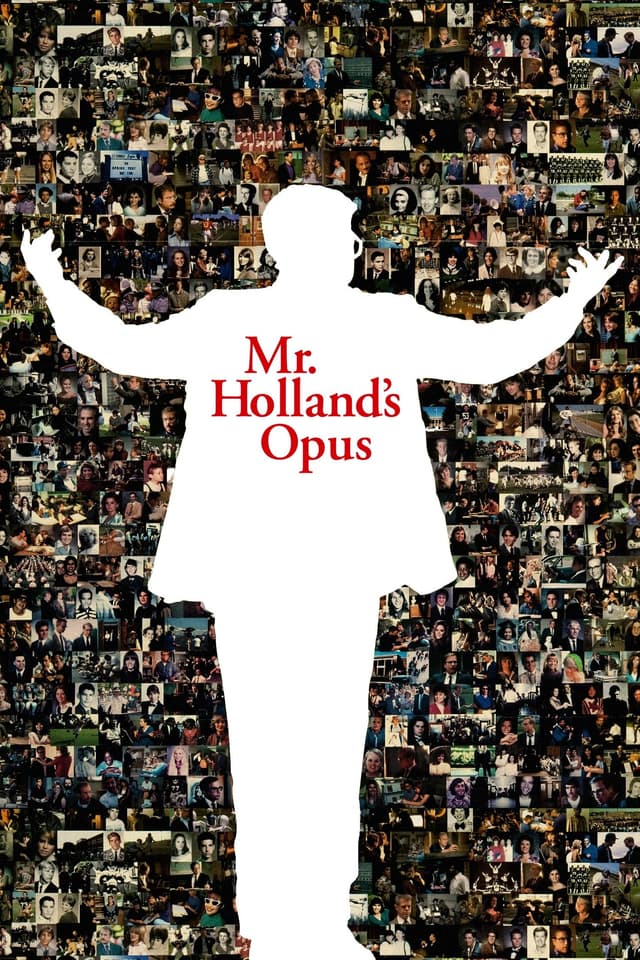
Mr. Holland's Opus (1995), directed by Stephen Herek and distributed by Buena Vista Pictures through Disney's Hollywood Pictures label, was produced on a reported budget of $31,000,000. Interscope Communications and PolyGram Filmed Entertainment co-financed the production alongside Hollywood Pictures, with the relatively modest investment reflecting a deliberate strategy: build a sweeping three-decade character drama around a single anchor performance from Richard Dreyfuss rather than spend on spectacle, effects, or large location moves.
The film became one of the rare mid-budget mid-1990s dramas to dramatically out-earn its production cost, taking in $106,267,663 worldwide against that $31,000,000 outlay. The math worked because the screenplay by Patrick Sheane Duncan demanded almost no expensive set construction: classrooms, school auditoriums, a suburban home, and a closing concert hall covered the vast majority of the picture, with the prosthetic aging of Dreyfuss across thirty story years substituting for elaborate period reconstruction.
Key Budget Allocation Categories
Mr. Holland's Opus distributed its $31,000,000 budget across the categories that mattered for a long-arc character study:
- Above-the-Line Talent: Richard Dreyfuss, an Oscar winner for The Goodbye Girl (1977) and a returning A-list dramatic lead after Postcards from the Edge and What About Bob?, commanded the largest single line item. Director Stephen Herek, fresh off the box office success of The Mighty Ducks (1992) and Disney's live-action 101 Dalmatians prep, took a feature-director fee in line with mid-budget studio drama. Supporting work from Glenne Headly, Jay Thomas, Olympia Dukakis, William H. Macy, and Jean Louisa Kelly added depth without star-tier salaries.
- Prosthetic Aging and Hair: Dreyfuss appears as Glenn Holland across thirty story years, from 1965 to 1995, which required a sustained makeup, hair, and prosthetic-aging program throughout principal photography. The film carried a more extensive prosthetics line than a typical contemporary drama because nearly every scene called for either the young, middle-aged, or older Holland, with continuity tracked across out-of-sequence shooting.
- Period Production Design: Set decoration, costumes, and props had to track three full decades of American high school life. The 1960s classrooms, 1970s teacher's lounge, 1980s school assemblies, and 1990s farewell concert each required distinct wardrobe, signage, archival posters, and student-extra styling. Production designer David Nichols and costume designer Aggie Guerard Rodgers handled the period turn on a tight schedule.
- Music Licensing: The score by Michael Kamen anchored the film, but the budget also covered theatrical licensing of John Lennon's "Beautiful Boy (Darling Boy)," which scored the emotional centerpiece tied to Holland's deaf son Cole. Additional needle drops spanning three decades of popular music, from Coltrane to Tower of Power to Stevie Wonder, required period-accurate clearances. Kamen also composed the original "American Symphony" piece performed at the film's climax, which doubled as an in-story composition and a real concert work.
- Portland Location Shoot: Principal photography took place primarily in Portland, Oregon, with John Marshall High School standing in for the fictional John F. Kennedy High School. The Oregon shoot covered roughly fourteen weeks across the autumn and winter of 1994-1995, with cast lodging, local crew, transportation, and stage rental representing a meaningful share of the budget. Oregon offered cooperative permits and a self-contained urban-suburban environment that allowed the production to play three decades without major relocation.
- Concert Climax: The closing sequence, in which Mr. Holland conducts his "American Symphony" before an auditorium of former students, required dressing a real concert hall, hiring a full orchestra of extras and players, and recording a live-feeling performance synced to Kamen's pre-recorded composition. The day cost a multiple of an average shoot day and was scheduled at the end of production to capture every key cast member returning for cameo appearances.
- Editing and Sound: The three-decade arc required intricate editorial work from Trudy Ship, with sound design that integrated classical, jazz, rock, and the in-world American Symphony into a single coherent track. The post schedule ran approximately seven months between February and September 1995 ahead of the December 29 release.
How Does Mr. Holland's Opus's Budget Compare to Similar Films?
At $31,000,000, Mr. Holland's Opus sits squarely in the mid-budget inspirational-teacher and Dreyfuss-led drama bracket of its era. The comparison set shows how the film over-performed:
- Dead Poets Society (1989): Budget $16,400,000 | Worldwide $235,860,116. Peter Weir's Robin Williams-led prep school drama spent roughly half what Mr. Holland's Opus cost and out-grossed it more than two to one, the gold-standard outlier in the inspirational-teacher genre.
- Dangerous Minds (1995): Budget $23,000,000 | Worldwide $179,519,401. The contemporaneous Michelle Pfeiffer drama released five months earlier in August 1995 cost less and earned more, anchored by Coolio's "Gangsta's Paradise" topping the Billboard Hot 100 for twelve weeks.
- School of Rock (2003): Budget $35,000,000 | Worldwide $131,282,949. Richard Linklater's Jack Black-led comedy is a roughly equivalent investment a decade later, with a similar 4x multiplier on worldwide gross to budget, suggesting the inspirational-music-teacher subgenre has a stable commercial ceiling.
- Good Will Hunting (1997): Budget $10,000,000 | Worldwide $225,933,435. Gus Van Sant's mentor drama, released two years later, cost a third of Mr. Holland's Opus and earned more than twice as much, riding original screenplay buzz and a Robin Williams Best Supporting Actor Oscar.
- Finding Forrester (2000): Budget $43,000,000 | Worldwide $80,049,764. The Sean Connery mentor drama spent more and earned less, illustrating how Mr. Holland's Opus's 3.4x return on production budget represented an outperformance rather than a category baseline.
Mr. Holland's Opus Box Office Performance
Mr. Holland's Opus opened on January 19, 1996 (following a December 29, 1995 limited Oscar-qualifying release in Los Angeles and New York), debuting at $4,800,420 from 1,225 screens in wide release. The film expanded steadily on positive word of mouth, eventually crossing 1,800 screens, and crucially held screens through Valentine's Day, Presidents' Day, and into the spring corridor, posting one of the cleanest extended-leg runs of the 1996 first quarter.
Against a $31,000,000 production budget, here is the financial breakdown:
Box Office Breakdown
Mr. Holland’s Opus

Mr. Holland's Opus returned approximately $1.90 to $2.08 in worldwide gross for every $1 invested when measured against total estimated production and marketing spend. Domestic receipts of $82,569,971 represented 78% of the worldwide haul, with international adding $23,697,692, a split that confirms the film played strongest with the American audiences who recognized the high school setting and three-decade cultural touchstones. The film's home video, television, and inflation-adjusted theatrical re-release ancillary revenue would push the project further into clear profitability over the late 1990s and 2000s.
The commercial success directly inspired The Mr. Holland's Opus Foundation, founded by Michael Kamen in 1996 to donate musical instruments to underfunded public school music programs across the United States, an extension of the film's central thesis that has now provided instruments worth tens of millions of dollars to thousands of schools.
Mr. Holland's Opus Production History
Patrick Sheane Duncan, a Vietnam veteran and screenwriter who had broken through with Mr. Saturday Night and Nick of Time, wrote the original Mr. Holland's Opus screenplay as a tribute to his own high school music teacher. The script circulated at studios for several years before Interscope Communications' Ted Field and Robert W. Cort acquired it and packaged it with Hollywood Pictures and PolyGram Filmed Entertainment in 1994. Stephen Herek, coming off The Mighty Ducks and reviewing offers across Disney's drama and family slate, attached as director after responding to the script's three-decade emotional arc.
Richard Dreyfuss was the first and only choice for Glenn Holland. Dreyfuss, who had won the Best Actor Oscar for The Goodbye Girl (1977) and who carried major dramatic credits including Close Encounters of the Third Kind (1977), Jaws (1975), and Stand by Me (1986), brought immediate above-the-title credibility. He agreed to the multi-decade prosthetic aging schedule and committed to learning conducting fundamentals from composer Michael Kamen, who served as music advisor in addition to scoring the film.
Principal photography took place primarily in Portland, Oregon between November 1994 and February 1995. John Marshall High School in the city's Beaumont-Wilshire neighborhood served as the primary stand-in for the fictional John F. Kennedy High School, with additional locations across the Portland metropolitan area covering the suburban home, dance halls, and music venues. The Oregon shoot allowed the production to capture multiple seasons of light and weather within a single contiguous schedule, supporting the three-decade time jumps without major relocations.
Michael Kamen's score, written in parallel with the shooting schedule, included the original "American Symphony" composition heard at the film's climax. The piece was recorded with a full orchestra and used the same musicians who would appear on camera in the closing sequence, ensuring the live performance read as authentically as possible. The licensing of John Lennon's "Beautiful Boy (Darling Boy)," which scores the moment Holland realizes the depth of his bond with his deaf son Cole, was negotiated directly with Yoko Ono's representatives and proved to be one of the film's most emotionally durable creative choices.
Post-production ran from February through September 1995 ahead of the December 29 Oscar-qualifying limited release and the January 19, 1996 nationwide expansion. Editor Trudy Ship navigated the three-decade narrative across roughly 142 minutes of finished runtime, with sound mixing layering classical, rock, jazz, and the in-world symphony into a single coherent track.
Awards and Recognition
Mr. Holland's Opus earned Richard Dreyfuss the most consequential recognition of the film's awards run: a Best Actor nomination at the 68th Academy Awards, his second Oscar nod after winning for The Goodbye Girl in 1978. Dreyfuss lost the 1996 Best Actor prize to Nicolas Cage for Leaving Las Vegas, in a year that also nominated Anthony Hopkins (Nixon), Sean Penn (Dead Man Walking), and Massimo Troisi (Il Postino).
The film received a Golden Globe nomination for Best Motion Picture - Drama and a Best Actor - Drama nod for Dreyfuss, with Dreyfuss also nominated by the Screen Actors Guild for Outstanding Performance by a Male Actor in a Leading Role. Michael Kamen's score for the film won the BMI Film Music Award and earned a Grammy nomination for Best Instrumental Composition Written for a Motion Picture or for Television. The film also received the Heartland Film Festival's Crystal Heart Award and was named one of the National Board of Review's Top Ten Films of 1995.
Beyond formal trophies, the most lasting institutional legacy is The Mr. Holland's Opus Foundation, established by Michael Kamen in 1996 in direct response to the film's success, which has donated thousands of musical instruments to underfunded school music programs across the United States and continues to operate today.
Critical Reception
Mr. Holland's Opus received warm reviews. The film holds a 75% approval rating on Rotten Tomatoes based on 51 critic reviews, with the critical consensus describing it as a sentimental but well-acted character study elevated by Dreyfuss's lived-in performance. On Metacritic, the film scored 67 out of 100, indicating generally favorable reviews. Audiences responded even more strongly: the film earned an A+ CinemaScore on opening weekend, one of the highest grades the polling service issues, signaling word-of-mouth that drove the long theatrical run.
Roger Ebert awarded the film three and a half stars in the Chicago Sun-Times, writing that the picture "works," praising Dreyfuss for delivering "a performance of great subtlety and complexity" that carries the long timeline. Janet Maslin of The New York Times called it "a generous, uncynical movie of the sort that's becoming all too rare," while Owen Gleiberman of Entertainment Weekly was more reserved, grading the film a B and writing that it occasionally slips into greeting-card sentiment but recovers through the strength of its lead.
Detractors, including Variety's Todd McCarthy, flagged the episodic structure and the film's tendency to telegraph emotional beats, particularly around the deaf son Cole's storyline. Even skeptical critics, however, singled out the concert finale as one of the most effective closing sequences of the year, and the film's enduring presence in classroom and family-film circulation reflects an audience response that has comfortably outlasted the initial critical reception.
Frequently Asked Questions
How much did it cost to make Mr. Holland's Opus (1995)?
The reported production budget was $31,000,000. The film was financed by Hollywood Pictures (a Disney subsidiary), Interscope Communications, and PolyGram Filmed Entertainment, with Buena Vista Pictures handling theatrical distribution under the Hollywood Pictures label.
How much did Mr. Holland's Opus earn at the box office?
The film grossed $82,569,971 domestically and $23,697,692 internationally, for a worldwide total of $106,267,663. It opened to $4,800,420 in wide release on January 19, 1996 from 1,225 screens and held screens steadily through the spring on strong word of mouth.
Was Mr. Holland's Opus a box office success?
Yes. Against a $31,000,000 production budget and an estimated $20,000,000 to $25,000,000 in marketing spend, the film returned approximately $1.90 to $2.08 in worldwide gross for every $1 invested. It was one of the most commercially successful mid-budget dramas of the 1995-1996 release window.
Who directed Mr. Holland's Opus?
Stephen Herek directed the film, working from an original screenplay by Patrick Sheane Duncan. Herek came to the project after directing The Mighty Ducks (1992) and prior to Disney's live-action 101 Dalmatians (1996).
Where was Mr. Holland's Opus filmed?
Principal photography took place primarily in Portland, Oregon between November 1994 and February 1995. John Marshall High School in Portland's Beaumont-Wilshire neighborhood served as the primary stand-in for the fictional John F. Kennedy High School, with additional locations across the Portland metropolitan area covering the suburban home and music venues.
Did Richard Dreyfuss win an Oscar for Mr. Holland's Opus?
No, but he was nominated. Dreyfuss earned a Best Actor nomination at the 68th Academy Awards, his second Oscar nod after winning Best Actor for The Goodbye Girl in 1978. He lost the 1996 Best Actor prize to Nicolas Cage for Leaving Las Vegas.
Who composed the score for Mr. Holland's Opus?
Michael Kamen composed the score, including the original "American Symphony" performed in the film's climax. Kamen also founded The Mr. Holland's Opus Foundation in 1996, which has donated thousands of musical instruments to underfunded public school music programs across the United States.
What song is used in the deaf son scene in Mr. Holland's Opus?
John Lennon's "Beautiful Boy (Darling Boy)" scores the emotional centerpiece in which Glenn Holland realizes the depth of his bond with his deaf son Cole. The theatrical licensing was negotiated directly with Yoko Ono's representatives and remains one of the film's most recognized creative choices.
How does Mr. Holland's Opus compare to other inspirational-teacher films?
Mr. Holland's Opus cost roughly twice as much as Dead Poets Society (1989), which spent $16,400,000 and earned $235,860,116 worldwide, but exceeded the four-times-budget multiplier shared by School of Rock (2003) ($35M budget, $131M worldwide). It out-performed Finding Forrester (2000), which cost $43,000,000 and earned only $80,049,764, and tracked just behind Dangerous Minds (1995), which earned $179,519,401 on a $23,000,000 budget.
What did critics think of Mr. Holland's Opus?
The film received generally favorable reviews, holding a 75% approval rating on Rotten Tomatoes (based on 51 critics) and a 67 out of 100 Metacritic score. Audiences gave the film an A+ CinemaScore on opening weekend, one of the highest grades the polling service issues. Roger Ebert awarded three and a half stars, praising Dreyfuss for delivering a performance of great subtlety and complexity.
Filmmakers
Mr. Holland’s Opus

Build budgets like this one in Saturation
Start from an industry-standard feature film template, import the schedule and rates you already have, and let the cost report keep itself current as you spend. Real-time collaboration, no spreadsheets.