McHale's Navy Budget
 Comedy
Updated
Synopsis
Former Navy lieutenant commander Quinton McHale, retired to a quiet Caribbean smuggling life with his PT-73 crew, is recalled to active duty when an international terrorist threatens the island. McHale and his ragtag crew must stop the global criminal mastermind in this big-screen reboot of the 1962-1966 ABC sitcom.
What Is the Budget of McHale's Navy (1997)?
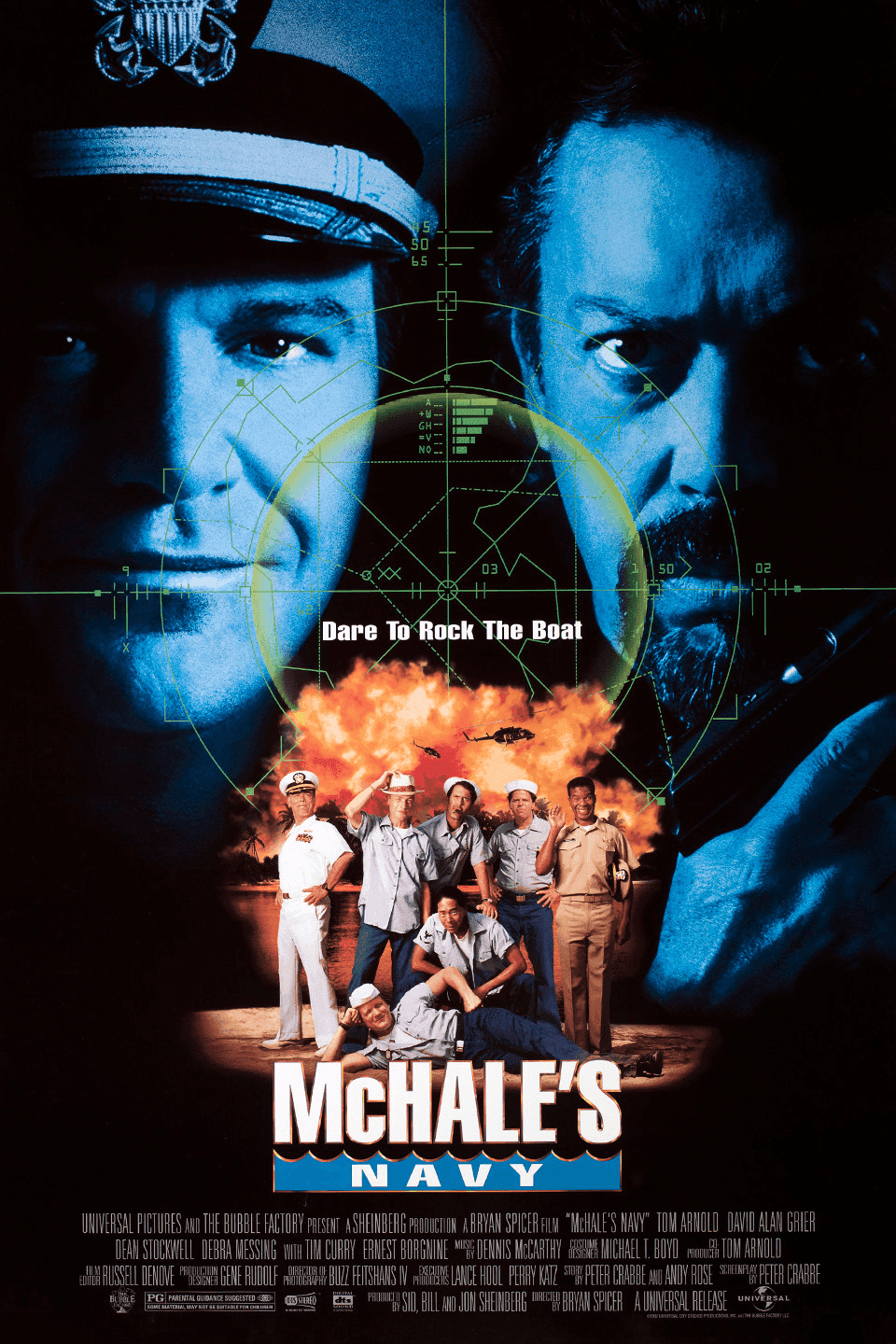
McHale's Navy (1997), directed by Bryan Spicer and distributed by Universal Pictures, was produced on a reported budget of $42,000,000. The big-screen reboot of the 1962-1966 ABC sitcom that originally starred Ernest Borgnine and Tim Conway was financed by Universal in partnership with Bubble Factory, with Sheinberg Productions executive-producing through the involvement of former Universal chief Sid Sheinberg. The $42,000,000 commitment was substantial for a comedy reboot of a three-decade-old sitcom property, reflecting the location shooting in Mexico, the practical PT-boat sequences, and the comedy ensemble headlined by Tom Arnold.
The financial structure was built around Tom Arnold's post-True Lies recognition and the family-comedy nostalgia for the original sitcom. Arnold took the lead at a feature rate appropriate to his True Lies and Big Bully visibility, with Dean Stockwell, David Alan Grier, Debra Messing, and original sitcom cast member Ernest Borgnine in a cameo as Cobra. Director Bryan Spicer, primarily a television director (Picket Fences, The X-Files), commanded a feature-director rate appropriate to his first major studio comedy assignment. The bulk of the budget went to Mexican location shooting, practical PT-boat and helicopter work, and a Dennis McCarthy score.
Key Budget Allocation Categories
The $42,000,000 budget for McHale's Navy was distributed across several core production areas:
- Above-the-Line Talent: Tom Arnold led the cast as Quinton McHale at a feature rate appropriate to his post-True Lies visibility. Dean Stockwell, David Alan Grier, Tim Curry as the villain Major Vladikov, Debra Messing as McHale's love interest, and original sitcom cast member Ernest Borgnine in a cameo as Cobra rounded out the principal cast. Director Bryan Spicer commanded a television-to-feature rate.
- Mexican Location Shooting: Principal photography ran primarily in Acapulco, Puerto Vallarta, and additional Mexican coastal locations doubling for the fictional Caribbean island San Marcos. The production based out of resort properties, operated PT-boat sequences in Mexican waters, and used Mexican local crews. Location, freight, and travel costs across the Mexican block were substantial.
- Practical PT-Boat and Helicopter Sequences: The film required substantial marine-stunt and helicopter coordination, with practical PT-boat chases, sinking sequences, and a climactic helicopter assault. The marine-stunt budget was a meaningful below-the-line line item, with multiple period-correct PT-boat hulls assembled or modified for the production.
- Dennis McCarthy Score: Composer Dennis McCarthy, primarily known at the time for his television work on Star Trek: Deep Space Nine and Star Trek: Voyager, scored the film with a full orchestral approach that referenced the bouncy theme song of the original sitcom. The soundtrack budget covered original composition, orchestra recording, and licensing of period needle drops used in the comedy sequences.
- Production Design and Practical Effects: Production designer Gene Rudolf dressed the fictional San Marcos island base, the PT-73 boat interiors, and the villain's mountain lair. Practical effects included multiple explosion sequences and the climactic destruction of the villain's base, requiring substantial pyrotechnics coordination.
- Marketing and Theatrical Release: Universal opened the film wide on April 18, 1997 on 1,705 screens, with an estimated prints and advertising spend in the $15,000,000 to $20,000,000 range to support the spring family-comedy positioning. The marketing campaign emphasized Tom Arnold's broad comedy approach and the nostalgia for the original sitcom, both of which struggled to find a 1997 family audience.
How Does McHale's Navy's Budget Compare to Similar Films?
At $42,000,000, McHale's Navy sits in the upper-mid range for mid-1990s comedy reboots of television properties. The comparison set illustrates how its commercial outcome diverged from peers:
- The Beverly Hillbillies (1993): Budget $20,000,000 | Worldwide $44,000,000. The previous Penelope Spheeris television-reboot comedy cost less than half of McHale's Navy and grossed nearly ten times worldwide, illustrating the gap between a TV-reboot comedy that found its audience and one that did not.
- The Brady Bunch Movie (1995): Budget $12,000,000 | Worldwide $46,576,941. Paramount's earlier television-reboot comedy cost less than a third of McHale's Navy and grossed ten times worldwide, providing a stark comparison for the same category.
- Sgt. Bilko (1996): Budget $30,000,000 | Worldwide $30,341,536. The Steve Martin military-comedy television reboot cost roughly 70% of McHale's Navy and grossed nearly seven times worldwide, providing the closest direct comparison for a 1990s military-themed sitcom reboot.
- Spy Hard (1996): Budget $26,000,000 | Worldwide $26,937,449. The Leslie Nielsen spy-spoof comedy cost approximately 60% of McHale's Navy and grossed nearly six times worldwide, illustrating how a broad spoof comedy could substantially outperform McHale's Navy in the same general comedy window.
- That Darn Cat (1997): Budget $30,000,000 | Worldwide $18,556,915. The contemporaneous Disney family-comedy reboot cost less than McHale's Navy and grossed four times worldwide, suggesting Universal's budget was substantially overcommitted for the audience the McHale's Navy brand could deliver in 1997.
McHale's Navy Box Office Performance
McHale's Navy opened wide on April 18, 1997 on 1,705 screens, earning $2,000,000 in its opening weekend and finishing thirteenth at the domestic box office behind Liar Liar, Anaconda, Volcano, Murder at 1600, Romy and Michele's High School Reunion, and several other films. The opening was catastrophic for a $42,000,000 studio production opening on 1,705 screens, and the film disappeared from the domestic box office reports within weeks.
Against a $42,000,000 production budget, the film needed approximately $100,000,000 worldwide to reach profitability after marketing. Here is the financial breakdown:
Box Office Breakdown
McHale's Navy

McHale's Navy returned approximately $0.08 in worldwide theatrical revenue for every $1 invested when measured against total estimated production and marketing spend, placing it among the most decisive box office bombs of 1997. The domestic gross of $4,531,563 was effectively the entire commercial return, with Box Office Mojo not consolidating an international theatrical figure, indicating that international territories largely passed on a theatrical release in favor of direct-to-video and pay-television treatment.
The film's commercial collapse killed any further reboot consideration of the McHale's Navy property and contributed to the broader contraction of the mid-1990s television-reboot comedy cycle. The losses were absorbed by Universal across the studio's 1997 fiscal year and have been retrospectively cited as one of the more notable Sid Sheinberg-era Bubble Factory disappointments.
McHale's Navy Production History
Development began at Universal in 1995 immediately after the modest success of The Brady Bunch Movie demonstrated commercial appetite for self-aware television-reboot comedies. Former Universal chief Sid Sheinberg, through his Bubble Factory production company, optioned the McHale's Navy property from the original television production company and brought in Tom Arnold to anchor the project. Screenwriter Peter Crabbe delivered the original screenplay framed as a contemporary update of the sitcom premise, with the action shifted to a Caribbean smuggling-and-terrorism plot rather than the original World War II Pacific Theater setting.
Bryan Spicer was attached to direct in early 1996, making McHale's Navy one of his earliest feature credits after extensive television work on Picket Fences, The X-Files, Wings, and the Fox Mulder-related episodes that had attracted Universal's attention. Casting Tom Arnold as Quinton McHale was a deliberate effort to position the film for Arnold's post-True Lies and Big Bully audience, with Dean Stockwell, David Alan Grier, and Debra Messing filling out the ensemble. Tim Curry signed on as Major Vladikov, the international terrorist villain, with Ernest Borgnine appearing in a cameo as Cobra, his original 1960s sitcom character reimagined as a separate eccentric figure.
Principal photography ran from June to October 1996, primarily on location in Acapulco, Puerto Vallarta, and additional coastal sites across Mexico doubling for the fictional Caribbean island San Marcos. The production based out of resort properties, operated practical PT-boat sequences in Mexican waters with multiple period-correct hulls, and used Mexican local crews for the bulk of the below-the-line work. The marine-stunt unit, led by water specialists, ran a separate operation from the main unit to capture the PT-boat chase and sinking sequences.
Dennis McCarthy recorded the score in early 1997, and the film was completed for an April 18, 1997 release. The marketing campaign emphasized Tom Arnold's broad comedy approach and the nostalgia for the original sitcom, both angles that struggled to find a 1997 family audience. Test screenings in late 1996 and early 1997 had shown weak audience response, but the studio elected to proceed with the wide release on the basis of the substantial sunk-cost commitment to a feature production at this budget level.
Awards and Recognition
McHale's Navy received no major awards nominations. The film failed to register at the Academy Awards, Golden Globes, BAFTA Awards, Saturn Awards, or any of the major industry honors. Tom Arnold's lead performance generated mild Razzie attention but did not result in any actual nominations, with the 1997 Razzie nominations going to other broader-target underperformers including Speed 2: Cruise Control and Batman & Robin.
Dennis McCarthy's score earned no major industry recognition. The film has retained minimal catalog visibility, primarily appearing in retrospective lists of the failed mid-1990s television-reboot comedy cycle. The original 1962-1966 ABC sitcom remains the more frequently cited cultural touchstone, with the 1997 film almost never referenced in academic or popular discussions of either Tom Arnold's career or the broader history of television reboot films.
Critical Reception
McHale's Navy received overwhelmingly negative reviews. The film holds a 0% approval rating on Rotten Tomatoes based on 12 critic reviews retrospectively logged, with a critical consensus that called it laugh-free, inert, and unable to justify either the budget or the property revival. Contemporary 1997 reviews ranged from harshly negative to actively hostile. Audiences gave the film a C-minus CinemaScore, well below the family-comedy floor and a clear signal that the limited audience that did attend reacted poorly to the broad-comedy approach.
Critics broadly excoriated the screenplay, the strained Tom Arnold lead performance, the unfocused direction by Bryan Spicer, and the dated approach to a Cold War-adjacent property in a post-Cold War 1997 landscape. Roger Ebert in the Chicago Sun-Times gave the film one star and wrote that "the movie has the unmistakable feel of a project that should never have left development hell." Janet Maslin in The New York Times called it "a hapless reboot that mistakes high-energy mugging for comedy and Caribbean scenery for ambition."
Genre and trade press were no more forgiving. Variety's Joe Leydon wrote that "Tom Arnold mugs furiously to no effect, while director Bryan Spicer's pacing makes the film's 110 minutes feel like a tour of duty." The overwhelmingly negative critical reception combined with the commercial collapse has positioned McHale's Navy as one of the most notable box-office disasters of 1997 and a frequent inclusion in retrospective lists of failed television-reboot films and Tom Arnold leading-man vehicles.
Frequently Asked Questions
How much did McHale's Navy (1997) cost to make?
The reported production budget was $42,000,000. Universal Pictures financed the film in partnership with Bubble Factory, the production company of former Universal chief Sid Sheinberg, and Sheinberg Productions. The bulk of the budget went to Mexican location shooting, practical PT-boat sequences, and the comedy ensemble led by Tom Arnold.
How much did McHale's Navy earn at the box office?
The film grossed $4,531,563 in the United States, finishing thirteenth in its opening weekend on April 18, 1997. Comprehensive international box office figures are not consolidated in publicly available Box Office Mojo data, indicating that international territories largely passed on a theatrical release in favor of direct-to-video and pay-television treatment.
Was McHale's Navy a box office bomb?
Yes. Against a $42,000,000 production budget and an estimated $15,000,000 to $20,000,000 in marketing spend, the film returned approximately $0.08 in worldwide gross for every $1 invested. Universal absorbed an estimated loss of around $55,000,000, placing it among the most decisive box office disasters of 1997 and contributing to the broader contraction of the mid-1990s television-reboot comedy cycle.
Is the slug 'mchale-s-navy-1962' for the original TV series or the 1997 film?
The slug references the original 1962-1966 ABC sitcom premiere year, but the CMS entry and this article cover the 1997 Universal feature-film reboot directed by Bryan Spicer and starring Tom Arnold. The original 1962-1966 television series starred Ernest Borgnine and Tim Conway and ran for four seasons, but is not the subject of this budget entry. Ernest Borgnine appears in a cameo in the 1997 film as Cobra, his original sitcom character reimagined as a separate eccentric figure.
Who directed McHale's Navy (1997)?
Bryan Spicer directed the film. McHale's Navy was one of Spicer's earliest feature credits after extensive television work on Picket Fences, The X-Files, and Wings. The screenplay was written by Peter Crabbe, based on the characters created by Edward Montagne for the original 1962-1966 ABC television series.
Where was McHale's Navy filmed?
Principal photography took place from June to October 1996, primarily on location in Acapulco, Puerto Vallarta, and additional coastal sites across Mexico doubling for the fictional Caribbean island San Marcos. The production based out of resort properties and operated practical PT-boat sequences in Mexican waters with multiple period-correct hulls.
Who plays Quinton McHale in the 1997 film?
Tom Arnold plays Quinton McHale in the 1997 reboot. Arnold came to the project off his post-True Lies and Big Bully visibility. The character was originally played by Ernest Borgnine in the 1962-1966 ABC sitcom, and Borgnine appears in a cameo in the 1997 film as Cobra, his original sitcom character reimagined.
Who scored McHale's Navy (1997)?
Dennis McCarthy scored the film with a full orchestral approach that referenced the bouncy theme song of the original 1960s sitcom. McCarthy was primarily known at the time for his television work on Star Trek: Deep Space Nine and Star Trek: Voyager.
What did critics think of McHale's Navy (1997)?
The film received overwhelmingly negative reviews, with a 0% approval rating on Rotten Tomatoes based on 12 critic reviews. Audiences gave it a C-minus CinemaScore. Roger Ebert gave it one star, writing that the film felt like a project that should never have left development hell. Critics excoriated the screenplay, Tom Arnold's strained lead performance, and the dated Cold War-adjacent property approach in a post-Cold War 1997 landscape.
Did McHale's Navy get a sequel?
No. The catastrophic commercial and critical reception killed any further reboot consideration of the McHale's Navy property. The 1997 film stands as the final feature-film attempt to revive the property, with no subsequent theatrical, television, or streaming reboot in development as of 2026.
Filmmakers
McHale's Navy

Official Trailer
Build budgets like this one in Saturation
Start from an industry-standard feature film template, import the schedule and rates you already have, and let the cost report keep itself current as you spend. Real-time collaboration, no spreadsheets.