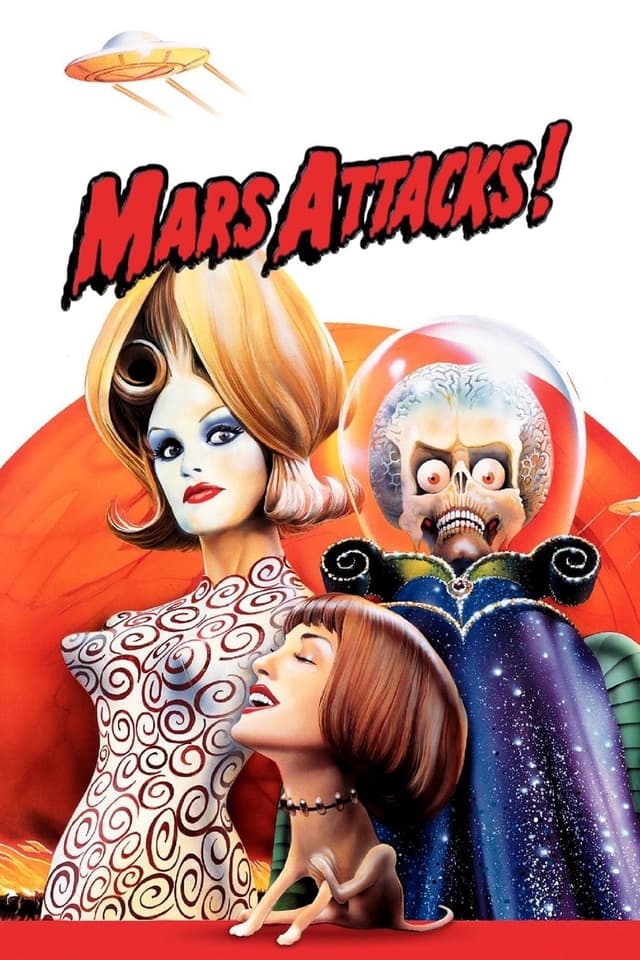
Mars Attacks! Budget
 ComedyFantasyScience Fiction106 minutes
Updated
Synopsis
It is a normal day for everyone, until President of the United States James Dale (Jack Nicholson) announces Martians have been spotted circling Earth. The Martians land and a meeting is arranged, but not everything goes to plan, and the Martians seem to have other plans for Earth. Are they just misunderstood beings or do they really want to destroy all of humanity?
What Is the Budget of Mars Attacks!?
Mars Attacks! (1996) was produced on a budget of $70 million, financed by Warner Bros. and distributed worldwide by the studio. Director Tim Burton, coming off the commercial success of Batman Returns (1992) and Ed Wood (1994), was given a large canvas to realize his adaptation of the cult Topps trading card series from 1962. The budget covered an all-star ensemble cast headlined by Jack Nicholson in a dual role, a massive production design effort, and a late pivot from stop-motion animation to computer-generated imagery for the Martian characters after early tests revealed the stop-motion approach would require far more time and money than initially scoped.
Originally, Tim Burton planned to use stop-motion puppets for the Martians, a technique consistent with his aesthetic on The Nightmare Before Christmas and other projects. After test footage proved the look was not landing, Industrial Light and Magic was brought in to create fully CG Martians, a decision that added significant cost and production complexity mid-shoot. The production also required extensive practical sets, location work across multiple US states, and the logistics of coordinating dozens of A-list actors across different shooting schedules.
Key Budget Allocation Categories
- Above-the-Line Talent: Jack Nicholson commanded top dollar for his dual performance as President James Dale and Las Vegas lounge lizard Art Land. The supporting ensemble, including Glenn Close, Annette Bening, Pierce Brosnan, Danny DeVito, Martin Short, Sarah Jessica Parker, Michael J. Fox, Rod Steiger, and Tom Jones, required individual negotiations that collectively pushed above-the-line costs well above $20 million. Tom Jones, appearing as himself, added an iconic cameo that cost a premium despite its brevity.
- Visual Effects and Martian Animation: The decision to replace stop-motion puppets with fully CG Martians midway through production created a significant budget overrun. Industrial Light and Magic built the Martian characters from scratch in CG, animating their skeletons, translucent helmets, and disintegration rays. This pivot consumed an estimated $15 to $20 million of the total budget and extended the post-production schedule by several months.
- Production Design and Practical Sets: Production designer Wynn Thomas constructed a sprawling White House interior, a Las Vegas casino floor, a Kansas farmhouse compound, and multiple alien spacecraft interiors. The film's deliberately gaudy, Pop Art aesthetic required custom furniture, costumes, and set dressing that could not be sourced from studio stock. Cinematographer Peter Suschitzky, known for his work with David Cronenberg, lit the film in saturated primaries to match the trading card source material.
- Music: Composer Danny Elfman, Burton's longtime collaborator, scored the film with a theremin-heavy orchestral soundtrack evoking 1950s science fiction B-movies. Elfman's score required a full orchestra recording session and bespoke sound design for the Martian ray guns and spacecraft. The film also licensed Tom Jones's back catalog for the Las Vegas sequences, adding sync licensing costs on top of the original score budget.
- Location Filming: Production traveled to Las Vegas, Nevada for exterior casino district shots, Dodge City, Kansas for the rural sequences, and Washington, D.C. for exterior establishing shots of the White House and National Mall landmarks. Coordinating multi-city location work with a cast of dozens added substantial travel, hotel, and local crew costs to the below-the-line budget.
How Does Mars Attacks!'s Budget Compare to Similar Films?
Mars Attacks! was released in December 1996, just five months after Independence Day dominated the summer box office with its own alien invasion storyline. The comparison was inevitable, and the contrast in commercial results is striking. Tim Burton's film spent nearly as much to make as Roland Emmerich's blockbuster but earned a fraction of the worldwide gross. The tone could not have been more different: Independence Day played its premise earnestly, while Mars Attacks! was a pitch-black satire that confused mainstream audiences expecting a crowd-pleaser.
- Independence Day (1996): Budget $75M | Worldwide BO $817M | Roland Emmerich's earnest alien invasion spectacle opened five months before Mars Attacks! and defined audience expectations for the genre that summer. Its $817M worldwide gross made it the highest-grossing film of 1996 and set an impossible benchmark for the Burton film to chase.
- Batman Returns (1992): Budget $80M | Worldwide BO $266M | Tim Burton's own prior blockbuster showed he could direct dark, studio-scale spectacle successfully. Batman Returns was considered too dark for mainstream audiences by Warner Bros., a controversy that contributed to the studio replacing Burton with Joel Schumacher for the franchise. Mars Attacks! repeated the same gamble on tone with worse results.
- Ed Wood (1994): Budget $18M | Worldwide BO $5.9M | Burton's passion project immediately before Mars Attacks! was a critical darling and commercial disappointment. It won Martin Landau an Academy Award but earned only $5.9M worldwide, a result that made Warner Bros. nervous even before Mars Attacks! underperformed.
- Starship Troopers (1997): Budget $105M | Worldwide BO $121M | Paul Verhoeven's satirical science fiction film, released a year after Mars Attacks!, shared a similar impulse: use an alien invasion as cover for political and social satire. Starship Troopers also baffled audiences expecting a straightforward action film and underperformed domestically, though it earned more internationally.
Mars Attacks! Box Office Performance
Mars Attacks! opened in North American theaters on December 13, 1996, distributed by Warner Bros. The film earned $37.8 million domestically against a $70 million production budget, a significant domestic shortfall. International markets showed considerably more enthusiasm: the film earned approximately $63.6 million outside North America, particularly in France, Germany, and Japan, where Burton's aesthetic sensibility and the film's absurdist tone resonated more broadly. The worldwide total of $101.4 million represents a rare case of a film that earned nearly twice as much abroad as at home.
Adding an estimated $30 million in prints and advertising costs, Warner Bros.'s total investment in Mars Attacks! was approximately $100 million. With theaters retaining roughly 50 percent of the gross, the studio's share of the worldwide box office was approximately $50.7 million, leaving the film far short of recouping its combined production and marketing expenditure in theatrical release alone. Home video and international television licensing helped close the gap over time, but Mars Attacks! was broadly considered a commercial disappointment relative to its cost and the expectations Warner Bros. had placed on a Tim Burton holiday tentpole.
Box Office Breakdown
Mars Attacks!

Mars Attacks! earned roughly $1.45 for every $1 invested in production, but once prints and advertising are included in the denominator, the film returned approximately $0.51 on the dollar in theatrical revenue alone. The film's CinemaScore grade of C+ reflected audience confusion over its tone, and weak word-of-mouth contributed to a steep domestic drop after its opening weekend. The film has since built a devoted cult following, and its home video and streaming residuals have made it profitable over the long term, though it was not the holiday hit Warner Bros. had hoped for.
Mars Attacks! Production History
Mars Attacks! originated as a development project based on the notorious Topps trading card series from 1962, which depicted Martian invaders committing graphic acts of violence against humans in lurid painted illustrations. The cards were so controversial that Topps pulled them from production shortly after release, making them collector's items for decades. Producer Larry Franco acquired the rights, and screenwriter Jonathan Gems developed a script that preserved the cards' gleeful mayhem while building a satirical narrative around Washington bureaucracy, celebrity culture, and American hubris. Tim Burton signed on to direct, drawn to the project's connection to the 1950s science fiction B-movies he grew up watching.
Principal photography began in 1995 with a production plan that called for stop-motion animation puppets to portray the Martian characters, consistent with the technique used by Henry Selick on The Nightmare Before Christmas. Tim Burton had championed stop-motion as the right visual language for the project. However, after early puppet tests were completed, Burton and the producers concluded the results were not achieving the right look. Industrial Light and Magic was contracted to replace the Martians with fully computer-generated characters, a decision that required substantial reworking of scenes already shot and added months to the post-production schedule. The CG Martians became one of the film's most distinctive visual elements, though the production had not initially planned to rely on the technology.
The film was shot by cinematographer Peter Suschitzky on locations including Las Vegas, Nevada and Washington, D.C., with extensive studio work at Warner Bros. facilities. Assembling the ensemble cast required precise scheduling across dozens of actors with competing commitments. Jack Nicholson's dual role as President Dale and Art Land required costume and makeup changes between separate shooting days. Composer Danny Elfman scored the film in post-production, incorporating theremin and orchestral arrangements that consciously referenced Ennio Morricone and the Bernard Herrmann tradition of 1950s science fiction scores.
Warner Bros. positioned Mars Attacks! as a major holiday release for December 1996, scheduling it in the same season as Independence Day's massive re-release push on video. The studio's marketing campaign leaned into the absurdist comedy angle, but test screenings showed audiences were divided on whether the film was funny or simply bizarre. The theatrical run confirmed those divisions: critics were sharply split, and the film opened below expectations. Tim Burton has described Mars Attacks! as one of his most personal projects despite its commercial failure, noting that the film's rejection by mainstream audiences in 1996 and its subsequent cult status mirrors the story of the original trading cards themselves.
Awards and Recognition
Mars Attacks! received no major awards nominations during its initial theatrical run, a reflection of both its commercial disappointment and its critical reception, which was too mixed to generate awards traction. The film's CinemaScore grade of C+ placed it among the weakest-performing releases of the holiday season relative to audience expectations. The Academy Awards, Golden Globes, and BAFTA all passed on the film, which was not unusual for a genre satire that underperformed at the box office.
In the years since its release, Mars Attacks! has been recognized as an important entry in Tim Burton's filmography and a distinctive example of 1990s Hollywood blockbuster filmmaking. Danny Elfman's score has been cited by film music critics as one of his most inventive compositions, and the film's visual design has been referenced in retrospective surveys of science fiction production design. The film is regularly screened at genre festivals and retrospective events dedicated to Burton's work, where it has found the appreciative audience that eluded it in 1996.
Critical Reception
Mars Attacks! earned a 53% approval rating on Rotten Tomatoes and a score of 52 out of 100 on Metacritic, making it one of Tim Burton's most divisively reviewed films. Critics who admired the film praised its commitment to its own absurdist vision and its willingness to kill off major stars with anarchic glee. Roger Ebert gave the film three stars, writing that it achieved exactly what it set out to do as a spoof of alien invasion movies and that audiences expecting Independence Day-style heroics were simply watching the wrong film. The Chicago Tribune and Los Angeles Times were among the outlets offering strong positive reviews.
Critics who disliked the film argued that its relentless irony wore thin over two hours and that the satire lacked sufficient emotional stakes to justify the audience's investment. Janet Maslin of The New York Times wrote that the film was so committed to its own detachment that it became difficult to care about any of the characters, even ironically. The film's marketing had primed audiences for broad comedy, and several critics noted that the actual tone was closer to a deadpan art film than a studio comedy. The CinemaScore grade of C+ from opening-weekend audiences reflected this disconnect between expectation and delivery.
The film holds an IMDb rating of 6.3 out of 10 based on over 200,000 user ratings, suggesting a broad audience that finds the film merely serviceable, while a devoted cult minority rates it much higher. Home video releases have brought new generations of viewers to the film, and its reputation has gradually improved among critics who have reframed it as a deliberate anti-blockbuster made at blockbuster scale. Mars Attacks! is now frequently cited alongside Starship Troopers and Idiocracy as films whose satirical premises were misunderstood upon release and better appreciated in retrospect.
Frequently Asked Questions
How much did Mars Attacks! cost to make?
The production budget was $70,000,000. Warner Bros. financed the all-star sci-fi comedy, betting on Tim Burton's post-Batman cachet and an ensemble cast that included three Oscar winners. The visual effects budget alone exceeded $20,000,000.
How much did Mars Attacks! earn at the box office?
The film grossed $37,777,544 domestically and $63,560,000 internationally, for a worldwide total of approximately $101,300,000. It opened to $9,388,000 on December 13, 1996, finishing third behind Jerry Maguire and Beavis and Butt-Head Do America.
Who directed Mars Attacks!?
Tim Burton directed the film. It was Burton's sixth feature after Pee-wee's Big Adventure (1985), Beetlejuice (1988), Batman (1989), Batman Returns (1992), and Ed Wood (1994). Mars Attacks! was his first major box office disappointment.
Who is in the cast of Mars Attacks!?
The ensemble cast includes Jack Nicholson in dual roles as President James Dale and Las Vegas developer Art Land, with Glenn Close as the First Lady, Pierce Brosnan, Annette Bening, Sarah Jessica Parker, Michael J. Fox, Rod Steiger, Tom Jones, Lukas Haas, Natalie Portman, and Martin Short.
Is Mars Attacks! based on something?
Yes. The film adapts the 1962 Topps trading card set Mars Attacks, illustrated by Wally Wood, Bob Powell, and Norman Saunders. The original 55-card series was pulled from shelves in 1962 after parent complaints about violent imagery, making it a cult collectible by the time Burton acquired the rights.
Where was Mars Attacks! filmed?
Principal photography took place in Burbank and on location across Nevada and Arizona, including extensive Las Vegas Strip sequences. Stage work occurred on the Warner Bros. lot, with extensive practical effects miniatures supplementing the CGI Martians.
How were the Martians created?
Tim Burton initially planned stop-motion Martians from Henry Selick's team, but the technique was abandoned for cost reasons in favor of CGI from Industrial Light & Magic. The decision contributed to the elevated $70,000,000 budget and ironically dated the visual effects more quickly than stop motion would have.
What did critics think of Mars Attacks!?
Reviews were mixed, with a 56% approval rating on Rotten Tomatoes and a 52 out of 100 score on Metacritic. Critics praised the design and Jack Nicholson's commitment but objected to the scattershot ensemble structure and tonal whiplash between camp comedy and graphic violence.
Was Mars Attacks! a box office bomb?
Yes, by Warner Bros. expectations. Against the $70,000,000 production budget and an estimated $30,000,000 to $40,000,000 in marketing spend, the worldwide gross of approximately $101,300,000 fell well short of the 2.5x theatrical-profitability rule. The film became a cult favorite on home video, which closed much of the financial gap.
How does Mars Attacks! compare to Independence Day?
The films faced off in 1996 as competing alien-invasion blockbusters. Independence Day, released July 3, 1996 with a $75,000,000 budget, grossed $817,400,000 worldwide. Mars Attacks!, released December 13, was widely viewed as a satirical response, but Burton's film could not approach the same commercial scale.
Official Trailer
Build budgets like this one in Saturation
Start from an industry-standard feature film template, import the schedule and rates you already have, and let the cost report keep itself current as you spend. Real-time collaboration, no spreadsheets.