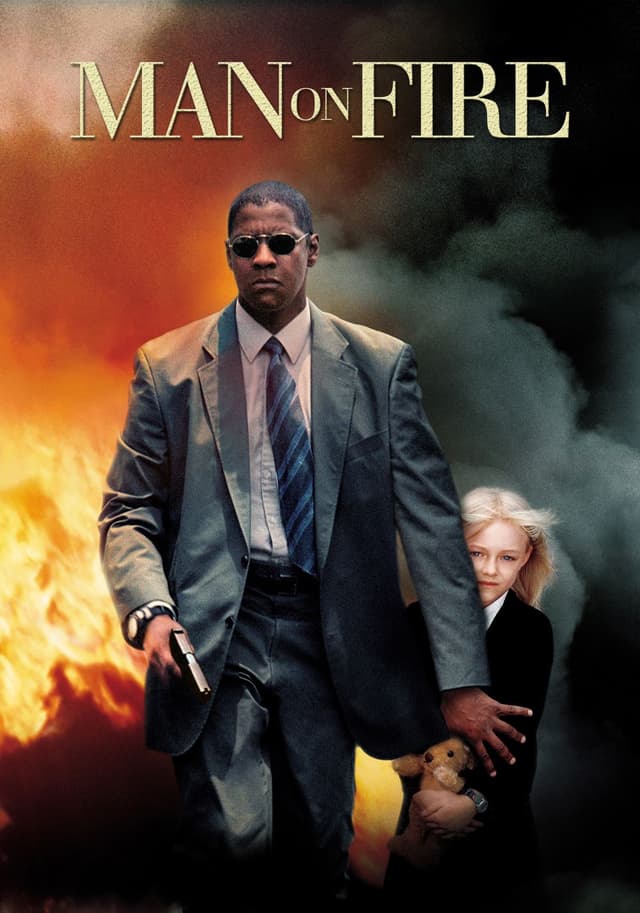
Man on Fire Budget
 ActionDramaThriller2h 26m
Updated
Synopsis
"Man on Fire" is a gripping action thriller that follows the story of John Creasy, a former CIA operative turned bodyguard, portrayed by Denzel Washington. Set against the backdrop of Mexico City, Creasy is hired to protect a young girl named Pita, played by Dakota Fanning, the daughter of a wealthy businessman. Initially reluctant and haunted by his past, Creasy forms a deep bond with Pita, finding a renewed sense of purpose in his life.
When Pita is kidnapped, Creasy's world is turned upside down. Fueled by rage and a desire for vengeance, he embarks on a relentless quest to rescue her, taking on the criminal underworld with brutal efficiency. As he navigates a web of corruption and betrayal, Creasy's transformation from protector to avenger showcases the lengths one will go to for love and redemption. The film masterfully blends intense action sequences with emotional depth, making it a compelling exploration of sacrifice and the human spirit.
What is the budget of Man on Fire?
"Man on Fire," an action released in 2004, was directed by Tony Scott and stars Denzel Washington, Dakota Fanning. The production budget was $70,000,000, placing it in the high-budget range for action productions of its era.
Key Budget Allocation Categories
While specific budget breakdowns are not publicly available, typical cost drivers for an action production like this include:
- Stunts, Action Sequences & Visual Effects: Action films allocate a substantial portion of their budget to choreographing and executing practical stunts, pyrotechnics, and CGI-heavy sequences.
- Above-the-Line Talent (Cast & Director): A-list talent commands significant upfront fees plus backend participation.
- Production Design, Sets & Locations: Action films frequently require multiple international shooting locations, large-scale set construction, vehicle acquisitions and modifications, and specialized equipment , all of which drive production costs well above those of dialogue-driven genres.
- Development: When a remake of Man on Fire was first considered, producer Arnon Milchan, who also produced the 1987 version, initially looked at directors Michael Bay and Antoine Fuqua before reaching out to Tony Scott to see if he was still interested.
What were the major cost factors in Man on Fire?
Several factors contributed to the overall production costs of "Man on Fire."
- Stunts: Stunts, Action Sequences & Visual Effects is one of the primary cost drivers in action productions of this scale.
- Above-the-Line Talent (Cast: Above-the-Line Talent (Cast & Director) is one of the primary cost drivers in action productions of this scale.
- Production Design: Production Design, Sets & Locations is one of the primary cost drivers in action productions of this scale.
How Does Man on Fire's Budget Compare to Similar Films?
At $70,000,000, Man on Fire sits in the high-budget range. Here is how it compares to productions with a similar budget:
- A Civil Action (1998): Budget $70,000,000, Worldwide Gross $56,709,981
- Babylon A.D. (2008): Budget $70,000,000, Worldwide Gross $72,109,200
- Beowulf (2007): Budget $70,000,000, Worldwide Gross $195,735,876
- Couples Retreat (2009): Budget $70,000,000, Worldwide Gross $171,844,840
- Dudley Do-Right (1999): Budget $70,000,000, Worldwide Gross $10,000,000
The median budget for wide-release action films in the 2000s ranges from $30 to 80M for mid-budget to $150M+ for tentpoles.
Man on Fire Box Office Performance
"Man on Fire" earned $77,911,774 domestically and $130,300,000 worldwide at the box office. Against a production budget of $70,000,000, the film showed modest profitability in theatrical release.
A film typically needs to earn approximately twice its production budget to cover marketing and distribution costs. For "Man on Fire," that break-even threshold was roughly $140,000,000. With worldwide earnings of $130,300,000, the film fell short of that threshold but recouped its production costs in theatrical release.
Box Office Breakdown
Man on Fire

At 86.1%, "Man on Fire" returned its production investment but margin was tight after marketing and distribution costs.
Man on Fire Production History
When a remake of Man on Fire was first considered, producer Arnon Milchan, who also produced the 1987 version, initially looked at directors Michael Bay and Antoine Fuqua before reaching out to Tony Scott to see if he was still interested. 20th Century Fox intended for the film to remain set in Italy, with an early draft of the script taking place in Naples. However, Scott argued that if the setting remained in Italy, the film would need to be a period piece, as kidnappings had become increasingly rare there by the 2000s.
Robert De Niro was initially offered the role of Creasy, and Gene Hackman was also considered for the part. However, Tony Scott ultimately cast Denzel Washington in the role after they had previously collaborated on the action thriller film Crimson Tide (1995). Marlon Brando was originally the top choice to play Rayburn, having been Scott's first pick for the role of Creasy back in 1983.
Principal photography for Man on Fire took place in Mexico, primarily in Mexico City, Ciudad Juárez, and Puebla. Interior scenes were filmed at Estudios Churubusco. Marcelo Ebrard, who was the Chief of Police for Mexico City at the time, served as a consultant to the producers, with the hope that the film would raise awareness about the ongoing issue of kidnappings in the region.
Awards and Recognition
1 win & 7 nominations total
Critical Reception
On Rotten Tomatoes, Man on Fire holds a rating of 39% based on 166 reviews with an average rating of 5.30/10. The consensus notes that "Man on Fire's solid action and top-shelf cast are undone by a relentlessly grim story that gets harder to take the longer it goes on." On Metacritic, the film has a score of 47 out of 100 based on 36 reviews, indicating "mixed or average reviews." However, audiences polled by CinemaScore gave the film a grade of "A-" on a scale from A to F.
Frequently Asked Questions
How much did Man on Fire cost to make?
The production budget was $70,000,000. Twentieth Century Fox produced the film, with Regency Enterprises co-financing. Fox 2000 Pictures backed the prestige Denzel Washington vehicle as part of the studio's collaboration with Tony Scott.
How much did Man on Fire earn at the box office?
The film grossed $77,911,774 domestically and $52,300,000 internationally, for a worldwide total of approximately $130,200,000. It opened to $22,754,124 on April 23, 2004, finishing first at the U.S. box office for the weekend.
Is Man on Fire based on a book?
Yes. The film adapts the 1980 novel Man on Fire by A.J. Quinnell. The story had been previously adapted in 1987 with Scott Glenn in the lead role, an Italian-French co-production directed by Élie Chouraqui that performed modestly at the box office.
Who directed Man on Fire?
Tony Scott directed the film, the third of his five collaborations with Denzel Washington following Crimson Tide (1995) and preceding Deja Vu (2006), The Taking of Pelham 1 2 3 (2009), and Unstoppable (2010). Scott was known for his kinetic, saturated visual style.
Who stars in Man on Fire?
Denzel Washington stars as Creasy, a former CIA officer hired as a bodyguard for nine-year-old Pita, played by Dakota Fanning. Christopher Walken, Marc Anthony, Radha Mitchell, Mickey Rourke, and Giancarlo Giannini fill the supporting roles.
Where was Man on Fire filmed?
Principal photography took place entirely in Mexico, primarily in Mexico City. The decision to shoot on-location rather than substitute another country was unusual for an American studio production at the time and contributed to the film's grounded sense of place.
What did critics think of Man on Fire?
Reviews were mixed, with a 39% approval rating on Rotten Tomatoes and a 47 out of 100 score on Metacritic. Critics praised the lead performances by Denzel Washington and Dakota Fanning but objected to the extreme violence and what they viewed as ethically troubling vigilante framing.
Was Man on Fire profitable?
Yes. Against the $70,000,000 production budget and an estimated $40,000,000 in worldwide marketing spend, the $130,200,000 worldwide theatrical gross delivered a modest theatrical profit. Strong home video sales and cable broadcast revenue substantially extended the financial return.
How does Man on Fire compare to other Tony Scott films?
Man on Fire grossed less than Tony Scott's Top Gun (1986, $356,800,000 worldwide) and Crimson Tide (1995, $157,400,000 worldwide), but more than Deja Vu (2006, $180,500,000 worldwide) on a percentage-margin basis. It is widely viewed as Scott's most stylistically aggressive work.
Was there a Man on Fire TV series?
Yes. FX developed a Man on Fire television series with original director Tony Scott attached as executive producer. The series was in development for several years before being effectively abandoned. A separate Netflix limited series adaptation was announced in 2023, with John Cena attached.
Official Trailer
Build budgets like this one in Saturation
Start from an industry-standard feature film template, import the schedule and rates you already have, and let the cost report keep itself current as you spend. Real-time collaboration, no spreadsheets.