Man cheng jin dai huang jin jia Budget
 ActionDramaFantasy1h 54m
Updated
Synopsis
During the Tang dynasty's Later Tang period, the Emperor (Chow Yun-fat) returns to the imperial palace on the eve of the Chrysanthemum Festival to find his ailing Empress (Gong Li) locked in a long and lethal struggle for control of the throne. As the Empress secretly orchestrates an uprising led by her warrior son Prince Jai (Jay Chou), buried family secrets surface and the palace erupts in a golden-armored siege that the Emperor has anticipated all along.
What Is the Budget of Curse of the Golden Flower (2006)?
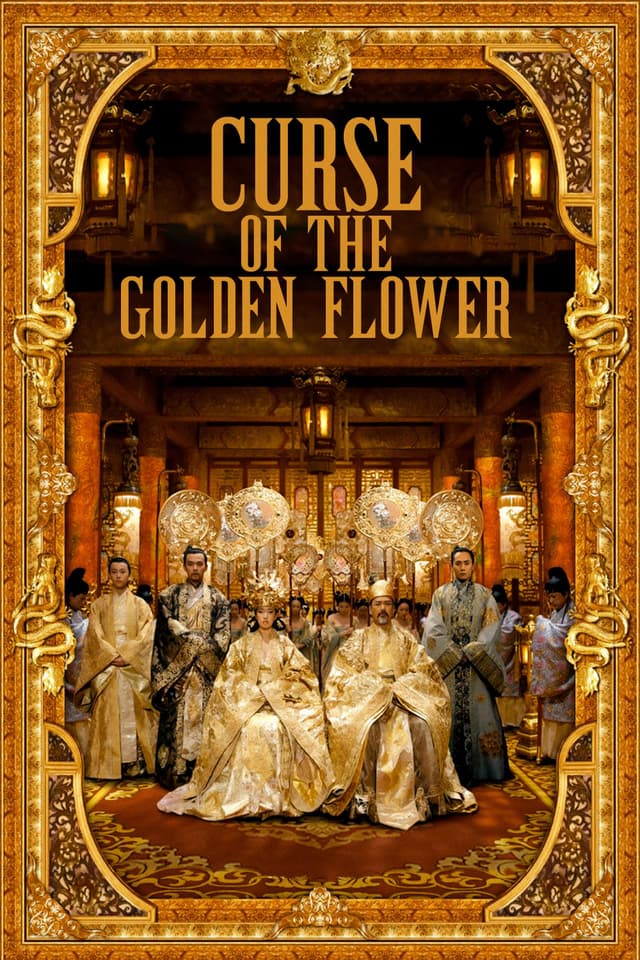
Curse of the Golden Flower (Mandarin title Man cheng jin dai huang jin jia, 2006), directed by Zhang Yimou and distributed internationally by Sony Pictures Classics, was produced on a reported budget of $45,000,000. The figure made it the most expensive Chinese-language film ever produced at the time of its release, surpassing the prior record held by Chen Kaige's The Promise (2005). Financing came from Beijing New Picture Film Company, Edko Films, and Film Partner International, with international pre-sales to Sony Pictures Classics and a slate of European distributors providing significant working capital ahead of principal photography.
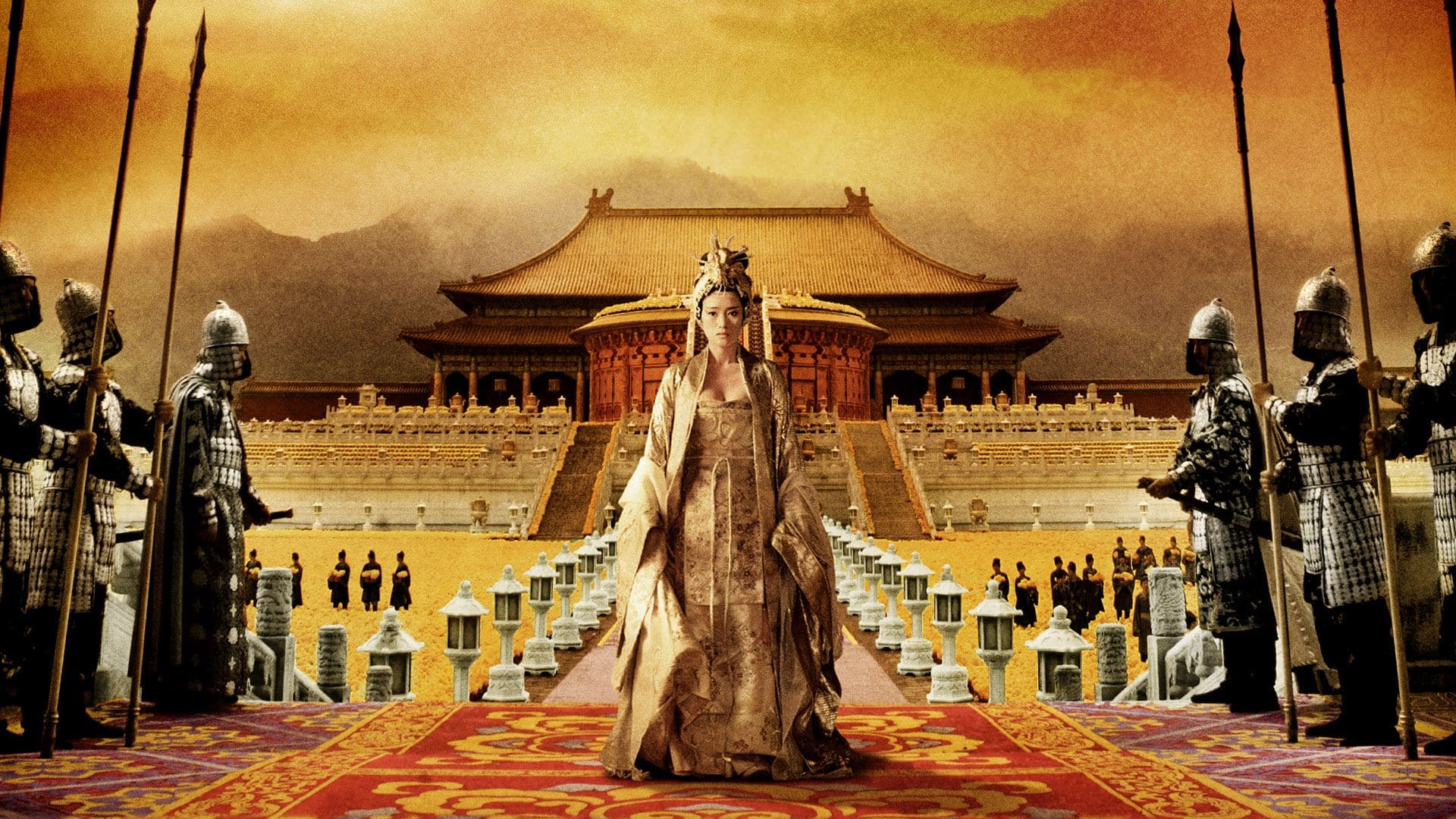
Zhang's investment reflected the same logic that had pushed Chinese wuxia and historical-epic budgets steadily upward through the 2000s. After the global crossover success of Crouching Tiger, Hidden Dragon in 2000, his own Hero (2002), and House of Flying Daggers (2004), Chinese producers and overseas distributors saw mainland-shot, star-driven costume epics as a reliable international export category. The Curse of the Golden Flower budget bankrolled a fully-built Tang dynasty imperial palace set, the largest costume program in Chinese cinema history to that point, and an A-tier above-the-line lineup headed by Chow Yun-fat, Gong Li, and Mandopop superstar Jay Chou in his feature debut.
Key Budget Allocation Categories
Curse of the Golden Flower's reported $45,000,000 budget was distributed across several core production areas:
- Above-the-Line Talent: Director Zhang Yimou, fresh off the back-to-back successes of Hero and House of Flying Daggers, commanded a top-tier fee for a Chinese-language production. Chow Yun-fat, reunited with Zhang two decades after their earlier non-collaboration trajectories crossed, brought Hollywood-level compensation expectations following Crouching Tiger, Hidden Dragon and the Pirates of the Caribbean franchise. Gong Li returned to Zhang's filmography after a long professional separation, and Jay Chou's casting as Prince Jai represented a major financial play to capture the Mandopop fan base across mainland China, Taiwan, Hong Kong, and the Southeast Asian Chinese diaspora.
- Costume Design: Hong Kong designer Yee Chung-Man oversaw the largest costume operation in the history of Chinese filmmaking up to 2006. More than one thousand costumes were hand-tailored, with the imperial robes for Gong Li and Chow Yun-fat featuring extensive gold thread embroidery, ornate beadwork, and elaborate phoenix and dragon motifs requiring weeks of bench work per garment. The chrysanthemum-rebel infantry wore matching golden armor, and the palace ladies-in-waiting were costumed in tightly corseted, low-cut Tang dynasty robes that became one of the film's most discussed visual signatures.
- Production Design and Set Construction: Production designer Huo Tingxiao, working with art director Zhao Bin, built a full-scale replica of the inner Tang dynasty palace complex on a Beijing soundstage and adjacent backlot, with gold-leaf detailing across every column, screen, and lattice. The chrysanthemum-petal courtyard sequence, in which tens of thousands of yellow blossoms carpet the palace plaza for the Double Ninth Festival, used real and artificial flowers procured in quantities never previously assembled for a Chinese production.
- Action and Stunts: Veteran Hong Kong action director Ching Siu-tung, who choreographed Hero, designed the film's wuxia combat and the climactic palace siege, including the assault by the golden-armored rebel army and the wire-assisted descent of the masked black-clad ninja assassins. Several hundred extras and stunt performers were trained for synchronized fight choreography across multiple courtyards.
- Visual Effects: VFX supervisor Angie Lam led digital extension of the palace exteriors, crowd duplication for the imperial army (estimated on screen at well over ten thousand soldiers), and the matte-painted Tang dynasty cityscape glimpsed beyond the palace walls. The CG flower-trampling sequence and blood-soaked aftermath required additional post-production passes.
- Score and Music: Veteran composer Shigeru Umebayashi, who had previously scored Hero and House of Flying Daggers, returned for a sweeping orchestral score blending traditional Chinese instrumentation with a full Western orchestra. Jay Chou wrote and performed the end-credits song Chrysanthemum Terrace, which became a major chart hit across Greater China and significantly bolstered the soundtrack release.
- Cinematography: Director of photography Zhao Xiaoding, who had shot House of Flying Daggers for Zhang, used a heavily saturated palette of gold, scarlet, jade green, and lapis blue. The lighting package for the palace interiors required extensive overhead practical units and bounce, since Zhang's brief called for every surface to read as polished metal.
How Does Curse of the Golden Flower's Budget Compare to Similar Films?
At a reported $45,000,000, Curse of the Golden Flower sits at the very top of mid-2000s Chinese-language production budgets and remains a useful benchmark for the wuxia-epic and Chinese historical-spectacle category:
- Hero (2002): Budget $31,000,000 | Worldwide $177,394,432. Zhang Yimou's first wuxia epic cost about two thirds of Curse of the Golden Flower and out-grossed it worldwide by more than two to one, anchored by a delayed US release that landed it at the top of the domestic box office.
- House of Flying Daggers (2004): Budget $12,000,000 | Worldwide $92,863,945. Zhang's follow-up cost roughly a quarter of Curse of the Golden Flower yet earned a substantially higher worldwide gross, the strongest ROI in his wuxia trilogy.
- The Promise (2005): Budget $35,000,000 | Worldwide $40,287,975. Chen Kaige's Tang dynasty fantasy held the most-expensive-Chinese-film record for one year before Curse of the Golden Flower eclipsed it, and its narrow worldwide return illustrates how thin the margins were on this category of production.
- Red Cliff (2008): Budget $80,000,000 | Worldwide $250,000,000. John Woo's Three Kingdoms epic, released two years later, nearly doubled Curse of the Golden Flower's budget and earned roughly three times its worldwide gross, marking the next escalation rung in Chinese-language spectacle.
- The Great Wall (2016): Budget $150,000,000 | Worldwide $334,932,329. Zhang Yimou's later English-language coproduction with Legendary Entertainment cost more than three times Curse of the Golden Flower and still struggled to recoup, demonstrating how much riskier the budget tier became when Hollywood-scale spending arrived.
- Raise the Red Lantern (1991): Budget approximately $1,000,000 | Worldwide $2,603,061. Zhang's earlier domestic family drama, made for less than three percent of Curse of the Golden Flower, provides the bookend on his trajectory from arthouse miniatures to imperial spectacle.
Curse of the Golden Flower Box Office Performance
Curse of the Golden Flower opened in mainland China on December 14, 2006 and rolled out to North American theaters via Sony Pictures Classics on December 22, 2006 in a limited Oscar-qualifying run before expanding wider in January 2007. The film opened to approximately $123,000 on six US screens before broadening, eventually peaking at 1,234 North American screens. In mainland China, it set a domestic opening-week record and became the highest-grossing domestic release in Chinese cinema history at the time.
Against a reported production budget of $45,000,000, the film needed approximately $90,000,000 to $110,000,000 in worldwide gross to reach profitability when accounting for marketing and distribution costs. Here is the financial breakdown:
Box Office Breakdown
Man cheng jin dai huang jin jia

Curse of the Golden Flower returned approximately $1.12 in theatrical revenue for every $1 invested when measured against the low end of total estimated production and marketing spend, putting it modestly in the black on theatrical alone before factoring in home video, broadcast, and streaming receipts. The mainland Chinese share of the gross was $36,748,840 against an international share of $41,820,137, an almost even split that was unusual for a Mandarin-language release of this size and which reflected both the Sony Pictures Classics marketing campaign and the Oscar-season costume nomination.
Sony Pictures Classics' specialty-distribution strategy, modeled on its handling of Crouching Tiger, Hidden Dragon six years earlier, kept the film in theaters from December 2006 through April 2007, with subtitled screenings in major US art-house chains and a smaller dubbed footprint. The home video release in mid-2007 added several million in domestic catalog revenue and the film became a fixture on early Blu-ray premium reference discs because of its color-saturated imagery.
Curse of the Golden Flower Production History
Zhang Yimou began developing Curse of the Golden Flower in 2005 immediately after wrapping House of Flying Daggers, working from a screenplay he co-wrote with Wu Nan and Bian Zhihong. The script reframed Cao Yu's 1934 play Thunderstorm, a domestic tragedy set in 1920s Republican-era China, as a Tang dynasty imperial court intrigue centered on the Emperor, his Empress, and their three sons. Zhang has said in interviews that he wanted to bring Cao Yu's interlocking pattern of betrayals and the slow poisoning of a wife by her husband into the most lavish visual context Chinese cinema could afford, deliberately pushing color, pattern, and scale to the brink of decorative excess.
Casting Chow Yun-fat as the Emperor was the financing-anchor decision. Chow had not headlined a major Chinese-language production since the 1990s and his Crouching Tiger, Hidden Dragon and Pirates of the Caribbean profile delivered the international name recognition the budget required. Gong Li, Zhang's longtime collaborator and former partner from the late 1980s and 1990s, returned to his filmography for the first time since Shanghai Triad (1995), with her casting as the Empress widely covered in the Chinese press as a creative reunion. Jay Chou's casting as Prince Jai was a calculated move to draw the Mandopop audience and the Taiwanese youth demographic into a costume drama they would not otherwise have prioritized.
Principal photography ran from spring through summer 2006, primarily on a custom-built Tang dynasty palace set constructed on a Beijing soundstage and adjacent lot, with additional photography at Hengdian World Studios in Zhejiang Province and other mainland locations. The shoot was logistically dense: a single courtyard sequence required tens of thousands of fresh and silk chrysanthemums to be laid by hand daily and replaced when crushed, and the climactic siege used several thousand costumed extras and stunt performers in golden armor against a similar number of imperial guards. Special-effects teams provided digital extension of the palace exteriors and crowd duplication for the army sequences, supervised by Angie Lam.
Post-production at Beijing-based facilities focused on color grading the heavily saturated palette and finishing the digital crowd and matte work. The film was rated R in the United States for its frontal violence and the much-discussed neckline of the imperial robes, an unusually restrictive rating for a Sony Pictures Classics specialty release that limited the North American theatrical footprint.
Awards and Recognition
Curse of the Golden Flower earned its most prominent recognition at the 79th Academy Awards, where Yee Chung-Man was nominated for Best Costume Design for the elaborate Tang dynasty wardrobe, the imperial robes, and the golden rebel-army armor. The category that year went to Marie Antoinette's Milena Canonero, but the nomination ratified the costume team's standing within Hollywood craft circles and contributed materially to the film's specialty box office.
At the 26th Hong Kong Film Awards in 2007, the film won four prizes including Best Actress for Gong Li, Best Art Direction for Huo Tingxiao, Best Costume and Make Up Design for Yee Chung-Man, and Best Original Film Song for Jay Chou's Chrysanthemum Terrace, against fourteen total nominations. At the 44th Golden Horse Awards in Taiwan it took home Best Art Direction, Best Makeup and Costume Design, and Best Original Film Score for Shigeru Umebayashi. The film was selected as China's submission for Best Foreign Language Film at the 79th Academy Awards but did not advance to the nominee shortlist, a result widely attributed to the saturation of contemporaneous Chinese-language Oscar entries rather than any specific weakness in the campaign.
Critical Reception
Curse of the Golden Flower received a mixed-to-positive reception. The film holds a 67% approval rating on Rotten Tomatoes based on 137 critic reviews, with a critical consensus describing it as visually overwhelming if narratively overheated. On Metacritic, the film scored 64 out of 100, indicating generally favorable reviews. Audiences in North America were more divided, with the film polarizing between those captivated by its visual maximalism and those alienated by the deliberate emotional artifice of Zhang's late-period style.
Mainstream US critics generally admired the craft while questioning the narrative. Roger Ebert of the Chicago Sun-Times awarded the film three and a half stars and wrote that Zhang Yimou had made a film in which the production design and color are the main characters, calling the palace sequences among the most extraordinary visual passages in recent cinema. A.O. Scott of The New York Times praised Gong Li's performance as the slow-motion epicenter of the film while criticizing the script's stately repetition. Manohla Dargis, also writing in The New York Times during the awards-season coverage, called the costume work the film's true subject, an observation echoed in nearly every English-language review.
Chinese-language reception was more enthusiastic. The film became the highest-grossing domestic release in Chinese cinema history at the time of its run and was widely covered in mainland Chinese press as a national event. Critical voices within the Chinese cinema community, however, foreshadowed the discussion that would surround Zhang's later commercial work, with some critics arguing that the spectacle had crowded out the directorial precision that defined his earlier films Raise the Red Lantern and To Live. The film's legacy within world cinema has settled into a stable position as the third and most baroque entry in Zhang's wuxia-epic trilogy, frequently revisited for its costume and production-design influence on subsequent Asian period drama.
Frequently Asked Questions
How much did it cost to make Curse of the Golden Flower (2006)?
The reported production budget was $45,000,000, making it the most expensive Chinese-language film ever produced at the time of its release. Financing came from Beijing New Picture Film Company, Edko Films, and Film Partner International, with international pre-sales to Sony Pictures Classics and a slate of European distributors providing significant working capital ahead of principal photography.
How much did Curse of the Golden Flower earn at the box office?
The film grossed approximately $36,748,840 in mainland China and $41,820,137 internationally, for a worldwide total of $78,568,977. In mainland China it became the highest-grossing domestic release in Chinese cinema history at the time of its run.
Who directed Curse of the Golden Flower?
Zhang Yimou directed the film, working from a screenplay he co-wrote with Wu Nan and Bian Zhihong. The script reframed Cao Yu's 1934 play Thunderstorm as a Tang dynasty imperial court intrigue. It was the third entry in Zhang's wuxia-epic trilogy following Hero (2002) and House of Flying Daggers (2004).
Where was Curse of the Golden Flower filmed?
Principal photography ran from spring through summer 2006, primarily on a custom-built Tang dynasty palace set constructed on a Beijing soundstage and adjacent backlot, with additional photography at Hengdian World Studios in Zhejiang Province and other mainland Chinese locations.
Was Curse of the Golden Flower a box office success?
Yes, on a modest basis. Against a $45,000,000 production budget and an estimated $25,000,000 to $35,000,000 in marketing spend, the film returned approximately $1.12 in theatrical revenue for every $1 invested, putting it modestly in the black on theatrical alone before factoring in home video, broadcast, and streaming receipts. It also set a domestic Chinese box office record at the time of its release.
How does Curse of the Golden Flower compare to other Zhang Yimou films?
It is the most expensive of his wuxia-epic trilogy. Hero (2002) cost $31,000,000 and grossed $177,394,432 worldwide. House of Flying Daggers (2004) cost $12,000,000 and grossed $92,863,945 worldwide. Curse of the Golden Flower cost $45,000,000 and grossed $78,568,977 worldwide, the lowest worldwide gross of the three despite the highest budget.
Who stars in Curse of the Golden Flower?
Chow Yun-fat plays the Emperor, Gong Li plays the Empress, and Mandopop singer Jay Chou plays Prince Jai in his feature debut. Supporting roles include Liu Ye as Crown Prince Wan, Qin Junjie as Prince Yu, Ni Dahong as Imperial Doctor Jiang, and Li Man as Jiang Chan. Gong Li's return marked her first collaboration with Zhang Yimou since Shanghai Triad (1995).
Did Curse of the Golden Flower win any awards?
Yee Chung-Man was nominated for Best Costume Design at the 79th Academy Awards. At the 26th Hong Kong Film Awards, the film won Best Actress for Gong Li, Best Art Direction, Best Costume and Make Up Design, and Best Original Film Song for Jay Chou's Chrysanthemum Terrace, against fourteen total nominations. At the 44th Golden Horse Awards it won Best Art Direction, Best Makeup and Costume Design, and Best Original Film Score for Shigeru Umebayashi.
What is Curse of the Golden Flower based on?
The film is loosely adapted from Cao Yu's 1934 stage play Thunderstorm, a domestic tragedy originally set in 1920s Republican-era China. Zhang Yimou and his co-writers relocated the story to the Tang dynasty imperial court and reframed it as an intrigue between the Emperor, his Empress, and their three sons during the Chrysanthemum Festival.
What did critics think of Curse of the Golden Flower?
The film received mixed-to-positive reviews, with a 67% approval rating on Rotten Tomatoes (based on 137 critics) and a 64 out of 100 score on Metacritic. Roger Ebert awarded it three and a half stars and called the palace sequences among the most extraordinary visual passages in recent cinema. A.O. Scott of The New York Times praised Gong Li's performance while criticizing the script's stately repetition. Mainstream US critics generally admired the craft while questioning the narrative.
Filmmakers
Man cheng jin dai huang jin jia

Official Trailer
Build budgets like this one in Saturation
Start from an industry-standard feature film template, import the schedule and rates you already have, and let the cost report keep itself current as you spend. Real-time collaboration, no spreadsheets.