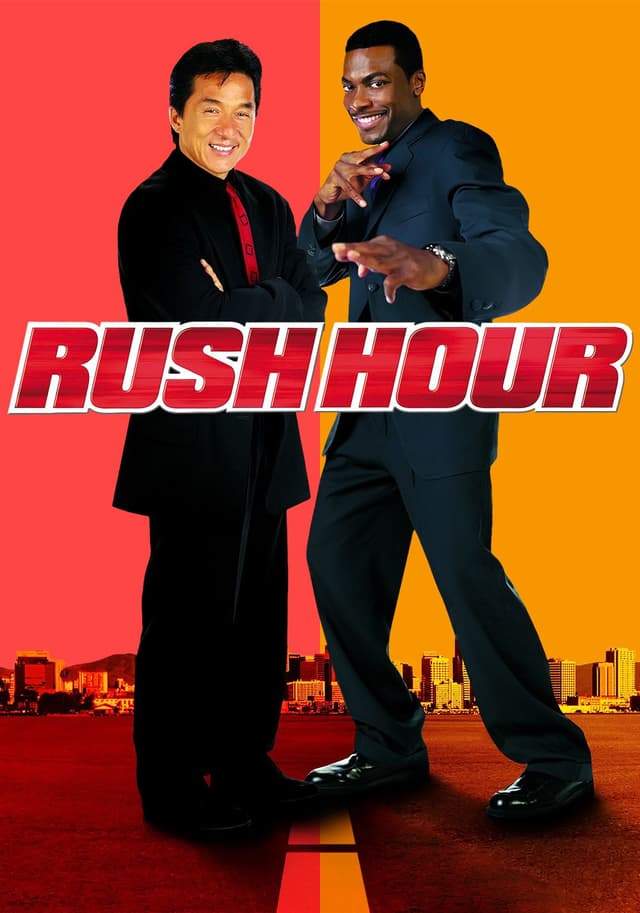
Rush Hour Budget
 ActionComedyCrime1h 37m
Updated
Synopsis
Cultures clash and tempers flares as the two cops named Detective Inspector Lee a Hong Kong Detective and Detective James Carter FBI, a big-mouthed work-alone Los Angeles cop who are from different worlds discovers one thing in common: they can't stand each other. With time running out, they must join forces to catch the criminals and save the eleven-year-old Chinese girl of the Chinese consul named Soo Yung.
What is the budget of Rush Hour?
"Rush Hour," an action released in 1998, was directed by Brett Ratner and stars Jackie Chan, Chris Tucker. The production budget was $33,000,000, placing it in the mid-budget range for action productions of the 1990s.
Key Budget Allocation Categories
While specific budget breakdowns are not publicly available, typical cost drivers for an action production like this include:
- Stunts, Action Sequences & Visual Effects: Action films allocate a substantial portion of their budget to choreographing and executing practical stunts, pyrotechnics, and CGI-heavy sequences.
- Above-the-Line Talent (Cast & Director): A-list talent commands significant upfront fees plus backend participation.
- Production Design, Sets & Locations: Action films frequently require multiple international shooting locations, large-scale set construction, vehicle acquisitions and modifications, and specialized equipment , all of which drive production costs well above those of dialogue-driven genres.
What were the major cost factors in Rush Hour?
Several factors contributed to the overall production costs of "Rush Hour."
- Stunts: Stunts, Action Sequences & Visual Effects is one of the primary cost drivers in action productions of this scale.
- Above-the-Line Talent (Cast: Above-the-Line Talent (Cast & Director) is one of the primary cost drivers in action productions of this scale.
- Production Design: Production Design, Sets & Locations is one of the primary cost drivers in action productions of this scale.
How Does Rush Hour's Budget Compare to Similar Films?
At $33,000,000, Rush Hour sits in the mid-budget range. Here is how it compares to productions with a similar budget:
- 21 Bridges (2019): Budget $33,000,000, Worldwide Gross $49,900,000
- Exit Wounds (2001): Budget $33,000,000, Worldwide Gross $79,958,599
- Halloween Ends (2022): Budget $33,000,000, Worldwide Gross $105,400,796
- Micmacs (2009): Budget $33,000,000, Worldwide Gross $14,000,000
- Mike and Dave Need Wedding Dates (2016): Budget $33,000,000, Worldwide Gross $77,100,000
The median budget for wide-release action films in the era ranges from $30 to 80M for mid-budget to $150M+ for tentpoles.
Rush Hour Box Office Performance
"Rush Hour" earned $141,186,864 domestically and $244,721,064 worldwide at the box office. Against a production budget of $33,000,000, the film performed strongly at the box office.
A film typically needs to earn approximately twice its production budget to cover marketing and distribution costs. For "Rush Hour," that break-even threshold was roughly $66,000,000. With worldwide earnings of $244,721,064, the film cleared that threshold comfortably.
Box Office Breakdown
Rush Hour

At 641.6%, "Rush Hour" earned roughly $7.42 for every $1 invested in production.
Awards and Recognition
6 wins & 9 nominations total
Frequently Asked Questions
How much did it cost to make Rush Hour (1998)?
The production budget was $33,000,000, covering principal photography, visual effects, cast and crew salaries, locations, sets, post-production, and music. Marketing and distribution (P&A) costs are estimated at an additional $16,500,000 - $26,400,000, bringing the total studio investment to approximately $49,500,000 - $59,400,000.
How much did Rush Hour (1998) earn at the box office?
Rush Hour grossed $141,186,864 domestic, $103,534,200 international, totaling $244,721,064 worldwide.
Was Rush Hour (1998) profitable?
Yes. Against a production budget of $33,000,000 and estimated total costs of ~$82,500,000, the film earned $244,721,064 theatrically - a 642% ROI on production costs alone.
What were the biggest costs in producing Rush Hour?
The primary cost drivers were above-the-line talent (Jackie Chan, Chris Tucker, Tom Wilkinson); visual effects, practical stunts, and A-list talent compensation.
How does Rush Hour's budget compare to similar action films?
At $33,000,000, Rush Hour is classified as a low-budget production. The median budget for wide-release action films in the era ranges from $30 - 80M for mid-budget to $150M+ for tentpoles. Comparable budgets: 21 Bridges (2019, $33,000,000); Exit Wounds (2001, $33,000,000); Halloween Ends (2022, $33,000,000).
Did Rush Hour (1998) go over budget?
There are no widely reported accounts of significant budget overruns for this production. However, studios rarely disclose precise budget overrun figures publicly. The reported production budget reflects the final estimated cost.
What was the return on investment (ROI) for Rush Hour?
The theatrical ROI was 641.6%, calculated as ($244,721,064 − $33,000,000) ÷ $33,000,000 × 100. This measures gross revenue against production budget only - it does not account for P&A or exhibitor shares.
What awards did Rush Hour (1998) win?
6 wins & 9 nominations total.
Who directed Rush Hour and who were the key crew members?
Directed by Brett Ratner, written by Ross LaManna, Jim Kouf, shot by Adam Greenberg, with music by Ira Hearshen, Lalo Schifrin, edited by Mark Helfrich.
Where was Rush Hour filmed?
Rush Hour was filmed in United States of America.
Filmmakers
Rush Hour

Official Trailer
Build budgets like this one in Saturation
Start from an industry-standard feature film template, import the schedule and rates you already have, and let the cost report keep itself current as you spend. Real-time collaboration, no spreadsheets.