Life of Pi Budget
 AdventureDrama2h 7m
Updated
Synopsis
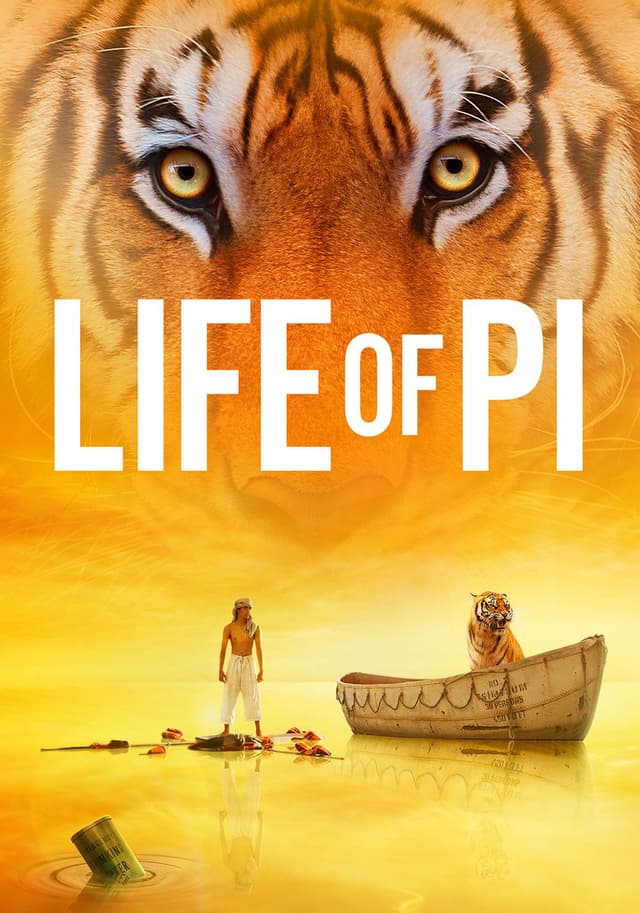
A young man survives a disaster at sea and is hurtled into a journey of adventure and discovery. While cast away, he forms an amazing and unexpected connection with another survivor... a fearsome Bengal tiger.
What Is the Budget of Life of Pi?
Life of Pi had a production budget of $120,000,000. Directed by Ang Lee and released by Fox 2000 Pictures in November 2012, the film was a prestige adaptation of Yann Martel's acclaimed novel that few in Hollywood had believed was filmable. The budget reflected the enormous technical demands of the project: a near-photorealistic digital tiger, large-scale ocean sequences, a purpose-built wave tank in Taiwan, and extensive 3D cinematography. For an effects-heavy drama without an established franchise or action-hero brand, $120 million represented a genuine creative gamble.
The film opened to $22.4 million domestically and ultimately earned $609 million worldwide, delivering a strong return on that investment and cementing its place as one of the most visually ambitious prestige dramas of the decade.
Key Budget Allocation Categories
- CGI Tiger (Richard Parker): The digital Bengal tiger Richard Parker required years of development by Rhythm & Hues Studios and hundreds of VFX artists. The team studied real tiger movement, fur simulation, and muscle dynamics in minute detail. Richard Parker appears in virtually every scene of the film and had to be entirely convincing alongside a live human actor. The visual effects work was so demanding that Rhythm & Hues filed for bankruptcy shortly after the film won the Oscar for Best Visual Effects, drawing attention to financial pressures in the VFX industry.
- Taiwan Wave Tank Construction: The production built the world's largest self-generating wave tank at an abandoned airport in Taoyuan, Taiwan. The tank held 1.7 million imperial gallons of water and was engineered to produce controlled waves up to 40 feet high. The facility allowed Ang Lee's team to film ocean sequences with precise lighting and weather conditions, a level of control impossible to achieve on open water. Construction and operation of this facility represented one of the largest single line items in the budget.
- 3D Photography and Post-Production: Lee shot the film natively in 3D using a custom rig, viewing it as integral to the storytelling rather than a post-conversion gimmick. He believed 3D was uniquely suited to capture the transparency and reflectivity of water. The 3D workflow added cost across both production and post, requiring specialized cameras, additional lighting setups, and extensive stereo compositing during VFX.
- Suraj Sharma Preparation and Training: After selecting 17-year-old newcomer Suraj Sharma from over 3,000 auditions, the production invested heavily in preparing him for the physical and emotional demands of the role. Sharma underwent months of swimming, yoga, meditation, and survival training before cameras rolled, and he was on set for the majority of the shooting schedule.
- Location and Period Production: Beyond the wave tank, filming took place in India, Canada, and on the ocean near Taiwan. Sets depicting the Pondicherry zoo and the cargo ship required detailed period construction. The visual palette of the film relied on practical environments enhanced by digital work rather than purely synthetic environments.
How Does Life of Pi's Budget Compare to Similar Films?
Life of Pi occupies a specific niche as a high-budget prestige drama driven by visual effects rather than action-franchise mechanics. Its $120 million budget sits at the upper end of what studios will commit to a literary adaptation with no pre-existing fanbase. Comparable films illustrate both the risks and rewards of that position.
- Gravity (2013) | Budget: $105M | Worldwide: $723M. Alfonso Cuaron's space survival thriller had comparable visual demands and a similar budget, but its simpler two-character premise and broader commercial appeal translated to a significantly larger domestic gross. Both films won Best Director at their respective Oscar ceremonies.
- Hugo (2011) | Budget: $170M | Worldwide: $185.8M. Martin Scorsese's 3D period adventure was a box office disappointment despite its prestige pedigree and strong reviews. Life of Pi achieved a far better return on a lower budget, largely due to its international appeal in Asian markets.
- Noah (2014) | Budget: $125M | Worldwide: $362.6M. Darren Aronofsky's biblical epic was similarly positioned as an effects-heavy prestige adaptation. Life of Pi outperformed it internationally while spending slightly less in production.
- The Secret Life of Walter Mitty (2013) | Budget: $90M | Worldwide: $188.1M. Another Fox prestige adventure in the same era, with a lower budget but also a far weaker commercial result, underscoring the difficulty of selling adult-skewing adventure films domestically.
Life of Pi Box Office Performance
Life of Pi opened on November 21, 2012, grossing $22.4 million in its opening weekend from 2,902 theaters, a modest start for a $120 million film. The domestic performance throughout its run was respectable but unremarkable: American audiences were slower to embrace the film's meditative tone and unconventional structure. The international markets told a different story entirely.
Box Office Breakdown
Life of Pi

International markets drove the film's commercial success. Taiwan, where much of the film was shot, responded with exceptional enthusiasm. China, India, and European markets all performed strongly, while the domestic gross of $124.9 million represented only about 20% of the total worldwide take. The film's visual spectacle, spiritual themes, and cross-cultural story of survival proved far more universal outside the United States than domestic tracking had suggested.
The surprise commercial performance, combined with four Academy Award wins, transformed Life of Pi into one of the definitive prestige hits of the 2010s. It demonstrated that a patient, visually ambitious film could succeed globally without franchise mechanics or domestic box office dominance.
Life of Pi Production History
Yann Martel's novel, published in 2001 and awarded the Booker Prize in 2002, was considered essentially unfilmable by most of Hollywood. The story's internal narrator, its non-human co-lead, and its overtly philosophical framework posed challenges that stymied development for nearly a decade.
M. Night Shyamalan was the first director attached to the project, coming aboard in 2003, but he departed after completing The Village. Alfonso Cuaron took an interest in 2005 before ultimately committing to Children of Men. Jean-Pierre Jeunet, the French director of Amelie, spent several years developing the project between 2005 and 2009 before also departing. Each departure reflected how difficult the material was to crack on a practical filmmaking level.
Ang Lee accepted the project in 2009, viewing the challenge as a reason to take it rather than a reason to avoid it. Lee saw 3D not as a commercial tool but as a formal choice suited to the story, believing the technology could render the surface tension and luminosity of water in ways flat photography could not replicate. He made the commitment to 3D before Avatar had demonstrated its commercial potential.
Casting the lead proved equally demanding. The script required a teenage actor with no prior film experience who could carry the emotional weight of the film largely alone, while physically convincing audiences he was adrift at sea with a 450-pound tiger. The production held global open auditions, screening over 3,000 candidates, before selecting 17-year-old Suraj Sharma from New Delhi in October 2010. Sharma had come in to accompany his brother to an audition. He spent months training in swimming, yoga, and physical conditioning before production began.
A small number of real tiger shots were filmed for reference footage and certain close-up sequences, but the primary Bengal tiger Richard Parker was created digitally by Rhythm & Hues Studios. The team spent years developing fur simulation, muscle physics, and behavioral reference libraries, studying tigers at a conservation facility to capture authentic movement. The boundary between digital and practical animals in the finished film remains difficult to detect even on close inspection.
Principal photography ran from March to September 2011, with the wave tank sequences shot at the Taoyuan facility in Taiwan. The tank was built specifically for the production on the grounds of a decommissioned airport and was designed to generate waves of varying sizes, allowing Lee to control weather and lighting conditions precisely. Tobey Maguire was initially cast as the framing character The Writer but was replaced by Rafe Spall, a decision attributed to concerns about international casting balance.
Awards and Recognition
Life of Pi received 11 Academy Award nominations at the 85th Academy Awards in February 2013, the most of any film that year. It won four awards, more than any other film at the ceremony.
- Academy Award, Best Director: Ang Lee. His second Oscar in this category, following his win for Brokeback Mountain (2005).
- Academy Award, Best Cinematography: Claudio Miranda. The cinematographer's work, combining practical underwater photography with extensive compositing, was cited for its unprecedented visual quality.
- Academy Award, Best Original Score: Mychael Danna. The score blended Western orchestration with Indian classical and devotional music, reflecting Pi's multicultural background.
- Academy Award, Best Visual Effects: Bill Westenhofer, Guillaume Rocheron, Erik-Jan de Boer, Donald R. Elliott. The win was notable for the subsequent attention drawn to the financial collapse of Rhythm & Hues Studios, which had done the principal VFX work.
Additional nominations at the Academy Awards included Best Picture, Best Adapted Screenplay (David Magee), Best Film Editing, Best Original Song, Best Production Design, Best Sound Mixing, and Best Sound Editing. The film received nine BAFTA nominations and was named one of AFI's Top Ten Movies of 2012. At the Golden Globes, it won Best Original Score and received nominations for Best Picture (Drama) and Best Director.
Critical Reception
Life of Pi holds an 86% approval rating on Rotten Tomatoes based on 253 reviews, with an average rating of 7.9 out of 10. The critical consensus describes it as a visually stunning adventure with genuine emotional and philosophical depth. On Metacritic the film scores 79 out of 100 based on 44 reviews, indicating generally favorable reception. Audiences awarded it a CinemaScore of A-.
Roger Ebert awarded the film four stars and called it a miraculous achievement of storytelling and a landmark of visual mastery. Peter Travers of Rolling Stone wrote that Lee uses 3D with the delicacy and lyricism of a poet, and that you do not just watch this movie, you live it. Director James Cameron stated that the film breaks the paradigm that 3D has to be some big action fantasy spectacle.
Critics broadly praised Suraj Sharma's debut performance, noting that his ability to project thought and feeling in near-isolation gave the film its emotional foundation. The visual effects work, particularly Richard Parker, received near-universal acclaim. Some critics took issue with the film's framing device and its explicit exploration of faith, finding the philosophical scaffolding more heavy-handed than the novel's lighter touch. The ending's narrative ambiguity generated significant critical discussion, with many reviewers praising it as the film's most daring structural choice.
The film's reputation has grown in the years since release. Its technical achievements, particularly the digital tiger work and the 3D cinematography, are now studied as benchmarks for photorealistic VFX in prestige drama contexts.
Frequently Asked Questions
What was the production budget for Life of Pi?
Life of Pi had a production budget of $120,000,000. The budget was largely driven by the cost of creating a photorealistic digital tiger, building a custom wave tank in Taiwan, and executing extensive native 3D photography across a complex visual effects pipeline.
How much did Life of Pi make at the box office?
Life of Pi earned $124,987,023 domestically and $609,016,565 worldwide. The film's international performance far outpaced its domestic run, with markets in Taiwan, China, and India contributing significantly to the total gross. It delivered approximately $5.08 for every $1 invested in production.
How was the tiger Richard Parker created for Life of Pi?
Richard Parker was almost entirely a digital creation by Rhythm & Hues Studios, requiring years of development and hundreds of VFX artists. The team built detailed simulations of tiger fur, muscle movement, and behavioral patterns, studying real tigers at a conservation facility for reference. A small number of real tiger shots were used in limited close-up sequences, but the vast majority of Richard Parker's screen time is fully computer generated. The visual effects team won the Academy Award for Best Visual Effects for their work.
How many Academy Awards did Life of Pi win?
Life of Pi won four Academy Awards from eleven nominations at the 85th Academy Awards in 2013, the most wins of any film that year. The four wins were Best Director for Ang Lee, Best Cinematography for Claudio Miranda, Best Original Score for Mychael Danna, and Best Visual Effects for the Rhythm & Hues team. The film also received nominations for Best Picture and Best Adapted Screenplay, among others.
Was a real tiger used in Life of Pi?
A small number of real tiger shots were filmed for close-up reference and specific sequences, but Richard Parker as he appears throughout the film is primarily a digital creation. The production faced scrutiny after a 2013 Hollywood Reporter investigation published leaked emails suggesting a real tiger nearly drowned during filming. The American Humane Association's certification for the production was subsequently questioned. For the sustained dramatic sequences on the lifeboat, Suraj Sharma acted opposite an animatronic tiger or an empty set, with Richard Parker composited in during post-production.
Is Life of Pi based on a true story?
No. Life of Pi is a work of fiction by Canadian author Yann Martel, first published in 2001. The novel won the Booker Prize in 2002. Martel has said the novel was inspired in part by a review of a Brazilian novel about a man stranded on a lifeboat with a hyena, as well as his own reflections on faith and storytelling. The film adaptation preserves the novel's metafictional framing, in which the story itself is presented as one possible account of events, leaving the literal truth deliberately ambiguous.
Filmmakers
Life of Pi

Official Trailer
Build budgets like this one in Saturation
Start from an industry-standard feature film template, import the schedule and rates you already have, and let the cost report keep itself current as you spend. Real-time collaboration, no spreadsheets.