La Notte Budget
Updated
Synopsis
Over the course of a single day and night in Milan, a novelist and his wife visit a dying friend, attend a book launch, and end up at an industrialist's party in the country. As the hours pass, they confront the slow erosion of their marriage with unsparing emotional candor.
What is known about the production of La Notte?
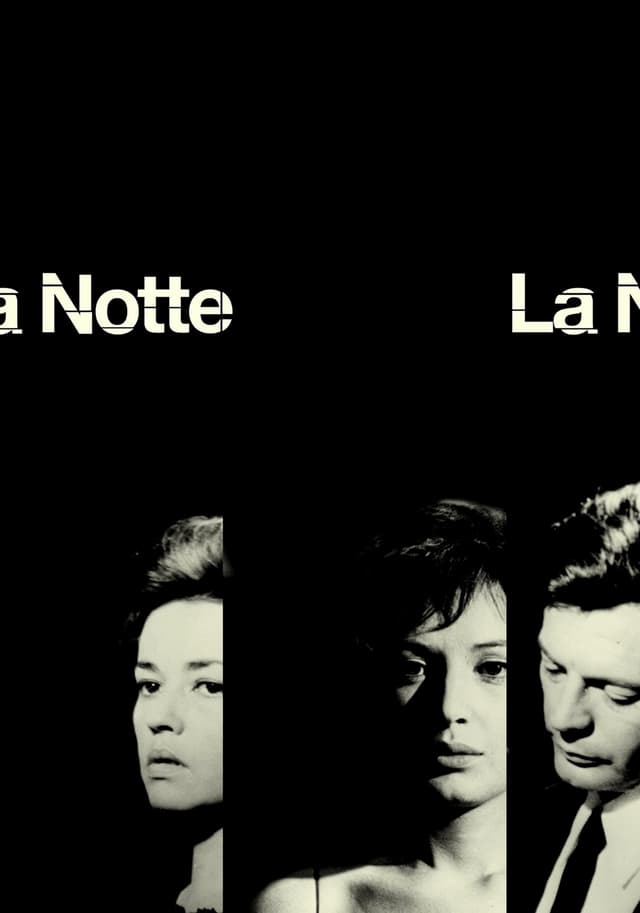
"La Notte," a drama released in 1961, was directed by Michelangelo Antonioni and stars Marcello Mastroianni, Jeanne Moreau. The production budget has not been publicly disclosed, though Nepi Film, Silver Films, Sofitedip produced the film, making it a notable entry in the drama landscape whose financial details remain private.
What were the major cost factors in La Notte?
Several factors contributed to the overall production costs of "La Notte."
- Above-the-Line Talent: A-list cast and director fees, including Marcello Mastroianni are often the largest single line item in drama productions.
- Location Filming: On-location photography and period-appropriate production design add meaningfully to the overall cost.
- Post-Production: Careful editorial pacing, color grading, and an original score are essential investments in drama filmmaking.
La Notte Box Office Performance
"La Notte" earned $39,236 domestically.
Awards and Recognition
6 wins & 4 nominations total
- Golden Bear
Critical Reception
On the review aggregator website Rotten Tomatoes, the film holds an approval rating of 84% based on 31 reviews, with an average rating of 7.6/10.
How Does La Notte's Budget Compare to Similar Films?
- L'Avventura (1960): Budget undisclosed | Worldwide undisclosed. Antonioni's preceding picture and the opening chapter of his alienation trilogy. La Notte was developed as an immediate companion piece.
- L'Eclisse (1962): Budget undisclosed | Worldwide undisclosed. The third entry in the alienation trilogy, also starring Marcello Mastroianni, on a similar Italian European arthouse production scale.
- La Dolce Vita (1960): Budget approximately $2,000,000 | Worldwide approximately $19,500,000. Fellini's contemporaneous Italian masterpiece, useful for benchmarking the scale of prestige Italian filmmaking around the start of the 1960s.
- 8½ (1963): Budget undisclosed | Worldwide undisclosed. Fellini's 1963 self portrait, another emblematic Italian art picture of the period sharing a similar critical pedigree and international distribution model.
La Notte Production History
La Notte was developed by Michelangelo Antonioni as the second feature in what would become his loose alienation trilogy following L'Avventura (1960) and continuing in L'Eclisse (1962). Antonioni co-wrote the screenplay with Ennio Flaiano, a key writing partner of Federico Fellini, and his longtime collaborator Tonino Guerra. Italian producer Emanuele Cassuto and the French production company Sofitedip co-financed the picture through Nepi Film and Silver Film.
Principal photography took place in Milan in mid-1960. Antonioni and cinematographer Gianni Di Venanzo composed the picture's slow tracking shots and architectural exteriors around the city's postwar modern landscape, including the Pirelli Tower then under construction. Composer Giorgio Gaslini scored the picture as a single small jazz combo, working live in the party sequence at the climax. Production was efficient by the standards of European auteur cinema at the time, with the relatively confined Milan setting limiting location costs.
La Notte premiered at the Berlin International Film Festival in June 1961 and won the Golden Bear, the festival's top prize. The picture was released theatrically in Italy in early 1961 and went on to a sustained international art house run through 1962 and 1963. Restored versions through Cineteca di Bologna and the Criterion Collection have kept the picture continuously available since the 2000s.
Frequently Asked Questions
What was the production budget of La Notte (1961)?
The exact production budget of La Notte has not been publicly disclosed. The picture was made on a typical Italian and French art cinema budget for a Michelangelo Antonioni feature of the early 1960s.
How much did La Notte gross worldwide?
La Notte enjoyed a sustained European and US art house run from 1961 through 1963. US specialty reissue and home video grosses through the Criterion Collection have totaled approximately $39,165.
Who directed La Notte?
Michelangelo Antonioni directed La Notte, his eighth feature and the second entry in his loose alienation trilogy.
Who stars in La Notte?
Marcello Mastroianni plays the novelist Giovanni Pontano, Jeanne Moreau plays his wife Lidia, and Monica Vitti plays the young Valentina at the party. Bernhard Wicki rounds out the principal cast.
Where was La Notte filmed?
La Notte was shot in Milan in mid-1960, with location work in the Pirelli Tower, the Sempione park, and surrounding city neighborhoods, plus a country villa for the party sequence.
What awards did La Notte win?
La Notte won the Golden Bear for Best Film at the 1961 Berlin International Film Festival and the David di Donatello for Best Director. The film also won the Italian Silver Ribbon for Best Director.
How does La Notte fit within Antonioni's alienation trilogy?
La Notte is the second entry in Michelangelo Antonioni's loose alienation trilogy, following L'Avventura (1960) and preceding L'Eclisse (1962). The three pictures share a thematic preoccupation with emotional distance and the architectural emptiness of postwar Italy.
Who composed the music for La Notte?
Italian jazz pianist Giorgio Gaslini composed the score for La Notte, performed by a small live combo that appears in the party sequence at the climax.
What is the ending of La Notte about?
The picture closes with the couple reading aloud an early love letter the husband had forgotten he wrote. The letter exposes both how deep the marriage once was and how completely the emotional intimacy has eroded.
What is La Notte rated and how long is it?
La Notte is unrated by the MPAA and has a running time of 122 minutes.
Filmmakers
La Notte

Official Trailer
Build budgets like this one in Saturation
Start from an industry-standard feature film template, import the schedule and rates you already have, and let the cost report keep itself current as you spend. Real-time collaboration, no spreadsheets.