Hero Budget
 Comedy
Updated
Synopsis
In ancient China, a nameless warrior recounts to the King of Qin how he defeated three legendary assassins who had sworn to kill him. As the story unfolds in shifting colors and contested versions, the king begins to suspect that the real plot is far closer than he imagined.
What Is the Budget of Hero (2002)?
Hero, directed by Zhang Yimou and starring Jet Li, was produced on a reported budget of approximately $31,000,000, financed primarily by Beijing New Picture Film Co. with co-financing from Elite Group Enterprises and Sil-Metropole Organisation. At the time of its 2002 release in mainland China it was the most expensive Chinese-language film ever produced, a record it held until Zhang's follow-up House of Flying Daggers (2004). The CMS slug records 2001 because principal photography began in late 2001, although the film did not premiere in Beijing until October 24, 2002 and did not reach North America until Miramax's August 27, 2004 wide release.
The investment was unusually large for a Chinese production of the period and reflected an explicit international ambition. Beijing New Picture and producer Bill Kong built the financing assuming Hero would play not only across Greater China and East Asia but as an art-house crossover in Europe and the United States, a market that Crouching Tiger, Hidden Dragon had opened two years earlier. Miramax acquired US rights for a reported $20,000,000 and held the film for two years before releasing it, a delay that became one of the most discussed acquisitions in early-2000s art-house distribution.
Key Budget Allocation Categories
Hero's reported $31,000,000 budget was distributed across several core production areas:
- Production Design and Costumes: Production designers Tingxiao Huo and Zhenzhou Yi and costume designer Emi Wada built a film organized around chromatic chapters, with red, blue, white, green, and black wardrobes and sets fabricated as full standalone palettes. Wada's costume work alone consumed a substantial share of below-the-line cost, with hundreds of hand-dyed silk garments produced for the desert and library sequences.
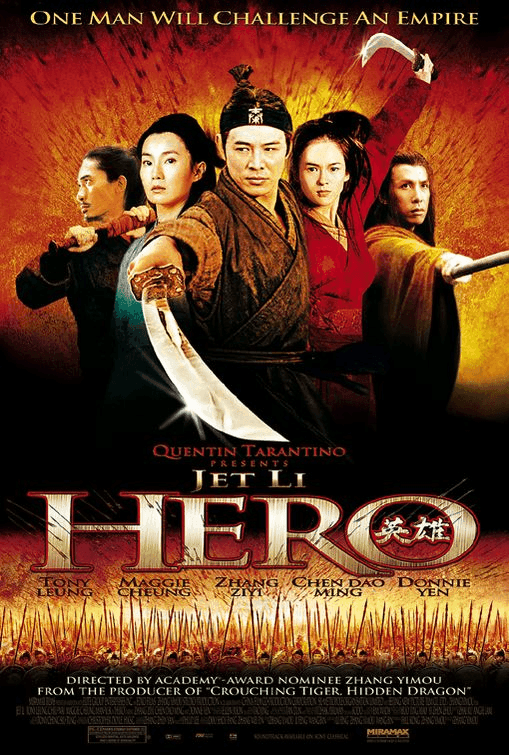
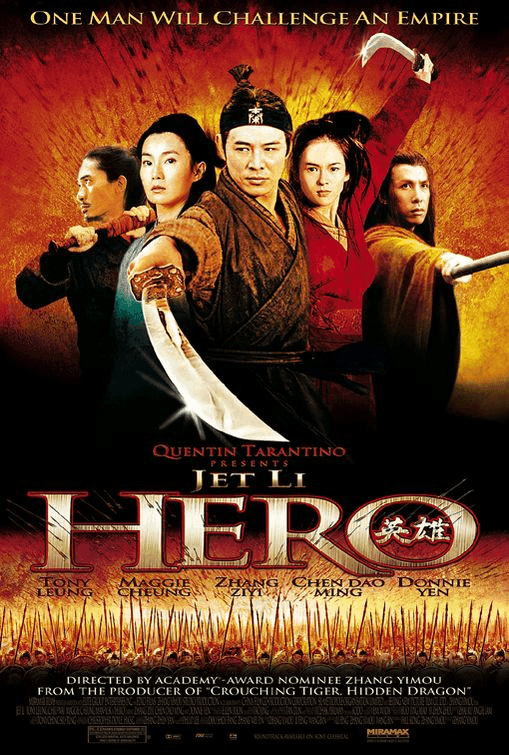
- Above-the-Line Talent: Jet Li headlined as Nameless and was joined by Tony Leung Chiu-wai, Maggie Cheung, Zhang Ziyi, Donnie Yen, and Chen Daoming as the King of Qin. The casting union of Hong Kong wuxia stars (Li, Leung, Cheung) with mainland prestige names commanded fees calibrated to international box office potential rather than typical mainland Chinese rates.
- Location Photography: Cinematographer Christopher Doyle (In the Mood for Love) shot across multiple Chinese provinces, including the Gobi Desert in Dunhuang, Inner Mongolia, Jiuzhaigou's lakes in Sichuan, and Yunnan, with a separate New Zealand pickup unit for portions of the chess-courtyard sequence. Long-distance moves with full crew, animals, and color-specific costume packages drove up location costs.
- Action Choreography: Action director Ching Siu-tung designed the film's wirework duels, including the chess-courtyard fight, the rooftop calligraphy sequence, and the lake duel between Broken Sword and Flying Snow. Multi-week rehearsal blocks and dedicated stunt teams for each principal added meaningful schedule.
- Visual Effects: Tweak Films and a small group of Asia-based vendors handled the storm of arrows over the Zhao calligraphy school, water-surface duel enhancements, and the painterly chromatic grades that distinguish each color chapter. The effects budget was modest by Hollywood standards but extensive for a Chinese production of the period.
- Score: Tan Dun, fresh off his Oscar-winning score for Crouching Tiger, Hidden Dragon, composed the soundtrack with solo violin performed by Itzhak Perlman. International orchestra recording in London and an Itzhak Perlman session both sat well above typical mainland Chinese music budgets.
How Does Hero's Budget Compare to Similar Films?
At $31,000,000, Hero sits in a small group of high-budget Chinese-language wuxia films that targeted international crossover audiences:
- Crouching Tiger, Hidden Dragon (2000): Budget $17,000,000 | Worldwide $213,525,736. Ang Lee's precursor cost roughly half of Hero and earned more worldwide, demonstrating both the market Hero was chasing and the difficulty of matching Crouching Tiger's North American crossover.
- House of Flying Daggers (2004): Budget $12,000,000 | Worldwide $92,863,945. Zhang Yimou's direct follow-up was made for roughly a third of Hero's cost yet earned more than 60% of its worldwide gross, becoming the more efficient producer return.
- Curse of the Golden Flower (2006): Budget $45,000,000 | Worldwide $78,568,977. Zhang's subsequent Tang-dynasty epic exceeded Hero's budget but earned less than half its worldwide total, the point at which the wuxia crossover cycle began to lose international momentum.
- Kung Fu Hustle (2004): Budget $20,000,000 | Worldwide $101,104,669. Stephen Chow's comedy-action hybrid earned 5x its budget and demonstrated an alternate, lower-cost path to international wuxia crossover.
- Zhang Yimou's Shadow (2018): Budget $43,000,000 | Worldwide $30,300,000. The director's late-career return to monochrome wuxia recouped less than its budget worldwide, highlighting how rare Hero's commercial success has become.
Hero Box Office Performance
Hero opened in China on October 24, 2002, and grossed CNY 250,000,000 (approximately $30,000,000) across mainland China, setting a domestic record. Miramax acquired US rights almost immediately but held the film until August 27, 2004, when it opened on 2,031 screens to a US-leading $18,004,319 opening weekend and held the number-one spot for two consecutive weekends.
Against a reported $31,000,000 production budget, the film easily cleared its break-even threshold. Here is the financial breakdown:
Box Office Breakdown
Hero

Hero returned approximately $2.69 in theatrical revenue for every $1 invested. The film earned $53,710,019 in North America, $30,000,000 in mainland China, and the balance across Japan, Hong Kong, Taiwan, Korea, and Europe, with Japan alone contributing nearly $40,000,000. The two-week US run at number one made it the highest-grossing foreign-language film in North American history at the time of release, a position it held until Crouching Tiger's remaining catalog and later subtitled imports overtook it.
Hero Production History
Zhang Yimou developed Hero in 1998 with co-writers Li Feng and Wang Bin, drawing on the historical figure of Jing Ke, the assassin sent to kill Qin Shi Huang in 227 BC, but reframing the story around an unnamed assassin and a chromatic Rashomon structure. The project was conceived as Zhang's first wuxia film and as a deliberate response to Crouching Tiger, Hidden Dragon's international success, with producer Bill Kong of Edko Films, who had co-produced Crouching Tiger, joining Beijing New Picture's Zhang Weiping on the financing.
Principal photography began in late 2001 and ran through 2002 across the Gobi Desert near Dunhuang, the Jiuzhaigou lakes in Sichuan, the autumn forests of Inner Mongolia, and stages at Beijing Film Studio. Christopher Doyle, the Australian cinematographer best known for his work with Wong Kar-wai, shot the film and developed the chromatic structure with Zhang in pre-production, locking each color chapter to a specific physical environment.
Miramax acquired US rights in 2002 but held the film for two years while negotiating with Zhang over potential cuts and English-language framing. Quentin Tarantino, by then a Miramax favorite and a vocal admirer of the film, lobbied publicly for a wide US release without recutting, and his "Quentin Tarantino Presents" branding was added to the US release in 2004. The two-year delay became one of the most-discussed acquisition decisions in early-2000s art-house distribution.
Hero was selected as China's submission for the Best Foreign Language Film category at the 75th Academy Awards and received an Oscar nomination, the second consecutive Best Foreign Language Film nomination for a Zhang Yimou wuxia following Crouching Tiger's 2001 win for Ang Lee.
Awards and Recognition
Hero received an Academy Award nomination for Best Foreign Language Film at the 75th Academy Awards in 2003, where it lost to Caroline Link's Nowhere in Africa. The film also received a BAFTA nomination for Best Film Not in the English Language and a Golden Globe nomination for Best Foreign Language Film. At the 2003 Berlin International Film Festival, Hero received the Alfred Bauer Prize for a feature film opening new perspectives.
At the Hong Kong Film Awards, Hero won seven prizes including Best Cinematography for Christopher Doyle, Best Art Direction, Best Costume and Make Up Design for Emi Wada, Best Sound Design, Best Visual Effects, Best Action Choreography for Ching Siu-tung, and Best Original Film Score for Tan Dun. The Golden Horse Awards in Taiwan added wins for Best Visual Effects and Best Cinematography. The film was named Best Foreign Language Film by the National Board of Review in 2004 and appeared on numerous critics' ten-best lists that year.
Critical Reception
Hero received largely positive reviews on its 2004 US release. The film holds a 95% approval rating on Rotten Tomatoes based on 215 critic reviews, with a critical consensus that praised its visual splendor and choreographic ambition. On Metacritic, the film scored 85 out of 100, indicating universal acclaim.
Roger Ebert awarded the film four stars and wrote that "to watch this film is to lose all consciousness of time and place" while praising the precision of Zhang's color-coded storytelling. A. O. Scott of The New York Times called it "a sumptuous spectacle that ranks among the most beautiful films ever made," and Manohla Dargis, then at the Los Angeles Times, wrote that the chromatic structure transformed wuxia conventions into "a meditation on memory and history."
A minority of Western critics, led by J. Hoberman in The Village Voice and David Edelstein in Slate, criticized what they viewed as the film's political subtext, arguing that the conclusion endorsed unification under a strong central ruler in ways that read as an apology for contemporary Chinese state authority. The political reading remained a recurring strand in Hero's critical legacy, separate from its widely acknowledged formal and choreographic achievement.
Frequently Asked Questions
How much did it cost to make Hero (2002)?
The reported production budget was approximately $31,000,000, financed by Beijing New Picture Film Co., Elite Group Enterprises, and Sil-Metropole Organisation. At the time of release it was the most expensive Chinese-language film ever produced, a record held until Zhang Yimou's House of Flying Daggers (2004).
How much did Hero earn at the box office?
The film grossed $177,394,432 worldwide, including $53,710,019 in North America after Miramax's August 2004 US release, approximately $30,000,000 in mainland China, and nearly $40,000,000 in Japan. It topped the US box office for two consecutive weekends.
Was Hero a box office success?
Yes. Against a $31,000,000 production budget, Hero returned approximately $2.69 in worldwide gross for every $1 invested in production and marketing. It was the highest-grossing foreign-language film in North American history at the time of its 2004 US release.
Who directed Hero?
Zhang Yimou directed the film, working from a screenplay he co-wrote with Li Feng and Wang Bin. It was Zhang's first wuxia film, made in response to the international success of Ang Lee's Crouching Tiger, Hidden Dragon (2000).
Where was Hero filmed?
Principal photography took place across multiple Chinese provinces, including the Gobi Desert near Dunhuang, the Jiuzhaigou lakes in Sichuan, the autumn forests of Inner Mongolia, and Yunnan, with stage work at Beijing Film Studio. Cinematographer Christopher Doyle shot the film, organizing the photography around five distinct color chapters.
Why did Miramax delay Hero's US release by two years?
Miramax acquired US rights in 2002 but held the film for two years while negotiating with Zhang Yimou over potential cuts and English-language framing. Quentin Tarantino lobbied publicly for a wide US release without recutting and his "Quentin Tarantino Presents" branding was added to the August 27, 2004 US release. The delay became one of the most-discussed acquisition decisions in early-2000s art-house distribution.
How does Hero compare to Crouching Tiger, Hidden Dragon?
Crouching Tiger, Hidden Dragon (2000) was made for $17,000,000 and earned $213,525,736 worldwide. Hero cost roughly twice as much at $31,000,000 and earned $177,394,432 worldwide, a slightly smaller total but still a strong commercial result and a higher mainland China share than Crouching Tiger.
Who stars in Hero?
Jet Li plays the unnamed Nameless, with Tony Leung Chiu-wai as Broken Sword, Maggie Cheung as Flying Snow, Zhang Ziyi as Moon, Donnie Yen as Sky, and Chen Daoming as the King of Qin. The casting united Hong Kong wuxia stars with mainland prestige names.
What did critics think of Hero?
The film received widespread acclaim, with a 95% approval rating on Rotten Tomatoes (based on 215 critics) and a Metacritic score of 85 out of 100. Roger Ebert awarded four stars. A minority of Western critics, including J. Hoberman and David Edelstein, criticized what they viewed as the film's political endorsement of strong central rule.
Did Hero win any awards?
Hero received an Academy Award nomination for Best Foreign Language Film at the 75th Academy Awards in 2003, plus BAFTA and Golden Globe nominations in the same category. It won seven Hong Kong Film Awards including Best Cinematography for Christopher Doyle and Best Original Film Score for Tan Dun, plus the Alfred Bauer Prize at the 2003 Berlin Film Festival.
Filmmakers
Hero

Official Trailer
Build budgets like this one in Saturation
Start from an industry-standard feature film template, import the schedule and rates you already have, and let the cost report keep itself current as you spend. Real-time collaboration, no spreadsheets.