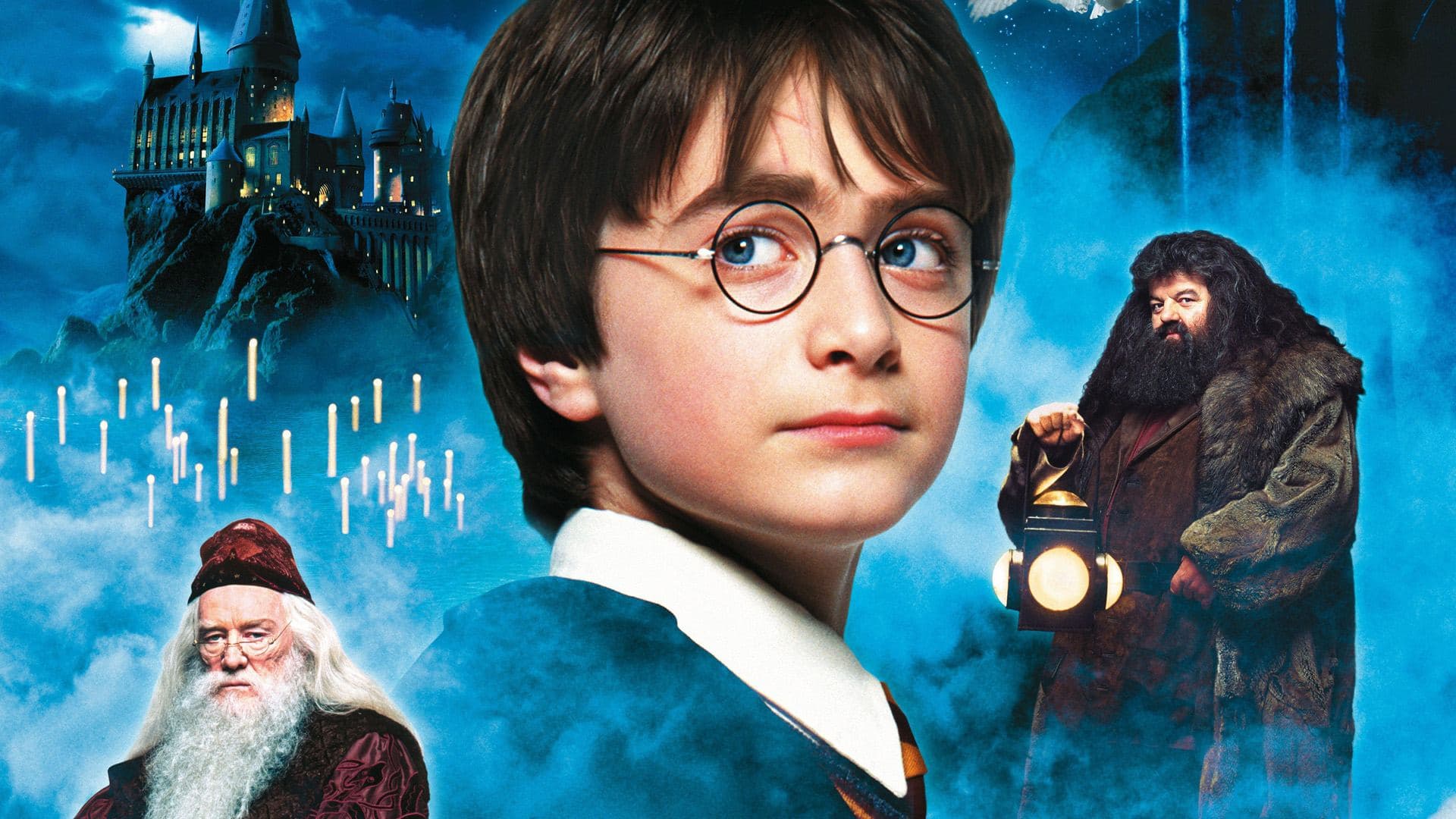
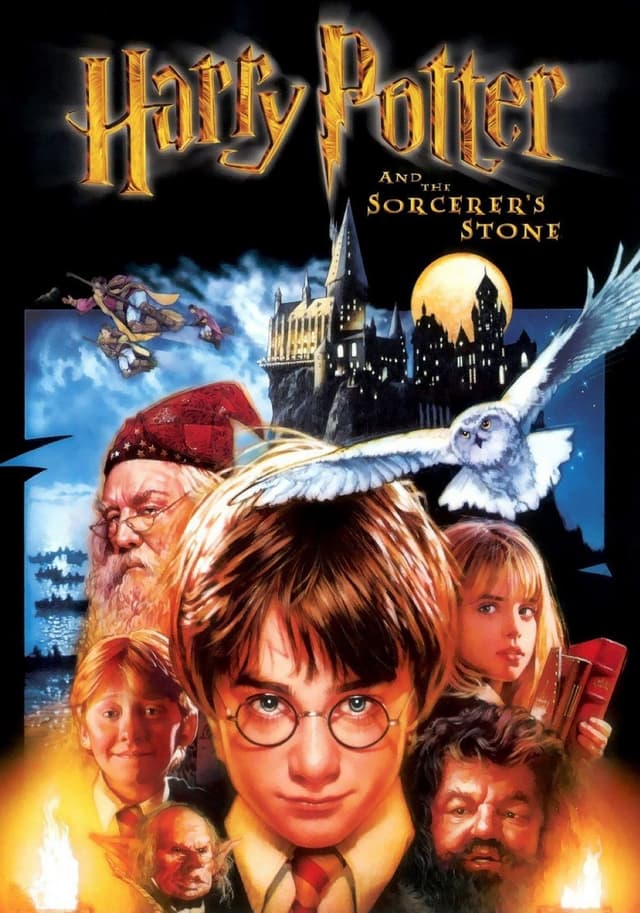
Harry Potter and the Sorcerer's Stone Budget
 AdventureFantasy2h 32m
Updated
Synopsis
On his eleventh birthday, orphan Harry Potter learns from Hagrid that he is a wizard, famous for surviving the attack by the dark wizard Voldemort that killed his parents. At Hogwarts School of Witchcraft and Wizardry he befriends Ron Weasley and Hermione Granger, becomes Seeker for the Gryffindor Quidditch team and discovers that something called the Sorcerer's Stone, which can grant immortality, is hidden in the school. Suspecting that someone is trying to steal it to restore Voldemort, the three friends pass a series of enchanted defenses, and Harry confronts Professor Quirrell, who carries Voldemort on the back of his head.
What Is the Budget of Harry Potter and the Sorcerer's Stone?
Harry Potter and the Sorcerer's Stone (2001), released in Britain as Harry Potter and the Philosopher's Stone, had a production budget of $125,000,000. That is the figure Box Office Mojo and The Numbers both list and the one Wikipedia cites, and Warner Bros. has never published a different number. Directed by Chris Columbus and produced by David Heyman for Warner Bros. Pictures, Heyday Films and 1492 Pictures, it was shot at Leavesden Film Studios and on location around the United Kingdom between September 2000 and March 2001.
Warner Bros. had bought the film rights to the first four novels in 1999 for a reported £1,000,000, about $1,650,000. Two early decisions shaped how the rest of the money was spent: J.K. Rowling's condition that the cast be British and Irish, and the studio's agreement to a request from British film industry officials to make the film in the United Kingdom, with their help on locations, studio space and child labour rules. The film went on to gross $1,021,320,042 worldwide across its original run and re-releases, 8.2 times its budget.
Key Budget Allocation Categories
Warner Bros. has never published a line-item budget for the film, but the production record shows where the money went.
- Sets and Stages: Production designer Stuart Craig built the main sets at Leavesden Film Studios, including a Great Hall modeled on English cathedrals. Asked to film Diagon Alley on an existing old street, he built his own instead, mixing Tudor, Georgian and Queen Anne architecture. The art direction was nominated for an Academy Award.
- Visual Effects and Creatures: The film has nearly 600 effects shots split across several companies. Industrial Light & Magic created Voldemort's face on the back of Quirrell's head, Rhythm & Hues animated the baby dragon Norbert, and Sony Pictures Imageworks produced the Quidditch match and the mountain troll. Jim Henson's Creature Shop supplied creature effects and Nick Dudman the prosthetics.
- Location Shooting: Alnwick Castle and Gloucester Cathedral stood in for Hogwarts, with further scenes at Harrow School, two weeks at Durham Cathedral, and Oxford's Divinity School, Duke Humfrey's Library and Christ Church. London's Australia House became Gringotts, and the crew also shot at London Zoo's Reptile House, King's Cross and Goathland station in North Yorkshire.
- Privet Drive: Filming the Dursleys' street on Picket Post Close in Bracknell, Berkshire, took two days instead of the planned one, so payments to the residents went up. Later Privet Drive scenes were shot on a set at Leavesden, which proved cheaper than the location.
- Child Cast and Schooling: The three leads came from open casting calls limited to British children. On set the young actors filmed for four hours a day and spent three hours on schoolwork. The proposal that brought the shoot to Britain included help adjusting UK child labour rules, adding a small number of working hours per week and making on-set lessons more flexible.
- Two Titles, Two Takes: Because the American title differs from the British one, every scene that names the stone was filmed twice, once with the actors saying "philosopher's" and once with "sorcerer's".
How Does Harry Potter and the Sorcerer's Stone's Budget Compare to Similar Films?
At $125,000,000, Harry Potter and the Sorcerer's Stone was one of the most expensive family films of its time. The worldwide figures below are Box Office Mojo's original-release grosses, so each film is measured on its first run; Harry Potter and the Sorcerer's Stone's original run took $974,755,371.
- The Lord of the Rings: The Fellowship of the Ring (2001): Budget $93,000,000 | Worldwide $868,385,360. The other big fantasy adaptation of the 2001 holiday season opened about five weeks later. It cost $32,000,000 less, as the first of three films shot together in New Zealand, and grossed $106,370,011 less.
- Monsters, Inc. (2001): Budget $115,000,000 | Worldwide $528,773,250. Pixar's film opened two weeks earlier and cost $10,000,000 less. Harry Potter took its record for the biggest November opening, $90,294,621 against $62,577,067, and grossed 84% more worldwide.
- Harry Potter and the Chamber of Secrets (2002): Budget $100,000,000 | Worldwide $878,979,634. The sequel, also directed by Chris Columbus and released a year later, cost $25,000,000 less, opened to $88,357,488 and grossed $95,775,737 less in its original run.
- Spider-Man (2002): Budget $139,000,000 | Worldwide $804,500,648. Spider-Man took the opening weekend record with $114,844,116 the following May and earned more in North America, $403,706,375, but grossed $170,254,723 less worldwide on a budget $14,000,000 higher.
- The Chronicles of Narnia: The Lion, the Witch and the Wardrobe (2005): Budget $180,000,000 | Worldwide $745,013,115. Another adaptation of a British children's classic, it cost 44% more than Harry Potter and grossed $229,742,256 less.
Harry Potter and the Sorcerer's Stone Box Office Performance
Harry Potter and the Sorcerer's Stone opened in the United Kingdom and in the United States and Canada on November 16, 2001. In North America it took $32,300,000 on its first day, a single-day record that beat Star Wars Episode I: The Phantom Menace (1999), and $90,294,621 from 3,672 theaters over the weekend, the biggest opening of all time until then, ahead of The Lost World: Jurassic Park (1997). Its five-day Thanksgiving gross of $82,387,621 stood as the holiday record for twelve years, and it stayed at number one for three weekends before Ocean's Eleven (2001) opened. In the UK and Ireland it opened to a record £16,300,000 including previews and finished with about £66,100,000, second only to Titanic (1997) in that market at the time.
The original run grossed $317,575,550 in the United States and Canada and $657,179,821 internationally, a worldwide total of $974,755,371 that made it the highest-grossing film of 2001, the highest-grossing Warner Bros. film to that point and the second-highest-grossing film ever behind Titanic. Re-releases have since added $46,564,671. The largest came in August 2020, when a 4K 3D restoration opened in China and grossed $27,300,000, carrying the film past $1,000,000,000 worldwide. Further runs followed in 2021 in 11 markets and for the 25th anniversary in August 2026 in 15.
Box Office Mojo lists $1,034,760,714 across all releases, including $319,765,078 in the United States and Canada. That total also counts six re-release rows that their own weekend grosses cannot support: United Kingdom rows for 2022, 2023 and 2025 and a 2023 Türkiye row that repeat earlier running totals, a 2020 Brazil row of $3,552,958 built from weekends under $6,000, and a 2021 Netherlands row of $4,328,645 that jumps by $4,110,659 in a week with a $63,845 weekend. Excluding those $13,440,672 gives the worldwide figure used here.
Box Office Breakdown
Harry Potter and the Sorcerer's Stone

The film earned 31.3% of its total in the United States and Canada, close to its 32.6% share in the original run, and Box Office Mojo has estimated that it sold more than 55,900,000 tickets there. Warner Bros.' parent company reported the payoff in its filings: AOL Time Warner's quarterly report for the period ended September 30, 2002 attributed the rise in Warner Bros.' earnings "principally" to "the profitability of Harry Potter and the Sorcerer's Stone," and its 2002 annual report said the film had sold 23,000,000 DVD units worldwide, leading the more than 1,500 DVD titles its home video division had released.
Warner Bros. never disclosed its own marketing spend. The Associated Press reported in February 2001 that the studio's promotional deal with Coca-Cola would put $150,000,000 of Coke's marketing behind the film, though other estimates put that partnership at $40,000,000 to $50,000,000 worldwide, and that partner spending is separate from the studio's own prints and advertising budget. Without a reported P&A figure, a return per dollar invested cannot be calculated.
Harry Potter and the Sorcerer's Stone Production History
In 1997 producer David Heyman was looking for a children's book to adapt at his company Heyday Films when his assistant suggested Harry Potter. After Harry Potter and the Chamber of Secrets was published in 1998, he pitched the novels to Warner Bros., and in 1999 J.K. Rowling sold the studio the rights to the first four books, insisting on a British and Irish cast. Steven Spielberg negotiated to direct and developed a draft of the script with screenwriter Steve Kloves, reportedly favoring an animated version, but left the project. Heyman recalled that Spielberg chose A.I. Artificial Intelligence instead; Spielberg said in 2023 that he turned it down to spend time with his family.
More than a dozen directors were discussed, including Terry Gilliam, who was Rowling's first choice, and Rob Reiner and Wolfgang Petersen, who both withdrew in March 2000. Chris Columbus, a fan of the books through his daughter, asked to be the last director Warner Bros. met and arrived with a 130-page director's version of the script. The studio chose him, citing family films such as Home Alone and Mrs. Doubtfire (1993), and he turned down Spider-Man to make it. Warner had planned a July 4, 2001 release, but the short production window drove some candidates away and the date moved to November 16, 2001.
Casting director Susie Figgis ran open calls for the three leads, then left the production on 11 July 2000 after disagreements with Columbus. Daniel Radcliffe, Rupert Grint and Emma Watson were chosen on 21 August 2000; Grint had sent in a video of himself rapping. Alan Rickman and Richard Harris were confirmed as Snape and Dumbledore that month, and Maggie Smith and Robbie Coltrane joined on 14 August. The British and Irish rule held: Robin Williams's interest in playing Hagrid and Rosie O'Donnell's offer to play Molly Weasley for free were both turned away.
Principal photography began on 29 September 2000 at Leavesden and ended on 23 March 2001, with final work in July. Canterbury Cathedral refused to host Hogwarts over the story's "pagan" theme, so Alnwick Castle and Gloucester Cathedral took the role. John Williams, who had worked with Columbus on Home Alone, recorded his score in London in September 2001, introducing the "Hedwig's Theme" that recurs through the series. The film premiered at the Odeon Leicester Square in London on 4 November 2001 and opened twelve days later in the widest release either the United Kingdom or the United States had seen at the time. Seven sequels followed, ending in 2011.
Awards and Recognition
The film's honors went mostly to its design, costumes and music.
- Academy Awards: Nominated for Best Art Direction (Stuart Craig and Stephenie McMillan), Best Costume Design (Judianna Makovsky) and Best Original Score (John Williams) at the 74th Academy Awards.
- British Academy Film Awards: Seven nominations, including Best British Film, Best Supporting Actor for Robbie Coltrane, Best Production Design, Best Costume Design, Best Makeup and Hair, Best Sound and Best Visual Effects.
- Saturn Awards: Won Best Costume for Judianna Makovsky, from nine nominations that included Best Fantasy Film and Best Director for Chris Columbus.
- Critics' Choice Awards: Won Best Family Film from the Broadcast Film Critics Association, with nominations for Daniel Radcliffe and John Williams.
- Guild Awards: Won the Costume Designers Guild award for period and fantasy film and a Casting Society of America award for Janet Hirshenson and Jane Jenkins. David Heyman was nominated by the Producers Guild, and the film was also nominated by the Art Directors Guild and American Cinema Editors.
- Grammy and Hugo Awards: John Williams received two Grammy nominations, for Best Score Soundtrack Album and for "Hedwig's Theme" as Best Instrumental Composition, and the film was nominated for the Hugo Award for Best Dramatic Presentation.
The young cast was recognized too. Rupert Grint won the Satellite Award for Outstanding New Talent and a Young Artist Award as Most Promising Young Newcomer, and Emma Watson shared the Young Artist Award for leading young actress. Stuart Craig won the Evening Standard British Film Awards' technical achievement award, and in 2005 the American Film Institute nominated Williams' score for its 100 Years of Film Scores list.
Critical Reception
Reviews were positive, if less unanimous than the box office. The film holds 80% on Rotten Tomatoes from 201 critics, with an average rating of 7.3/10 and Certified Fresh status, and a Metacritic score of 65 out of 100 from 37 critics, indicating generally favorable reviews. Audiences polled by CinemaScore gave it an A. The Rotten Tomatoes consensus says the film "adapts its source material faithfully while condensing the novel's overstuffed narrative" into a "big-screen magical caper."
Roger Ebert gave it four out of four stars, calling it "a red-blooded adventure movie, dripping with atmosphere" and "an enchanting classic that does full justice to a story that was a daunting challenge." Todd McCarthy of Variety wrote that "the script is faithful, the actors are just right," and Kirk Honeycutt of The Hollywood Reporter praised the sets, effects and cast while calling Williams' score "a great clanging, banging music box that simply will not shut up." The dissenters objected to the same faithfulness: Richard Corliss of Time called it a "by the numbers adaptation," and Elvis Mitchell of The New York Times compared it to "a theme park that's a few years past its prime."
Frequently Asked Questions
How much did it cost to make Harry Potter and the Sorcerer's Stone (2001)?
Harry Potter and the Sorcerer's Stone had a production budget of $125,000,000, the figure listed by Box Office Mojo and The Numbers. Warner Bros. had also paid a reported £1,000,000 in 1999 for the film rights to the first four novels. The studio never disclosed its marketing spend.
How much did Harry Potter and the Sorcerer's Stone make at the box office?
It has grossed $1,021,320,042 worldwide across its original run and re-releases, including $319,765,078 in the United States and Canada. The original run took $974,755,371: $317,575,550 domestic and $657,179,821 international, after a $90,294,621 opening weekend, according to Box Office Mojo.
Was Harry Potter and the Sorcerer's Stone profitable?
Yes. AOL Time Warner attributed Warner Bros.' earnings growth in the first nine months of 2002 principally to the film's profitability, and its 2002 annual report said it had sold 23,000,000 DVD units worldwide. Its worldwide gross is 8.2 times its $125,000,000 budget, but Warner never disclosed its marketing spend, so an exact ROI cannot be calculated.
Why is this worldwide total lower than Box Office Mojo's $1,034,760,714?
Box Office Mojo's all-releases figure counts six re-release rows that its own weekend data cannot support: United Kingdom rows for 2022 ($1,552,919), 2023 ($1,838,342) and 2025 ($1,975,049) and a 2023 Türkiye row ($192,759) that repeat earlier running totals, plus a 2020 Brazil row ($3,552,958) and a 2021 Netherlands row ($4,328,645). Excluding those $13,440,672 gives $1,021,320,042.
Is Harry Potter and the Sorcerer's Stone the same film as Harry Potter and the Philosopher's Stone?
Yes. Harry Potter and the Philosopher's Stone is the original British title, and Sorcerer's Stone is the title used in the United States, India and the Philippines. Every scene that names the stone was filmed twice, once with each word.
When did Harry Potter and the Sorcerer's Stone pass the billion-dollar mark?
In August 2020, when a 4K 3D restoration was released in China and grossed $27,300,000, according to Box Office Mojo. That made it the second Harry Potter film to pass $1,000,000,000 worldwide, after Deathly Hallows Part 2.
How much did Warner Bros. pay for the Harry Potter film rights?
J.K. Rowling sold Warner Bros. the film rights to the first four Harry Potter books in 1999 for a reported £1,000,000, about $1,650,000, after producer David Heyman of Heyday Films pitched the series to the studio. Rowling required the cast to be British and Irish.
Where was Harry Potter and the Sorcerer's Stone filmed?
At Leavesden Film Studios and on location in the United Kingdom from 29 September 2000 to 23 March 2001. Alnwick Castle and Gloucester Cathedral doubled as Hogwarts, with scenes at Durham Cathedral, Harrow School and Oxford. Australia House in London played Gringotts, and Goathland station, London Zoo and King's Cross were also used.
What awards was Harry Potter and the Sorcerer's Stone nominated for?
It received three Academy Award nominations, for Best Art Direction, Best Costume Design and Best Original Score, and seven BAFTA nominations, including Best British Film. It won the Saturn Award for Best Costume, the Broadcast Film Critics Association award for Best Family Film and the Costume Designers Guild award for period and fantasy film.
How does Harry Potter and the Sorcerer's Stone's budget compare to Chamber of Secrets?
Harry Potter and the Chamber of Secrets (2002) cost $100,000,000, $25,000,000 less than the first film's $125,000,000, and grossed $878,979,634 worldwide in its original run, $95,775,737 less than the $974,755,371 the first film took in its original run, according to Box Office Mojo.
Filmmakers
Harry Potter and the Sorcerer's Stone

Official Trailer
Build budgets like this one in Saturation
Start from an industry-standard feature film template, import the schedule and rates you already have, and let the cost report keep itself current as you spend. Real-time collaboration, no spreadsheets.