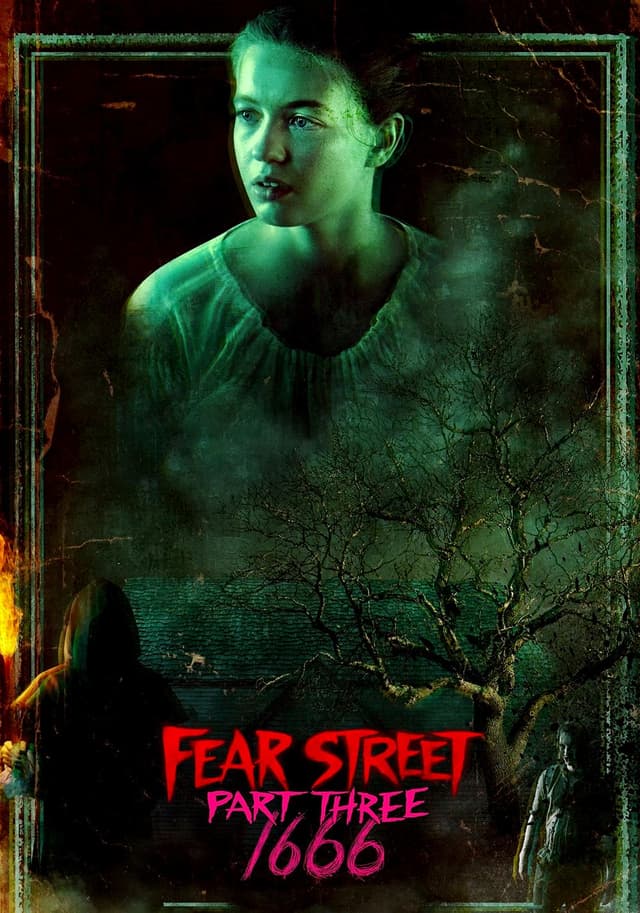
Fear Street 1666 Budget
 MysteryHorror1h 55m
Updated
Synopsis
In 1666, a colonial Puritan town named Union is gripped by a witch-hunt that condemns Sarah Fier, the woman whose curse echoes through three centuries to the 1994 generation of Shadyside teens trying to break it. Leigh Janiak's Netflix trilogy finale collapses the past and present timelines into one final confrontation.
What Is the Budget of Fear Street Part Three: 1666 (2021)?
Fear Street Part Three: 1666 (2021), directed by Leigh Janiak and distributed by Netflix, was the third installment of the Fear Street trilogy adapted from R.L. Stine's young-adult horror novel series. Neither Chernin Entertainment nor Netflix has publicly disclosed individual film budgets, but trade reporting on the trilogy as a whole places the combined production cost between $25,000,000 and $35,000,000 across all three features, with industry estimates assigning roughly $9,000,000 to $12,000,000 per film once the back-to-back shooting model is factored in. The trilogy was originally developed at 20th Century Fox before Disney's 2019 acquisition, and Disney sold the project to Netflix in August 2020 for an estimated $20,000,000 to $30,000,000 in addition to absorbing the production cost.
The 1666 installment carried unique cost pressures within the trilogy. Where Part One and Part Two used contemporary 1994 and 1978 settings that could be dressed practically on Georgia stages and exteriors, Part Three required period set construction, candle-and-firelight cinematography, hand-stitched costumes, and a full Puritan colonial village built from scratch. The casting structure deliberately reused the principal players from Parts One and Two in 1666 doubled roles, which removed scale cost but compressed the production schedule.
Key Budget Allocation Categories
The estimated $9,000,000 to $12,000,000 production budget for Fear Street Part Three: 1666 was distributed across:
- Above-the-Line Talent: The ensemble cast led by Kiana Madeira, Olivia Scott Welch, Benjamin Flores Jr., Ashley Zukerman, Gillian Jacobs, Maya Hawke, Sadie Sink, and Emily Rudd carried over from Parts One and Two, with most performers double-cast as 17th-century counterparts. Director Leigh Janiak helmed all three films on a single trilogy contract, with screenplay credits across the slate to Janiak, Phil Graziadei, and Kate Trefry.
- Period Production Design: The 1666 timeline required construction of a Puritan colonial village set complete with church, meetinghouse, residential dwellings, and surrounding forest. Production designer Scott Kuzio built the village on a Georgia exterior location with practical structures rather than digital extensions, a significant line item that absorbed the largest share of below-the-line spend.
- Costumes and Hair: Costume designer Amanda Ford produced authentic Puritan colonial wardrobe across 30+ principal speaking parts plus background, with hand-stitching, period-accurate fabrics, and aging treatments. Period costumes carry approximately 4 to 5x the per-unit cost of contemporary wardrobe on a film of this scale.
- Visual Effects: Witch trial sequences, supernatural manifestations of Sarah Fier's curse, and the timeline-collapsing climax required VFX work across multiple vendor houses. The 1666 installment used less VFX than Part One but more than Part Two, with the witchcraft mythology grounded in practical effects supplemented by digital flame, blood, and supernatural movement.
- Cinematography and Lighting: Cinematographer Caleb Heymann shot the 1666 sequences predominantly by candlelight and natural firelight, with extensive use of Cooke S4 lenses and slow film stocks to achieve the period aesthetic. Lighting and gripping packages for low-light period photography exceeded the budget allocated to Parts One and Two by a notable margin.
- Reshoots and Post-Production: The trilogy completed principal photography in fall 2019 but spent 18 months in post-production through 2020 and into 2021. Pandemic-related additional photography and pickup work in 2020 added incremental cost. Post-production at Netflix-affiliated facilities included editorial, VFX integration, sound mix, and Dolby Atmos premix.
How Does Fear Street Part Three: 1666's Budget Compare to Similar Films?
At an estimated $9,000,000 to $12,000,000, the film sits at the lower end of contemporary studio horror feature budgets but represents a premium within the YA horror category. The comparison set illustrates the trilogy's position:
- Fear Street Part One: 1994 (2021): Estimated budget approximately $9,000,000 to $11,000,000. The trilogy opener shared the back-to-back production model and roughly equivalent per-film cost structure, with Janiak directing the slate as a single creative project.
- Fear Street Part Two: 1978 (2021): Estimated budget approximately $9,000,000 to $11,000,000. The Camp Nightwing slasher chapter sat in the same per-film band, with summer-camp practical effects offsetting the period setting costs.
- The Witch (2015): Budget $4,000,000 | Worldwide $40,423,945. Robert Eggers' 17th-century New England horror covered closely related period territory at less than half the per-film cost and grossed roughly ten times its production budget theatrically.
- The Crucible (1996): Budget $25,000,000 | Worldwide $7,343,008. Nicholas Hytner's prestige Arthur Miller adaptation cost more than double Fear Street: 1666 and grossed only $7,300,000 worldwide, illustrating the financial gap between prestige period drama and streaming-bound genre programming.
- Hocus Pocus 2 (2022): Estimated budget approximately $25,000,000 to $40,000,000. Disney+'s contemporaneous witch sequel cost roughly two to three times Fear Street: 1666 and benefited from existing brand recognition and a 30-year IP runway.
Fear Street Part Three: 1666 Box Office Performance
Fear Street Part Three: 1666 had no theatrical release. The film premiered exclusively on Netflix on July 16, 2021, the third weekly drop in the trilogy following Part One (July 2) and Part Two (July 9). Netflix does not publish per-title revenue figures, but the company's Top 10 reporting and weekly engagement data placed all three Fear Street films in the global top ten English-language films during their July 2021 release window, with Part Three: 1666 spending an estimated three weeks in the top ten worldwide. Here is the financial breakdown:
Box Office Breakdown
Fear Street 1666

Netflix data released through the company's Top 10 site indicated the trilogy accumulated over 200,000,000 hours viewed globally during the July and August 2021 window. Part One: 1994 led the trilogy in raw engagement, followed by Part Two: 1978, with Part Three: 1666 completing the trilogy arc and benefiting from binge-style household viewing patterns established by Netflix's weekly drop strategy.
The trilogy's commercial success extended Netflix's YA-horror programming runway. A fourth Fear Street film, Prom Queen, was announced in 2023 with Matt Palmer directing and based on a different R.L. Stine novel, indicating Netflix's satisfaction with the trilogy's engagement performance and subscriber retention contribution.
Fear Street Part Three: 1666 Production History
Development on the Fear Street trilogy began at 20th Century Fox in 2017 with Chernin Entertainment producing. Leigh Janiak, coming off Honeymoon (2014) and episodic television work on Outcast, signed on to direct all three features as a unified trilogy following the success of Stephen King adaptations including It (2017). The screenplay was developed by Janiak with co-writers Phil Graziadei and Kate Trefry across 18 months in 2017 and 2018, with R.L. Stine consulting on continuity between the films and his original novel series.
Principal photography for all three films ran in a single continuous block from March to September 2019 in Georgia, Georgia, utilizing the state's 30 percent film tax credit. The unit base was located at Atlanta Metro Studios with location work across the East Point and Riverdale areas. The 1666 Puritan village set was constructed at a wooded location north of Atlanta and dressed for autumn shooting between July and August 2019.
The 1666 production schedule represented the densest creative challenge of the trilogy. Janiak structured the shoot to cast the principal Part One and Part Two players in 17th-century doubled roles, with Kiana Madeira playing both Deena Johnson in 1994 and Sarah Fier in 1666, Olivia Scott Welch playing both Sam Fraser and Hannah Miller, Benjamin Flores Jr. doubling as Josh Johnson and Henry Fier, and so on across the principal ensemble. The casting structure required extensive blocking rehearsals and additional dialect work for the period sequences.
Following Disney's March 2019 acquisition of 20th Century Fox, the trilogy was placed in development limbo while Disney assessed how the R-rated horror series fit within its consolidated brand portfolio. In August 2020 Disney sold the completed trilogy to Netflix, which then committed to the weekly summer drop release strategy that ultimately defined the project's commercial outcome. Pandemic-affected reshoots and additional photography in 2020 finalized the films for July 2021 release.
Awards and Recognition
Fear Street Part Three: 1666 received MTV Movie & TV Awards recognition in 2022, with Kiana Madeira nominated for Best Performance in a Movie and the trilogy as a whole nominated in the Best Movie category. The film received Saturn Award nominations in 2022 for Best Horror Television Presentation, recognizing the streaming-release format. Costume designer Amanda Ford received industry recognition through the Costume Designers Guild for her period work across the trilogy.
Long-term recognition has emphasized the trilogy's contribution to the post-Stranger Things wave of nostalgia-driven YA horror programming on streaming platforms. The Hollywood Reporter, Variety, and IndieWire all included the Fear Street trilogy in 2021 year-end best-of lists, with critical attention focused on Janiak's ambition in helming the three-film slate and the queer love story at the center of the trilogy narrative.
Critical Reception
Fear Street Part Three: 1666 received generally positive reviews. The film holds an 88 percent approval rating on Rotten Tomatoes based on 91 critic reviews, with a critical consensus that called it "a satisfying conclusion to a fun and frightening franchise." On Metacritic, the film scored 67 out of 100, indicating generally favorable reviews. Audience scores on Rotten Tomatoes register 81 percent, and the film holds a 6.7 out of 10 weighted user rating on IMDb across more than 30,000 user reviews.
Critics broadly praised the period craft, Kiana Madeira and Olivia Scott Welch's performances, and Janiak's ability to deliver a satisfying trilogy conclusion. IndieWire's David Ehrlich gave the film a B+ and wrote that the 1666 chapter "manages to tie everything together while still standing on its own as a wickedly entertaining period piece." Variety's Andrew Barker called it "a thrilling capstone to a propulsive trilogy" and singled out the queer romance at the trilogy's center as one of its most resonant elements.
The Guardian, Rolling Stone, Entertainment Weekly, and Polygon were similarly positive, with most critical reservations centered on the abrupt transition back to the 1994 timeline in the final act. Audience reception was strong, with the trilogy frequently cited in 2021 year-end best-of-streaming lists and credited with revitalizing R.L. Stine's Fear Street brand for a new generation of YA horror viewers.
Frequently Asked Questions
How much did Fear Street Part Three: 1666 (2021) cost to make?
Neither Chernin Entertainment, 20th Century Fox, nor Netflix has publicly disclosed individual film budgets. Trade reporting on the trilogy places the combined cost at $25,000,000 to $35,000,000 across all three features, with industry estimates assigning $9,000,000 to $12,000,000 per film given the back-to-back shooting model.
Why is Fear Street: 1666 on Netflix instead of theaters?
The trilogy was developed at 20th Century Fox before Disney's 2019 acquisition. Disney sold the completed trilogy to Netflix in August 2020 for an estimated $20,000,000 to $30,000,000 plus the assumed production cost, after the company concluded that the R-rated YA horror property did not fit within its consolidated brand portfolio.
When and where was Fear Street: 1666 filmed?
Principal photography for all three Fear Street films ran in a single continuous block from March to September 2019 in Georgia, taking advantage of the state's 30 percent film tax credit. The 1666 Puritan village set was constructed at a wooded location north of Atlanta and dressed for autumn shooting between July and August 2019.
Who directed all three Fear Street films?
Leigh Janiak directed all three Fear Street films on a single trilogy contract. She co-wrote the screenplays with Phil Graziadei and Kate Trefry, with R.L. Stine consulting on continuity to his original novel series.
Why does the same cast appear in all three Fear Street timelines?
Janiak deliberately cast principal players in doubled roles across the 1994, 1978, and 1666 timelines. Kiana Madeira plays both Deena Johnson and Sarah Fier, Olivia Scott Welch plays both Sam Fraser and Hannah Miller, and so on across the ensemble. The casting structure reinforces the trilogy's timeline-collapsing curse mythology.
How did Fear Street: 1666 perform on Netflix?
Netflix does not publish per-title revenue figures. The trilogy as a whole accumulated over 200,000,000 hours viewed globally during the July and August 2021 release window, with all three films spending multiple weeks in Netflix's Top 10 English-language films chart worldwide.
Was Fear Street based on the R.L. Stine books?
Yes. The trilogy adapts R.L. Stine's Fear Street young-adult horror novel series, originally published from 1989 through 2014 across more than 100 books. Janiak's trilogy assembles elements from multiple Fear Street novels rather than adapting a single book, with Stine consulting on continuity.
What did critics think of Fear Street: 1666?
The film received generally positive reviews, with an 88 percent approval rating on Rotten Tomatoes (91 critics) and a 67 out of 100 score on Metacritic. Critics praised the period craft, Kiana Madeira and Olivia Scott Welch's performances, and the trilogy's satisfying conclusion. IndieWire called it "a wickedly entertaining period piece."
Will there be a fourth Fear Street film?
Yes. Netflix announced Fear Street: Prom Queen in 2023, directed by Matt Palmer and based on a different R.L. Stine Fear Street novel. The new film is not directly connected to Janiak's trilogy but extends the brand within Netflix's YA horror programming.
How does Fear Street: 1666 compare to The Witch (2015)?
Robert Eggers' The Witch covered closely related 17th-century New England witchcraft territory at less than half the per-film cost. The Witch grossed $40,423,945 worldwide against a $4,000,000 budget. Fear Street: 1666 had no theatrical release as a Netflix exclusive but reached a far larger viewing audience through streaming.
Filmmakers
Fear Street 1666

Official Trailer
Build budgets like this one in Saturation
Start from an industry-standard feature film template, import the schedule and rates you already have, and let the cost report keep itself current as you spend. Real-time collaboration, no spreadsheets.