Dreamer: Inspired by a True Story Budget
 Drama
DramaUpdated
Synopsis
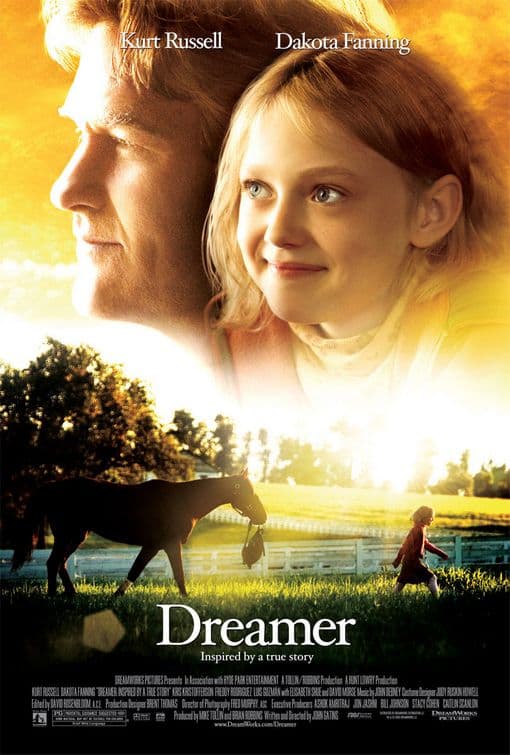
Trainer Ben Crane (Kurt Russell) saves a champion thoroughbred filly named Soñador from being put down after she shatters her leg in a race. He brings the horse home to recover, and with the encouragement of his young daughter Cale (Dakota Fanning) and his estranged father Pop (Kris Kristofferson), Ben commits to nursing the broken filly back to health. As Soñador heals against impossible odds, Cale dreams of returning her to the racetrack for one last impossible run at the Turfway Breeders' Cup.
What Is the Budget of Dreamer: Inspired by a True Story (2005)?
Dreamer: Inspired by a True Story (2005), directed and written by John Gatins in his feature directorial debut and distributed by DreamWorks Pictures, was produced on a reported budget of $32,000,000. The horse-racing family drama was loosely based on the real story of the racehorse Mariah's Storm, who broke her leg in a 1993 race and returned to win the Turfway Breeders' Cup. Gatins adapted the story around a fictional father-daughter narrative, casting Kurt Russell as the trainer Ben Crane and Dakota Fanning as his daughter Cale.
The $32,000,000 budget reflected DreamWorks Pictures' mid-2000s family-film economics. The figure positioned Dreamer above the typical Disney-style family-film budget tier ($20,000,000 to $25,000,000) but well below tentpole live-action family productions, reflecting the live-action horse footage and Kentucky location work that drove costs above the studio-soundstage family-drama floor.
Key Budget Allocation Categories
Dreamer's reported $32,000,000 budget was distributed across these production areas:
- Above-the-Line Talent: Kurt Russell played the lead trainer Ben Crane at a mid-six-figure rate. Dakota Fanning, then 10 years old and at the peak of her child-actor visibility following I Am Sam, War of the Worlds, and Hide and Seek, commanded a substantial supporting-lead salary. Kris Kristofferson played the grandfather Pop Crane, with David Morse, Elisabeth Shue, and Freddy Rodríguez in supporting roles.
- Kentucky Location Production: The film shot extensively in Kentucky from October 2004 to January 2005, using Keeneland Race Course in Lexington, Churchill Downs in Louisville, and surrounding horse-country properties. The Kentucky shoot was supported by the state's film tax credit program.
- Horse Wrangling and Racing Coordination: The film employed a substantial equestrian-coordination department managing the lead horse (Soñador, played primarily by a thoroughbred named Goldrush), the racing-sequence stunt horses, and the supporting horse-cast. Race-track choreography, picture-car coordination for the racing footage, and animal-welfare oversight comprised a meaningful share of production cost.
- Visual Effects: A modest VFX line covered the leg-injury inserts, the racing-finish-line composites, and the digital augmentation of crowd sequences at the Turfway Breeders' Cup climax.
- Score and Music: John Debney composed the score, working in an emotionally swelling American-pastoral register. Music licensing covered a small selection of country and Kentucky-bluegrass needle drops.
- Marketing Setup: DreamWorks positioned the film as the studio's October 2005 family-counter-programming, with marketing emphasizing the Kurt Russell-Dakota Fanning father-daughter pairing and the horse-racing genre that had been recently revived by Seabiscuit (2003).
How Does Dreamer's Budget Compare to Similar Films?
At $32,000,000, Dreamer sits in the middle of mid-2000s horse-racing and family-pastoral dramas:
- Seabiscuit (2003): Budget $87,000,000 | Worldwide $148,300,000. Gary Ross' Tobey Maguire-Jeff Bridges-Chris Cooper horse-racing drama cost nearly three times Dreamer and earned over four times its worldwide gross. Seabiscuit reactivated the horse-racing genre that Dreamer attempted to extend.
- Hidalgo (2004): Budget $100,000,000 | Worldwide $108,100,000. Joe Johnston's Viggo Mortensen desert-horse-race adventure cost over three times Dreamer with proportionally larger international results.
- Secretariat (2010): Budget $35,000,000 | Worldwide $60,200,000. Randall Wallace's Diane Lane Disney horse-racing drama matched Dreamer's budget tier and modestly outperformed its worldwide gross.
- My Friend Flicka (2006): Budget $15,000,000 | Worldwide $3,800,000. The 2006 Alison Lohman-Tim McGraw horse drama cost less than half Dreamer and posted a worse commercial result.
- Flicka (2006): Budget $15,000,000 | Worldwide $21,100,000. The 20th Century Fox horse drama benchmarks a low-budget family-pastoral release the year after Dreamer.
Dreamer Box Office Performance
Dreamer opened on October 21, 2005, earning $9,153,323 over its three-day opening weekend and finishing third at the domestic box office. The opening was solid for a $32,000,000 family drama in a crowded October corridor that included Saw II, Doom, and Wallace and Gromit: The Curse of the Were-Rabbit.
Against a reported production budget of $32,000,000, the film needed approximately $70,000,000 in worldwide gross to reach profitability accounting for marketing and distribution costs. Here is the financial breakdown:
Box Office Breakdown
Dreamer: Inspired by a True Story

Dreamer returned approximately $0.51 in worldwide theatrical revenue for every $1 invested when measured against total estimated production and marketing spend. The domestic share of the gross was $32,790,478 against an international share of just $109,195, a 99/1 split that confirmed the property's complete failure to register outside the United States market. The family-drama genre traveled poorly to international markets, a pattern consistent with similar mid-2000s American-pastoral family releases.
The shortfall on theatrical was partly offset by strong home-video performance in the family-rental category. DreamWorks Pictures had been absorbed into Paramount Pictures by 2006, and Dreamer's subsequent licensing and broadcast revenue contributed to Paramount's family-catalog. The commercial outcome did not damage John Gatins' career as a screenwriter, who went on to write Real Steel (2011) and Flight (2012, Oscar nomination).
Dreamer Production History
John Gatins wrote the original screenplay in the early 2000s, drawing on the real story of the racehorse Mariah's Storm, who broke her leg in a 1993 race and returned to win the 1995 Turfway Breeders' Cup. Gatins adapted the story around a fictional father-daughter narrative, with the protagonist trainer rebuilding the injured horse alongside his estranged young daughter. DreamWorks Pictures acquired the project in 2003, with Mike Tollin and Brian Robbins (Tollin/Robbins Productions) producing.
Casting Kurt Russell as Ben Crane and Dakota Fanning as his daughter Cale provided the project's lead anchor. Fanning, then ten years old, was at the peak of her child-actor visibility following her work on I Am Sam (2001), War of the Worlds (2005), and Hide and Seek (2005). Kris Kristofferson was cast as the grandfather Pop Crane, with David Morse as the antagonistic racehorse owner Palmer, Elisabeth Shue as Ben's wife Lily, and Freddy Rodríguez as the jockey Manolin.
Principal photography ran from October 2004 to January 2005 in Kentucky, with location work at Keeneland Race Course in Lexington, Churchill Downs in Louisville, and surrounding horse-country properties. The state's film tax credit program supported the production. The lead horse role was performed primarily by a thoroughbred named Goldrush, with additional stunt and racing horses across the equestrian-coordination department.
DreamWorks Pictures scheduled the United States release for October 21, 2005, positioning the film as fall family-counter-programming against the studio's horror and animated competition.
Awards and Recognition
Dreamer received limited industry awards recognition. Dakota Fanning won the 2006 Saturn Award for Best Performance by a Younger Actor for the role. The film and its young lead received nominations at the Young Artist Awards, the Critics' Choice Movie Awards, and the Phoenix Film Critics Society Awards.
Dreamer was nominated for two Razzie Awards (Worst Screen Couple for Kurt Russell and Dakota Fanning, and a follow-up Worst Family-Drama Premise nomination), but did not win. The film has been largely absent from awards conversation since its release, fitting within the broader pattern of mid-2000s family-pastoral dramas that registered commercially without earning sustained awards-circuit visibility.
Critical Reception
Dreamer received mixed-to-positive reviews. The film holds a 64% approval rating on Rotten Tomatoes based on 142 critic reviews, with a critical consensus that called it conventionally heartwarming but anchored by strong lead performances. On Metacritic, the film scored 64 out of 100, indicating generally favorable reviews. Audiences surveyed by CinemaScore gave the film an A, the highest possible grade and a strong endorsement of the family-target.
Critics broadly praised Kurt Russell and Dakota Fanning's chemistry and Kris Kristofferson's supporting turn, while noting that the screenplay leaned heavily on familiar inspirational-sports beats. Roger Ebert gave the film three and a half stars in the Chicago Sun-Times, writing that "Dreamer earns its emotional payoff because it has done the work to deserve it." The Hollywood Reporter's Kirk Honeycutt called Dakota Fanning "extraordinary in a role that other child actors would either underplay or overshoot."
The A CinemaScore and the 64% Rotten Tomatoes score against the modest commercial outcome reflected a striking gap between audience approval and box-office results. Family viewers who attended responded warmly, but the film failed to convert the strong word-of-mouth into a wider audience reach during its theatrical run. The mixed commercial outcome combined with the positive critical and audience response cemented Dreamer's reputation as a representative example of the under-monetized mid-2000s family-pastoral drama.
Frequently Asked Questions
How much did it cost to make Dreamer (2005)?
The reported production budget was $32,000,000. The film was produced by Mike Tollin and Brian Robbins through Tollin/Robbins Productions together with Hyde Park Entertainment, and distributed by DreamWorks Pictures.
How much did Dreamer earn at the box office?
The film grossed $32,790,478 domestically and just $109,195 internationally for a worldwide total of $32,899,673. It opened to $9,153,323 over its October 21, 2005 weekend, finishing third at the domestic box office.
Was Dreamer profitable?
No. Against a $32,000,000 production budget and approximately $30 to $35 million in marketing costs, the film returned approximately $0.51 in worldwide theatrical revenue for every $1 invested. The shortfall on theatrical was partly offset by strong home-video performance in the family-rental category.
Who directed Dreamer?
John Gatins directed Dreamer in his feature directorial debut, working from his own original screenplay. Gatins subsequently wrote Real Steel (2011) and Flight (2012, for which he received an Oscar nomination for Best Original Screenplay).
Where was Dreamer filmed?
Principal photography ran from October 2004 to January 2005 in Kentucky, with location work at Keeneland Race Course in Lexington, Churchill Downs in Louisville, and surrounding horse-country properties. The state's film tax credit program supported the production.
Is Dreamer based on a true story?
Yes, loosely. The film is "inspired by" the real story of the racehorse Mariah's Storm, who broke her leg in a 1993 race and returned to win the 1995 Turfway Breeders' Cup. John Gatins adapted the real story around a fictional father-daughter narrative, with the protagonist trainer rebuilding the injured horse alongside his estranged young daughter.
Who stars in Dreamer?
Kurt Russell stars as trainer Ben Crane, with Dakota Fanning as his daughter Cale, Kris Kristofferson as the grandfather Pop Crane, David Morse as the antagonistic racehorse owner Palmer, Elisabeth Shue as Ben's wife Lily, Freddy Rodríguez as the jockey Manolin, and Luis Guzmán in support.
Did Dreamer win any awards?
Dakota Fanning won the 2006 Saturn Award for Best Performance by a Younger Actor for her role as Cale Crane. The film received nominations at the Young Artist Awards, the Critics' Choice Movie Awards, and the Phoenix Film Critics Society Awards. It was also nominated for two Razzies but did not win.
What did critics think of Dreamer?
The film received mixed-to-positive reviews, with a 64% Rotten Tomatoes score based on 142 critics and a 64 Metacritic score. Audiences gave it an A CinemaScore. Critics praised Russell and Fanning's chemistry and Kris Kristofferson's supporting turn while noting the screenplay's reliance on familiar inspirational-sports beats. Roger Ebert gave the film three and a half stars.
How does Dreamer compare to other horse-racing films?
Dreamer's $32 million budget sits well below Seabiscuit (2003, $87M budget, $148M worldwide) and Hidalgo (2004, $100M budget, $108M worldwide). It matched Secretariat (2010, $35M budget, $60M worldwide) closely in budget terms but underperformed its worldwide gross.
Filmmakers
Dreamer: Inspired by a True Story

Build budgets like this one in Saturation
Start from an industry-standard feature film template, import the schedule and rates you already have, and let the cost report keep itself current as you spend. Real-time collaboration, no spreadsheets.