
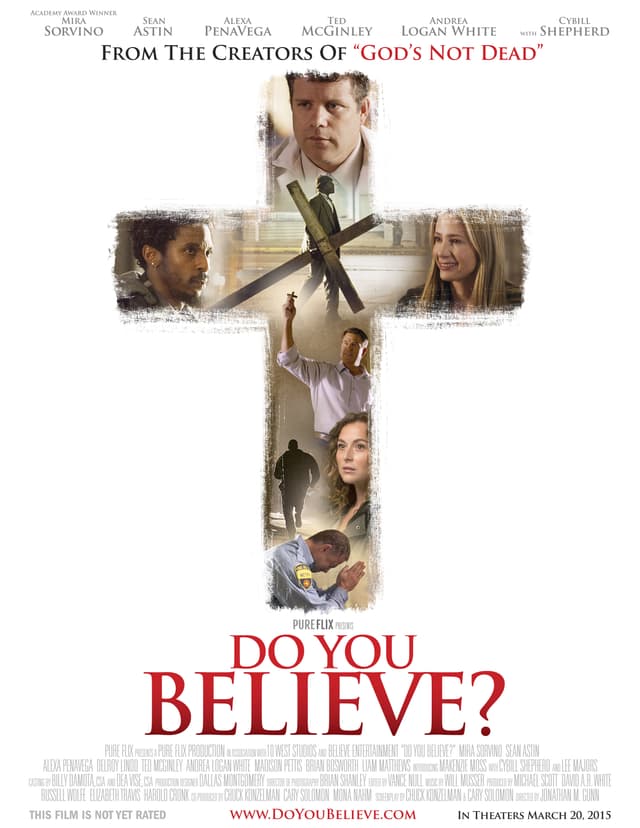
Do You Believe? Budget
 Drama2h
Updated
Synopsis
When a pastor is shaken by the visible faith of a street-corner preacher, he is reminded that true belief always requires action. His response ignites a journey that impacts everyone it touches in ways that only God could orchestrate.
What Is the Budget of Do You Believe??
Do You Believe? (2015), directed by Jonathan M. Gunn and distributed by Pure Flix Entertainment, had a reported production budget of approximately $2,000,000. This places the film firmly within the low-budget independent category, consistent with other releases from Pure Flix during that period. The film was produced using a traditional independent financing model supported by private investment and production partnerships rather than crowdfunding.
Its budget reflects a focus on ensemble storytelling, contained locations, and efficient production methods rather than scale or technical complexity. The film's narrative ambition, managing multiple intersecting storylines and a wide cast, required production discipline that kept each thread affordable while delivering a coherent, emotionally resonant whole.
Key Budget Allocation Categories
The $2 million budget for Do You Believe? was primarily allocated toward cast, production logistics, and the coordination demands of a large ensemble structure:
- Ensemble Cast — The film features a wide cast including Mira Sorvino, Sean Astin, Cybill Shepherd, and Lee Majors, which contributed to above-the-line costs despite the modest overall budget. Assembling a cast of this profile within $2 million reflects the faith community's willingness to reduce rates for aligned projects and Pure Flix's growing reputation as a commercially viable distribution platform.
- Practical Location Production — The film takes place in contemporary urban and suburban environments that could be captured using practical locations rather than constructed sets. This approach maintained visual authenticity while controlling costs, allowing the production to invest its resources in performance and storytelling rather than set construction.
- Multi-Strand Scheduling and Coordination — Managing multiple intersecting storylines and a large ensemble requires careful scheduling and production coordination that adds complexity without adding spectacle. For a $2 million production, the organizational demands of an ensemble narrative represent a meaningful cost in time and logistics that single-storyline films at the same budget do not face.
- Distribution and Church Outreach Alignment — As with God's Not Dead, the production was designed around Pure Flix's church group distribution model. The film's content and structure were calibrated to encourage organized group theatrical attendance from churches and Christian organizations, the mechanism that Pure Flix had demonstrated with its prior releases.
How Does Do You Believe? Compare to Similar Films?
At approximately $2,000,000, Do You Believe? aligns with the low-budget faith-based dramas Pure Flix produced in the early 2010s. The relevant comparisons contextualize its commercial result:
- God's Not Dead (2014) — Budget $2,000,000 | Worldwide $64,700,000. The direct predecessor at an identical production budget. God's Not Dead's extraordinary performance on the same budget is the unavoidable baseline: Do You Believe?'s $12.8 million is a strong result for a $2 million production, but the comparison illustrates how much specific narrative premise, the campus debate hook, drove the earlier film's cultural mobilization.
- Heaven Is for Real (2014) — Budget $12,000,000 | Worldwide $101,300,000. The Sony faith film at six times Do You Believe?'s budget demonstrates the commercial ceiling for faith-based drama when combined with mainstream studio distribution. Do You Believe?'s $12.8 million against a $2 million budget represents a stronger proportional efficiency than Heaven Is for Real at $12 million.
- Courageous (2011) — Budget $2,000,000 | Worldwide $34,500,000. The Kendrick Brothers' fatherhood drama on an identical budget achieved nearly three times Do You Believe?'s result, demonstrating how much the right specific premise in faith community distribution matters. Courageous gave church groups a specific emotional and cultural hook that the more diffuse ensemble narrative of Do You Believe? did not replicate.
- Fireproof (2008) — Budget $500,000 | Worldwide $33,400,000. On a quarter of Do You Believe?'s budget, the Kendrick Brothers' marriage drama achieved more than twice the result. The contrast between these two films is a study in the commercial power of specific cultural premises versus general statements of belief in faith-based theatrical distribution.
- Blue Like Jazz (2012) — Budget $1,500,000 | Worldwide $595,260. The faith memoir adaptation that significantly underperformed at a similar budget illustrates the baseline risk for faith-based films that lack the specific cultural hook or community mobilization mechanism that Pure Flix had built through God's Not Dead. Do You Believe?'s $12.8 million is dramatically stronger.
Do You Believe? Box Office Performance
Do You Believe? earned $12,777,873 worldwide at the box office. Against a production budget of $2,000,000, the film performed strongly and generated more than six times its production cost in worldwide revenue. The film was released on March 20, 2015, in over 1,300 theaters, positioning it for a wide but targeted release during the pre-Easter theatrical window.
A film typically needs to earn approximately twice its production budget to cover marketing and distribution costs. For Do You Believe?, that break-even threshold was roughly $4,000,000. Based on its wide release footprint, Prints and Advertising costs are estimated at approximately $5,000,000, bringing the total estimated investment to around $7,000,000. With worldwide earnings of $12,777,873, the film cleared that threshold comfortably.
Box Office Breakdown
Do You Believe?

At approximately +82.5%, Do You Believe? returned roughly $1.83 for every $1 invested during its theatrical run. For a $2 million ensemble drama, this result demonstrates the commercial efficiency that faith community distribution can deliver when production costs are controlled and audience alignment is strong. The film's success is driven not by scale but by audience alignment, clear messaging, and disciplined production.
Do You Believe? Production History
Do You Believe? was developed by Pure Flix as part of its strategy to produce faith-based films with strong ensemble casts and interconnected narratives, building on the proven audience base established by God's Not Dead. The project followed the success of that earlier film, capitalizing on the distribution infrastructure and church group engagement model Pure Flix had developed. Production was completed efficiently using practical locations and a relatively short shooting schedule, consistent with Pure Flix's cost-controlled approach.
The film was released theatrically on March 20, 2015, in over 1,300 theaters, targeting the pre-Easter window when faith community theatrical engagement is traditionally strongest. There is no evidence of a public crowdfunding campaign tied to the film's production or marketing, indicating a traditional financing and distribution approach. The film benefited from a well-established audience base and the targeted marketing strategy Pure Flix had developed through its church group engagement model.
Awards and Recognition
Do You Believe? received strong audience engagement within its target demographic and performed well relative to its budget, though it did not emerge as a major awards contender in mainstream film circuits. Within faith-based film circles, the film's affirmation of active belief over passive faith resonated with the Christian community it was designed for. Its commercial performance, generating more than six times its production cost, is the most significant recognition available to a micro-budget independent faith film.
Critical Reception
Critical reception for Do You Believe? was largely negative, with critics pointing to its narrative structure and overt messaging as weaknesses. Reviewers found the ensemble format crowded and the characterization thin, noting that the film's ambition to cover a wide range of human experiences within a single narrative limited the depth available to any individual storyline.
Audience reception was significantly stronger than critical response, reflecting the consistent pattern within the faith-based film market where community connection and thematic resonance drive viewer satisfaction independently of formal critical assessment. The film's $12.8 million worldwide result represents an audience that found the central question meaningful and the film's answers worth the price of admission.
Frequently Asked Questions
How much did Do You Believe? cost to make?
The production budget recorded on Saturation.io is $2,000,000. Pure Flix Entertainment financed and distributed the film as a follow-up to the company's breakout success God's Not Dead (2014, $2,000,000 budget, $64,000,000 worldwide).
How much did Do You Believe? earn at the box office?
The film grossed $12,985,600 domestically and approximately $12,777,873 worldwide as recorded on Saturation.io. It opened to $3,962,210 on March 20, 2015, finishing fifth in a weekend led by The Divergent Series: Insurgent.
Is Do You Believe? a sequel to God's Not Dead?
No, but Pure Flix marketed Do You Believe? as a thematic follow-up from the same producing team. The two films share producers David A.R. White, Russell Wolfe, and Elizabeth Travis, although the casts and stories are unrelated.
Who stars in Do You Believe?
The ensemble cast includes Mira Sorvino, Sean Astin, Lee Majors, Alexa PenaVega, Cybill Shepherd, Ted McGinley, Liam Matthews, Brian Bosworth, Madison Pettis, and Senyo Amoaku. The film carries a notably broader recognizable cast than is typical for the Pure Flix slate.
Who directed Do You Believe?
Jon Gunn directed the film. Gunn had previously directed My Date with Drew (2004) and went on to direct The Case for Christ (2017) and American Underdog (2021), establishing himself as a primary creative voice within the faith-coded theatrical category.
What did critics think of Do You Believe?
Reviews were largely negative, with an 18% approval rating on Rotten Tomatoes and a 28 out of 100 score on Metacritic. Critics objected to a structure that intercuts twelve characters across multiple plot lines, while audiences gave the film an A CinemaScore consistent with strong faith-audience reception.
Was Do You Believe? profitable?
Yes. Against the $2,000,000 production budget and an estimated $3,000,000 to $5,000,000 in marketing spend, the worldwide gross of approximately $12,777,873 produced clear theatrical profit. Home video, cable broadcast, and Pure Flix subscription performance have extended profitability further.
Where was Do You Believe? filmed?
Principal photography took place in Los Angeles and the surrounding Southern California region, using California's standard production-cost framework. Pure Flix has historically shot the bulk of its slate in California to support the company's Los Angeles production base.
How does Do You Believe? compare to other Pure Flix films?
Do You Believe? underperformed God's Not Dead (2014, $2,000,000 budget, $64,000,000 worldwide) but outperformed several subsequent Pure Flix theatrical releases including God's Not Dead 2 (2016, $5,000,000 budget, $24,500,000 worldwide) and The Case for Christ (2017, $3,000,000 budget, $17,800,000 worldwide).
Where can I stream Do You Believe?
The film streams on Pure Flix's subscription service, now operating as Great American Pure Flix, alongside availability on Amazon Prime Video for digital purchase and rental. It has periodically rotated through additional faith-focused streaming platforms.
Official Trailer
Build budgets like this one in Saturation
Start from an industry-standard feature film template, import the schedule and rates you already have, and let the cost report keep itself current as you spend. Real-time collaboration, no spreadsheets.