Cleopatra Budget
 DramaHistoryRomance4h 11m
Updated
Synopsis
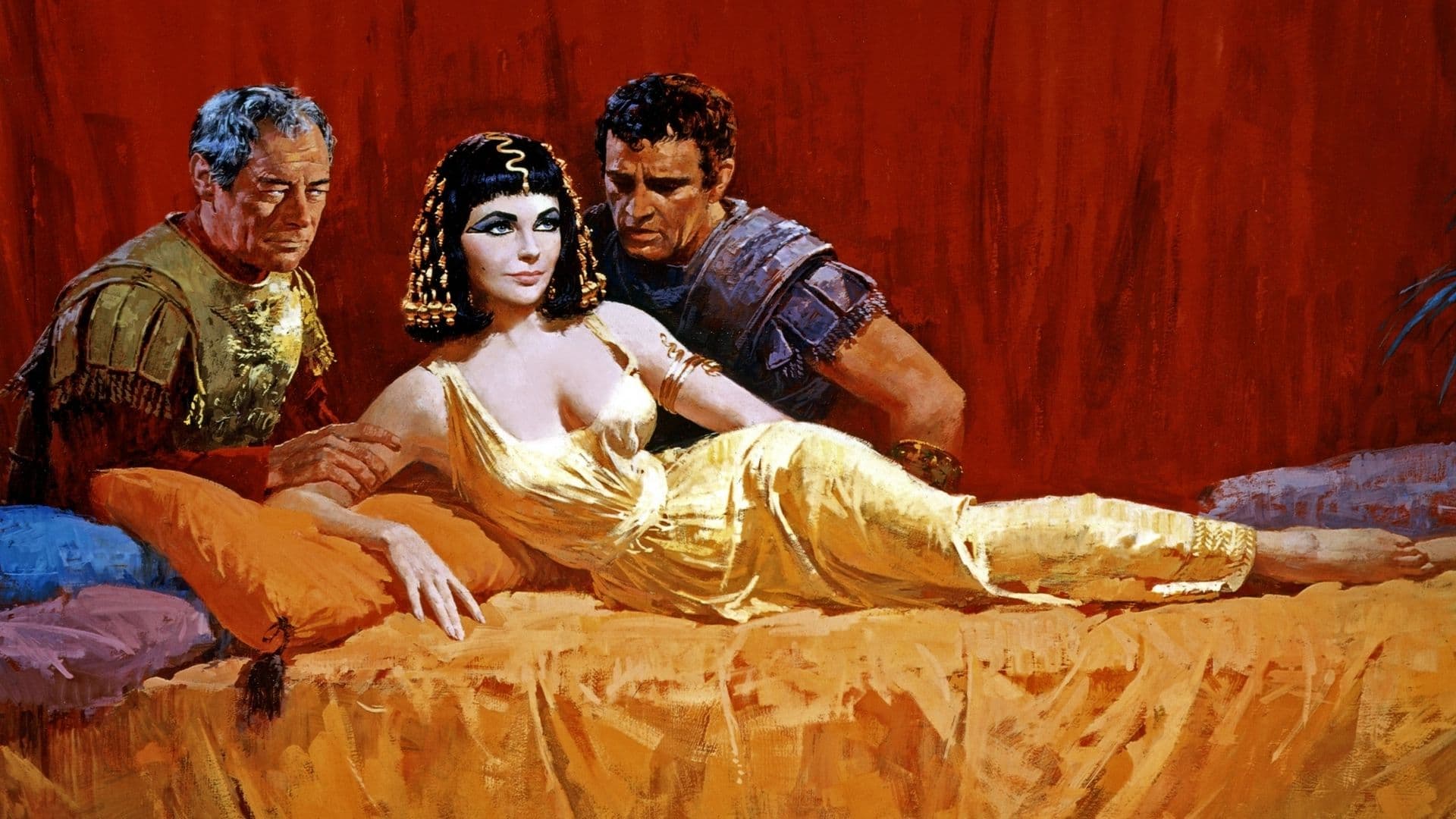
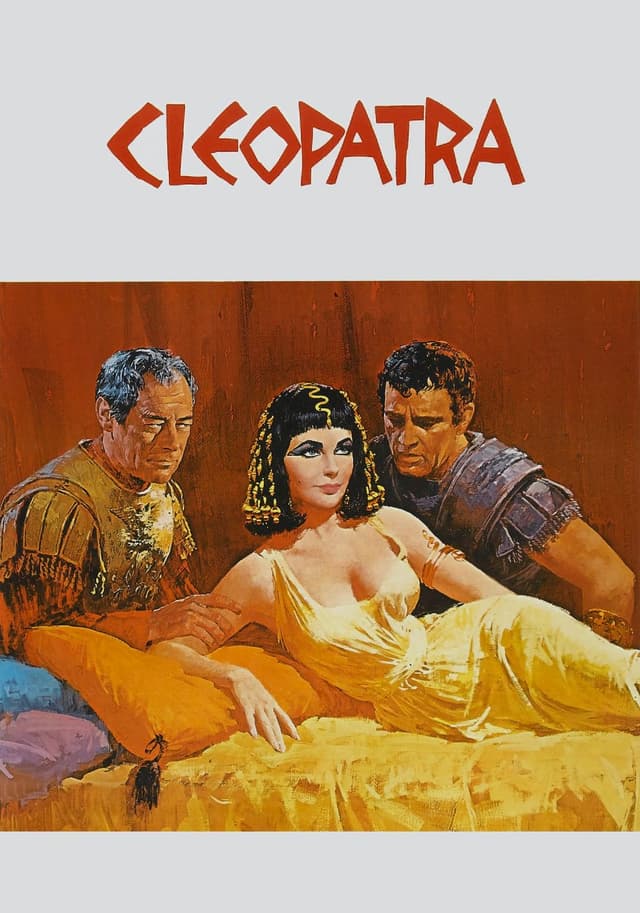
In 48 B.C., Julius Caesar (Sir Rex Harrison) pursues Pompey from Pharsalia to Egypt. Pharaoh Ptolemy XIII (Richard O'Sullivan), now supreme ruler after deposing his older sister, Cleopatra VII (Dame Elizabeth Taylor), attempts to gain favor with Caesar by presenting the conquerer with the head of Pompey, borne by his governors, Pothinus (Grégoire Aslan) and Achillas (John Doucette). To win Caesar's support from her brother, Cleopatra hides herself in a rug, which Apollodorus (Cesare Danova), her servant, presents to Caesar. The Roman is immediately infatuated. Banishing Ptolemy, he declares Cleopatra Egypt's sole ruler and takes her as his mistress. A son, Caesarion (Loris Loddi), is born of their union. Caesar, however, must return to Italy. Although he is briefly reunited with Cleopatra during a magnificent reception for the Queen in Rome, Caesar is assassinated shortly thereafter, and Cleopatra returns to Egypt. When Mark Antony (Richard Burton), Caesar's protégé, beholds Cleopatra aboard her elaborate barge at Tarsus some years later, he is smitten and becomes both her lover and military ally. Their liaison notwithstanding, Antony, to consolidate his position in Rome, marries Octavia (Jean Marsh), sister of the ambitious Octavian (Roddy McDowall). The marriage satisfies no one. Cleopatra is infuriated, and Antony, tiring of his Roman wife, returns to Egypt. There he flaunts his liaison by marrying Cleopatra in a public ceremony. Sensing Antony's weakness, Octavian attacks and defeats his forces at Actium. Alarmed, Cleopatra withdraws her fleet and seeks refuge in her tomb.
What is the budget of Cleopatra?
"Cleopatra," a drama released in 1963, was directed by Joseph L. Mankiewicz and stars Elizabeth Taylor, Richard Burton. The production budget was $44,000,000, placing it in the mid-budget range for drama productions of the 1960s.
Key Budget Allocation Categories
While specific budget breakdowns are not publicly available, typical cost drivers for a drama production like this include:
- Above-the-Line Talent: Drama films live or die on the strength of their performances.
- Location Filming & Period Production Design: Authentic locations , whether contemporary or historical , require scouting, permits, travel, lodging, and often significant dressing to match the story's time period.
- Post-Production, Color Grading & Score: The editorial process for dramas is typically longer than genre films, with careful attention to pacing and tone.
- Development: Wanger pitched the idea to various film studios, including Monogram and RKO Pictures.
What were the major cost factors in Cleopatra?
Several factors contributed to the overall production costs of "Cleopatra."
- Above-the-Line Talent: Above-the-Line Talent is one of the primary cost drivers in drama productions of this scale.
- Location Filming: Location Filming & Period Production Design is one of the primary cost drivers in drama productions of this scale.
- Post-Production: Post-Production, Color Grading & Score is one of the primary cost drivers in drama productions of this scale.
How Does Cleopatra's Budget Compare to Similar Films?
At $44,000,000, Cleopatra sits in the mid-budget range. Here is how it compares to productions with a similar budget:
- Charlie St. Cloud (2010): Budget $44,000,000, Worldwide Gross $48,200,000
- Argo (2012): Budget $44,500,000, Worldwide Gross $232,300,000
- 28 Days (2000): Budget $43,000,000, Worldwide Gross $62,198,945
- 65 (2023): Budget $45,000,000, Worldwide Gross $60,730,568
- A Monster Calls (2016): Budget $43,000,000, Worldwide Gross $47,309,313
The median budget for wide-release drama films in the era ranges from $30 to 80M for mid-budget to $150M+ for tentpoles.
Cleopatra Box Office Performance
"Cleopatra" earned $57,777,778 domestically and $57,779,280 worldwide at the box office. Against a production budget of $44,000,000, the film showed modest profitability in theatrical release.
A film typically needs to earn approximately twice its production budget to cover marketing and distribution costs. For "Cleopatra," that break-even threshold was roughly $88,000,000. With worldwide earnings of $57,779,280, the film fell short of that threshold but recouped its production costs in theatrical release.
Box Office Breakdown
Cleopatra

At 31.3%, "Cleopatra" returned its production investment but margin was tight after marketing and distribution costs.
Cleopatra Production History
Wanger pitched the idea to various film studios, including Monogram and RKO Pictures. He also approached Taylor and her husband Michael Todd about producing the project with United Artists. Taylor expressed interest in the project but delegated the decision to Todd.
At a meeting, in October 1958, production head Buddy Adler favored a relatively cheap production of $2 million, with one of Fox's contract actresses, such as Joan Collins (who tested extensively for the part), Joanne Woodward or model Suzy Parker, in the title role. Wanger protested, envisioning a much more opulent epic with a voluptuous actress as Cleopatra. Wanger suggested Susan Hayward while Audrey Hepburn, Sophia Loren, and Gina Lollobrigida were also under consideration.
On September 25, 1961, principal photography began on the revamped production of Cleopatra. Mankiewicz had expressed his intention of directing a two-part epic: "I had in mind two separate but closely linked Elizabeth Taylor films,Caesar and Cleopatra and Antony and Cleopatra,each to run three hours, both segments to receive simultaneous release. Moreover, I felt compelled to undertake the writing of both halves myself, a measure of my total dissatisfaction with the material that had been produced to date." At that time, he had completed 132 pages of the shooting script, with another 195 pages that remained to be written, so Mankiewicz shot the film in sequence, leaving several actors waiting indefinitely until their scenes were ready to be shot.
Awards and Recognition
Won 4 Oscars. 7 wins & 13 nominations total
- Academy Award for Best Cinematography, Color: Leon Shamroy (36th Academy Awards)
- Academy Award for Best Visual Effects: Emil Kosa Jr. (36th Academy Awards)
- Academy Award for Best Art Direction, Color , John DeCuir: Sr. (36th Academy Awards)
- Academy Award for Best Art Direction, Color: Jack Martin Smith (36th Academy Awards)
- Academy Award for Best Art Direction, Color: Walter M. Scott (36th Academy Awards)
- Academy Award for Best Art Direction, Color: Boris Juraga (36th Academy Awards)
- Academy Award for Best Art Direction, Color: Herman A. Blumenthal (36th Academy Awards)
- Academy Award for Best Art Direction, Color: Elven Webb (36th Academy Awards)
Official Trailer
Build budgets like this one in Saturation
Start from an industry-standard feature film template, import the schedule and rates you already have, and let the cost report keep itself current as you spend. Real-time collaboration, no spreadsheets.