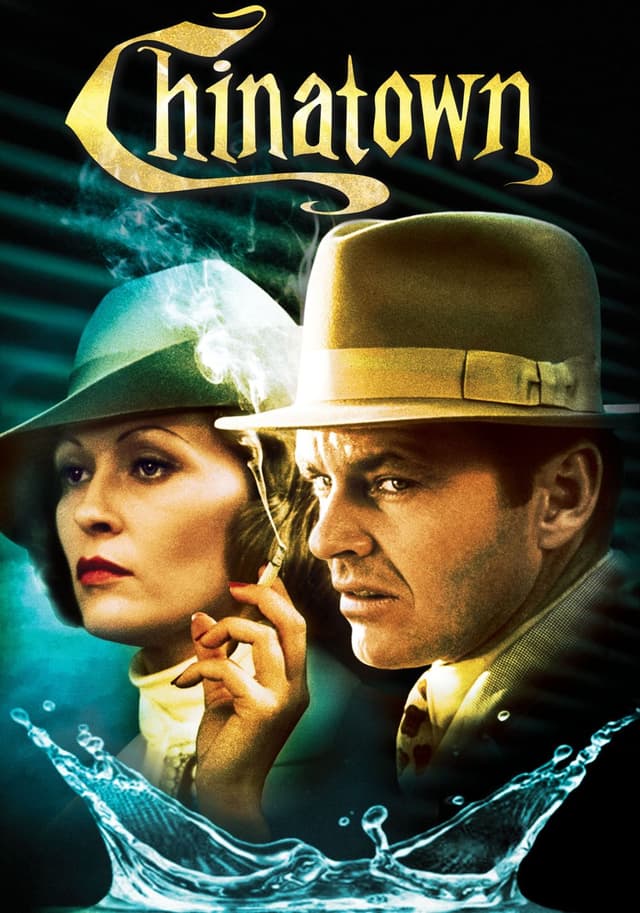
Chinatown Budget
 CrimeDramaMysteryThriller2h 10m
Updated
Synopsis
In 1937 Los Angeles, private investigator Jake 'J.J.' Gittes specializes in cheating-spouse cases. His current target is Hollis Mulwray, high-profile chief engineer for the Los Angeles Department of Water and Power, whose wife suspects him of infidelity. In following Mulwray, Gittes witnesses some usual business dealings, such as a public meeting for construction of a new dam to create additional water supply for Los Angeles, as fresh water is vital to the growing community during the chronic drought; Mulwray opposes the dam. Eventually Gittes sees Mulwray meeting with an unknown young woman who isn't his wife. Once news of the supposed tryst between Mulwray and this woman hits the media, additional information comes to light that makes Gittes believe that Mulwray is being framed for something and that he himself is being set up. In his investigation of the issue behind Mulwray's framing and his own setup, Gittes is assisted by Mulwray's wife Evelyn, but he thinks she isn't being forthright with him. The further he gets into the investigation, the more secrets he uncovers about the Mulwrays' professional and personal dealings, including Mulwray's former business-partnership with Evelyn's father, Noah Cross. The identity of the unknown woman may be the key to uncovering the whole story.
What is the budget of Chinatown?
"Chinatown," a crime released in 1974, was directed by Roman Polanski and stars Jack Nicholson, Faye Dunaway. The production budget was $6,000,000, placing it in the low-budget range for crime productions of the 1970s.
Key Budget Allocation Categories
While specific budget breakdowns are not publicly available, typical cost drivers for a crime production like this include:
- Talent & Director Compensation: Thrillers depend on compelling lead performances to sustain tension, making cast compensation a primary budget concern. Directors with proven thriller credentials command premium fees.
- Cinematography & Location Photography: Thriller aesthetics demand specific visual languages , surveillance-style photography, claustrophobic framing, or expansive location work across multiple cities or countries.
- Editorial & Sound Post-Production: Precision editing , controlling information flow, building suspense through pacing, and orchestrating reveals , requires extended post-production schedules.
- Casting: * J.
What were the major cost factors in Chinatown?
Several factors contributed to the overall production costs of "Chinatown."
- Talent: Talent & Director Compensation is one of the primary cost drivers in crime productions of this scale.
- Cinematography: Cinematography & Location Photography is one of the primary cost drivers in crime productions of this scale.
- Editorial: Editorial & Sound Post-Production is one of the primary cost drivers in crime productions of this scale.
How Does Chinatown's Budget Compare to Similar Films?
At $6,000,000, Chinatown sits in the low-budget range. Here is how it compares to productions with a similar budget:
- The Godfather (1972): Budget $6,000,000, Worldwide Gross $245,066,411
- The Father (2020): Budget $6,000,000, Worldwide Gross $21,029,340
- I Swear (2025): Budget $6,000,000, Worldwide Gross $8,682,832
- Marcel the Shell with Shoes On (2022): Budget $6,000,000, Worldwide Gross $6,909,209
- Kagemusha (1980): Budget $6,000,000, Worldwide Gross $4,000,000
The median budget for wide-release crime films in the era ranges from $30 to 80M for mid-budget to $150M+ for tentpoles.
Chinatown Box Office Performance
"Chinatown" earned $29,200,000 domestically and $30,000,000 worldwide at the box office. Against a production budget of $6,000,000, the film performed strongly at the box office.
A film typically needs to earn approximately twice its production budget to cover marketing and distribution costs. For "Chinatown," that break-even threshold was roughly $12,000,000. With worldwide earnings of $30,000,000, the film cleared that threshold comfortably.
Box Office Breakdown
Chinatown

At 400%, "Chinatown" earned roughly $5 for every $1 invested in production.
Chinatown Production History
* J. J. Gittes was named after Nicholson's friend, producer Harry Gittes. * Evelyn Mulwray is, according to Towne, intended to initially seem the classic "black widow" character typical of lead female characters in film noir, but is eventually revealed to be a tragic victim. Jane Fonda was strongly considered for the role, but Polanski insisted on Dunaway.
Principal photography took place from October 1973 to January 1974. William A. Fraker accepted the cinematographer position from Polanski when Paramount agreed.
Jerry Goldsmith composed and recorded the film's score in ten days, after producer Robert Evans rejected Phillip Lambro's original effort at the last minute. It received an Academy Award nomination and remains widely praised, ranking ninth on the American Film Institute's list of the top 25 American film scores. Goldsmith's score, with "haunting" trumpet solos by Hollywood studio musician and MGM's first trumpet Uan Rasey, was released through ABC Records and features 12 tracks at a running time just over 30 minutes.
Awards and Recognition
Won 1 Oscar. 21 wins & 24 nominations total
- Academy Award for Best Writing, Original Screenplay: Robert Towne (47th Academy Awards)
- National Board of Review: Top Ten Films
Critical Reception
Chinatown received widespread critical acclaim for its screenplay, direction, and performances, and is often regarded as one of the greatest films of the 20th century.
Frequently Asked Questions
How much did it cost to make Chinatown (1974)?
The production budget was $6,000,000, covering principal photography, cast and crew salaries, locations, sets, post-production, and music. Marketing and distribution (P&A) costs are estimated at an additional $3,000,000 - $4,800,000, bringing the total studio investment to approximately $9,000,000 - $10,800,000.
How much did Chinatown (1974) earn at the box office?
Chinatown grossed $29,200,000 domestic, $800,000 international, totaling $30,000,000 worldwide.
Was Chinatown (1974) profitable?
Yes. Against a production budget of $6,000,000 and estimated total costs of ~$15,000,000, the film earned $30,000,000 theatrically - a 400% ROI on production costs alone.
What were the biggest costs in producing Chinatown?
The primary cost drivers were above-the-line talent (Jack Nicholson, Faye Dunaway, John Huston); talent compensation, location cinematography, and tension-driven editorial.
How does Chinatown's budget compare to similar crime films?
At $6,000,000, Chinatown is classified as a micro-budget production. The median budget for wide-release crime films in the era ranges from $30 - 80M for mid-budget to $150M+ for tentpoles. Comparable budgets: The Godfather (1972, $6,000,000); The Father (2020, $6,000,000); I Swear (2025, $6,000,000).
Did Chinatown (1974) go over budget?
There are no widely reported accounts of significant budget overruns for this production. However, studios rarely disclose precise budget overrun figures publicly. The reported production budget reflects the final estimated cost.
What was the return on investment (ROI) for Chinatown?
The theatrical ROI was 400.0%, calculated as ($30,000,000 − $6,000,000) ÷ $6,000,000 × 100. This measures gross revenue against production budget only - it does not account for P&A or exhibitor shares.
What awards did Chinatown (1974) win?
Won 1 Oscar. 21 wins & 24 nominations total.
Who directed Chinatown and who were the key crew members?
Directed by Roman Polanski, written by Robert Towne, shot by John A. Alonzo, with music by Jerry Goldsmith, edited by Sam O'Steen.
Where was Chinatown filmed?
Chinatown was filmed in United States of America. Principal photography took place from October 1973 to January 1974. William A.
Filmmakers
Chinatown

Official Trailer
Build budgets like this one in Saturation
Start from an industry-standard feature film template, import the schedule and rates you already have, and let the cost report keep itself current as you spend. Real-time collaboration, no spreadsheets.