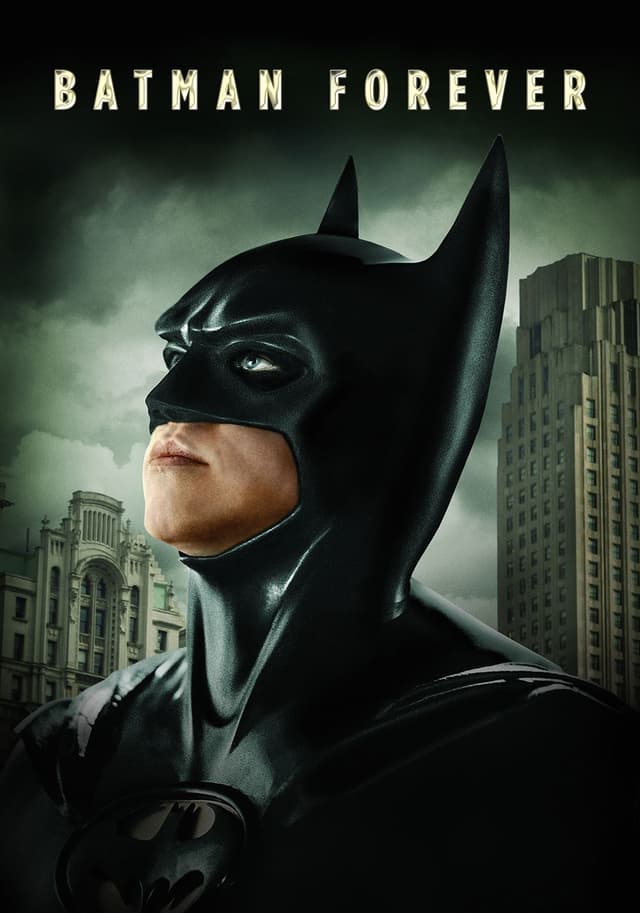
Batman Forever Budget
 ActionCrimeFantasy2h 1m
Updated
Synopsis
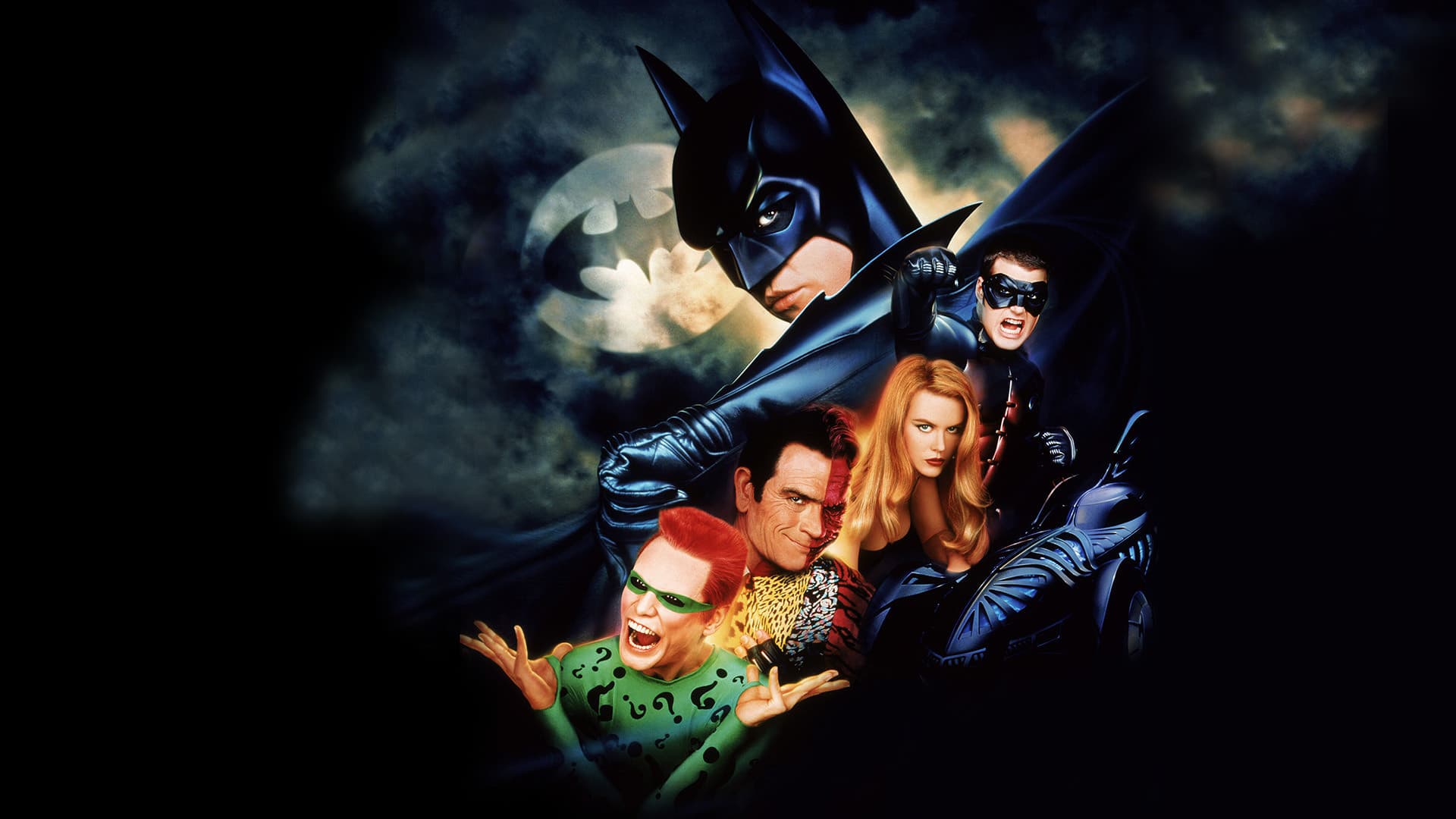
The Riddler teams up with Two-Face to bring down Batman and drain the minds of Gotham City residents with his device, while Batman gets some much-needed help in the form of circus performer Dick Grayson, out for vengeance after being orphaned by Two-Face.
What is the budget of Batman Forever?
"Batman Forever," an action released in 1995, was directed by Joel Schumacher and stars Val Kilmer, Tommy Lee Jones. The production budget was $100,000,000, placing it in the high-budget range for action productions of the 1990s.
Key Budget Allocation Categories
While specific budget breakdowns are not publicly available, typical cost drivers for an action production like this include:
- Stunts, Action Sequences & Visual Effects: Action films allocate a substantial portion of their budget to choreographing and executing practical stunts, pyrotechnics, and CGI-heavy sequences.
- Above-the-Line Talent (Cast & Director): A-list talent commands significant upfront fees plus backend participation.
- Production Design, Sets & Locations: Action films frequently require multiple international shooting locations, large-scale set construction, vehicle acquisitions and modifications, and specialized equipment , all of which drive production costs well above those of dialogue-driven genres.
- Casting: Production went on a fast track with Rene Russo cast as Chase Meridian, but Keaton decided not to reprise Batman because he did not like the direction the series was headed in, and rejected the script.
What were the major cost factors in Batman Forever?
Several factors contributed to the overall production costs of "Batman Forever."
- Stunts: Stunts, Action Sequences & Visual Effects is one of the primary cost drivers in action productions of this scale.
- Above-the-Line Talent (Cast: Above-the-Line Talent (Cast & Director) is one of the primary cost drivers in action productions of this scale.
- Production Design: Production Design, Sets & Locations is one of the primary cost drivers in action productions of this scale.
How Does Batman Forever's Budget Compare to Similar Films?
At $100,000,000, Batman Forever sits in the high-budget range. Here is how it compares to productions with a similar budget:
- 1917 (2019): Budget $100,000,000, Worldwide Gross $446,064,352
- American Gangster (2007): Budget $100,000,000, Worldwide Gross $269,755,430
- Bad Boys: Ride or Die (2024): Budget $100,000,000 , Gross $404,547,819
- Asterix at the Olympic Games (2008): Budget $97,250,400, Worldwide Gross $131,856,927
- A Wrinkle in Time (2018): Budget $103,000,000, Worldwide Gross $132,675,864
The median budget for wide-release action films in the era ranges from $30 to 80M for mid-budget to $150M+ for tentpoles.
Batman Forever Box Office Performance
"Batman Forever" earned $184,069,126 domestically and $336,529,144 worldwide at the box office. Against a production budget of $100,000,000, the film performed strongly at the box office.
A film typically needs to earn approximately twice its production budget to cover marketing and distribution costs. For "Batman Forever," that break-even threshold was roughly $200,000,000. With worldwide earnings of $336,529,144, the film cleared that threshold comfortably.
Box Office Breakdown
Batman Forever

At 236.5%, "Batman Forever" earned roughly $3.37 for every $1 invested in production.
Batman Forever Production History
Production went on a fast track with Rene Russo cast as Chase Meridian, but Keaton decided not to reprise Batman because he did not like the direction the series was headed in, and rejected the script. Keaton's departure was announced in July 1994. Keaton also wanted to pursue "more interesting roles", turning down $15 million.
Principal photography began on September 24, 1994, and wrapped on March 5, 1995. Schumacher hired Barbara Ling for production design, claiming that the film needed a "force" and good design. Ling could "advance on it".
Elliot Goldenthal was hired by Schumacher to compose the film score before the screenplay was written. In discussions with Schumacher, the director wanted Goldenthal to avoid taking inspiration from Danny Elfman and requested an original composition. The film's promotional teaser trailer, however, used the main title theme from Elfman's score from the 1989 film.
Awards and Recognition
Nominated for 3 Oscars. 10 wins & 26 nominations total
Critical Reception
On Rotten Tomatoes, Batman Forever has an approval rating of 41% based on 73 reviews, with an average rating of 5.1/10. The site's critical consensus reads: "Loud, excessively busy, and often boring, Batman Forever nonetheless has the charisma of Jim Carrey and Tommy Lee Jones to offer mild relief." On Metacritic, the film has a weighted average score of 51 out of 100, based on 23 critics, indicating "mixed or average" reviews. Audiences polled by CinemaScore gave the film an average grade of "A-" on an A+ to F scale.
Frequently Asked Questions
How much did it cost to make Batman Forever (1995)?
The production budget was $100,000,000, covering principal photography, visual effects, cast and crew salaries, locations, sets, post-production, and music. Marketing and distribution (P&A) costs are estimated at an additional $50,000,000 - $80,000,000, bringing the total studio investment to approximately $150,000,000 - $180,000,000.
How much did Batman Forever (1995) earn at the box office?
Batman Forever grossed $184,069,126 domestic, $152,460,018 international, totaling $336,529,144 worldwide.
Was Batman Forever (1995) profitable?
Yes. Against a production budget of $100,000,000 and estimated total costs of ~$250,000,000, the film earned $336,529,144 theatrically - a 237% ROI on production costs alone.
What were the biggest costs in producing Batman Forever?
The primary cost drivers were above-the-line talent (Val Kilmer, Tommy Lee Jones, Jim Carrey); visual effects, practical stunts, and A-list talent compensation; international production across United States of America, United Kingdom.
How does Batman Forever's budget compare to similar action films?
At $100,000,000, Batman Forever is classified as a big-budget production. The median budget for wide-release action films in the era ranges from $30 - 80M for mid-budget to $150M+ for tentpoles. Comparable budgets: 1917 (2019, $100,000,000); American Gangster (2007, $100,000,000); Bad Boys: Ride or Die (2024, $100,000,000).
Did Batman Forever (1995) go over budget?
There are no widely reported accounts of significant budget overruns for this production. However, studios rarely disclose precise budget overrun figures publicly. The reported production budget reflects the final estimated cost.
What was the return on investment (ROI) for Batman Forever?
The theatrical ROI was 236.5%, calculated as ($336,529,144 − $100,000,000) ÷ $100,000,000 × 100. This measures gross revenue against production budget only - it does not account for P&A or exhibitor shares.
What awards did Batman Forever (1995) win?
Nominated for 3 Oscars. 10 wins & 26 nominations total.
Who directed Batman Forever and who were the key crew members?
Directed by Joel Schumacher, written by Lee Batchler, Janet Scott Batchler, Akiva Goldsman, shot by Stephen Goldblatt, with music by Elliot Goldenthal, edited by Mark Stevens, Dennis Virkler.
Where was Batman Forever filmed?
Batman Forever was filmed in United States of America, United Kingdom. Principal photography began on September 24, 1994, and wrapped on March 5, 1995. Schumacher hired Barbara Ling for production design, claiming that the film needed a "force" and good design.
Filmmakers
Batman Forever

Official Trailer
Build budgets like this one in Saturation
Start from an industry-standard feature film template, import the schedule and rates you already have, and let the cost report keep itself current as you spend. Real-time collaboration, no spreadsheets.