Backrooms Budget
 HorrorMysteryScience Fiction110 minutes
Updated
Synopsis
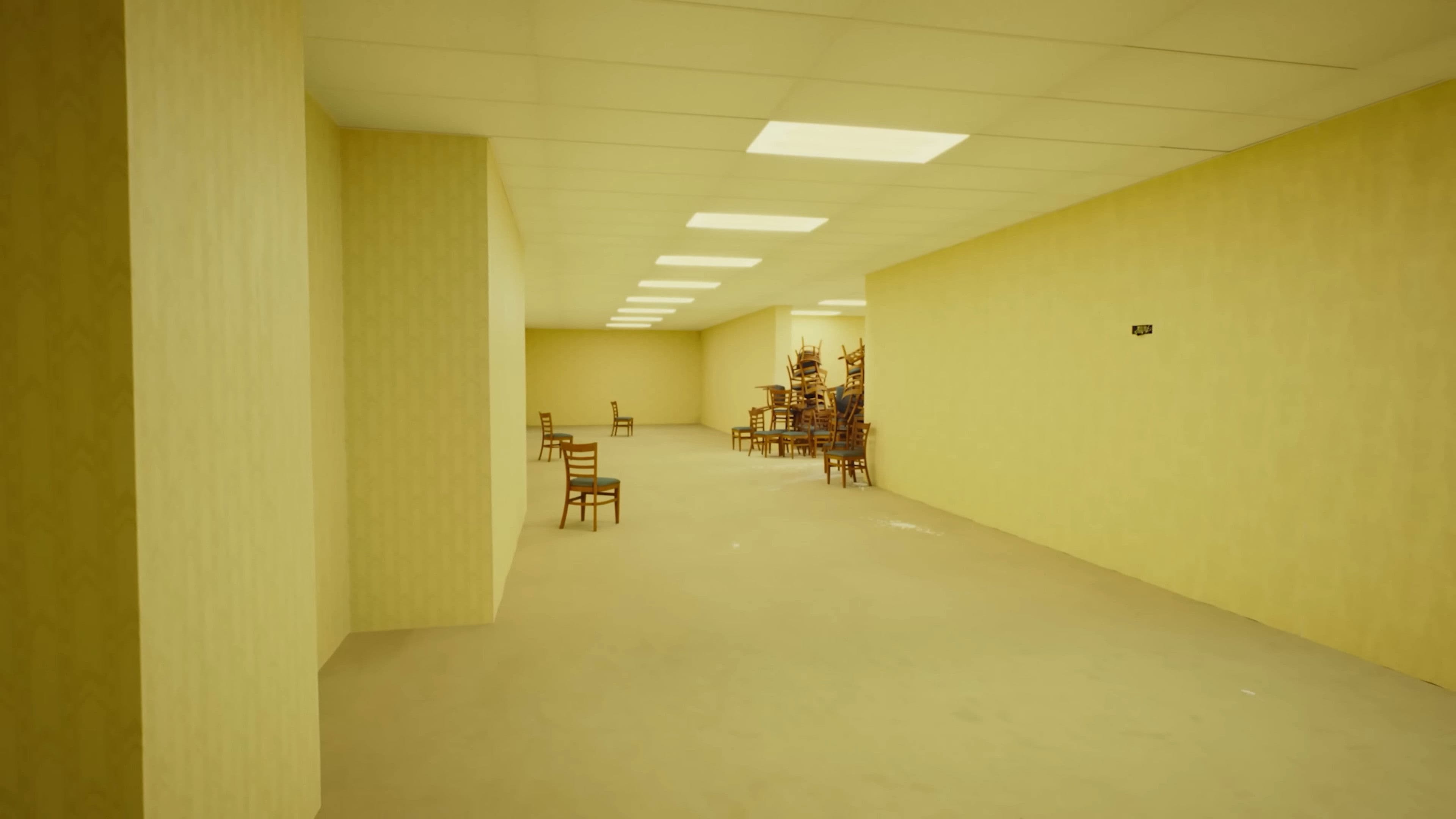
When a strange doorway appears in the basement of a furniture showroom, a group of ordinary people stumble through into the Backrooms: a vast, liminal expanse of endlessly repeating yellow-carpeted offices with no exits and no discernible logic. As they navigate the unsettling non-space, they must confront not only the eerie emptiness but something far worse lurking within it.
What Is the Budget of Backrooms (2026)?
Backrooms was produced for approximately $10,000,000, co-financed by A24 and Chernin Entertainment. For a horror film opening in over 3,000 theaters and releasing from one of independent cinema's most prestigious distributors, this is a deliberately lean budget, reflecting both A24's risk-managed model for genre fare and director Kane Parsons's roots in zero-budget analog horror filmmaking.
The $10 million figure places Backrooms in the same bracket as other A24 elevated-horror breakouts: well below studio tentpole horror but above the micro-budget range where the Backrooms mythology was originally born. Parsons built the viral Kane Pixels YouTube series entirely on a consumer camera; the jump to a theatrical feature with Chiwetel Ejiofor and Renate Reinsve headlining required real infrastructure, but the production resisted bloat.
Key Budget Allocation Categories
- Production Design and Practical Sets: The Backrooms concept lives or dies on the oppressive geometry of its liminal spaces. Constructing accurate, large-scale reproductions of the iconic yellow-carpeted office corridors required extensive practical set builds in Vancouver, balancing repetitive architectural elements against the need for subtle variation that keeps the space feeling genuinely infinite rather than cheaply repeated.
- Visual Effects and Digital Extension: While the production leaned heavily on practical spaces, seamless digital extensions were essential for conveying infinite scale. VFX work extended hallways, multiplied identical rooms, and populated the darkness beyond fluorescent tubes with the suggestion of something vast and unknowable.
- Practical Effects and Creature Work: A key creative decision was grounding whatever inhabits the Backrooms in tangible, tactile horror rather than pure CGI. Prosthetics, puppetry, and in-camera tricks helped deliver visceral creature moments without the uncanny-valley quality that tends to undercut CGI horror.
- Cast Fees: Chiwetel Ejiofor and Renate Reinsve are serious dramatic actors whose presence elevated the material from a nostalgia play to a genuine thriller. Their fees, alongside Mark Duplass, Finn Bennett, Lukita Maxwell, and Avan Jogia, consumed a meaningful share of the budget.
- Sound Design and Score: The Backrooms mythos is defined by its soundscape: the hum of fluorescent lighting, the silence that is somehow louder than sound, the distant sounds that do not have sources. Sound design and the score represent a disproportionate creative investment relative to budget.
- Cinematography and Lighting: Replicating and then distorting the specific visual grammar of office fluorescent light required specialized lighting rigs and camera work to make the familiar feel profoundly wrong.
How Does Backrooms's Budget Compare to Similar Films?
Backrooms occupies a proven sweet spot in the A24 horror playbook: high-concept premise, controlled scope, and a budget small enough that modest theatrical performance still constitutes a hit. Against that lean spend, Backrooms went on to gross $395,180,370 worldwide, becoming A24's highest-grossing release ever.
- Hereditary (2018): Budget $10M | Worldwide $79M: Ari Aster's debut matched the Backrooms budget almost exactly. Hereditary became a word-of-mouth phenomenon that established the template for prestige A24 horror. Backrooms drew from the same playbook.
- Midsommar (2019): Budget $9M | Worldwide $29M: A narrower theatrical result than Hereditary, but the film's cult longevity proved that A24 horror succeeds on a long time horizon beyond opening weekend.
- Talk to Me (2022): Budget $4.5M | Worldwide $68M: The A24 model applied to social-media-native horror by two YouTube creators, making it the closest structural comparison to Kane Parsons's trajectory. Backrooms had more than double the budget but followed the same creative path.
- The Boogeyman (2023): Budget $35M | Worldwide $72M: A conventional studio horror film from a major IP at nearly four times the cost that delivered a comparable worldwide gross, illustrating exactly why A24's budget discipline matters.
- Heretic (2024): Budget $10M | Worldwide $38M: Another A24 horror at the same price point that performed solidly on the back of Hugh Grant's casting and strong reviews, reinforcing the studio's formula.
Backrooms (2026) Box Office Performance
Backrooms opened to strong results in its domestic release on May 29, 2026, benefiting from intense pre-release anticipation from the Kane Pixels fanbase and a marketing campaign that deliberately mirrored the aesthetic of the original YouTube series. Its South Korean release on May 27 provided early international momentum heading into the domestic opening weekend.
- Production Budget: $10,000,000
- Estimated Prints & Advertising (P&A): approximately $15,000,000
- Total Estimated Investment: approximately $25,000,000
- Domestic Gross: $197,483,656 (through 9 weeks of release)
- International Gross: approximately $197,696,714
- Worldwide Gross: $395,180,370 ($197,483,656 domestic, $197,696,714 international)
- Net Return: approximately $364,741,657
- ROI: approximately $15.59 for every $1 invested
Backrooms generated approximately $38.97 for every $1 of production cost, placing it among the most profitable horror releases of the decade. Through its ninth week of release the film has grossed $197,483,656 domestically and approximately $197,696,714 internationally, and counting. The gap between investment and return reflects both A24's distribution efficiency and the film's cross-demographic appeal, drawing both longtime Backrooms lore enthusiasts and general horror audiences.
The worldwide gross of $395,180,370, built on a record $81,402,424 domestic opening weekend (roughly $118 million worldwide in its first three days), far exceeded the theatrical break-even threshold of roughly $25 million, validating A24's model of co-financing with Chernin Entertainment to limit downside exposure. For context, Talk to Me generated $68 million on $4.5 million, and Hereditary delivered $79 million on $10 million. Backrooms outperformed both comps at the same budget level.
Backrooms (2026) Production History
The Backrooms mythology originated as a single image posted to 4chan in 2019: a grainy photograph of an empty office carpeted in sickly yellow, lit by humming fluorescents, with no doors or windows in sight. The accompanying caption described it as a place you end up when you "noclip out of reality" : fall through the floor of the normal world into an infinite back-of-house that has no exit. The image spread across Reddit, YouTube, and horror forums, accumulating its own taxonomy of levels, entities, and survival rules. By 2021 it had grown into one of the most elaborate collaborative horror mythologies on the internet.
Kane Parsons was born June 18, 2005, in Petaluma, California. His father was a video game developer, and Parsons absorbed software instinctively from an early age. He taught himself Adobe After Effects at 11 (on a pirated copy, by his own account) and picked up Blender in February 2020, during the first pandemic lockdown, when he was 14. He attended the Marin School of the Arts at Novato High School, where he studied film formally alongside his self-taught visual effects work. Before the Backrooms, he made Attack on Titan fan short films in 2021 that gained enough traction online to fund equipment upgrades. None of it was professional. All of it was practice.
On January 7, 2022, Parsons uploaded a nine-minute found-footage short to his YouTube channel, Kane Pixels, titled simply "The Backrooms (Found Footage)." He was 16 years old. The video accumulated millions of views within days. It now has more than 77 million views. What distinguished it from the hundreds of other Backrooms interpretations was structural: Parsons built a coherent internal mythology rooted in a fictional entity called the Async Research Institute, which had discovered a gateway into the Backrooms in 1989, linked to the real-world Loma Prieta earthquake. He maintained a 70-page internal lore document, deliberately kept most of it off-screen, and treated the Backrooms not as a setting but as a conspiracy with a paper trail. The series grew to 24 episodes with more than 197 million combined views.
Within roughly a month of the first video going viral, production companies were reaching out. Shawn Levy's 21 Laps Entertainment and James Wan's Atomic Monster connected with Parsons, eventually partnering to develop the project together. Parsons secured managers and entertainment lawyers. By fall 2022 he was pitching the film to studios. He was 17, finishing his senior year of high school, and simultaneously filling out college applications. "I was assuming this will come and this will go," he told IndieWire. "I see that happen to people all the time, and it usually turns into nothing." A24 won the pitch. His parents attended early studio meetings. When the deal was confirmed, Parsons deferred college entirely.
The project was formally announced in February 2023 as a joint production between A24, Chernin Entertainment, Atomic Monster, and 21 Laps Entertainment. Roberto Patino was originally attached as screenwriter. Will Soodik later wrote the version that went into production. James Wan, Shawn Levy, and Osgood Perkins served as producers. The film was greenlit at under $10 million, consistent with A24's approach to elevated horror: enough budget to execute the concept properly, not enough to dilute the creative urgency.
Casting began in earnest in May 2025. Chiwetel Ejiofor and Cristin Milioti entered negotiations to lead the film. Ejiofor was confirmed the following month alongside Soodik's final script revisions. Milioti's deal ultimately fell through, and Renate Reinsve was cast in her place in June 2025. Mark Duplass, Finn Bennett, Lukita Maxwell, and Avan Jogia completed the ensemble in July. Jogia, who had been a fan of the Kane Pixels series before being cast, recalled spending extensive time with Parsons during production discussing the lore despite his character's relatively limited screen time.
Principal photography began in Vancouver, Canada on July 7, 2025, under the working title Effigy. Production wrapped on August 14, completing a six-week shoot. Vancouver provided the studio infrastructure needed for the large-scale practical set construction the film required: entire floors of the Backrooms had to be built and dressed, with deliberate architectural inconsistencies that the camera would slowly reveal. Parsons was 19 during production and turned 20 on June 18, 2025, three weeks before cameras rolled.
The film premiered at the Aero Theatre in Santa Monica on May 7, 2026. It opened in South Korea on May 27 and in the United States on May 29 through A24. With its opening weekend, Parsons became the youngest director to open a film for A24 in the studio's history, and one of the youngest directors to open a wide-release studio film in Hollywood's modern era. On the subject of creative control at the studio, he said: "It feels sort of like a weird dream come true, where there's really not been many barriers to creative control."
Awards and Recognition
Backrooms opened May 29, 2026, placing it outside the eligibility window for most awards cycles currently in progress. The film premiered theatrically without a prior festival run, bypassing the traditional festival circuit in favor of a wide studio release strategy consistent with A24's commercial horror slate.
Critical recognition has been swift: the film's 88% Rotten Tomatoes score and 77 Metacritic metascore put it among the better-reviewed wide-release horror films of the year. Kane Parsons, 20 years old at the time of release, has drawn particular attention as the youngest director A24 has commissioned for a theatrical feature, with early industry conversation around his trajectory as a filmmaker to watch.
The film is expected to be eligible for the 2026 Saturn Awards (Academy of Science Fiction, Fantasy and Horror Films), Critics Choice Super Awards, and the Horror category at the MTV Movie and TV Awards. Given its commercial performance as A24's biggest opening ever, with $81,402,424 domestic on opening weekend and a record $395,180,370 worldwide gross as the studio's highest-grossing film ever, awards consideration in genre categories is anticipated.
Critical Reception
Backrooms earned strong reviews from mainstream critics, landing an 88% Rotten Tomatoes Tomatometer from 272 reviews with an average rating of 7.5/10 and a 74% audience score. Metacritic assigned a 77 metascore based on 45 critic reviews, categorized as "generally favorable." Audiences gave the film a CinemaScore of B-, a result typical of polarizing or slow-burn horror that rewards patient viewers over general audiences.
Variety described the film as "a creepy meditative dada horror trip" in the vein of Eraserhead and Skinamarink, calling it "as an atmospheric freakout, extraordinarily effective." IndieWire compared it to The Blair Witch Project crossed with Annihilation, calling it "mind-bending but occasionally brain-freezing horror." RogerEbert.com said it was "worth getting lost in this promising horror debut." The Hollywood Reporter offered the most measured take, with critic Angie Han writing that "eeriness for its own sake has its limits" as the film's endless liminal geography began to wear in its second half.
The critical consensus on Rotten Tomatoes reads: "A startlingly assured feature debut from director Kane Parsons, Backrooms bends the liminal spaces that have haunted the internet for years into a horror film that's as mesmerizing as it is terrifying." The B- CinemaScore reflects a divide between the film's critical admirers and general audiences expecting more conventional horror pacing, a pattern consistent with other A24 prestige horror films including Midsommar and Hereditary.
Frequently Asked Questions
What is the budget of Backrooms (2026)?
Backrooms (2026) was produced for approximately $10,000,000, co-financed by A24 and Chernin Entertainment. The lean budget reflects A24's disciplined approach to genre filmmaking and director Kane Parsons's roots in no-budget YouTube horror.
How much did Backrooms make at the box office?
Backrooms has earned approximately $390,263,059 worldwide as of late July 2026, including $197,284,287 domestically and $192,978,772 internationally, following its theatrical release on May 29, 2026, in the United States and May 27, 2026, in South Korea. That total makes it A24's highest-grossing film ever. It opened to a record $81,402,424 domestic weekend (around $118 million worldwide in its first three days). Against a $10 million production budget and an estimated $15 million in prints and advertising, the film has generated an ROI of roughly 3,797% on its production cost alone.
Who directed Backrooms (2026)?
Backrooms was directed by Kane Parsons, making his feature-length theatrical debut. Parsons first built the Backrooms universe as a teenage filmmaker on YouTube under the channel Kane Pixels, where his found-footage analog horror series attracted tens of millions of views beginning in January 2022.
Who stars in Backrooms (2026)?
Backrooms stars Chiwetel Ejiofor and Renate Reinsve in the lead roles, with Mark Duplass, Finn Bennett, Lukita Maxwell, and Avan Jogia rounding out the ensemble. Renate Reinsve replaced Cristin Milioti, who had initially been cast but departed before production began.
Who produced Backrooms (2026)?
Backrooms was produced by Shawn Levy, James Wan, Osgood Perkins, Dan Cohen, Dan Levine, Michael Clear, Roberto Patino, Kori Adelson, Chris Ferguson, Jenno Topping, and Peter Chernin. Production companies include Atomic Monster, 21 Laps Entertainment, A24, Phobos, and The North Road Company.
Where was Backrooms (2026) filmed?
Principal photography on Backrooms took place in Vancouver, Canada, beginning July 7, 2025, under the working title Effigy. Production wrapped on August 14, 2025, completing a tight six-week shoot. Vancouver provided the controlled studio infrastructure needed for the film's large-scale practical set builds replicating the Backrooms' iconic liminal spaces.
Is Backrooms (2026) based on a true story?
Backrooms is based on the internet creepypasta mythology of "the Backrooms," which originated as a 2019 4chan post describing a liminal space outside normal reality. Kane Parsons adapted and expanded this mythology in his Kane Pixels YouTube series beginning in 2022 before transitioning it into the theatrical film with A24.
What is the runtime of Backrooms (2026)?
Backrooms has a runtime of 110 minutes. The film is rated R.
Filmmakers
Backrooms

Official Trailer
Build budgets like this one in Saturation
Start from an industry-standard feature film template, import the schedule and rates you already have, and let the cost report keep itself current as you spend. Real-time collaboration, no spreadsheets.