Incentive:
20-42%
Annual Cap: $16M/year ($8M film + $8M episodic)
Project Cap: None
More Info:
How the Missouri Film Tax Credit Works
Missouri's Show MO Act, officially the Motion Media Production Tax Credit, is a transferable tax credit program that gives productions the ability to recover up to 42% of qualifying Missouri expenditures. The program is administered by the Missouri Film Office and the Missouri Department of Economic Development (DED). It was reinstated in 2023 after Missouri had been without an active film incentive for several years, and it has already demonstrated strong results: in 2025, its first full year of operation, 54 productions qualified for the program, generating over $40.7 million in Missouri production spending and nearly $15.7 million in authorized incentives.
The credit is transferable, meaning production companies that earn the credit can sell it to Missouri taxpayers who need state tax liability offsets. This structure makes the program valuable for out-of-state production companies that have no Missouri tax liability to apply the credit against. The production earns the credit, then transfers (sells) it to a buyer at a negotiated price, typically between 85 and 92 cents on the dollar depending on market conditions, receiving cash in return. Productions should factor the transfer discount into their budget modeling when projecting the net value of the incentive.
The program is authorized through 2028 with a $16 million annual cap. The cap is split into two equal pools: $8 million for film productions and $8 million for episodic productions. Missouri Film Office Director Andrea Klund stated publicly in early 2026 that the state expects to fully commit all $16 million in fiscal year 2026, reflecting strong demand from the production community.
Missouri Film Tax Credit Rates
The base credit rate is 20% of qualified Missouri expenditures. Productions can stack additional uplifts on top of the base to reach the maximum 42% rate:
Missouri filming bonus: 5% additional credit for productions filming at least 50% of the project in Missouri
Rural or blighted area bonus: 5% additional credit for productions incurring at least 15% of qualified expenses in a rural area or a designated blighted area of Missouri
Workforce development bonus: 5% additional credit for productions that advance at least three Missouri resident crew members to the next level of their craft in at least three production departments
Additional uplifts may apply based on production structure and agreement terms
The three 5% uplifts combined with the 20% base yield 35%, and additional program elements can push the combined rate toward 42% for qualifying productions. Productions should work directly with the Missouri Film Office to determine which uplifts their specific project qualifies for, as the uplift criteria require documentation of specific production choices and workforce outcomes.
Annual Cap and Budget Split
The Show MO Act's $16 million annual cap is divided into:
$8 million for film productions (features, documentaries, commercials, music videos, etc.)
$8 million for episodic productions (scripted and unscripted series, pilots)
The split-cap structure prevents one production type from dominating the program's annual allocation. Productions should apply early in the fiscal year to secure a reservation of program funds, as the cap has been approaching full commitment annually since the program launched.
Minimum Spend Requirements
Missouri sets minimum qualifying expenditures by production type:
Film productions: typically $50,000 minimum in qualified Missouri expenditures
Episodic productions: minimum qualifying spend varies by project scale
Productions should confirm the current minimum spend thresholds directly with the Missouri Film Office, as program guidelines are periodically updated.
Eligible Production Types
The Show MO Act covers a broad range of content formats:
Narrative feature films
Documentary features and series
Scripted television series and miniseries
Unscripted and reality television
Pilots
Commercials
Music videos
Video games
Webisodes and digital content intended for commercial distribution
Virtual reality and augmented reality productions
Post-production only projects
The Show MO Act's inclusion of video games, VR, AR, and post-production makes it one of the broader incentive programs in the Midwest in terms of content format eligibility.
Workforce Development Requirement
A distinctive feature of the Show MO Act is its apprenticeship and workforce development mandate. Productions must employ Missouri-resident apprentices or veterans in production roles, with the number of required apprenticeship positions scaling based on total production budget:
Budgets under $250,000: 2 registered apprentices and/or veterans
Budgets of $250,000 to $1 million: 4 registered apprentices and/or veterans
Budgets over $1 million: 8 registered apprentices and/or veterans
The apprentices or veterans must be Missouri residents. Productions that want to qualify for the workforce development bonus (the 5% uplift for advancing Missouri residents to the next level in their craft) must document the specific advancement in at least three production departments. This requirement reflects Missouri's policy goal of building a sustainable, home-grown production workforce rather than simply importing out-of-state crew for each production.
What Qualifies as a Missouri Expenditure
Qualified Missouri expenditures include wages with Missouri withholding and payments to Missouri-based vendors. Specifically:
All wages and compensation for which Missouri income tax withholding is applied
Payments to vendors with physical Missouri addresses for goods and services used in the production
Equipment rentals from Missouri-based companies
Location fees paid to Missouri property owners
Set construction materials from Missouri suppliers
Catering and craft services from Missouri businesses
Lodging for cast and crew while working in Missouri
Transportation and vehicle rentals from Missouri companies
Post-production services from Missouri facilities
Story rights, music rights, marketing and distribution costs, and expenditures clearly incurred outside Missouri are not qualified expenses. For wages, the Missouri withholding requirement means productions should confirm that crew members are having Missouri income tax withheld from their wages as a condition of those wages qualifying for the credit.
How to Apply for the Missouri Film Tax Credit
Step 1: Pre-Application Contact
Contact the Missouri Film Office at mofilm@ded.mo.gov before submitting a formal application to discuss your project's eligibility, the applicable uplifts, and current fund availability. Missouri Film Office staff can advise on how to structure the production's workforce development component to meet the apprenticeship requirements.
Step 2: Application Submission
Submit the application to the Missouri Film Office with your production budget, projected Missouri expenditure breakdown, the specific uplifts being claimed, evidence of financing, and a distribution or exhibition plan. Applications should be submitted well before principal photography begins to secure a reservation in the annual cap.
Step 3: Production and Documentation
During production, maintain payroll records that document Missouri income tax withholding, vendor receipts with Missouri addresses, and documentation of apprenticeship and workforce development activities. Productions claiming the rural or blighted area uplift should track which expenditures were incurred in qualifying areas. Productions claiming the workforce development uplift should document the advancement of Missouri resident crew members through the production cycle.
Step 4: Post-Production Submission and Audit
After principal photography wraps, submit the final cost report to the Missouri Film Office. A CPA audit of qualifying expenditures is required. The audit documentation should organize expenses by eligibility category and match the specific uplift claims in the application.
Step 5: Credit Certificate and Transfer
Following approval, the Missouri DED issues the tax credit certificate. Productions that want to convert the credit to cash must find a qualified Missouri taxpayer buyer. Credit brokers and financial intermediaries who specialize in Missouri film tax credits can facilitate the transfer, typically at a rate between 85 and 92 cents on the dollar. Productions should engage a credit broker early in the process to confirm market conditions for Missouri film tax credits before committing to the program.
Missouri Film Locations
Missouri offers a genuine range of filming environments within the continental heartland:
Kansas City
Kansas City provides a major metropolitan environment with distinctive architecture from its Country Club Plaza (a Spanish-influenced entertainment district), a vibrant arts district in the Crossroads neighborhood, historic jazz clubs on 18th and Vine, and modern glass-and-steel corporate districts. The city's infrastructure supports productions of significant scale, and its central location in the continental United States simplifies logistics for large cast and crew movements.
St. Louis
St. Louis is anchored visually by the Gateway Arch, the Mississippi riverfront, and neighborhoods that range from Gilded Age mansions in Clayton to the industrial character of Cherokee Street and the South Side. Forest Park, one of the largest urban parks in the United States, offers wooded landscapes, lakes, and the St. Louis Zoo within the city limits. The city's architecture ranges from pre-Civil War brick buildings to mid-century modern institutional structures.
The Ozarks
Southern Missouri's Ozark plateau covers a large section of the state with rugged forested hills, spring-fed rivers, and Ozark hill-country culture that is distinctive to the region. The Lake of the Ozarks is one of the largest man-made lakes in the United States. The visual and cultural character of the Ozarks has attracted productions seeking authentic Midwestern rural settings that differ from both the Great Plains and the Deep South.
Mark Twain Country
Hannibal and the Mississippi River towns of northeastern Missouri carry a 19th-century American vernacular character rooted in the era of Mark Twain and river commerce. The historic architecture, bluff landscapes above the Mississippi, and small-town character of this region support period productions and rural American narratives.
Columbia and Jefferson City
Columbia is a vibrant college town with University of Missouri's main campus, providing collegiate settings and a young professional community that has supported several recent productions. Jefferson City, the state capital, features Missouri's distinctive capitol building, historic downtown architecture, and the Missouri River corridor.
Missouri Film Production Infrastructure
Kansas City and St. Louis both have growing production communities with established crew networks:
IATSE Local 421 (St. Louis) and Local 29 (Kansas City) provide union below-the-line crew across departments
Equipment rental companies in both major markets serve productions of varying scales
Production soundstages in Kansas City and St. Louis support controlled environment shoots
Post-production facilities in both cities offer editorial, color, and sound services
SAG-AFTRA talent pools in both metropolitan areas
The state's central location makes it logistically efficient for large crew and equipment movements from both coasts
The Show MO Act's workforce development requirement has accelerated the growth of Missouri's resident crew base, as productions bring in apprentices and advance local talent across departments. This compounding effect is beginning to establish Missouri as a genuine production workforce hub rather than a location that requires importing most crew from out of state.
Notable Productions in Missouri
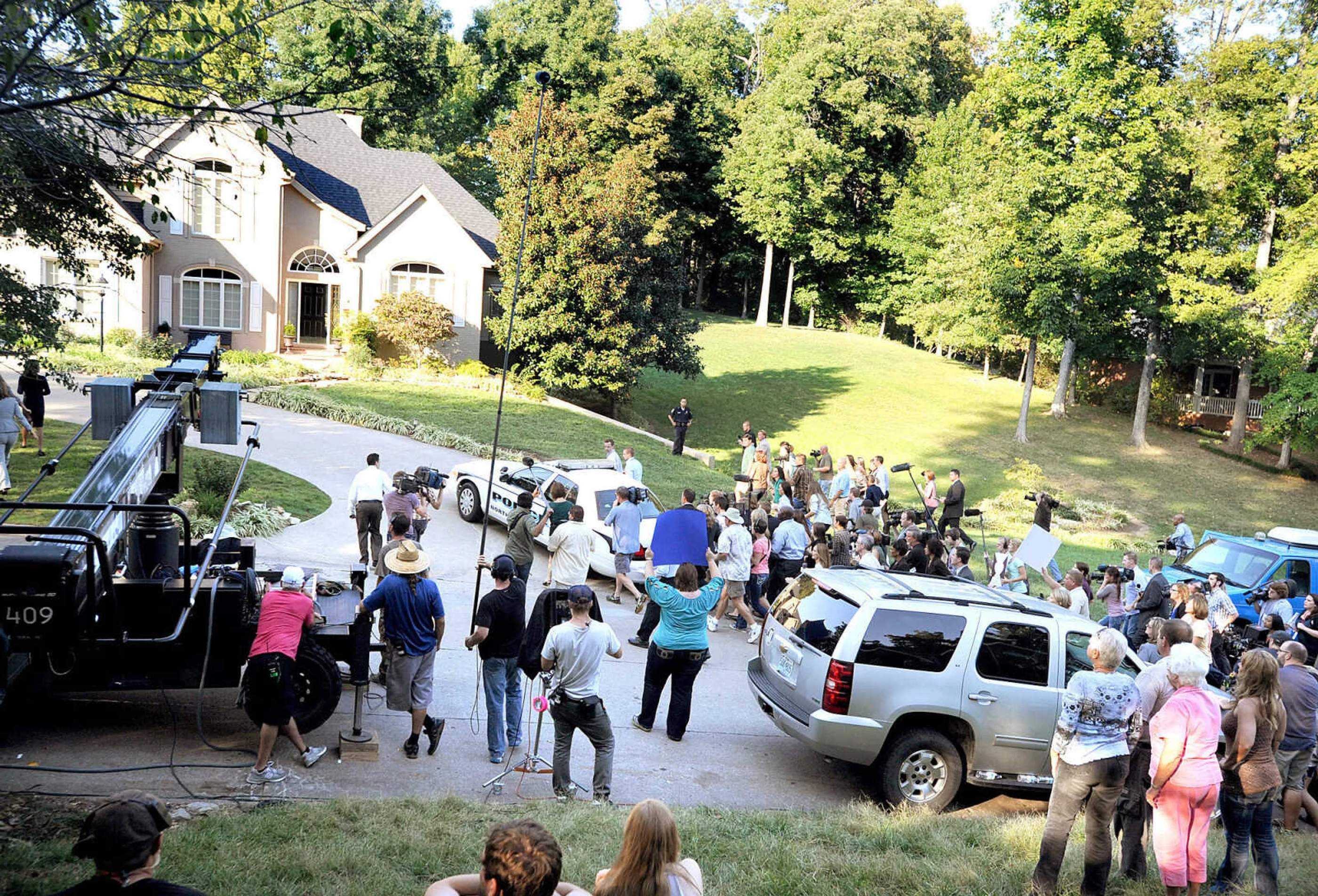
Since the Show MO Act launched in 2023, Missouri has attracted productions from A&E, Apple TV+, and Hallmark Media, among others. The program's first full year in 2025 saw 54 qualifying productions, a mix of features, documentaries, commercials, and episodic content. Kansas City Magazine and Missouri Chamber of Commerce have both highlighted the program as a successful economic development initiative, and the state's February 2026 announcement that the program generated $40.7 million in 2025 production spending demonstrated its growing traction with the production community.
How Missouri Compares to Neighboring States
Missouri vs. Oklahoma
Oklahoma's Filmed in Oklahoma Act offers a direct cash rebate of 20-38%, eliminating the credit transfer process that Missouri's transferable credit requires. Oklahoma's $30 million annual cap is larger than Missouri's $16 million. However, Missouri's potential 42% combined rate exceeds Oklahoma's 38% maximum, and Missouri's urban markets (Kansas City, St. Louis) provide different production environments than Oklahoma's.
Missouri vs. Illinois
Illinois offers a 30% transferable tax credit through its Illinois Film Production Tax Credit, with a higher base rate than Missouri's 20%. Chicago's deep crew base and urban infrastructure give Illinois an advantage for larger productions. Missouri's uplift structure can push its combined rate above Illinois's 30% for qualifying productions, and Missouri's production costs in smaller cities and rural areas are typically lower than the Chicago market.
Missouri vs. Minnesota
Minnesota offers a 25% transferable tax credit with a $25 million annual cap. Missouri's base rate of 20% is lower than Minnesota's, but Missouri's uplifts can take the total rate well above Minnesota's 25%. Minnesota has a longer track record with its program and a more established crew base in the Minneapolis-St. Paul market. Missouri's central location and lower overall production costs give it a different cost profile that can favor certain productions over Minnesota.
Managing Missouri Production Budgets with Saturation
Missouri's combination of the Missouri withholding requirement for wages and the vendor physical address requirement for non-labor expenditures means productions need to track two distinct eligibility criteria for every expense category. The workforce development mandate adds a third documentation stream for apprenticeship hours and advancement records.
Saturation's cloud-based production budgeting software supports the Missouri program by tracking qualified versus non-qualified expenditures from the point of purchase order issuance, flagging wages where Missouri withholding may be required, and maintaining a record of vendor addresses for qualifying purchases. Productions using the rural or blighted area uplift can tag location-specific expenditures to support that bonus claim in the final audit documentation.
Frequently Asked Questions
Is Missouri's film tax credit transferable?
Yes. The Show MO Act provides a transferable tax credit. Productions that earn the credit and have no Missouri tax liability can transfer (sell) the credit to a Missouri taxpayer. Credit transfer prices in the Missouri market typically range from 85 to 92 cents on the dollar, meaning a $1 million credit generates roughly $850,000 to $920,000 in cash for the production after transfer.
What is the apprenticeship requirement?
Productions must hire Missouri-resident registered apprentices and/or veterans in production roles. The number required scales from 2 (budgets under $250,000) to 8 (budgets over $1 million). The apprentices and veterans must be Missouri residents. This requirement applies to all qualifying productions, not just those seeking the workforce development bonus uplift.
When does the program expire?
The Show MO Act is currently authorized through 2028. Missouri Film Office staff and industry advocates have indicated strong support for program extension, given the documented economic impact in the program's first two years of operation. Productions planning Missouri shoots in 2028 or beyond should monitor legislative developments as the 2028 sunset date approaches.
Can a post-production only project qualify?
Yes. The Show MO Act includes post-production as an eligible production format. Productions that completed principal photography outside Missouri can qualify for the credit on post-production expenditures incurred in Missouri, subject to the same minimum spend and Missouri withholding requirements.
Contact the Missouri Film Office
The Missouri Film Office administers the Show MO Act and serves as the primary contact for productions considering Missouri. Applications and inquiries should be directed to mofilm@ded.mo.gov. The Missouri Film Office website at mofilm.org provides program guidelines, the current application, and contact information. Productions are encouraged to reach out early in development to discuss program eligibility and current fund availability before the annual cap is committed.
Missouri Film Office:
Missouri Department of Economic Development
301 West High Street, Suite 290, Jefferson City, MO 65101
Applying for the credit?
Get Free Template
Use our budget template to add qualified expenses to the proper chart of accounts as required by the state.