Seattle International Film Festival
About
The largest film festival in the United States by programming volume, presenting 400+ films over 25 days each spring.
Submit
Submission Page
Type
Top 50
Time of Year
May
Qualifies For
—
Template
Browse All
About the Seattle International Film Festival
The Seattle International Film Festival was founded in 1976 and has grown into one of the largest film festivals in North America by raw volume: more than 400 films across 25 days in late May and early June. That 25-day run is the longest of any major film festival in the United States, and it is not incidental to what SIFF is. The length reflects a deliberate institutional commitment to programming breadth and to giving Seattle audiences sustained engagement with world cinema rather than a compressed sprint through prestige titles. SIFF is an audience festival in the most literal sense. It exists to put a large, enthusiastic Pacific Northwest public in front of films from around the world, and the Golden Space Needle Awards, which are determined entirely by audience vote, are its most significant prizes.
That audience orientation distinguishes SIFF from festivals organized around industry access or critic gatekeeping. Sundance is a market. Telluride is a critical institution. SIFF is, by design and by history, a public festival. Its scale and its independence are related: the festival has remained an independent nonprofit organization through five decades of growth, resisting the acquisitions-focused gravity that has reshaped many comparable events. That independence has allowed SIFF to build a program that serves its city rather than serving the industry, which in turn has produced an audience culture in Seattle that is among the most genuinely engaged at any American festival of this size.
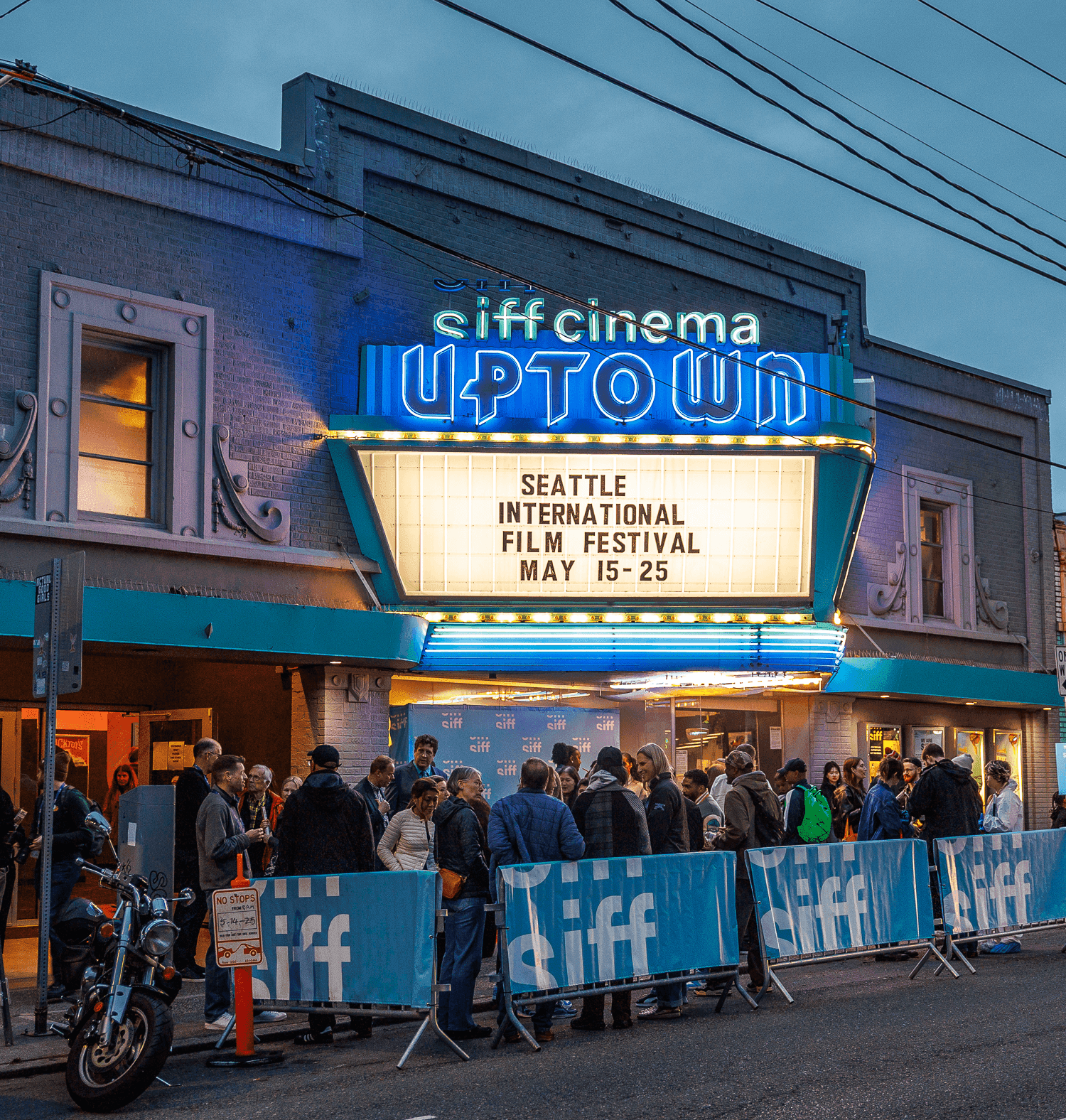
The festival's year-round presence through its own cinema venues reinforces that civic identity. SIFF Cinema Uptown is a three-screen venue in Seattle's Queen Anne neighborhood that programs international film, independent cinema, and repertory titles throughout the year. SIFF Cinema Egyptian is the historic Egyptian Theatre on Capitol Hill, a 1915-era venue that SIFF acquired and operates as a year-round cinema and event space. The Egyptian seats approximately 400 and is one of the most distinctive screening environments in the Pacific Northwest. Having two permanent venues gives SIFF an institutional weight and community visibility that distinguishes it from festivals that exist only as an annual event, and it sustains a year-round relationship with the Seattle film audience that most festivals cannot match.
Festival Submission Fees
Submission Fees
Seattle International Film Festival

One of the largest film festivals in North America, screening 400+ films over approximately 25 days in May/June. Submissions via FilmFreeway. SIFF members receive discounted submission fees. Oscar-qualifying for short films. Washington State filmmakers may be eligible for reduced rates. All fees are non-refundable. Source: https://www.siff.net/festival/submissions
Competition and Programs
Golden Space Needle Awards are the centerpiece of SIFF's competitive identity. Unlike jury prizes that rely on a panel of industry professionals, the Golden Space Needle is determined by audience vote across every competition-eligible screening. Audiences score films after each screening, and cumulative scores across the festival run determine the winners. Awards are given for Best Film, Best Director, Best Documentary, and Best Short Film, with jury prizes awarded separately in the same categories by an industry panel. The combination of audience and jury recognition gives the Golden Space Needle genuine weight: it is one of the most important audience awards in the United States, and for films with strong popular appeal, a SIFF audience prize can be a meaningful credential in a distribution conversation.
New American Cinema is the flagship competition section for American narrative features. The section focuses on independent US cinema with strong characters and genuine emotional investment. Films in New American Cinema are in direct competition for both the Golden Space Needle audience award and the jury prizes. Programmers look for distinctly American stories told with authorial confidence, and the section has historically been receptive to genre films, regional cinema, and films that reflect corners of American life underrepresented in the prestige independent market.
New Directors showcases debut features from filmmakers around the world. The section is organized as a dedicated competition for first features, giving debut directors a specific context rather than placing them in competition with established filmmakers. Films in New Directors compete for the SIFF Prize for New Directors, awarded by a jury. The section tends toward films with a strong original vision and is not restricted by country of origin or genre.
World Cinema is SIFF's international feature competition, drawing from the full breadth of global narrative filmmaking. Films in World Cinema represent countries and production contexts across six continents, and the section reflects SIFF's long-standing commitment to programming international cinema that has not yet found North American distribution. A World Cinema selection at SIFF is often a film's US premiere, and the section has historically introduced Pacific Northwest audiences to filmmakers who later achieved significant international recognition.
Documentary has a dedicated competition section with its own Golden Space Needle and jury prizes. SIFF's documentary programming spans investigative journalism, observational cinema, personal essay, and socially engaged non-fiction. The documentary competition is one of the festival's strongest sections, and the Seattle audience's enthusiasm for documentary film has made SIFF one of the better audience proving grounds in the country for non-fiction work seeking distribution.
Shorts run as a competitive program with jury prizes and Golden Space Needle eligibility. SIFF programs shorts with genuine curatorial intention, not as filler between feature presentations. The shorts competition has been an early platform for filmmakers who went on to significant feature careers, and the festival takes its discovery mandate in the short film category seriously. Short films submitted for competition should have genuine world or US premiere ambition rather than treating SIFF as a secondary platform.
The SIFF Audience and Seattle Culture
More than 150,000 people attend SIFF screenings over the 25-day festival run, making it one of the most publicly attended film festivals in the United States in terms of aggregate audience. That number is not driven by industry delegates; it is driven by Seattle residents who buy tickets and show up in large numbers across the full 25-day schedule, including for international films without English dialogue, documentary subjects without celebrity attachment, and debut features without prior critical attention. The Golden Space Needle scoring system means that every film shown in competition gets scored by real audience members, and the cumulative results across hundreds of screenings reflect genuine public response rather than the tastes of a small deliberating jury.
The Seattle audience that SIFF serves has a specific cultural character that shapes what connects at the festival. The city's economic identity is built on the technology sector, and the SIFF audience skews educated, globally curious, and accustomed to engaging with complexity. The Pacific Northwest cultural identity, distinct from the coasts it sits between, combines an outdoors orientation, a strong independent music culture, and a political progressivism that is pragmatic rather than performative. Films that engage seriously with technology and its social effects, environmental subjects, labor and economic equity, and international political situations tend to find attentive audiences at SIFF. So do formally adventurous films, genre films made with craft and intelligence, and films from underrepresented national cinemas.
SIFF's year-round presence through its cinema venues means the festival has a relationship with its audience that extends beyond the 25-day annual event. SIFF Cinema Uptown and SIFF Cinema Egyptian program throughout the year, and the audience that attends these venues regularly is the same audience that turns out for the festival in force each May. Filmmakers who screen at SIFF are entering a city with a genuine cinephile infrastructure, not just an annual festival audience that disperses immediately afterward. That sustained relationship between the festival and its city is part of what makes a SIFF screening meaningful beyond the immediate run.
What Programmers Look For
SIFF programs breadth deliberately. More than 400 films across 25 days means the festival accepts submissions from across the full spectrum of filmmaking, and it is not a festival that privileges one aesthetic tradition or production context above others. The large volume of programming is not a symptom of undiscriminating selection; the competition sections are genuinely curated, and the difference between a competition selection and a non-competition screening slot at SIFF is meaningful. Understanding which section your film belongs in, and what that section values, is the essential first step in targeting SIFF strategically.
New American Cinema values American independent storytelling with characters that earn genuine audience investment. Programmers in this section are looking for films where the emotional stakes are real, the performances are grounded, and the story has something to say about American life that is specific and observed rather than generic. The section is not limited to drama: genre films, dark comedies, and formally adventurous work all appear regularly. What matters is that the film has a clear reason for being American and a clear sense of what it is doing with that identity.
New Directors rewards original vision from debut features. The section is not tracking conventional career progression or waiting for filmmakers to arrive with established critical credentials; it is specifically looking for first features that demonstrate a distinctive way of seeing. Films that reflect genuine personal urgency, that found form that serves their subject, and that feel like the work of someone who had no choice but to make this particular film will read well for this section. The section is international in scope and has no preference for narrative over documentary form.
Documentary is one of SIFF's strongest areas, and the Seattle audience's response to documentary work is particularly reliable. Programmers look for films that use the tools of cinema rather than the tools of journalism: a documentary that achieves extraordinary access, builds a compelling formal structure, or finds an unexpected way into a subject will stand out from well-intentioned advocacy films that substitute important topics for cinematic craft. The documentary competition is open to films from all countries and does not favor any particular subgenre. Character-driven stories, high-stakes investigative films, and formally adventurous non-fiction all have a track record at SIFF.
Submission Guide
SIFF accepts submissions through FilmFreeway at filmfreeway.com/siff. The submission window for the May/June festival opens in November, with deadline tiers running through February. The festival uses early, regular, and late deadline structures that affect submission fees; early deadlines offer meaningfully lower fees and are worth targeting for projects that are ready. All submissions received before the final deadline receive full programming consideration regardless of which tier they use.
Premiere requirements vary by section. Films submitting to New American Cinema in competition should have achieved no more than a US premiere prior to SIFF; a world premiere at SIFF is preferred but a prior international festival showing is acceptable. Films submitting to New Directors should not have previously screened in the United States. Shorts submitting to the competitive program should have achieved no more than a regional premiere in the Pacific Northwest prior to the festival. World Cinema and the international programs generally require that the film has not been theatrically released in the United States. If your film has a complex premiere history, contact the programming office before submitting rather than making assumptions about eligibility.
To identify the right section, consider the following: New American Cinema for US narrative features, New Directors for debut features of any national origin, World Cinema for international narrative features, Documentary for non-fiction features from any country, and Shorts for films under 40 minutes regardless of national origin. Films that could fit multiple sections can note a preference in the project notes, which SIFF programmers read. Do not submit the same film to multiple sections simultaneously.
Submission fees for feature films range from approximately $45 at the early deadline to $70 at the late deadline. Short films have lower fee tiers. The festival does not publicly advertise a blanket waiver program, but filmmakers facing documented financial hardship can contact the submissions team to inquire before the deadline. Work-in-progress submissions are accepted; note the state of the cut clearly in the project notes along with the expected completion date. DCP is not required at submission; screener files through FilmFreeway are the standard format. Delivery requirements for selected films are coordinated by the programming office after notification.
The project notes field is read and matters. Use it to explain the creative context of your film, which section you believe it fits and why, any premiere history that affects eligibility, and anything about the subject or production that adds interpretive value to the programmers' read. Marketing language and festival comparisons waste the space. Write for someone who has already watched your film and is trying to understand why you made it, where it fits in the program, and what the SIFF audience will get from it.
Frequently Asked Questions
Why does SIFF run for 25 days, and is that unusually long?
It is the longest run of any major film festival in the United States. The 25-day schedule is a deliberate institutional choice that reflects SIFF's identity as a public festival serving a city rather than a compressed industry market. The length allows the festival to program more than 400 films and to give each film multiple screening opportunities, which feeds the Golden Space Needle audience scoring system: the cumulative scores from multiple screenings across the full run are more representative of genuine audience response than scores from a single premiere screening. The long run also gives Seattle audiences time to discover films that do not have immediate critical attention and to build word-of-mouth through the festival period, which has historically served films that might get lost in a shorter, more prestige-focused event.
What is the Golden Space Needle and how is the vote conducted?
The Golden Space Needle Awards are SIFF's audience awards, voted by the people who buy tickets and attend screenings throughout the 25-day festival. After each eligible screening, audience members score the film on a numerical scale. Scores are aggregated across all screenings of each film across the full festival run, and the films with the highest cumulative audience scores in each category win. Awards are given for Best Film, Best Director, Best Documentary, and Best Short Film. Jury prizes in the same categories are determined separately by an industry panel. The audience vote is independent of the jury process, and it is possible for a film to win both. The Golden Space Needle is one of the most significant audience awards in the United States: the scale of the SIFF audience and the 25-day aggregation period make the result a meaningful measure of public response rather than a snapshot from a single screening.
Does SIFF program 400-plus films and still maintain quality in competition?
The 400-plus film count includes the full program across all sections, including non-competition showcases, retrospectives, special events, and sidebar programs. The competition sections, which are where filmmakers typically focus their attention, are genuinely curated to a high standard. The acceptance rate for competition sections is comparable to other major American festivals at similar stature. The large overall program is a function of SIFF's commitment to breadth across world cinema and to serving a 25-day public audience, not a function of undiscriminating selection in the competitive categories. A competition selection at SIFF means the film passed a rigorous programming read; a non-competition screening means the film was selected for its value to the program without competing for prizes.
What SIFF Cinema venues are open year-round?
SIFF operates two permanent cinema venues in Seattle outside of the annual festival. SIFF Cinema Uptown is a three-screen venue in the Queen Anne neighborhood that programs international cinema, independent film, and repertory titles throughout the year. SIFF Cinema Egyptian is the historic Egyptian Theatre on Capitol Hill, built in 1915, which SIFF acquired and operates as a year-round cinema and event space with approximately 400 seats. Both venues run regular programming outside the festival period and serve as community cinemas for Seattle's film audience. The Egyptian is one of the most distinctive screening rooms in the Pacific Northwest. Filmmakers interested in screening a film at either venue outside the festival window can inquire through SIFF directly.
How does SIFF compare to SXSW for Pacific Northwest filmmakers?
SXSW is an acquisitions market embedded in a multi-disciplinary technology and culture conference, held in Austin each March. SIFF is an audience festival in a single city, held in Seattle each May and June. They are not direct competitors for most films. SXSW draws a concentrated industry audience of buyers who are in Austin for multiple conference contexts simultaneously, making it a more active acquisitions environment during the festival week. SIFF draws a larger public audience but a less concentrated industry contingent, and the Golden Space Needle audience prize can generate meaningful credentials for distribution conversations without the immediate transactional pressure of an acquisitions market. For a Pacific Northwest filmmaker, SIFF offers a home territory advantage: the Seattle audience has a specific relationship with the festival and with its city, and a film that connects deeply in Seattle has a regional story to tell. SXSW offers broader national industry exposure in a shorter window. The right choice depends on the film, its premiere timing, and which audience and which industry context it is built for.
Does SIFF require a US premiere for international films?
Requirements vary by section. Films submitting to World Cinema, the international narrative feature competition, should not have been theatrically released in the United States before the festival; a prior international festival premiere is generally acceptable for competition eligibility. Films submitting to New Directors should not have previously screened in the United States in any context. For documentary features in the documentary competition, SIFF prefers films that have not yet had a US theatrical release. The festival is not rigid about requiring world premieres for all sections, which distinguishes it from festivals like Telluride or Toronto, but competition sections do require that the film have not been previously available to US audiences through theatrical release, broadcast, or streaming. If your film has a prior international festival history, confirm your eligibility directly with the SIFF programming office before submitting rather than interpreting the submission guidelines yourself.
Submit Your Film
Submissions to the Seattle International Film Festival open each November through FilmFreeway at filmfreeway.com/siff. Deadline tiers run from early December through February for the following May/June festival. For eligibility questions, premiere status confirmation, or section guidance, contact the SIFF programming office through the festival's website at siff.net. SIFF Cinema Uptown and SIFF Cinema Egyptian, SIFF's year-round venues in Seattle, are listed at siff.net/cinema for screenings and event information outside the annual festival.
Awards & Recognition
Seattle International Film Festival presents awards across its competition sections, recognizing excellence in filmmaking across multiple categories. Competition awards represent meaningful recognition from a distinguished jury of film professionals.
Award categories typically include recognition for Best Film, directorial achievement, performance, and short film excellence. Winning or being shortlisted at Seattle International Film Festival provides a meaningful credential for press materials, distribution discussions, and future festival submissions.
Festival Leadership & Programmers
Seattle International Film Festival is guided by a dedicated team of programmers and arts administrators who collectively bring deep knowledge of world cinema to the selection process. The festival's programming team works year-round reviewing submissions, attending international festivals, and cultivating relationships with filmmakers from around the world.
Plan every dollar of your festival run in Saturation
Map deadlines on the calendar, schedule submission payments, and report on campaign spend from one production budget.