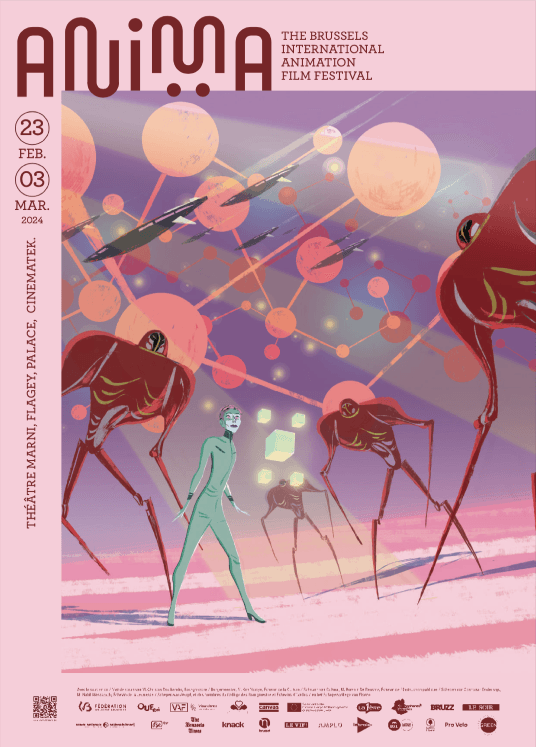
Anima – The Brussels Animation Film Festival
About
Belgium's leading animation festival, an Oscar qualifier.
Submit
Submission Page
Type
Film Festival
Time of Year
February
Qualifies For
—
Template
Browse All
About Anima, The Brussels Animation Film Festival
Anima is the largest animation film festival in the Benelux region and one of the oldest dedicated animation events in Europe. Organized by Folioscope, the Brussels-based nonprofit animation organization, the festival has been running since 1982 and takes place annually in late February and early March, typically spanning ten days across multiple venues in the Belgian capital. For more than four decades, Anima has served as the primary gathering point for animation professionals, students, and audiences across Belgium, the Netherlands, and Luxembourg.
The festival presents a competitive international program alongside an extensive non-competitive selection, children's screenings, educational workshops, and industry-facing events. It draws filmmakers and programmers from across Europe and beyond, functioning both as a public celebration of the medium and as a professional platform where animation careers are built and projects find their first significant audiences. Its longevity and geographic position make it an essential stop on the European animation circuit, particularly for filmmakers working in the French-language production sphere.
Brussels is a fitting home for the festival. The city is the seat of the European Union's principal institutions and a genuine crossroads of European cultures, where French, Dutch, and German influences all leave visible marks on daily life. It is also, less conspicuously, one of the more significant nodes in the European animation industry. Cartoon, the intergovernmental European animation industry association funded in part by the Creative Europe MEDIA Programme, is headquartered in Brussels and organizes major co-production forums including Cartoon Movie and Cartoon Forum. The presence of Cartoon in the same city as Anima has helped entrench Brussels's status as a hub for animation development and financing, giving Anima a natural connection to the commercial side of the industry that purely art-focused festivals often lack.
Belgium itself has a strong and distinctive tradition in animation. The country that gave the world Tintin, the Smurfs, and the surrealist comic sensibility of figures like Andre Franquin has a visual culture deeply attuned to line, character, and graphic storytelling. Belgian-French co-productions have historically been a significant force in European animated features, and Folioscope exists in part to support the conditions that make that kind of work possible. Anima reflects that dual orientation: it is a festival with serious artistic ambitions and genuine affection for accessible, audience-facing animation at the same time.
Festival Submission Fees
Submission Fees
Anima – The Brussels Animation Film Festival

Fees and deadlines should be verified on the festival's official website or FilmFreeway. Fee waivers or student discounts may be available upon request.
Competition Sections
Anima organizes its competitive programming across several sections that together cover the full range of animated filmmaking, from international shorts to features to work produced within Belgium and the broader Benelux region.
International Short Film Competition: This is the festival's flagship competitive section, open to short animated films from any country. The Anima Award for best international short is the festival's most prestigious prize and carries genuine weight in the international animation community. The selection spans hand-drawn, CG, stop-motion, experimental, and hybrid techniques, and the jury composition changes year to year to ensure that no single aesthetic tendency dominates the selection over time.
International Feature Film Competition: Open to animated feature films from any country, this section evaluates both commercial-scale productions and independent features. As animated features have expanded as both an art-house and a family entertainment category, this section has grown in visibility. A selection here puts a film in front of the full Anima audience, which skews toward engaged, knowledgeable animation fans rather than general multiplex audiences.
Belgian and Benelux Competition: A dedicated competitive section for animated films produced in Belgium, the Netherlands, or Luxembourg. This section functions as both a showcase of regional talent and a platform for international programmers to discover work from the Benelux production community. Films competing here are eligible for a separate Anima Award for the best Belgian or Benelux production.
Children's Programming: Anima runs a substantial program of screenings and events aimed at young audiences, including school matinees that bring organized groups of children to the festival during the school week and weekend programming designed for families. The Animatins screenings at reduced ticket prices make the festival accessible to younger visitors. This strand reflects the festival's conviction that animation is a medium for audiences of all ages, not exclusively an art-house proposition.
Beyond the main competitions, the festival programs retrospectives, tributes, thematic special programs, and curated showcases from specific countries or movements. These non-competitive programs frequently surface work that is otherwise difficult to see and give the festival depth beyond its competitive prestige. The speed dating events for industry professionals, where filmmakers can meet briefly with producers and distributors, add a practical commercial layer to the festival calendar.
Brussels and Belgian Animation
Belgium's relationship with animated and graphic storytelling runs deeper than most people outside the field realize. The country that produced Herge's Tintin albums, Peyo's Smurfs, and the anarchic visual comedy of Panique au Village has a visual culture built on character, precision of line, and an appetite for absurdism that translates naturally into animation. Belgian-French co-productions have historically been a significant force in European animated features, and the infrastructure of studios, directors, and writers working in that tradition has made Brussels a genuine production center rather than merely a festival destination.
Folioscope, the organization that runs Anima, is not only a festival producer. It operates year-round as an animation center and advocacy organization, running educational programs, supporting production, maintaining a documentation library, and running outreach events that bring animation to audiences outside the festival window. Its year-round activity includes Anima on Tour, which brings festival selections to venues across Belgium, and Saturday programming that gives Brussels residents regular access to short animation outside the annual festival dates. That ongoing presence distinguishes Folioscope from purely festival-focused organizations and gives Anima a stronger institutional foundation.
The presence of Cartoon, the European animation industry association, in Brussels adds a dimension that few other animation festivals can claim from their home cities. Cartoon's major events, including Cartoon Movie for animated features and Cartoon Forum for television series, take place in other European cities, but the organization's headquarters in Brussels means that the people who run the industry's most important co-production forums are nearby. For Belgian and broader European animators, the proximity of Folioscope and Cartoon creates an ecosystem where artistic ambition and commercial development can coexist more naturally than they might elsewhere.
French-language European animation has a particular stake in Brussels. While Paris is the largest center of Francophone animation production, Belgian French-language producers have a distinct creative identity and have been involved in many of the most significant Francophone animated features of the past two decades. Anima reflects and reinforces this identity: programming in French and Dutch, presenting work from the Benelux region alongside international competition, and providing a platform where Belgian directors can show their films to international audiences without leaving home.
What Programmers Look For
Anima programs with a broader remit than some of the more exclusively art-focused animation festivals on the European circuit. The festival is genuinely interested in both formal experimentation and work that prioritizes storytelling and audience accessibility, and that dual orientation shapes what the selection responds to across all sections.
For the international short competition, the programming team responds to work where the animation itself is doing something meaningful: where the choice of technique, visual language, and movement is inseparable from what the film is actually communicating. That said, Anima does not share the strict avant-garde disposition of some experimental-focused events. A film that is technically inventive and emotionally immediate will fare well here. So will a formally straightforward film with a compelling story told with genuine craft. The selection has room for both.
Belgian and French-language European animation naturally receives careful attention, not because the selection committee favors local work on nationalist grounds, but because Anima has a specific role in the health of the Benelux production community. A well-made Belgian film that has not yet been seen internationally will get a serious look. The same is true for Francophone co-productions, particularly those with Belgian involvement. For filmmakers working within this production ecosystem, Anima is one of the most strategically important first stops on the festival circuit.
Family programming has its own logic at Anima. The children's competition and the family screening slots are not afterthoughts: they draw large audiences and receive genuine curatorial attention. Films that work for family audiences without condescending to them, particularly those that come from outside the mainstream commercial animation pipeline, have a natural home in this strand. The festival's commitment to accessible ticket pricing for family screenings signals that this is treated as a core part of the program, not a subsidiary track.
For feature submissions, the programming team looks for films that have something to say about the medium itself as much as for commercially ambitious productions. Independent animated features that push the form in some direction, whether through visual style, narrative structure, or subject matter, tend to be more interesting to Anima than large-scale productions that, while technically accomplished, do not represent anything new. International premiere or European premiere status is preferred for all competitive sections, though the festival considers films that have previously screened elsewhere.
Submission Guide
Anima accepts submissions through its official website at animafestival.be and through FilmFreeway. The submission window for the February/March festival typically opens in the early autumn of the preceding year, with early deadlines falling in October or November and regular and final deadlines running through December and into January. Filmmakers should check the current edition's submission page for precise dates, as deadlines shift slightly from year to year.
International Short Film: Open to short animated films from any country, typically completed within two years of the festival date. No strict runtime ceiling is imposed for the short category, though films under 30 minutes are standard for this section. World or international premiere status is preferred for competitive consideration, though the festival reviews applications from films that have previously screened on a case-by-case basis.
International Feature Film: Open to animated features of 60 minutes or longer. Films in theatrical release or with a confirmed distribution path are eligible. European premiere or Belgian premiere status is preferred.
Belgian and Benelux Competition: Open to animated films produced in Belgium, the Netherlands, or Luxembourg, regardless of runtime. Belgian and Benelux productions are encouraged to submit to both this section and the relevant international section simultaneously.
Submission fees apply and vary by category and deadline tier. Early submissions carry lower fees. All submissions must include English subtitles if dialogue is in a language other than French, Dutch, or English. A digital screener link is required at submission; the festival does not accept physical media. Filmmakers should confirm whether their film meets the eligibility window for its completion date before submitting, as older films may fall outside the eligible range.
The festival contact email for submission inquiries is info@folioscope.be. The FilmFreeway platform also provides submission support through its filmmaker dashboard. Accreditation for industry professionals is handled through the FestiCine registration system linked from the festival website.
Frequently Asked Questions
What is Folioscope and what does it do year-round?
Folioscope is the Brussels-based nonprofit organization that produces Anima and operates as a year-round animation center. Beyond the annual festival, Folioscope runs Anima on Tour, which brings festival selections to venues across Belgium outside Brussels. It maintains a documentation and archive function for animation history, organizes Saturday animation screenings at its Brussels home base, runs educational workshops for children and teenagers, and engages in advocacy for the animation sector in Belgium and at the European level. The organization was founded in 1982 alongside the festival itself and has grown into one of the most active animation organizations in the Benelux region. Its year-round programming means that Folioscope has a genuine relationship with Brussels animation audiences that extends well beyond the ten days of the festival.
How does Anima compare to Annecy?
Annecy, founded in 1960, is the oldest dedicated animation festival in the world and the largest, functioning as both a major competitive festival and an industry market through its MIFA co-production forum. It draws tens of thousands of attendees and has a significant commercial dimension alongside its artistic programming. Anima, founded in 1982, is smaller and more geographically focused, with a stronger emphasis on Benelux and French-language European animation alongside its international competition. Anima does not have the same scale of industry market activity, but its relationship to the Brussels animation ecosystem gives it a specific character that Annecy, as an international mega-event, cannot replicate. Many filmmakers and films appear at both festivals, and the two are complementary rather than competitive: Annecy is the industry summit, while Anima is the festival that pays close attention to what is happening in the region around it.
What animation technique does the festival favor?
Anima does not favor any single technique. The international short competition regularly selects hand-drawn, CG, stop-motion, cutout, sand, and hybrid films. The programming philosophy is less concerned with how a film is made than with whether what it is doing cannot be achieved in another medium. A stop-motion film that could just as effectively be a live-action film will interest the selection less than a CG film whose visual language is doing something that only animation makes possible. Beyond that criterion, the festival has room for work across a wide range from formally experimental to narrative-driven and family-accessible, which gives it a broader technical range than festivals with a more strictly avant-garde or commercially-focused remit.
Is the festival accessible to non-European submissions?
Yes. The international competition sections are open to animated films from any country, and the selection regularly includes work from outside Europe. Animators from Asia, Latin America, North America, and elsewhere appear in the international short and feature competitions. There is no geographic restriction on eligibility for the international sections. The Belgian and Benelux section is the only geographically defined competition, and it is limited to productions from Belgium, the Netherlands, and Luxembourg. Non-European filmmakers should note that French-language and European co-production work receives particular curatorial attention given the festival's context, but this does not exclude strong international submissions from any region.
What is the Brussels setting like for animation?
Brussels is a compact, multilingual city that is more walkable than its reputation as a bureaucratic capital suggests. The festival uses multiple venues in the central city, and the distances between them are manageable on foot or by metro. Belgian food culture, centered on restaurants and cafes that take quality seriously without requiring formality, makes the social side of the festival genuinely enjoyable. The presence of the EU institutions gives Brussels a cosmopolitan character, with English widely spoken alongside French and Dutch, which makes navigating the city easy for international visitors. Accommodation is more affordable than at festivals in Paris or Cannes, and February/March dates, while not warm, are mild by Northern European standards and rarely disruptive to travel.
When are submissions open?
Submissions for the February/March festival typically open in the early autumn of the preceding year, usually September or October. Early deadline tiers with lower fees run through October and November, with regular deadlines in December and final deadlines in January. The exact dates shift slightly each year, and filmmakers should check the current edition's submission page on animafestival.be or the FilmFreeway listing for confirmed dates. Films completed after the submission window opens but before the final deadline are eligible regardless of when in the production year they were finished, provided they fall within the festival's eligibility window for completion date.
Submit Your Film to Anima Brussels
Anima is the most important animation festival in the Benelux region and one of the most established animation events in Europe. For short filmmakers, a selection in the international competition puts your work in front of a knowledgeable, engaged audience and the programmers, distributors, and broadcasters who attend the festival. For Belgian and Benelux productions, the dedicated regional competition provides visibility within the domestic industry at a moment when that visibility can shape what gets made next.
Submissions open in autumn each year through animafestival.be and FilmFreeway. Early deadlines offer lower fees. Review the current edition's submission requirements for confirmed deadlines, eligibility windows, and fee schedules before submitting, and direct any questions to info@folioscope.be.
Awards & Recognition
Anima - The Brussels Animation Film Festival presents awards across its competition sections, recognizing excellence in filmmaking across multiple categories. Competition awards represent meaningful recognition from a distinguished jury of film professionals.
Award categories typically include recognition for Best Film, directorial achievement, performance, and short film excellence. Winning or being shortlisted at Anima - The Brussels Animation Film Festival provides a meaningful credential for press materials, distribution discussions, and future festival submissions.
Festival Leadership & Programmers
Anima - The Brussels Animation Film Festival is guided by a dedicated team of programmers and arts administrators who collectively bring deep knowledge of world cinema to the selection process. The festival's programming team works year-round reviewing submissions, attending international festivals, and cultivating relationships with filmmakers from around the world.
Plan every dollar of your festival run in Saturation
Map deadlines on the calendar, schedule submission payments, and report on campaign spend from one production budget.