X-Men 2 Budget
 Action
Updated
Synopsis
After an assassination attempt on the President by a mutant named Nightcrawler, anti-mutant Colonel William Stryker launches a military raid on Professor Xavier's school and abducts several students. Xavier's X-Men are forced into an uneasy alliance with their nemesis Magneto and Mystique to stop Stryker's plan to use Cerebro to kill every mutant on Earth.
What Is the Budget of X-Men 2 (2003)?
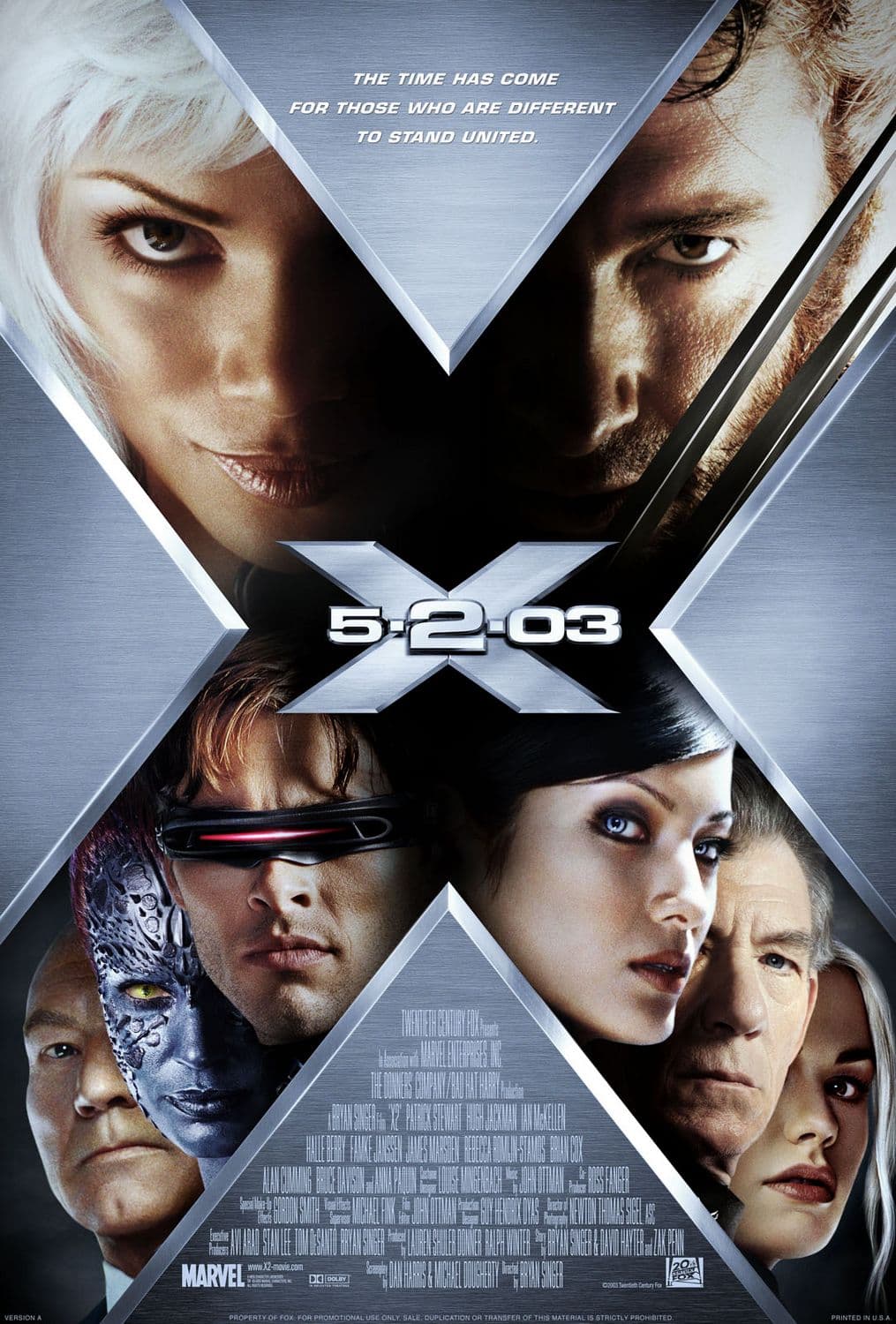
X2: X-Men United (2003), the second installment in Twentieth Century Fox's X-Men franchise, was produced on a reported budget of $110,000,000, a 60% increase over the $75,000,000 spent on the 2000 original. Fox greenlit the sequel after Bryan Singer's first X-Men film grossed $296,339,527 worldwide on a modest budget, exceeding internal projections and validating the studio's bet on a serious-toned adaptation of the Marvel Comics property. The expanded budget reflected the studio's confidence in Singer's vision and the franchise's expanding scope, with a larger ensemble cast, more elaborate action sequences, and significantly increased visual effects work.
Marvel Enterprises co-financed and co-produced through producer Lauren Shuler Donner, who continued in her role from the first film. The $110,000,000 outlay was structured to support pay raises for the returning principal cast (Patrick Stewart, Hugh Jackman, Ian McKellen, Halle Berry, Famke Janssen, James Marsden, Rebecca Romijn-Stamos, and Anna Paquin), the introduction of major new characters Nightcrawler (Alan Cumming) and Colonel Stryker (Brian Cox), and roughly nine months of principal photography and post-production across British Columbia and Alberta.
Key Budget Allocation Categories
X2's $110,000,000 budget was distributed across several core production areas:
- Above-the-Line Talent: The principal X-Men cast returned at significantly increased rates following the success of the first film, with Hugh Jackman in particular commanding a sequel raise as Wolverine emerged as the franchise breakout. Patrick Stewart and Ian McKellen continued as Xavier and Magneto at established rates. New cast Alan Cumming and Brian Cox joined at featured-player tiers. Director Bryan Singer received a substantial directing fee plus producing credit.
- Visual Effects: The film expanded the VFX scope dramatically over the original, with Nightcrawler's teleportation sequences, Pyro's flame manipulation, Iceman's freezing effects, the dam-bursting climax, and Lady Deathstrike's adamantium-claw fight all requiring extensive CG work. Industrial Light & Magic, Cinesite, Rhythm and Hues, Hydraulx, and Tippett Studio split the shot count across more than 800 effects shots.
- Production Design: Production designer Guy Hendrix Dyas built Stryker's Alkali Lake base, the Xavier mansion interiors (rebuilt and expanded from the first film), the Boston dam set, and Nightcrawler's abandoned church on stages at Vancouver's Mammoth Studios. The Cerebro reconstruction and the underground hangar additions were among the larger single-set builds.
- Vancouver and Alberta Locations: Principal photography ran from June 2002 to November 2002 across British Columbia and Alberta, with location work at Hatley Castle (Xavier's mansion), the Lower Mainland forest, and the Alberta Rockies. Local crew rates and Canadian production incentives offset costs compared with a US-based shoot.
- Cinematography and Lighting: Cinematographer Newton Thomas Sigel returned from the first film and worked across multiple Vancouver stages and exterior locations, with the Alkali Lake exterior requiring extensive winter exposure photography.
- Score and Music: Composer John Ottman, also serving as the film's editor, recorded the score with the Hollywood Studio Symphony. The score introduced new themes for Nightcrawler and Stryker while developing the X-Men motif from the first film.
- Marketing Tie-In Production: Fox coordinated marketing with Marvel comic tie-ins, Activision video-game development, and licensing partners, requiring asset production and unit photography overhead during the shoot.
How Does X-Men 2's Budget Compare to Similar Films?
At $110,000,000, X-Men 2 sat squarely in the upper-middle range of early-2000s superhero tentpoles. The comparison set illustrates how its commercial outcome stacked up:
- Spider-Man (2002): Budget $139,000,000 | Worldwide $825,025,036. Sam Raimi's Sony franchise opener cost 26% more than X2 and earned more than twice the worldwide gross, setting a new ceiling for superhero box office that would not be broken until The Dark Knight.
- Daredevil (2003): Budget $78,000,000 | Worldwide $179,179,718. Fox's contemporaneous Marvel adaptation cost 30% less than X2 and earned less than half the worldwide gross, demonstrating how X2 outperformed its budget tier among 2003 comic-book films.
- Hulk (2003): Budget $137,000,000 | Worldwide $245,360,480. Universal's Ang Lee-directed Marvel adaptation cost 25% more than X2 and earned roughly 60% of its worldwide total, a result that reinforced X2's standing as the leading non-Spider-Man Marvel film of the year.
- X-Men (2000): Budget $75,000,000 | Worldwide $296,339,527. The franchise opener cost 32% less than X2 and earned roughly 73% of the worldwide gross, showing how the sequel scaled both investment and return at compatible proportions.
- The Matrix Reloaded (2003): Budget $150,000,000 | Worldwide $738,599,701. Warner Bros.' Matrix sequel cost 36% more than X2 and earned 81% more worldwide, the closest spring 2003 ceiling for a major sequel and a result X2 trailed but did not embarrass itself against.
X-Men 2 Box Office Performance
X2: X-Men United opened on May 2, 2003, in 3,741 theaters and earned $85,558,731 over its opening weekend, the second-largest May opening to that point behind Spider-Man (2002) and a 50% increase over the original X-Men's $54,471,475 debut. The strong opening set Fox's commercial expectations for a $250,000,000-plus domestic finish.
Against a $110,000,000 production budget, the film needed approximately $250,000,000 in worldwide gross to reach profitability after marketing and distribution costs. Here is the financial breakdown:
- Production Budget: $110,000,000
- Estimated Prints & Advertising (P&A): approximately $60,000,000 to $75,000,000
- Total Estimated Investment: approximately $170,000,000 to $185,000,000
- Worldwide Gross: $407,711,549
- Net Return: approximately $222,000,000 to $237,000,000 gross over total estimated investment (strong theatrical profit)
- ROI: approximately 120% to 140% (against total estimated investment, before home video)
X-Men 2 returned approximately $2.32 in worldwide theatrical revenue for every $1 invested when measured against total estimated production and marketing spend, a result that confirmed the X-Men franchise as one of Fox's most reliable tentpole properties. The domestic share of the gross was $214,949,694 against an international share of $192,761,855, a 53/47 split that demonstrated balanced global appeal.
The strong performance prompted Fox to greenlight a third installment, X-Men: The Last Stand (2006), at an even larger $210,000,000 budget. X-Men 2 also drove substantial DVD and home video revenue, with the film ranking among the top home-video releases of 2003 and providing Fox with an annuity that supported the franchise's continued expansion across the 2000s and 2010s.
X-Men 2 Production History
Development on a sequel to X-Men began at Fox in late 2000 immediately after the original's box office success. Bryan Singer returned to direct under a deal that gave him substantial creative control. Singer brought back screenwriter David Hayter from the first film and added Michael Dougherty and Dan Harris, his frequent collaborators, to develop a screenplay drawing on the 1982 graphic novel "X-Men: God Loves, Man Kills" by Chris Claremont and Brent Anderson. The story's central anti-mutant antagonist William Stryker was adapted from that source material into Colonel William Stryker, played by Brian Cox.
Casting Alan Cumming as Nightcrawler in late 2001 reshaped the project. Cumming endured an eight-hour makeup application each shooting day, with body-blue paint, prosthetic facial features, and contact lenses applied by a dedicated team led by Gordon Smith. The film's opening White House attack sequence, in which Nightcrawler teleports through the West Wing while attempting to assassinate the President, was conceived as a marquee proof-of-concept for the character and became one of the most identifiable sequences in the franchise.
Principal photography ran from June 2002 to November 2002 across British Columbia and Alberta, anchored at Mammoth Studios in Burnaby. Hatley Castle outside Victoria returned as the Xavier mansion exterior, and the Alberta Rockies doubled for the Alkali Lake region. Canadian production tax credits and Vancouver's established VFX infrastructure provided a meaningful cost advantage over a Los Angeles-based shoot.
Post-production stretched across the winter of 2002-2003, with John Ottman serving as both composer and editor, an unusual dual role that gave the film an unusually cohesive rhythm between picture cuts and musical accents. The film opened wide on May 2, 2003, as Fox's summer tentpole and the first major comic-book release of the year.
Awards and Recognition
X-Men 2 received broad genre-press recognition. The film won three Saturn Awards from the Academy of Science Fiction, Fantasy and Horror Films: Best Science Fiction Film, Best Director (Bryan Singer), and Best Writing (Michael Dougherty, Dan Harris, David Hayter). It also received Saturn nominations for Best Actor (Hugh Jackman), Best Supporting Actor (Alan Cumming), Best Supporting Actress (Rebecca Romijn-Stamos and Famke Janssen), Best Special Effects, and Best Make-Up.
The film received no Academy Award nominations but earned a BAFTA Children's Award nomination for Best Feature Film and a Hugo Award nomination for Best Dramatic Presentation, Long Form. The Visual Effects Society honored the film with three VES Award nominations, including Best Visual Effects in an Effects-Driven Motion Picture, recognizing the Nightcrawler teleportation work and the Alkali Lake climax. Hugh Jackman received an MTV Movie Award nomination for Best Performance.
Critical Reception
X-Men 2 received widely positive reviews and is regularly cited as one of the strongest comic-book sequels of its era. The film holds an 85% approval rating on Rotten Tomatoes based on 257 critic reviews, with a critical consensus that praised its character work, themes, and action sequences. On Metacritic, the film scored 68 out of 100, indicating generally favorable reviews. Audiences surveyed by CinemaScore gave the film an A-, a strong score for a superhero sequel and an improvement over the original X-Men's B+.
Critics praised Bryan Singer's confident escalation of the original's civil-rights subtext, the expanded ensemble work, the Nightcrawler White House opening, and the moral complexity of the Stryker antagonist. Roger Ebert gave the film three and a half out of four stars and wrote that it had "depth, substance, and conviction," while The New York Times' Elvis Mitchell called it "the most satisfying superhero film since the first Superman."
Detractors flagged the film's lengthy 134-minute runtime, the underdeveloped roles for several younger mutant characters, and a downbeat dam-bursting climax that some critics felt borrowed too directly from Star Trek II: The Wrath of Khan. X-Men 2's critical reputation has only strengthened in the years since, with multiple retrospective lists naming it among the top ten superhero films of the 2000s and a key precursor to the Marvel Cinematic Universe's ensemble approach.
Frequently Asked Questions
How much did it cost to make X-Men 2 (2003)?
The reported production budget was $110,000,000, a 60% increase over the $75,000,000 spent on the 2000 original. Twentieth Century Fox financed the film with co-production and co-financing from Marvel Enterprises, reflecting the studio's confidence in Bryan Singer's vision after the first film's commercial success.
How much did X-Men 2 earn at the box office?
The film grossed $214,949,694 domestically and $192,761,855 internationally, for a worldwide total of $407,711,549. It opened to $85,558,731 over its May 2, 2003 weekend, the second-largest May opening to that point behind Spider-Man (2002).
Was X-Men 2 profitable?
Yes. Against an estimated $170,000,000 to $185,000,000 total investment (production plus marketing), the film returned approximately $2.32 in worldwide gross for every $1 invested, a strong theatrical profit before home video. The result prompted Fox to greenlight X-Men: The Last Stand (2006) at a $210,000,000 budget.
Who directed X-Men 2?
Bryan Singer directed the film, returning from the 2000 original. Singer received a substantial directing fee plus producing credit and brought back screenwriter David Hayter, adding Michael Dougherty and Dan Harris to develop a screenplay drawing on the 1982 Chris Claremont and Brent Anderson graphic novel "X-Men: God Loves, Man Kills."
Where was X-Men 2 filmed?
Principal photography ran from June 2002 to November 2002 across British Columbia and Alberta, anchored at Mammoth Studios in Burnaby. Hatley Castle outside Victoria returned as the Xavier mansion exterior, and the Alberta Rockies doubled for the Alkali Lake region. Canadian production tax credits and Vancouver's established VFX infrastructure provided a cost advantage over a Los Angeles-based shoot.
Who plays Nightcrawler in X-Men 2?
Alan Cumming plays Nightcrawler. Cumming endured an eight-hour makeup application each shooting day, with body-blue paint, prosthetic facial features, and contact lenses applied by a dedicated team led by Gordon Smith. The opening White House attack sequence, in which Nightcrawler teleports through the West Wing, became one of the most identifiable sequences in the franchise.
How does X-Men 2 compare to other X-Men films?
X-Men 2 cost $110M (more than X-Men's $75M but less than X-Men: The Last Stand's $210M) and earned $407M worldwide, between X-Men's $296M and The Last Stand's $460M. It remains the highest-rated entry in the original trilogy by Rotten Tomatoes (85%) and is widely cited as the creative high point of the Fox franchise before X-Men: First Class.
What did critics think of X-Men 2?
The film received widely positive reviews, with an 85% approval rating on Rotten Tomatoes (based on 257 critics) and a 68 out of 100 Metacritic score. Audiences gave it an A- CinemaScore. Critics praised Bryan Singer's confident escalation of the original's civil-rights subtext, the expanded ensemble work, and the Nightcrawler White House opening.
Did X-Men 2 win any awards?
The film won three Saturn Awards: Best Science Fiction Film, Best Director (Bryan Singer), and Best Writing. It also received Saturn nominations for Best Actor (Hugh Jackman) and Best Supporting Actor (Alan Cumming), a BAFTA Children's Award nomination, a Hugo Award nomination for Best Dramatic Presentation, and three Visual Effects Society Award nominations.
Why is X-Men 2 also called X2: X-Men United?
The film's full theatrical title in North America was X2: X-Men United, marketed primarily as X2 on posters and trailers. International territories used "X-Men 2" as the primary title. The "United" subtitle reflected the film's central story of an uneasy X-Men and Magneto alliance against Colonel Stryker's anti-mutant offensive.
Filmmakers
X-Men 2 (2003)

Build your own production budget
Create professional budgets with industry-standard feature film templates. Real-time collaboration, no spreadsheets.