
Wild Strawberries Budget
Updated
Synopsis
Aging professor Isak Borg drives from Stockholm to Lund to receive an honorary doctorate, accompanied by his estranged daughter-in-law Marianne. Along the way, dreams, memories, and chance encounters with younger travelers force the elderly physician to confront a lifetime of emotional coldness in Ingmar Bergman's masterwork of late-life reckoning.
What Is the Budget of Wild Strawberries (1957)?
Wild Strawberries (1957), written and directed by Ingmar Bergman and released by Svensk Filmindustri, was produced on a modest Swedish-feature budget that has been variously estimated at between $150,000 and $300,000 in 1957 dollars (roughly $1,600,000 to $3,200,000 in 2026 dollars). Svensk Filmindustri, Sweden's dominant production and distribution company, financed the picture in-house as part of its standing arrangement with Bergman, who was midway through the run of works that would establish him as one of the central figures in postwar European cinema.
The investment was sufficient for a black-and-white production with established lead Victor Sjöström, a co-financed location shoot across the highway from Stockholm to Lund, dream sequences with elaborate optical and in-camera effects, and the modest period dressings for the Borg family flashbacks. Bergman shot the picture quickly and economically, in keeping with the Swedish studio model of the period. The film's commercial and critical reception subsequently made it one of Svensk Filmindustri's most internationally successful titles of the late 1950s.
Key Budget Allocation Categories
Wild Strawberries' modest Svensk Filmindustri budget was distributed across several core production areas:
- Above-the-Line Talent Victor Sjöström, the pioneering Swedish director and actor returning to lead acting in his late seventies, took the role of Isak Borg in what would be his final screen performance. Ingmar Bergman commanded his standing writer-director fee at Svensk Filmindustri, where he was under multi-picture contract. Supporting cast Bibi Andersson, Ingrid Thulin, Gunnar Björnstrand, and a young Max von Sydow worked at Swedish-feature scale rates.
- Location Photography The narrative's framing road trip required location shooting along the route from Stockholm to Lund in southern Sweden, with set pieces at gas stations, lakeside picnic spots, the abandoned wild strawberry patch of the title, and university interiors at Lund. Travel logistics for cast and a small crew kept location costs in proportion to the modest overall budget.
- Dream Sequence Effects The famous opening dream of Isak Borg encountering a faceless mannequin, a hearse spilling his own corpse, and a clock without hands required practical optical effects, makeup, prosthetics, and elaborate set construction at Svensk Filmindustri's Stockholm studio. Cinematographer Gunnar Fischer collaborated with Bergman on the high-contrast lighting that defined the sequences.
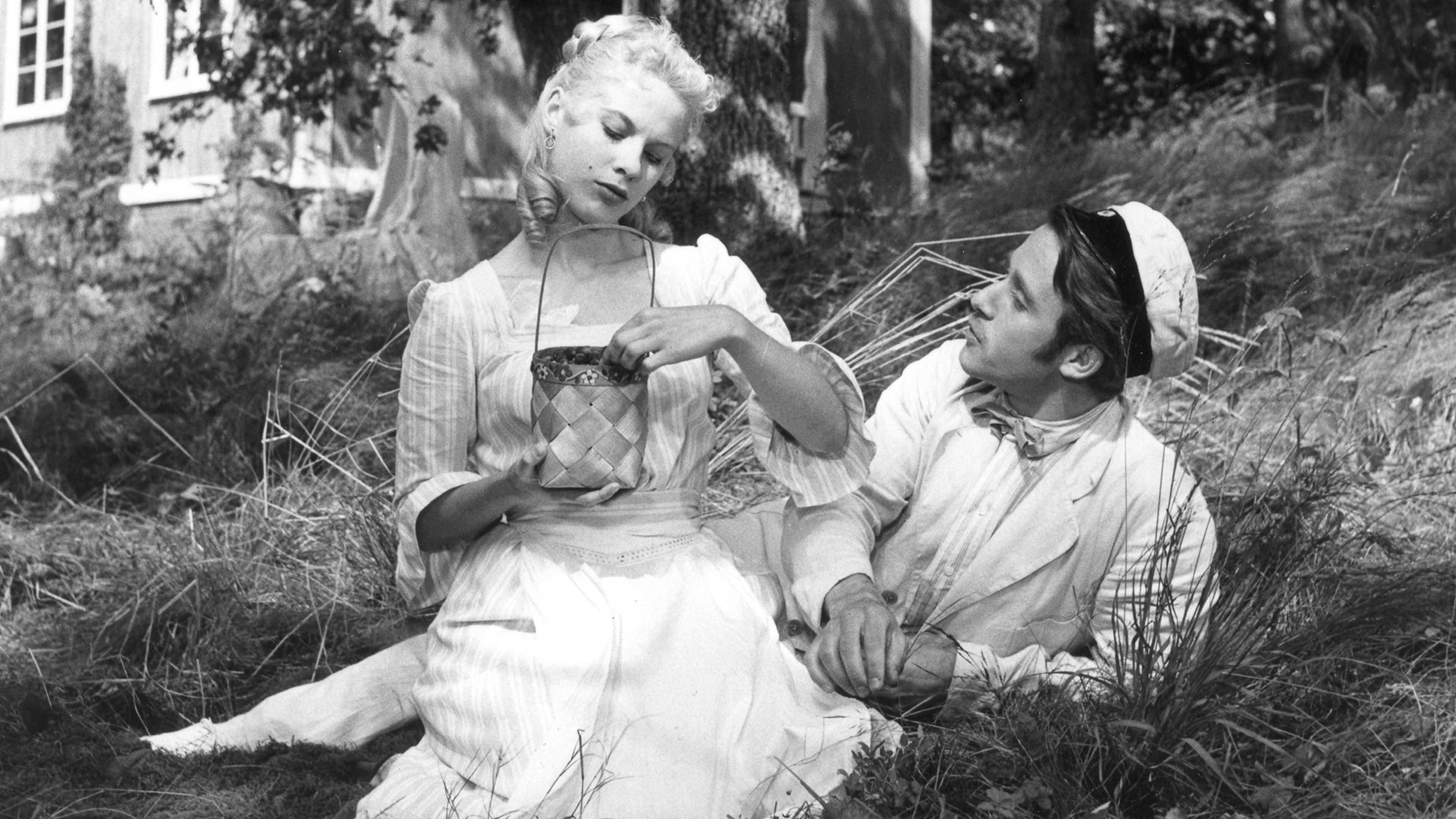
- Studio Interiors Period flashbacks to the Borg family summer home were shot on constructed interiors and exteriors at the Svensk Filmindustri lot, with detailed early-twentieth-century Swedish summer-house dressing. Production designer Gittan Gustafsson supervised the period detail.
- Score Composer Erik Nordgren delivered an unobtrusive orchestral score that supported the film's contemplative tone, recorded with the Stockholm Concert Society Orchestra at competitive Swedish union rates.
- Black-and-White Stock The Eastman Kodak black-and-white stock and processing accounted for a meaningful share of below-the-line costs in the 1957 production economy, although less than a color production would have required.
How Does Wild Strawberries' Budget Compare to Similar Films?
Wild Strawberries' modest Swedish-studio budget fits the European art-cinema economics of the late 1950s. The comparison set illustrates the budget scale of contemporaneous prestige titles:
- The Seventh Seal (1957): Budget approximately $150,000 | Worldwide reissue gross unreported. Bergman's earlier 1957 film, shot at Svensk Filmindustri the same year, was made on a comparable budget and established the international auteur reputation that helped Wild Strawberries travel.
- Nights of Cabiria (1957): Budget approximately $300,000 | Worldwide reissue gross unreported. Federico Fellini's Italian neorealist drama, released the same year, occupied a similar art-cinema budget tier and competed alongside Bergman's film on the international festival circuit.
- The 400 Blows (1959): Budget approximately $75,000 | Worldwide reissue gross unreported. François Truffaut's French New Wave landmark cost roughly a third of Wild Strawberries and established the lower budget tier that would define European auteur cinema through the 1960s.
- Ashes and Diamonds (1958): Budget approximately $200,000 | Worldwide reissue gross unreported. Andrzej Wajda's Polish drama, released a year later, represents the comparable Eastern European art-cinema budget envelope.
- Pather Panchali (1955): Budget approximately $3,000 | Worldwide reissue gross unreported. Satyajit Ray's debut, financed on extreme economic constraint, demonstrates the lower extreme of the international art-cinema budget range that Bergman's films sat above.
Wild Strawberries Box Office Performance
Wild Strawberries premiered in Stockholm on December 26, 1957 and rolled out across Swedish theaters through early 1958. Specific Swedish theatrical grosses from the period are not preserved in publicly available records, but Svensk Filmindustri reported the picture as commercially successful in the domestic market and as one of its most internationally distributed titles of the late 1950s.
Against a modest production budget estimated between $150,000 and $300,000, the picture's commercial performance was measured through international art-house distribution and subsequent decades of reissue, home video, and streaming licensing. Here is the financial breakdown:
Box Office Breakdown
Wild Strawberries

The international distribution success cemented Wild Strawberries as a perennially licensed art-house title. The picture has remained continuously in circulation through the Criterion Collection (with 35mm restoration, DVD, Blu-ray, and 4K UHD home video editions), academic film-class licensing, and streaming services including The Criterion Channel. Sixty-eight years after release the title remains one of Svensk Filmindustri's most commercially durable assets.
Bergman's international reputation, substantially built on the back of Wild Strawberries' festival reception, also accelerated the commercial performance of his subsequent films, including The Magician, The Virgin Spring, and Through a Glass Darkly. The picture is widely cited as the bridge between his 1950s prestige run and the chamber-drama phase that followed.
Wild Strawberries Production History
Ingmar Bergman developed Wild Strawberries in 1956 and early 1957, drafting the screenplay during a period of personal reflection on his strained relationship with his clergyman father. The story emerged from an autobiographical impulse, with Bergman later writing in The Magic Lantern that the picture represented an attempt to imagine his father's emotional life and to reckon with the silences of the Bergman family.
Casting Victor Sjöström as Isak Borg was the central creative coup. Sjöström, then 78 and a major figure of Swedish silent-era cinema (notably as a director of The Phantom Carriage and The Wind), had largely retired from acting. Bergman convinced him to return for the role with extensive on-set support, including reduced shooting hours, simplified blocking, and standing assistance for physically demanding sequences. Sjöström delivered a performance that critics including Pauline Kael and Andrew Sarris would later cite among the finest in cinema history.
Principal photography took place across Sweden in the summer of 1957, with location work along the Stockholm-to-Lund route, exteriors at Lund University, and studio interiors at Svensk Filmindustri's Stockholm facility. Cinematographer Gunnar Fischer collaborated with Bergman on the high-contrast black-and-white visual approach, particularly the surrealist treatment of Isak Borg's opening dream. The production wrapped quickly by Bergman's standards and post-production was completed for a December 1957 Stockholm premiere.
Sjöström died in January 1960, two years after the film's release. Wild Strawberries was his final screen role and is widely understood as both his career capstone and one of the great late-career performances in international cinema.
Awards and Recognition
Wild Strawberries won the Golden Bear at the 1958 Berlin International Film Festival, sharing the top prize. Victor Sjöström won the Best Actor award at the Mar del Plata International Film Festival. The picture received an Academy Award nomination for Best Original Screenplay at the 1960 Oscars (Bergman's first nomination in the category) and a Golden Globe nomination for Best Foreign Language Film.
The film also won the National Society of Film Critics Award and the New York Film Critics Circle Award for Best Foreign Language Film. Sjöström's performance was honored at the National Board of Review. Decades of retrospective recognition include consistent placement in critic-poll rankings of the greatest films of all time, including Sight & Sound's top-100 lists, the BFI's top-100 ranking, and TIME magazine's All-Time 100 Movies. The picture is widely taught in university film courses as a foundational text of art cinema and is regularly cited in Best Director and Best Performance career-overview lists for both Bergman and Sjöström.
Critical Reception
Wild Strawberries received overwhelming critical acclaim on initial release and has retained a near-universal critical reputation across nearly seven decades. The film holds a 92% approval rating on Rotten Tomatoes based on 62 critic reviews, with a critical consensus calling it "a moving, philosophically rich meditation on aging and regret anchored by Victor Sjöström's deeply affecting central performance." On Metacritic, the film scored 88 out of 100, indicating universal acclaim. Audience response on Letterboxd and IMDb consistently ranks the picture among the highest-rated Swedish-language films ever.
Roger Ebert included Wild Strawberries in his Great Movies series, writing that "the film penetrates the soul of an old man at a moment when he confronts the wasted opportunities of his life." Pauline Kael, in 5001 Nights at the Movies, called the picture "a haunting work, with Sjöström delivering a performance of devastating economy." Andrew Sarris ranked Bergman in his Pantheon category in The American Cinema, citing Wild Strawberries as one of two career-defining works alongside The Seventh Seal.
Subsequent generations of filmmakers have repeatedly cited the picture as a touchstone. Woody Allen has named Wild Strawberries his favorite film and has openly modeled multiple works including Deconstructing Harry and Another Woman on its structure. Paul Schrader's Transcendental Style in Film treats Bergman's late-1950s output as the European prong of the slow-cinema lineage. The picture's combination of dream surrealism, road-trip framing, and late-life reckoning has influenced filmmakers from Krzysztof Kieślowski to Terrence Malick.
Frequently Asked Questions
How much did Wild Strawberries (1957) cost to make?
Specific budget figures from the Svensk Filmindustri archives have not been publicly disclosed. The film was produced on a modest Swedish-feature budget variously estimated at between $150,000 and $300,000 in 1957 dollars (roughly $1,600,000 to $3,200,000 in 2026 dollars), in line with the studio's standing in-house arrangement with Ingmar Bergman during the late 1950s.
How much did Wild Strawberries earn at the box office?
Specific theatrical grosses from the 1957-1958 Swedish and international release are not preserved in publicly available records. Svensk Filmindustri reported the picture as commercially successful in domestic Sweden and as one of its most widely distributed international art-house titles of the period. The picture has remained continuously profitable through decades of reissue, home video, and streaming revenue.
Who directed Wild Strawberries?
Ingmar Bergman wrote and directed the film. It was his sixteenth feature as director and his second 1957 release after The Seventh Seal, marking the peak of his late-1950s creative run at Svensk Filmindustri.
Who plays Isak Borg in Wild Strawberries?
Victor Sjöström plays Isak Borg in what would be his final screen performance. Sjöström was a pioneering Swedish silent-era director and actor (notably The Phantom Carriage and The Wind) and was 78 when Bergman convinced him to return to acting for the role. He died in January 1960, two years after the film's release.
Where was Wild Strawberries filmed?
Principal photography took place across Sweden in the summer of 1957. Location work followed the narrative road-trip route from Stockholm to Lund in southern Sweden, with exteriors filmed at Lund University. Interior studio sequences were shot at Svensk Filmindustri's Stockholm facility.
Is Wild Strawberries autobiographical?
The film draws substantially on Bergman's own reflections on his strained relationship with his clergyman father. Bergman later wrote in his memoir The Magic Lantern that the picture represented an attempt to imagine his father's emotional life and to reckon with the silences of the Bergman family, though the surface narrative is fictional rather than directly autobiographical.
What is the opening dream sequence in Wild Strawberries?
The opening dream features Isak Borg walking through an empty city street where he encounters a faceless mannequin, a hearse spilling his own corpse, and a clock without hands. The sequence was achieved through practical optical effects, makeup, and high-contrast black-and-white cinematography by Gunnar Fischer. It is widely cited as one of the most influential dream sequences in cinema history.
Did Wild Strawberries win awards?
Yes. The film won the Golden Bear at the 1958 Berlin International Film Festival and received an Academy Award nomination for Best Original Screenplay at the 1960 Oscars (Bergman's first nomination in the category). Victor Sjöström won the Best Actor award at the Mar del Plata International Film Festival. The picture has consistently appeared on Sight & Sound and BFI all-time greatest-films polls.
What did critics think of Wild Strawberries?
Wild Strawberries received overwhelming critical acclaim on initial release and has retained near-universal critical standing across nearly seven decades. It holds a 92% approval rating on Rotten Tomatoes from 62 critics and an 88 out of 100 score on Metacritic. Roger Ebert included it in his Great Movies series, Pauline Kael called it "a haunting work," and Woody Allen has named it his favorite film.
Is Wild Strawberries on the Criterion Collection?
Yes. The Criterion Collection has released multiple editions of Wild Strawberries including DVD, Blu-ray, and 4K UHD versions, drawing on Svensk Filmindustri's 35mm restoration. The film is also available on The Criterion Channel and is frequently included in academic film-class licensing packages.
Filmmakers
Wild Strawberries

Official Trailer
Build budgets like this one in Saturation
Start from an industry-standard feature film template, import the schedule and rates you already have, and let the cost report keep itself current as you spend. Real-time collaboration, no spreadsheets.