WALL·E
Synopsis
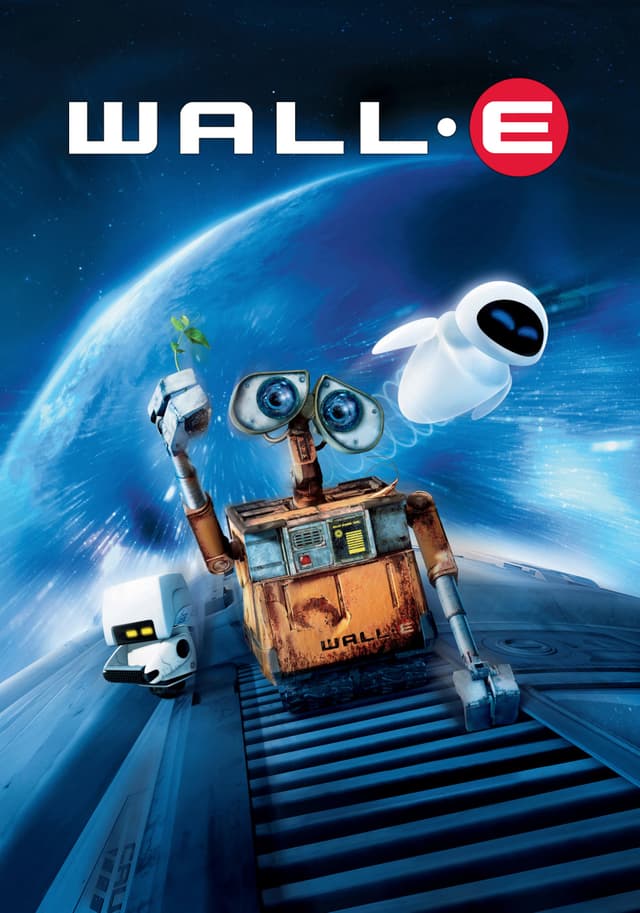
In a distant, but not so unrealistic, future where mankind has abandoned earth because it has become covered with trash from products sold by the powerful multi-national Buy N Large corporation, WALL-E, a garbage collecting robot has been left to clean up the mess. Mesmerized with trinkets of Earth's history and show tunes, WALL-E is alone on Earth except for a sprightly pet cockroach. One day, EVE, a sleek (and dangerous) reconnaissance robot, is sent to Earth to find proof that life is once again sustainable. WALL-E falls in love with EVE. WALL-E rescues EVE from a dust storm and shows her a living plant he found amongst the rubble. Consistent with her "directive", EVE takes the plant and automatically enters a deactivated state except for a blinking green beacon. WALL-E, doesn't understand what has happened to his new friend, but, true to his love, he protects her from wind, rain, and lightning, even as she is unresponsive. One day a massive ship comes to reclaim EVE, but WALL-E, out of love or loneliness, hitches a ride on the outside of the ship to rescue EVE. The ship arrives back at a large space cruise ship, which is carrying all of the humans who evacuated Earth 700 years earlier. The people of Earth ride around this space resort on hovering chairs which give them a constant feed of TV and video chatting. They drink all of their meals through a straw out of laziness and/or bone loss, and are all so fat that they can barely move. When the auto-pilot computer, acting on hastily-given instructions sent many centuries before, tries to prevent the people of Earth from returning by stealing the plant, WALL-E, EVE, the portly captain, and a band of broken robots stage a mutiny.
Production Budget Analysis
What was the production budget for WALL·E?
Directed by Andrew Stanton, with Ben Burtt, Elissa Knight, Jeff Garlin leading the cast, WALL·E was produced by Pixar with a confirmed budget of $180,000,000, placing it in the big-budget category for animation films.
A budget of $180,000,000 represents a significant studio commitment. Including estimated P&A of $50–100 million, the total investment likely approached $306,000,000–$360,000,000, requiring approximately $450,000,000 in worldwide grosses to break even.
Budget Comparison — Similar Productions
• Doctor Strange (2016): Budget $180,000,000 | Gross $676,343,174 → ROI: 276% • Fantastic Beasts and Where to Find Them (2016): Budget $180,000,000 | Gross $809,342,332 → ROI: 350% • Maleficent (2014): Budget $180,000,000 | Gross $758,539,785 → ROI: 321% • Pacific Rim (2013): Budget $180,000,000 | Gross $411,000,000 → ROI: 128% • Thor: Ragnarok (2017): Budget $180,000,000 | Gross $855,301,806 → ROI: 375%
Key Budget Allocation Categories
▸ Animation Production Pipeline The bulk of an animated film's budget funds the multi-year production pipeline: storyboarding, character modeling, rigging, animation, lighting, rendering, and compositing. Major studio animated features employ 300–600 artists over 3–5 years.
▸ Voice Talent Celebrity voice casting has become standard for studio animation, with A-list actors earning $5–15 million for voice roles.
▸ Music, Songs & Sound Design Original songs and orchestral scores are central to animated storytelling. Sound design for animated worlds must be created entirely from scratch.
Key Production Personnel
CAST: Ben Burtt, Elissa Knight, Jeff Garlin, Fred Willard, John Ratzenberger Key roles: Ben Burtt as WALL·E / M-O (voice); Elissa Knight as EVE (voice); Jeff Garlin as Captain (voice); Fred Willard as Shelby Forthright, BnL CEO
DIRECTOR: Andrew Stanton CINEMATOGRAPHY: Jeremy Lasky, Danielle Feinberg MUSIC: Thomas Newman EDITING: Stephen Schaffer PRODUCTION: Pixar FILMED IN: United States of America
Box Office Performance
WALL·E earned $223,808,164 domestically and $297,503,696 internationally, for a worldwide total of $521,311,860. Revenue was split 43% domestic / 57% international.
Break-Even Analysis
Using the industry-standard 2.5x multiplier (P&A + exhibitor shares of 40–50% + distribution fees), WALL·E needed approximately $450,000,000 to break even. The film surpassed this threshold by $71,311,860.
Return on Investment (ROI)
Revenue: $521,311,860 Budget: $180,000,000 Net: $341,311,860 ROI: 189.6%
Detailed Box Office Notes
WALL-E grossed $223.8 million in the United States and Canada and $308.7 million overseas, for a worldwide total of $532.5 million,
In the US and Canada, WALL-E opened in 3,992 theaters on June 27, 2008. The film grossed $23.1 million on its opening day, the highest of all nine Pixar titles to date. During its opening weekend, it topped the box office with $63,087,526. WALL-E crossed the $200 million mark by August 3, during its sixth weekend.
WALL-E grossed over $10 million in Japan ($44,005,222), UK, Ireland and Malta ($41,215,600), France and the Maghreb region ($27,984,103), Germany ($24,130,400), Mexico ($17,679,805), Spain ($14,973,097), Australia ($14,165,390), Italy ($12,210,993), and Russia and the CIS ($11,694,482).
Profitability Assessment
VERDICT: Profitable
WALL·E delivered a solid return, earning $521,311,860 worldwide on a $180,000,000 budget (190% ROI). Combined with ancillary revenue, the film was a financial positive for Pixar.
INDUSTRY IMPACT
Records: Crossed the $500M worldwide threshold, placing it among the top-grossing films of 2008.
PRODUCTION NOTES
▸ Music & Score
Thomas Newman recollaborated with Stanton on WALL-E since the two got along well on Finding Nemo, which gave Newman the Annie Award for Best Music in an Animated Feature. He began writing the score in 2005, in the hope that starting this task early would make him more involved with the finished film. But, Newman remarked that animation is so dependent on scheduling he should have begun work earlier on when Stanton and Reardon were writing the script. EVE's theme was arranged for the first time in October 2007. Her theme when played as she first flies around Earth originally used more orchestral elements, and Newman was encouraged to make it sound more feminine. Newman said Stanton had thought up many ideas for how he wanted the music to sound, and he generally followed them as he found scoring a partially silent film difficult. Stanton wanted the whole score to be orchestral, but Newman felt limited by this idea especially in scenes aboard the Axiom, and used electronics too.
Stanton originally wanted to juxtapose the opening shots of space with 1930s French swing music, but changed his mind after seeing The Triplets of Belleville (2003), not wanting to appear as if he were copying it. Stanton found that the song was about two naive young men looking for love, which was similar to WALL-E's own hope for companionship. Jim Reardon, storyboard supervisor for the film, suggested WALL-E find the film on video, and Stanton included "It Only Takes a Moment" and the clip of the actors holding hands, because he wanted a visual way to show how WALL-E understands love and conveys it to EVE. Hello, Dolly! composer Jerry Herman allowed the songs to be used without knowing what for; when he saw the film, he found their incorporation into the story "genius". Coincidentally, Newman's uncle Lionel worked on Hello, Dolly! but Newman asked if he could score the scene himself.
AWARDS & RECOGNITION
Summary: Won 1 Oscar. 96 wins & 95 nominations total
Awards Won: ★ Nebula Award for Best Script — Andrew Stanton ★ Nebula Award for Best Script — Pete Docter ★ Nebula Award for Best Script — Jim Reardon ★ Los Angeles Film Critics Association Award for Best Film ★ Hugo Award for Best Dramatic Presentation, Long Form — Andrew Stanton ★ Hugo Award for Best Dramatic Presentation, Long Form — Pete Docter ★ Hugo Award for Best Dramatic Presentation, Long Form — Jim Reardon ★ National Board of Review: Top Ten Films ★ Animation Kobe Theatrical Film Award ★ Satellite Award for Best Animated or Mixed Media Feature — Pixar ★ BAFTA Award for Best Animated Film — Andrew Stanton (62nd British Academy Film Awards) ★ Golden Globe Award for Best Animated Feature Film ★ Academy Award for Best Animated Feature — Andrew Stanton (81st Academy Awards) ★ Critics' Choice Movie Award for Best Animated Feature
Nominations: ○ Satellite Award for Best Animated or Mixed Media Feature ○ Satellite Award for Best Sound ○ National Society of Film Critics Award for Best Film ○ Broadcast Film Critics Association Award for Best Film ○ Nebula Award for Best Script ○ Golden Globe Award for Best Animated Feature Film ○ Academy Award for Best Writing, Original Screenplay (81st Academy Awards) ○ Academy Award for Best Sound (81st Academy Awards) ○ Academy Award for Best Sound Editing (81st Academy Awards) ○ Critics' Choice Movie Award for Best Animated Feature ○ BAFTA Award for Best Original Music ○ Academy Award for Best Original Score (81st Academy Awards) ○ Academy Award for Best Animated Feature (81st Academy Awards) ○ BAFTA Award for Best Animated Film ○ Satellite Award for Best Original Score ○ BAFTA Award for Best Sound ○ Hugo Award for Best Dramatic Presentation, Long Form
Additional Recognition: WALL-E won the Academy Award for Best Animated Feature and was nominated for Best Original Screenplay, Best Original Score, Best Original Song, Sound Editing, and Sound Mixing at the 81st Academy Awards. Walt Disney Pictures also pushed for an Academy Award for Best Picture nomination, but it was not nominated, sparking controversy over whether the Academy deliberately restricted WALL-E to the Best Animated Feature category. Film critic Peter Travers remarked, "If there was ever a time where [sic] an animated feature deserved to be nominated for best picture it's ." 1991's Beauty and the Beast was the first and only animated film nominated for Best Picture at the time. A reflective Stanton stated he was not disappointed the film was restricted to the Best Animated Film nomination because he was overwhelmed by the film's positive reception, and eventually "The line [between live-action and animation] is just getting so blurry that I think with each proceeding year, it's going to be tougher and tougher to say what's an animated movie and what's not an animated movie." the Chicago Film Critics Association, the Central Ohio Film Critics awards, the Online Film Critics Society, and most notably the Los Angeles Film Critics Association, where it became the first animated feature to win the prestigious award.
CRITICAL RECEPTION
The American Film Institute named WALL-E as one of the best films of 2008; the jury rationale states:
WALL-E proves to this generation and beyond that the film medium's only true boundaries are the human imagination. Writer/director Andrew Stanton and his team have created a classic screen character from a metal trash compactor who rides to the rescue of a planet buried in the debris that embodies the broken promise of American life. Not since Chaplin's "Little Tramp" has so much story—so much emotion—been conveyed without words. When hope arrives in the form of a seedling, the film blossoms into one of the great screen romances as two robots remind audiences of the beating heart in all of us that yearns for humanity—and love—in the darkest of landscapes.
At Metacritic, which assigns a normalized rating to reviews from mainstream critics, the film has an average score of 95 out of 100 based on 39 reviews, indicating "universal acclaim". Audiences polled by CinemaScore gave the film an average rating of "A" on an A+ to F scale.
IndieWire named WALL-E the third-best film of the year based on their annual survey of 100 film critics, while Movie City News shows that WALL-E appeared in 162 different top 10 lists, out of 286 different critics lists surveyed, the most mentions on a top 10 list of any film released in 2008.
Richard Corliss of Time named WALL-E his favorite film of 2008 (and later of the decade), noting the film succeeded in "connect[ing] with a huge audience" despite the main characters' lack of speech and "emotional signifiers like a mouth, eyebrows, shoulders, [and] elbows". It "evoke[d] the splendor of the movie past" and he also compared WALL-E and EVE's relationship to the chemistry of Spencer Tracy and Katharine Hepburn. Other critics who named WALL-E their favorite film of 2008 included Tom Charity of CNN, Michael Phillips of the Chicago Tribune, Lisa Schwarzbaum of Entertainment Weekly, A. O.
































Budget Templates
Build your own production budget
Create professional budgets with industry-standard feature film templates. Real-time collaboration, no spreadsheets.
Start Budgeting Free