Volcano Budget
 Action
Updated
Synopsis
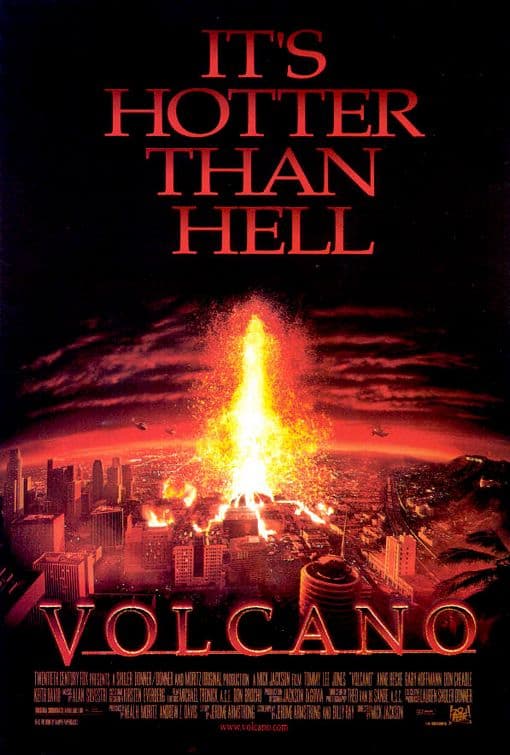
When a massive volcanic eruption ignites beneath the La Brea Tar Pits in Los Angeles, the city's Office of Emergency Management director must work alongside a geologist to redirect lava flows away from a major hospital, downtown high-rises, and tens of thousands of trapped commuters before half the city is destroyed. The film unfolds in close-to-real-time over a single afternoon and evening.
What Is the Budget of Volcano (1997)?
Volcano (1997), directed by Mick Jackson and distributed by 20th Century Fox, was produced on a reported budget of $90,000,000. Fox greenlit the project as a competing entry in the late-1990s disaster-film cycle that included Twister (1996), Independence Day (1996), Dante's Peak (1997), and Deep Impact (1998), positioning Volcano specifically against Universal's Dante's Peak, which was racing toward the same release window with a similar geological-disaster premise.
Producer Andrew G. Vajna, founder of Cinergi Pictures, co-financed the production with 20th Century Fox in a deal that gave Cinergi domestic distribution rights and Fox international rights. The $90,000,000 budget reflected the considerable expense of practical lava effects, full-scale set destruction across multiple Los Angeles street locations, extensive miniature work, and a CGI lava-flow integration that was state-of-the-art for the era.
Key Budget Allocation Categories
Volcano's $90,000,000 budget broke down across these core production areas:
- Above-the-Line Talent: Tommy Lee Jones, fresh off Men in Black (1997) and his Academy Award win for The Fugitive (1993), headlined the cast at a salary reflecting his A-list status. Anne Heche, riding momentum from her breakthrough year in Donnie Brasco and Wag the Dog, took the female lead. Don Cheadle, Gaby Hoffmann, John Carroll Lynch, Jacqueline Kim, Keith David, and Michael Rispoli filled out the ensemble. Director Mick Jackson, coming off The Bodyguard (1992), commanded a feature-director rate for a major studio tentpole.
- Practical Lava and Pyrotechnic Effects: Special effects coordinator Clay Pinney designed and executed extensive practical lava flows using a methylcellulose-based gel mixed with paint pigments, heated to glow under controlled lighting. The effects team built more than 50 fully functional lava-emitting set pieces across the production, plus extensive controlled burns for buildings and street fires.
- La Brea Tar Pits Set Construction: The film's central setting, the La Brea Tar Pits and adjacent Wilshire Boulevard, was reconstructed across multiple Los Angeles back-lot stages and on-location sets. Production designer Jackson DeGovia built fully detailed Wilshire Boulevard storefronts at 80% scale, plus a multi-story subway station set that was destroyed across the third act.
- Miniature and Optical Effects: Industrial Light & Magic and Boss Film Studios contributed miniature work for downtown Los Angeles cityscape destruction sequences. Boss Film, in one of its final major projects before closure, handled the climactic skyscraper lava-redirect sequence.
- CGI Lava Integration: Visual effects supervisor Mat Beck and his team at Light Matters integrated CGI lava with the practical effects, particularly for distance shots and wide-angle establishing footage. The CGI work, while limited by 1996-1997 capabilities, required custom proprietary software to render the lava's heat-distortion and surface texture realistically.
- Location Shooting in Los Angeles: Permits to film on Wilshire Boulevard, MacArthur Park, downtown Los Angeles, and Beverly Hills required extensive coordination with the Los Angeles Film Permit Office, the LAPD, and local transit authorities. The film was one of the largest-scale Los Angeles location shoots of the era.
- Marketing and Race-Against-Dante's-Peak Campaign: With Universal's Dante's Peak set for a February 1997 release and Volcano set for April 1997, Fox accelerated marketing spend to differentiate the two films. The marketing campaign emphasized Tommy Lee Jones, the urban Los Angeles setting, and the practical-effects scale that distinguished Volcano from its competitor.
How Does Volcano's Budget Compare to Similar Films?
At $90,000,000, Volcano sits in the mid-tier of late-1990s disaster-film tentpoles. Comparable productions:
- Dante's Peak (1997): Budget $116,000,000 | Worldwide $178,127,760. Universal's competing volcano disaster film, released two months earlier, cost more and earned more, with Pierce Brosnan's higher international profile driving stronger non-domestic returns.
- Twister (1996): Budget $92,000,000 | Worldwide $494,471,524. The Jan de Bont tornado film, released a year earlier, cost almost identically and grossed nearly four times Volcano worldwide, establishing how a fresh genre concept could outperform incremental follow-ups.
- Independence Day (1996): Budget $75,000,000 | Worldwide $817,400,891. Roland Emmerich's alien invasion blockbuster cost less and grossed nearly seven times Volcano worldwide.
- Deep Impact (1998): Budget $75,000,000 | Worldwide $349,464,664. Mimi Leder's comet disaster film, released the following year, cost less and grossed nearly three times Volcano.
- Armageddon (1998): Budget $140,000,000 | Worldwide $553,709,788. Michael Bay's asteroid film cost more than 50% more than Volcano and grossed more than four times as much.
Volcano Box Office Performance
Volcano opened on April 25, 1997, in 2,756 theaters, earning $14,581,740 in its opening weekend and finishing first at the domestic box office. The film's worldwide gross ultimately reached $122,823,468.
Against a reported production budget of $90,000,000, the film needed approximately $200,000,000 worldwide to reach profitability when accounting for marketing and distribution costs. The financial breakdown:
Box Office Breakdown
Volcano

Volcano returned approximately $0.88 in worldwide theatrical revenue for every $1 invested when measured against total estimated production and marketing spend, making it a theatrical underperformer that lost money in its initial release. The domestic share of $47,546,371 against an international share of $75,277,097 reflected a stronger international interest in the urban-disaster premise than in the domestic market, where audiences had already been served by Dante's Peak.
Home video, cable television, and ancillary windows allowed the film to eventually break into profitability, but it never reached the franchise-launching success Fox had hoped for. The film's release within ten weeks of Dante's Peak contributed to a sense among audiences of disaster-film fatigue, particularly given the similar geological premise.
Volcano Production History
Development on Volcano began in 1995, when screenwriter Jerome Armstrong sold his spec script to Fox in a high-profile deal in the wake of Twister's success. Armstrong's script, originally titled Lava, was set in modern Los Angeles and used the La Brea Tar Pits as a real-world hook to justify the otherwise unlikely premise of a volcanic eruption in a major American city. Producer Andrew G. Vajna brought the project to Cinergi Pictures and partnered with Fox on the co-financing deal.
Director Mick Jackson, hired in early 1996, was selected for his ability to handle both large-scale spectacle (he had directed The Bodyguard) and ensemble urban drama. Screenwriter Billy Ray was brought in for a substantial rewrite in mid-1996, adding character backstory and reorienting the film's structure around the Office of Emergency Management protagonist.
Principal photography began in October 1996 in Los Angeles, California, with shooting locations including Wilshire Boulevard, MacArthur Park, the actual La Brea Tar Pits, downtown Los Angeles, and the Fox lot. The production filmed nights and weekends to avoid disrupting daily commuter traffic on Wilshire Boulevard, with extensive on-location pyrotechnic and lava-effect work requiring closure of multi-block stretches of the street.
The lava effects, designed by Clay Pinney's special effects team, used a custom methylcellulose-based gel mixed with bright red and orange pigments and heated to glow under controlled lighting. The team built more than 50 functional lava-emitting set pieces across the production, with additional CG enhancement by Light Matters and miniature work by Industrial Light & Magic and Boss Film Studios. Production wrapped in February 1997, leaving only ten weeks for post-production and visual effects finishing ahead of the April release.
Awards and Recognition
Volcano received modest industry recognition, primarily in technical categories. The film won the Saturn Award for Best Music in a Science Fiction or Fantasy Film for Alan Silvestri at the 24th Saturn Awards in 1998, and received Saturn nominations for Best Science Fiction Film (losing to Men in Black) and Best Special Effects (losing to Starship Troopers).
The film also received a BMI Film Music Award for Alan Silvestri's score and was nominated at the MPSE Golden Reel Awards for Best Sound Editing in a Domestic Feature. It did not receive major nominations at the Academy Awards, Golden Globes, or BAFTAs, with the awards conversation in 1997 dominated by Titanic, As Good as It Gets, and L.A. Confidential.
Critical Reception
Volcano received mixed reviews. The film holds a 47% approval rating on Rotten Tomatoes based on 67 critic reviews, with the critical consensus calling it competently staged but narratively thin. On Metacritic, the film scored 50 out of 100, indicating mixed or average reviews. Audiences surveyed by CinemaScore gave the film a B+, slightly stronger than its critic reception.
Roger Ebert gave the film three stars out of four, writing that it "delivers the goods" as pure disaster spectacle and praising the inventiveness of the lava effects, though he objected to the broad characterizations. The Los Angeles Times' Kenneth Turan was less impressed, calling the film "a noisy, smoky exercise in genre filmmaking that never quite finds its emotional center." Variety's Todd McCarthy noted Tommy Lee Jones' strong central performance but criticized the film's tendency to lapse into self-parody.
Critical comparisons to Dante's Peak were generally unfavorable to Volcano, with most reviewers preferring the Roger Donaldson film's smaller-scale character focus and more grounded geological accuracy. In subsequent decades, Volcano has acquired a modest cult following for its practical effects, distinctive Los Angeles setting, and Tommy Lee Jones' committed central performance, but it remains a secondary entry in the 1990s disaster-film cycle.
Frequently Asked Questions
How much did Volcano (1997) cost to make?
The production budget was $90,000,000, co-financed by 20th Century Fox and Cinergi Pictures. The figure covered Tommy Lee Jones and Anne Heche's above-the-line compensation, more than 50 functional lava-effect set pieces, full-scale Wilshire Boulevard set reconstruction, and extensive miniature work by Industrial Light & Magic and Boss Film Studios.
How much did Volcano earn at the box office?
The film grossed $47,546,371 domestically and $75,277,097 internationally, for a worldwide total of $122,823,468. It opened to $14,581,740 in the U.S. on April 25, 1997, finishing first at the domestic box office.
Was Volcano a box office success?
No. Against a $90,000,000 production budget and an estimated $40,000,000 to $50,000,000 in marketing spend, the film returned approximately $0.88 in worldwide gross for every $1 invested, generating an estimated $7,000,000 to $17,000,000 theatrical loss before home video recoupment.
Who directed Volcano?
Mick Jackson directed the film. Jackson had previously directed The Bodyguard (1992), Chattahoochee (1989), and Threads (1984), and was hired for his combination of large-scale spectacle and character ensemble work.
How does Volcano compare to Dante's Peak?
Volcano cost $90,000,000 and grossed $122,823,468 worldwide. Dante's Peak, Universal's competing volcano disaster film released two months earlier in February 1997, cost $116,000,000 and grossed $178,127,760. Critics broadly preferred Dante's Peak's smaller-scale character focus, while Volcano emphasized urban destruction spectacle.
Where was Volcano filmed?
Principal photography began in October 1996 in Los Angeles, California, with shooting locations including Wilshire Boulevard, MacArthur Park, the actual La Brea Tar Pits, downtown Los Angeles, and the Fox lot. The production filmed nights and weekends to minimize disruption to commuter traffic.
How were the lava effects created in Volcano?
Special effects coordinator Clay Pinney designed practical lava using a methylcellulose-based gel mixed with red and orange paint pigments, heated to glow under controlled lighting. The team built more than 50 functional lava-emitting set pieces across the production, supplemented by CGI integration from Light Matters and miniature work by Industrial Light & Magic and Boss Film Studios.
Who stars in Volcano?
Tommy Lee Jones stars as Mike Roark, the director of the Los Angeles Office of Emergency Management, with Anne Heche as geologist Dr. Amy Barnes. The supporting cast includes Don Cheadle, Gaby Hoffmann (as Roark's daughter), John Carroll Lynch, Jacqueline Kim, Keith David, Michael Rispoli, and John Corbett.
What did critics think of Volcano?
The film received mixed reviews, with a 47% Rotten Tomatoes approval rating from 67 critics and a 50 out of 100 Metacritic score. Audiences gave it a B+ CinemaScore. Roger Ebert gave the film three stars and praised the inventiveness of the lava effects, while critics broadly preferred Dante's Peak for its more grounded characterization.
Did Volcano win any awards?
Volcano won the Saturn Award for Best Music in a Science Fiction or Fantasy Film for Alan Silvestri at the 24th Saturn Awards in 1998, and received Saturn nominations for Best Science Fiction Film and Best Special Effects. It also received a BMI Film Music Award and an MPSE Golden Reel nomination for Best Sound Editing.
Filmmakers
Volcano

Build budgets like this one in Saturation
Start from an industry-standard feature film template, import the schedule and rates you already have, and let the cost report keep itself current as you spend. Real-time collaboration, no spreadsheets.