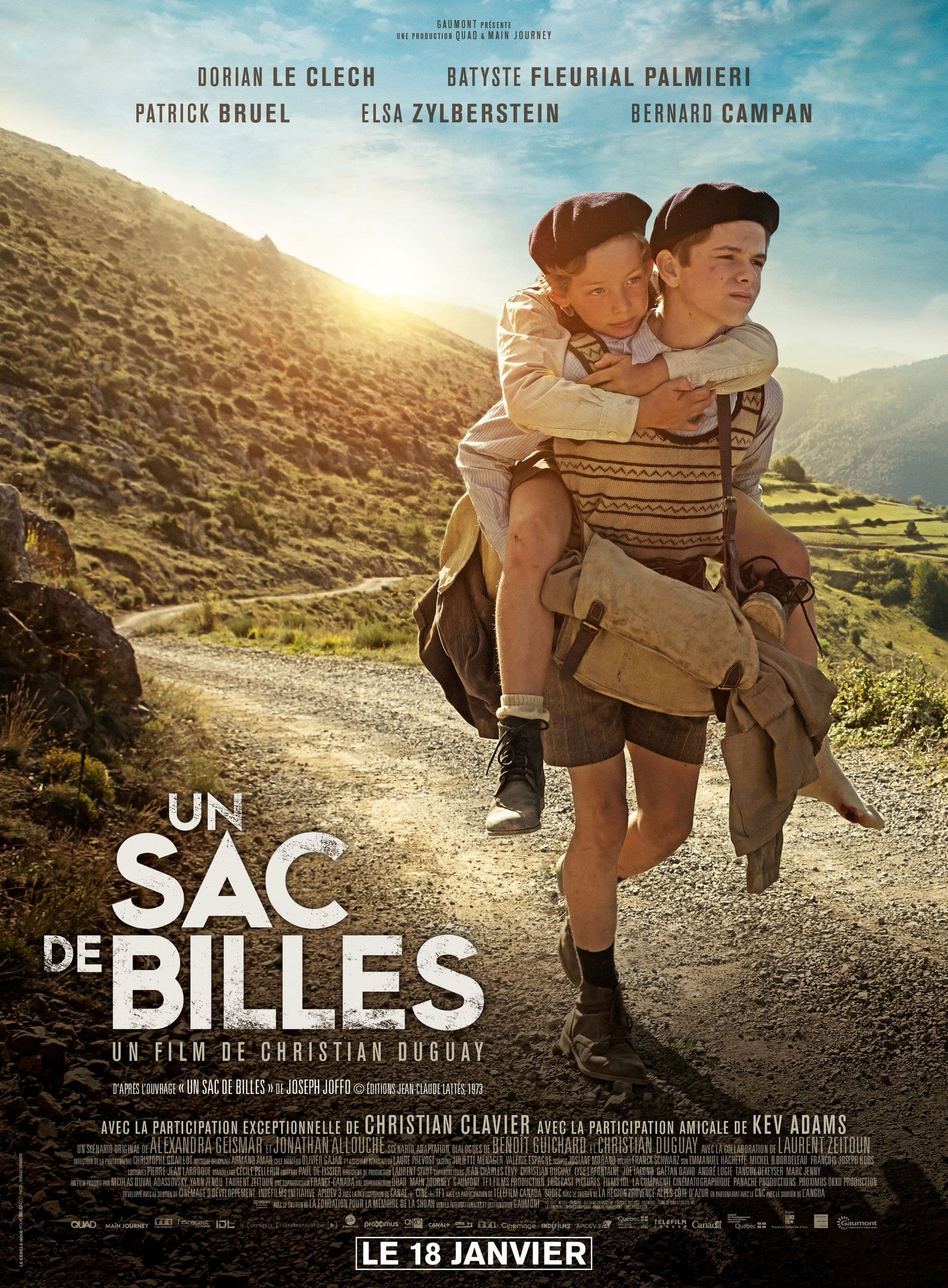
Un sac de billes Budget
 Drama
DramaUpdated
Synopsis
In Nazi-occupied Paris in 1941, two young Jewish brothers, Maurice and Joseph Joffo, ages thirteen and ten, are sent by their father to flee south alone across France to reach their older brothers in unoccupied Vichy territory. Carrying false identity papers and forbidden to admit they are Jewish, they journey through countryside, train carriages, hotel rooms, and the homes of strangers, surviving on cunning, luck, and the kindness of people who choose to help them.
What Is the Budget of Un sac de billes (2017)?
Un sac de billes (2017), directed by Christian Duguay and distributed by Gaumont in France with international distribution through multiple regional partners, was produced on a budget of approximately €18,000,000 (roughly $20,000,000 at 2016-2017 exchange rates). Quad+Ten and Davis Films co-produced through France's established prestige-period drama infrastructure, with Studiocanal providing additional finance. The film was an adaptation of Joseph Joffo's 1973 autobiographical novel of the same name, which had previously been adapted into a 1975 French film of the same title directed by Jacques Doillon, and which has been a fixture of French school curriculum for more than four decades.
The budget reflected the cost discipline of contemporary French prestige WWII period drama. The producers priced the film at the upper range of French national cinema, betting that the established source material's reputation in France, the established director (Christian Duguay, who had previously directed Belle and Sebastian: The Adventure Continues for Gaumont), and the period-production scale could deliver a French theatrical opening with significant downstream international rights revenue. The math required the film to clear roughly €35,000,000 worldwide to reach broad profitability, a target the film cleared on the strength of its French theatrical performance and television-rights revenue.
Key Budget Allocation Categories
Un sac de billes' approximately €18,000,000 budget was distributed across several core production areas:
- Above-the-Line Talent: Patrick Bruel anchored the cast as the boys' father Roman Joffo, with Elsa Zylberstein as their mother Anna. Christian Clavier took a meaningful supporting role as Monsieur Mancelier, the antisemitic Vichy bookseller whose attitudes shift over the course of the narrative, and Bernard Campan played the Catholic priest who shelters the boys at a critical moment. The two young leads, Dorian Le Clech (Maurice) and Batyste Fleurial (Joseph), were cast through an extensive French children's casting search, with both children appearing in their feature debuts.
- Multi-Region French Location Shoot: Principal photography ran across multiple French regions, including Île-de-France for the Paris occupation sequences, the South of France for the unoccupied Vichy zone sequences, and various rural exteriors that doubled for the brothers' multi-month flight across the demarcation line. The French regional production tax credit (the Crédit d'Impôt Cinéma) anchored the project's domestic budget structure.
- Period Costume and Production Design: Costume designer Jean-Daniel Vuillermoz and production designer Patrice Vermette dressed the multi-period 1941-1943 settings, including occupied Paris apartments, the Joffo barbershop, train carriages, the rural Vichy hotels, and various transit hubs. The Yellow Star and other Vichy-era period dressing required extensive research and accuracy, with French Holocaust scholars consulting on the production.
- Train and Period Vehicle Set Pieces: The film required dedicated period-train sequences for the brothers' multiple rail journeys, including the famous demarcation-line crossing. Working steam locomotives, period passenger carriages, and period freight cars were sourced through French railway-heritage organizations. The film also required dressed period vehicles for the various street and rural exterior sequences.
- Score and Music: Composer Armand Amar wrote the original score with a contemporary orchestral palette incorporating Jewish musical motifs appropriate to the Joffo family's heritage. The score anchored the film's emotional throughline and earned César nomination consideration.
- Child Performer Coaching and Schedule: The extensive coverage required of the two young leads (who appear in nearly every scene) required dedicated on-set coaching, French child-labor-law compliance, and the standard half-day shooting schedule that French child-performer regulations mandate. The compressed schedule extended the principal-photography calendar accordingly.
How Does Un sac de billes' Budget Compare to Similar Films?
At approximately €18,000,000 ($20,000,000), Un sac de billes sits in the upper-middle range of contemporary French prestige period drama. The comparison set illustrates the genre's commercial range:
- La Rafle (2010): Budget €19,000,000 (approximately $26,000,000) | Worldwide $25,000,000. Rose Bosch's French film about the 1942 Vel' d'Hiv Roundup cost slightly more and earned 80% more worldwide, the closest stylistic and tonal comparison among contemporary French Holocaust-themed dramas.
- Belle and Sebastian: The Adventure Continues (2015): Budget €17,000,000 (approximately $20,000,000) | Worldwide $15,000,000. Christian Duguay's previous Gaumont feature cost essentially the same as Un sac de billes and earned slightly more worldwide, the director's prior commercial benchmark.
- Les Choristes (2004): Budget €5,500,000 (approximately $7,000,000) | Worldwide $87,800,000. Christophe Barratier's coming-of-age post-WWII French drama cost less than a third of Un sac de billes and earned more than six times its worldwide gross, the cycle's commercial outlier.
- Au revoir les enfants (1987): Budget approximately $3,500,000 | Worldwide $7,650,000. Louis Malle's classic French WWII children's drama cost less than 20% of Un sac de billes (in nominal dollars) and earned a fraction of its worldwide gross, but won the Golden Lion at the Venice Film Festival and remains the canonical French film about Jewish children during the occupation.
- Les enfants du marais (1999): Budget approximately €12,000,000 | Worldwide $20,000,000. Jean Becker's French period drama cost less than Un sac de billes and earned more worldwide, illustrating the upper commercial range of mid-budget French period cinema.
Un sac de billes Box Office Performance
Un sac de billes opened in France on January 18, 2017, debuting to approximately €1,200,000 across 567 French theaters, finishing fourth on the French chart. The film opened against family-and-broader-audience competition and held competitively over multiple weekends, with strong word-of-mouth and the source material's curriculum-level recognition driving sustained attendance through French school groups. The film closed its French theatrical run at €11,000,000 (approximately $11,500,000 at 2017 exchange rates), with limited international theatrical exposure outside Francophone markets.
Against an approximately $20,000,000 production budget, Un sac de billes needed roughly $35,000,000 worldwide to reach broad profitability after marketing. Here is the financial breakdown:
Box Office Breakdown
Un sac de billes (2017)

Un sac de billes returned approximately $0.50 in theatrical revenue for every $1 invested when measured against total estimated production and marketing spend, an apparent theatrical loss that significantly underestimates the French production's broader commercial model. The film performed well in French theatrical release, drew significant French television-rights and home-entertainment revenue, and continues to circulate in French school and library distribution. The international share of the gross (essentially all of the $13,827,068 worldwide figure) was concentrated in France with limited expansion to Belgium, Switzerland, Germany, Italy, and other European markets. The film never received meaningful North American theatrical distribution.
The producers and Gaumont recouped substantial portions of the production cost through French television pre-sales (a standard French national-cinema finance mechanism), Canal+ pay-television rights, and the long-tail school and library distribution market. Un sac de billes has subsequently developed an enduring catalog presence on European streaming platforms, with French school groups and library audiences sustaining its reach into the 2020s. The source material's continued curriculum-level recognition in French education sustains long-term value for the production beyond the immediate theatrical-release window.
Un sac de billes Production History
Development began in 2013 when Gaumont and Quad+Ten optioned re-adaptation rights to Joseph Joffo's 1973 autobiographical novel, which had previously been adapted into a 1975 French film directed by Jacques Doillon. Screenwriters Christian Duguay, Benoît Guichard, Jonathan Allouche, and Alexandra Geismar adapted the novel across multiple drafts, with Duguay attached to direct following his successful Belle and Sebastian: The Adventure Continues (2015) work for Gaumont.
Joseph Joffo, then in his late eighties, served as a consulting producer on the new adaptation. Joffo's involvement provided both creative input and historical accuracy, with the author working closely with the production design and costume teams to verify period details and the lived experience of the Jewish family's journey across occupied France. Joffo died in 2018, the year after the film's release.
Casting was completed in 2015 and early 2016. The international casting search for the two young brother leads produced Dorian Le Clech (cast as Maurice) and Batyste Fleurial (cast as Joseph), both in their feature debuts. Patrick Bruel, Elsa Zylberstein, Christian Clavier, and Bernard Campan filled out the principal adult ensemble. The casting deliberately balanced veteran French talent against the young leads' newcomer status.
Principal photography ran from spring through summer 2016 across multiple French regions, including Île-de-France for the Paris occupation sequences, the South of France for the unoccupied Vichy zone sequences, and various rural exteriors. The French national production tax credit anchored the budget structure, and French Holocaust scholars consulted on the period accuracy throughout the shoot. The compressed child-performer schedule (which French regulations limit to roughly half-day shooting blocks for performers under sixteen) extended the principal-photography calendar to accommodate the extensive coverage required.
Awards and Recognition
Un sac de billes received limited industry awards recognition. It was not nominated at the major American or British awards (Academy Awards, Golden Globes, BAFTAs).
At the César Awards (the French national cinema awards), the film received nominations for Best Adapted Screenplay and Best Cinematography (Christophe Graillot), though it did not win in either category. The two young leads, Dorian Le Clech and Batyste Fleurial, received Lumières Award and ADAMI Award nominations from French acting bodies for their performances. The film has subsequently been included on French educational reading and viewing lists alongside the original 1973 Joseph Joffo novel, with the parallel adaptation and source material together serving as standard French curriculum material on the occupation, the Vichy regime, and Jewish survival narratives. The 2017 film's release also generated renewed public interest in Joffo's broader memoir work in his final years before his 2018 death.
Critical Reception
Un sac de billes received broadly positive reviews in France and Francophone markets. The film holds a 71% approval rating on Rotten Tomatoes based on 14 critic reviews (a small sample reflecting limited Anglophone critical exposure), and French press coverage was largely warm. Le Monde's Jacques Mandelbaum praised the production design, the two young performances, and Duguay's restraint with material that could easily have tipped into melodrama. Le Figaro called the film "une adaptation soignée et émouvante du chef-d'œuvre de Joseph Joffo," praising the central performances and the historical accuracy.
Critics broadly praised the central performances of Dorian Le Clech and Batyste Fleurial, the period production design, the rural French exteriors, and the screenplay's restraint with the source material's emotional weight. Several reviewers compared the film favorably to Louis Malle's Au revoir les enfants (1987) and Christian Carion's Joyeux Noël (2005) among other French historical features dealing with WWII-era children. A minority of critics, particularly those familiar with the 1975 Doillon adaptation, argued that the 2017 version softened some of the original's emotional edges in favor of a more accessible contemporary structure.
Among general French audiences, the film performed well in the French school distribution market following its initial theatrical release, with educational screening rights becoming a substantial portion of the film's overall revenue. Critical retrospectives in French publications have generally treated Un sac de billes as a respectful and well-mounted adaptation of canonical source material, with the central performances and production-design work receiving the most enduring praise. The film remains a regular reference point in French discussions of WWII-era children's cinema and the broader cycle of contemporary French Holocaust-themed historical drama.
Frequently Asked Questions
How much did it cost to make Un sac de billes (2017)?
The production budget was approximately €18,000,000 (roughly $20,000,000 at 2016-2017 exchange rates). The film was a French national production financed through Quad+Ten, Davis Films, Gaumont, Studiocanal, and TF1 Films Production, leveraging the French national production tax credit (the Crédit d'Impôt Cinéma).
How much did Un sac de billes earn at the box office?
The film earned approximately $13,827,068 worldwide, primarily concentrated in France (approximately €11,000,000 / $11,500,000) with limited expansion to Belgium, Switzerland, Germany, Italy, and other Francophone and European markets. The film did not receive meaningful North American theatrical distribution.
Was Un sac de billes profitable?
Theatrical returns alone showed a roughly $14M to $18M loss against estimated total investment. However, French national cinema profitability includes substantial French television pre-sales, Canal+ pay-television rights, and the long-tail school and library distribution market, which together produced overall production profitability. The source material's curriculum-level recognition in French education sustains long-term value.
Who directed Un sac de billes?
Christian Duguay directed the film. Duguay is a Canadian-born director who had previously directed Belle and Sebastian: The Adventure Continues (2015) for Gaumont. He also co-wrote the Un sac de billes screenplay with Benoît Guichard, Jonathan Allouche, and Alexandra Geismar.
Where was Un sac de billes filmed?
Principal photography ran from spring through summer 2016 across multiple French regions: Île-de-France for the Paris occupation sequences, the South of France for the unoccupied Vichy zone sequences, and various rural exteriors that doubled for the brothers' multi-month flight across the demarcation line. The Crédit d'Impôt Cinéma anchored the budget structure.
Is Un sac de billes based on a true story?
Yes. The film is an adaptation of Joseph Joffo's 1973 autobiographical novel of the same name, which recounts his actual childhood experience fleeing occupied Paris with his older brother Maurice in 1941-1943. The novel has been a fixture of French school curriculum for more than four decades, and Joffo himself served as a consulting producer on the 2017 adaptation. Joffo died in 2018, the year after the film's release.
Was Un sac de billes adapted before?
Yes. The novel was previously adapted into a 1975 French film of the same title directed by Jacques Doillon, with Richard Constantini and Paul-Eric Schulmann as the two young brothers. The 1975 version remains a respected entry in French cinema, with the 2017 adaptation deliberately positioned as a re-adaptation rather than a remake.
Who stars in Un sac de billes?
Dorian Le Clech stars as Maurice Joffo and Batyste Fleurial as Joseph Joffo, both in their feature debuts. Patrick Bruel plays the boys' father Roman, Elsa Zylberstein plays their mother Anna, Christian Clavier plays the Vichy bookseller Monsieur Mancelier, and Bernard Campan plays the Catholic priest who shelters the boys.
How does Un sac de billes compare to other French WWII films?
Un sac de billes earned $13.8M worldwide on an approximately $20M budget. La Rafle (2010) earned $25M on €19M (~$26M). Les Choristes (2004) earned $87.8M on €5.5M (~$7M). Au revoir les enfants (1987) earned $7.65M on ~$3.5M. Un sac de billes performed in the middle of the cycle.
What did critics think of Un sac de billes?
The film received broadly positive French reviews. Le Monde's Jacques Mandelbaum praised the production design, the two young performances, and Christian Duguay's restraint with material that could easily have tipped into melodrama. Le Figaro called it "une adaptation soignée et émouvante du chef-d'œuvre de Joseph Joffo." The Rotten Tomatoes score is 71% based on 14 critic reviews.
Filmmakers
Un sac de billes (2017)

Build budgets like this one in Saturation
Start from an industry-standard feature film template, import the schedule and rates you already have, and let the cost report keep itself current as you spend. Real-time collaboration, no spreadsheets.