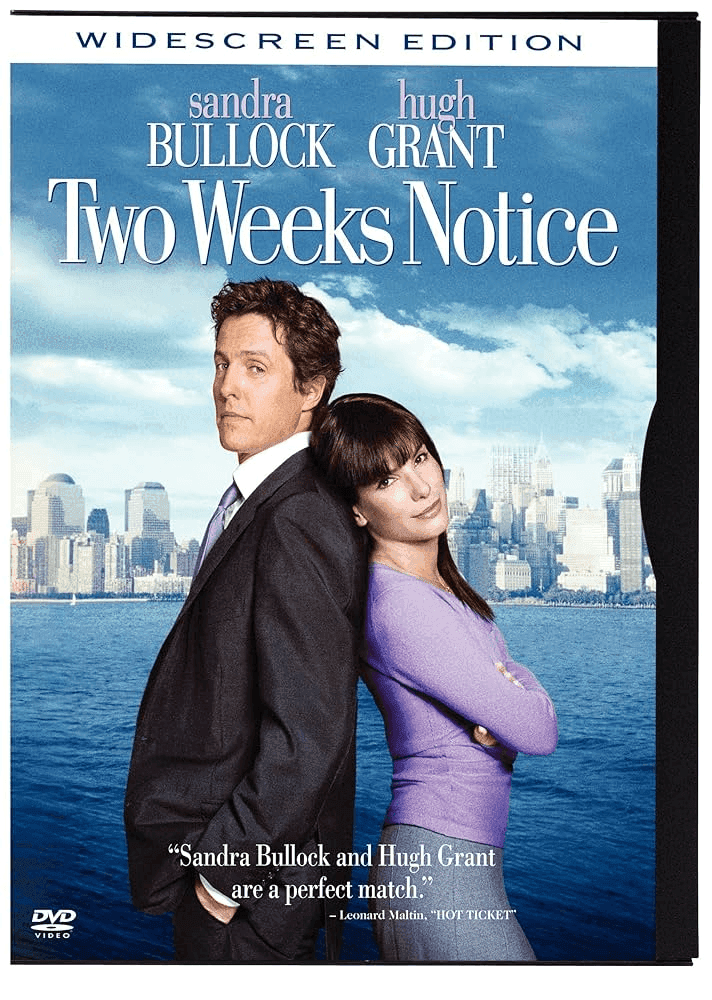
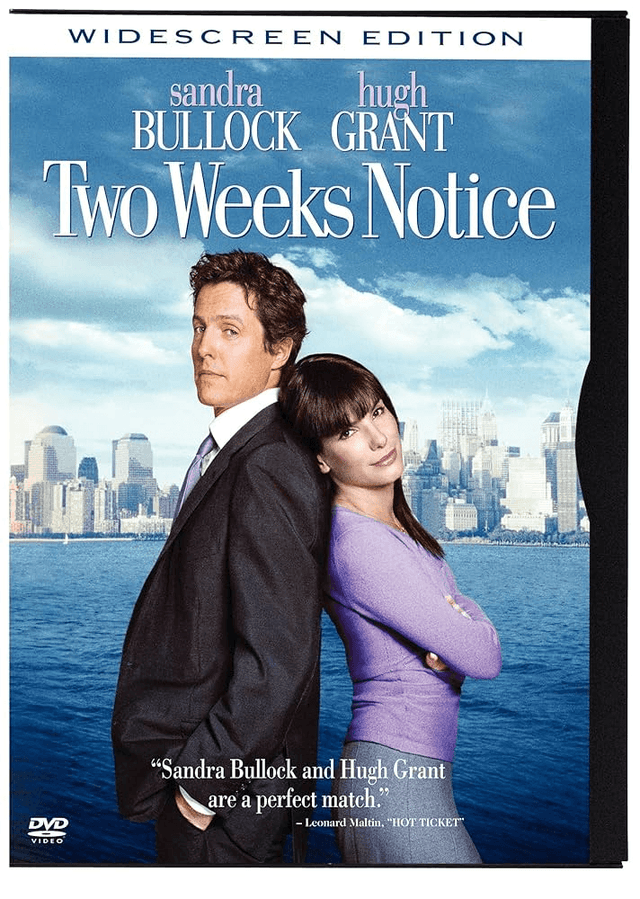
Two Weeks Notice Budget
 Romantic Comedy
Updated
Synopsis
A Harvard-educated public-interest lawyer fighting to save a Coney Island community center accepts a position as chief counsel to a self-absorbed Manhattan real-estate billionaire after he promises not to demolish the building. A year of round-the-clock personal demands, professional disrespect, and unreciprocated personal investment finally pushes her to submit her two-week resignation notice, only to find that the prospect of separation forces both her and her employer to confront feelings they have been refusing to acknowledge.
What Is the Budget of Two Weeks Notice (2002)?
Two Weeks Notice (2002), written and directed by Marc Lawrence and distributed by Warner Bros. Pictures, was produced on a reported budget of $60,000,000. The PG-13-rated romantic comedy starred Sandra Bullock as a Harvard-educated public-interest lawyer who agrees to become the chief counsel for a Manhattan real-estate billionaire played by Hugh Grant, then resigns after a year of unrelenting personal demands. Castle Rock Entertainment, Fortis Films, and Village Roadshow Pictures co-financed the project for Warner Bros., with Sandra Bullock herself producing through her Fortis Films company alongside Marc Lawrence and Mary McLaglen.
The investment reflected the cost of pairing two of the most expensive romantic-comedy stars of the early 2000s, with combined Bullock and Grant above-the-line compensation reported in the $25,000,000 to $30,000,000 range. The Manhattan-set production additionally absorbed substantial location and crew spend, and Warner Bros. needed worldwide grosses of approximately $120,000,000 to clear marketing and distribution costs, a benchmark the film cleared comfortably on the strength of strong international performance.
Key Budget Allocation Categories
Two Weeks Notice's reported $60,000,000 budget was distributed across several core production areas:
- Above-the-Line Talent: Sandra Bullock, coming off Miss Congeniality (2000), and Hugh Grant, fresh from Bridget Jones's Diary (2001) and About a Boy (2002), each commanded substantial leading-romantic-comedy fees with reported combined compensation in the $25,000,000 to $30,000,000 range. Writer-director Marc Lawrence, primarily a television comedy writer (Family Ties, Sister Act) making his feature-directing debut, received a writer-director rate that absorbed both fees.
- Manhattan Location Shoot: Principal photography took place extensively in Manhattan, with practical-location work in Midtown, the Financial District, the Upper East Side, Central Park, and Coney Island in Brooklyn. New York City Film Office permits, location fees, and the higher Manhattan crew rates absorbed a substantial portion of the below-the-line budget. The Coney Island sequence required a multi-day shoot at the practical amusement park, with Wonder Wheel and boardwalk choreography requiring careful coordination.
- Production Design and Wade Properties: Production designer Peter Larkin built the fictional Wade Corporation interiors as a series of glass-and-steel Manhattan office sets, with the Wade Tower exteriors composited from multiple practical Midtown skyscrapers. The fictional Brooklyn community center central to the plot, the Coney Island parade-route sequences, and multiple Manhattan apartment and restaurant interiors required extensive practical-location dressing alongside soundstage work at Kaufman Astoria Studios in Queens.
- Wardrobe and Sandra Bullock's Looks: Costume designer Susan Lyall built distinct wardrobe arcs for the lead character's parallel professional and personal looks, with the contrasting Wade Corporation power-suit wardrobe and the off-hours rumpled-public-interest-lawyer wardrobe each requiring multiple custom builds. Bullock's wardrobe spend was elevated relative to a standard romantic comedy because of her input into the styling and the multiple high-end gala and event wardrobe sequences.
- Music and Score: Composer John Powell delivered the orchestral score, while music supervisor Michael McQuarn assembled the soundtrack of contemporary pop, jazz standards, and original placements. The film required clearing master and synchronization rights for multiple needle drops used in Manhattan-montage and romantic-evening sequences. The accompanying soundtrack album was released by Warner Bros. Records.
- Post-Production and Editorial: Editor Susan E. Morse worked through Marc Lawrence's first-time-director assembly cut, with the romantic-comedy beats and the Bullock-Grant chemistry-sequence selection requiring careful editorial calibration. The production budgeted for some pickup shoots and extended editorial through the autumn of 2002 ahead of the December release.
How Does Two Weeks Notice's Budget Compare to Similar Films?
At a reported $60,000,000, Two Weeks Notice sat in the upper-middle tier for romantic comedies of the early 2000s. The comparison set below illustrates how its production scale stacked up against contemporaneous adult-romantic-comedy peers:
- Notting Hill (1999): Budget $42,000,000 | Worldwide $363,889,678. Universal's Hugh Grant and Julia Roberts romantic comedy cost roughly seventy percent of Two Weeks Notice and grossed almost twice as much worldwide, providing the gold-standard benchmark for the upmarket Hugh Grant romantic comedy that Two Weeks Notice consciously evoked.
- Miss Congeniality (2000): Budget $45,000,000 | Worldwide $212,742,720. Castle Rock's Sandra Bullock pageant comedy cost roughly seventy-five percent of Two Weeks Notice and grossed marginally more worldwide, providing the obvious Bullock-vehicle benchmark and confirming the actress's consistent commercial draw.
- Bridget Jones's Diary (2001): Budget $25,000,000 | Worldwide $281,929,795. Universal and Miramax's Hugh Grant and Renée Zellweger comedy cost roughly forty percent of Two Weeks Notice and grossed almost forty percent more worldwide, illustrating the upside available to lower-budget upmarket adult romcom.
- Maid in Manhattan (2002): Budget $55,000,000 | Worldwide $154,906,693. Columbia's Jennifer Lopez and Ralph Fiennes Manhattan-set romantic comedy, released the same December weekend as Two Weeks Notice, cost ninety percent of Two Weeks Notice and grossed about seventy-five percent worldwide, providing the closest direct same-release comp.
- How to Lose a Guy in 10 Days (2003): Budget $50,000,000 | Worldwide $176,460,212. Paramount's Kate Hudson and Matthew McConaughey romantic comedy cost about eighty-five percent of Two Weeks Notice and grossed about eighty-eight percent worldwide, providing the closest production-scale and commercial peer.
Two Weeks Notice Box Office Performance
Two Weeks Notice opened on December 20, 2002 to $14,313,070 in the United States, finishing second on its opening weekend behind The Lord of the Rings: The Two Towers in the latter film's second weekend. The film held within thirty-five percent declines for several weeks through the holiday season and continued to leg out on positive adult-female word of mouth through January and February 2003. It ended its domestic run at $93,354,851 and added $106,679,930 internationally for a worldwide total of $200,034,781. Here is the financial breakdown:
Box Office Breakdown
Two Weeks Notice

Two Weeks Notice returned approximately $1.82 to $2.00 in theatrical revenue for every $1 invested when measured against total estimated production and marketing spend, before accounting for DVD, VHS, pay television, and broadcast windows that would have pushed the lifetime return well past two-to-one. The domestic share of the gross was $93,354,851 against an international share of $106,679,930, a 47/53 split that demonstrated unusual international resilience for an English-language Manhattan-set romantic comedy and confirmed Hugh Grant's pan-European audience pull.
The result was a clear win for Warner Bros., Castle Rock, and Fortis Films, and it positioned Two Weeks Notice among the highest-grossing romantic comedies of the early 2000s. The film cemented Sandra Bullock as a reliable holiday-season romantic-comedy lead, reinforced Hugh Grant's transatlantic commercial profile, and demonstrated the durable audience appetite for opposite-personalities boss-employee romantic-comedy structure that subsequent studio releases would attempt to replicate through the decade.
Two Weeks Notice Production History
Development began in 2001 when Marc Lawrence, primarily known as a television comedy writer and as the writer of Forces of Nature (1999) and Miss Congeniality (2000), pitched the spec script to Castle Rock Entertainment as a starring vehicle for Sandra Bullock with Lawrence himself directing. Bullock signed on quickly and brought the project to her Fortis Films production company, which co-produced with Castle Rock and Mary McLaglen. Village Roadshow Pictures co-financed the production with Warner Bros. as part of its broader studio output deal.
Hugh Grant attached as the male lead in early 2002, immediately after the breakout success of Bridget Jones's Diary and About a Boy made him the most commercially valuable British romantic-comedy lead of the period. Casting was rounded out with Alicia Witt as Grant's character's rebound love interest June Carter, Dana Ivey as Bullock's mother, David Haig as Grant's brother and business partner, Robert Klein and Heather Burns in supporting roles, and Norma Michaels in a brief but memorable elderly-tenant scene.
Principal photography ran from April to July 2002 in Manhattan and surrounding boroughs, with extensive practical-location work in Midtown, the Financial District, the Upper East Side, Central Park, and Coney Island in Brooklyn. The Coney Island sequence, including the iconic Wonder Wheel proposal sequence and the boardwalk parade-route choreography, required a multi-day practical-amusement-park shoot. Interior soundstage work used Kaufman Astoria Studios in Queens, with the production accessing the modest New York State film tax credits available at the time.
Post-production extended through the autumn of 2002, with Warner Bros. setting a December 20 release date in a clear holiday-season counter-programming slot against The Lord of the Rings: The Two Towers. Marketing emphasized the Bullock-Grant pairing, the high-concept resignation premise, and the Manhattan setting, with trailers structured around the comic boss-and-employee chemistry and the inevitable romantic-comedy beats. The film opened to a strong holiday weekend and built unusually strong legs through the new year.
Awards and Recognition
Two Weeks Notice received limited but notable awards recognition primarily in the popular-vote categories. Sandra Bullock received a Golden Globe Award nomination for Best Actress in a Motion Picture, Musical or Comedy at the 60th Golden Globes in 2003, recognizing her central comic performance. Hugh Grant received a People's Choice Award nomination for Favorite Leading Man at the 2003 ceremony.
Bullock and Grant jointly received Empire Award nominations for Best Actress and Best Actor at the UK genre-and-popular-film ceremony in 2003. The film also received Teen Choice Award nominations for Choice Movie: Comedy, Choice Actress in a Comedy (Bullock), and Choice Actor in a Comedy (Grant) at the 2003 ceremony. The film was not in serious contention at the major industry-craft ceremonies, with the romantic-comedy genre broadly treated as a non-factor at the Oscars, the Screen Actors Guild Awards, and the major guild ceremonies.
Critical Reception
Two Weeks Notice received mixed reviews. The film holds a 44% approval rating on Rotten Tomatoes based on 158 critic reviews, with a critical consensus describing it as a pleasant if formulaic romantic comedy buoyed by the chemistry between Sandra Bullock and Hugh Grant. On Metacritic, the film scored 52 out of 100, indicating mixed or average reviews. Audiences surveyed by CinemaScore gave the film a B+, a respectable audience grade for an adult-skewing romantic comedy.
Critics broadly praised the chemistry between Sandra Bullock and Hugh Grant, the Manhattan location work, and the lead characters' comic-banter screenplay structure, but objected to the predictability of the third-act beats and what they characterized as a thin antagonist plot involving the Brooklyn community center. Roger Ebert gave the film three stars out of four, writing that "Bullock and Grant are a witty match and they raise the material's IQ," while The New York Times's Elvis Mitchell called it "a well-mannered Hollywood romantic comedy that knows what it is." Variety's Todd McCarthy noted the formulaic structure but called the lead performances "genuinely engaging."
Other reactions were more mixed, with The Hollywood Reporter's Kirk Honeycutt calling the film "familiar but agreeable," and Entertainment Weekly's Owen Gleiberman giving it a B-minus while praising the leads. The film's reputation has been substantially preserved in subsequent years, with Two Weeks Notice frequently cited in romantic-comedy retrospectives as one of the high points of early-2000s Hugh Grant-Sandra Bullock studio romantic comedy and as a reliable comfort-watch streaming title.
Frequently Asked Questions
How much did it cost to make Two Weeks Notice (2002)?
The reported production budget was $60,000,000, with combined Sandra Bullock and Hugh Grant above-the-line compensation reported in the $25,000,000 to $30,000,000 range. Warner Bros. distributed with Castle Rock Entertainment, Fortis Films (Sandra Bullock's production company), and Village Roadshow Pictures co-financing.
How much did Two Weeks Notice earn at the box office?
The film grossed $93,354,851 domestically and $106,679,930 internationally, for a worldwide total of $200,034,781. It opened to $14,313,070 in the United States, finishing second on the weekend of December 20, 2002 behind The Lord of the Rings: The Two Towers in its second weekend.
Was Two Weeks Notice a box office success?
Yes. Against a $60,000,000 production budget and an estimated $40,000,000 to $50,000,000 in marketing spend, the film returned approximately $1.82 to $2.00 in worldwide theatrical revenue for every $1 invested. Home video, DVD, pay television, and broadcast windows extended the lifetime return well past two-to-one, making the film a clear win for Warner Bros., Castle Rock, and Sandra Bullock's Fortis Films.
Who directed Two Weeks Notice?
Marc Lawrence wrote and directed the film, his feature-directing debut. Lawrence was primarily known as a television comedy writer (Family Ties, Sister Act) and as the screenwriter of Forces of Nature (1999) and Miss Congeniality (2000). He subsequently directed Music and Lyrics (2007), Did You Hear About the Morgans? (2009), and The Rewrite (2014).
Where was Two Weeks Notice filmed?
Principal photography ran from April to July 2002 extensively in Manhattan and surrounding boroughs, with practical-location work in Midtown, the Financial District, the Upper East Side, Central Park, and Coney Island in Brooklyn. Interior soundstage work used Kaufman Astoria Studios in Queens. The production accessed the modest New York State film tax credits available at the time.
How does Two Weeks Notice compare to Notting Hill?
Two Weeks Notice cost about forty percent more than Notting Hill ($42 million in 1999) and grossed about fifty-five percent as much worldwide. Both films starred Hugh Grant in their lead romantic role, and both demonstrated his durable commercial appeal in the early-2000s adult romantic comedy genre. Notting Hill remains the higher-grossing Hugh Grant title of the era, but Two Weeks Notice is similarly profitable on its release-window margins.
Who stars in Two Weeks Notice?
Sandra Bullock plays public-interest lawyer Lucy Kelson and Hugh Grant plays Manhattan real-estate billionaire George Wade. The supporting cast includes Alicia Witt, Dana Ivey, David Haig, Robert Klein, and Heather Burns, with then-real-estate-executive Donald Trump in a cameo role as himself. The chemistry between Bullock and Grant is widely cited as the principal driver of the film's commercial success.
Did Two Weeks Notice win any awards?
Sandra Bullock received a Golden Globe Award nomination for Best Actress in a Motion Picture, Musical or Comedy at the 60th Golden Globes in 2003. Hugh Grant received a People's Choice Award nomination for Favorite Leading Man. Both received Empire Award and Teen Choice Award nominations. The film was not a factor at the Oscars, the Screen Actors Guild Awards, or the major industry-craft ceremonies.
What did critics think of Two Weeks Notice?
The film received mixed reviews. It holds a 44% approval rating on Rotten Tomatoes (158 critics) and a 52 out of 100 Metacritic score. Audiences gave it a B+ CinemaScore. Roger Ebert gave the film three stars out of four. Critics broadly praised the chemistry between Sandra Bullock and Hugh Grant but objected to the predictable third-act structure and the thin community-center antagonist subplot.
Is Donald Trump in Two Weeks Notice?
Yes. Donald Trump, then a New York real-estate executive and television personality two years before The Apprentice premiered in 2004, appears in a brief cameo role as himself at a Wade Corporation function. Trump's appearance was a contemporary New York-real-estate-world casting choice given the film's Manhattan-real-estate-billionaire central character, and it has drawn renewed attention in retrospective coverage given his subsequent political career.
Filmmakers
Two Weeks Notice

Build budgets like this one in Saturation
Start from an industry-standard feature film template, import the schedule and rates you already have, and let the cost report keep itself current as you spend. Real-time collaboration, no spreadsheets.