To Die For Budget
 Black Comedy
Updated
Synopsis
Suzanne Stone, a small-town New Hampshire weather forecaster with ambitions of network stardom, decides her unsupportive husband is the only obstacle to her career. She seduces a teenage student into murdering him and watches the local news cover the crime, convinced she is finally about to be famous.
What Is the Budget of To Die For (1995)?
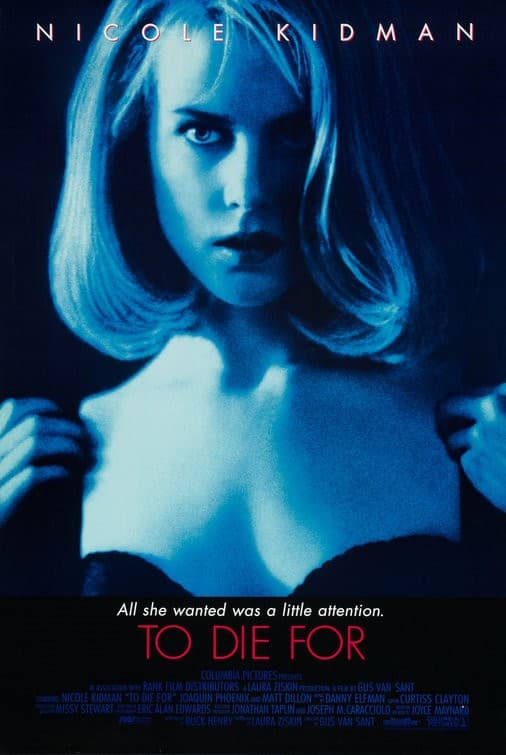
To Die For (1995), directed by Gus Van Sant and distributed by Columbia Pictures, was produced on a reported budget of $20,000,000. The dark satire was financed by Columbia Pictures alongside Laura Ziskin Productions and The Rank Organisation, with Ziskin producing through her studio-based shingle. The film was loosely based on Joyce Maynard's 1992 novel of the same name, which itself drew on the real-life Pamela Smart murder case in New Hampshire.
The mid-range budget reflected the project's status as a star-driven adult-audience film with a director coming off the critical and commercial success of My Own Private Idaho (1991). Buck Henry adapted the screenplay, and Nicole Kidman was cast in what became one of her defining early-career roles, transitioning her from supporting wife roles to lead-actress status.
Key Budget Allocation Categories
The $20,000,000 budget was distributed across these core production areas:
- Above-the-Line Talent: Nicole Kidman, Matt Dillon, and a deep supporting ensemble including Joaquin Phoenix (then Leaf Phoenix), Casey Affleck, Illeana Douglas, Alison Folland, Dan Hedaya, and Wayne Knight commanded the bulk of the cast budget. Director Gus Van Sant and screenwriter Buck Henry rounded out the above-the-line spending.
- New Hampshire and Toronto Location Filming: Principal photography took place primarily in Ontario, Canada (Toronto and surrounding towns standing in for Little Hope, New Hampshire), with additional location work for exteriors. The Canadian production tax incentives reduced the practical cost burden.
- Mockumentary Production Design: The film's framing as a series of media interviews, television broadcasts, and faux-documentary segments required production designer Missy Stewart to build multiple newsroom, suburban-home, and motel interiors with period-specific television-news aesthetics.
- Cinematography and Television Aesthetic: DP Eric Alan Edwards shot the film with deliberate stylistic shifts between cinema-film stock for the dramatic sequences and video aesthetics for the interview and broadcast framing segments. The technical complexity of matching multiple acquisition formats added post-production work.
- Score and Music: Danny Elfman composed the score, complemented by an extensive soundtrack of period-appropriate popular music. Music licensing for the soundtrack consumed a noteworthy share of the budget.
- Marketing and Distribution: Columbia's P&A spend was estimated at approximately $15,000,000 to $20,000,000, with a marketing campaign centered on Nicole Kidman's lead performance and the film's satirical media-critique positioning.
How Does To Die For's Budget Compare to Similar Films?
At $20,000,000, To Die For sat in the standard range of mid-1990s prestige satire and dark-comedy productions:
- Election (1999): Budget $25,000,000 | Worldwide $14,900,000. Paramount's Alexander Payne high-school satire cost slightly more and earned less, providing a thematic and tonal comparison for To Die For's media-celebrity critique.
- The Player (1992): Budget $8,000,000 | Worldwide $39,800,000. Robert Altman's Hollywood satire cost less than half and out-grossed To Die For nearly two-to-one, illustrating the financial range for adult-audience satirical features.
- Drugstore Cowboy (1989): Budget $7,000,000 | Worldwide $4,720,000. Van Sant's earlier independent feature cost a fraction of To Die For and posted modest commercial returns, framing To Die For as his transition into studio production.
- My Own Private Idaho (1991): Budget $2,500,000 | Worldwide $6,400,000. Van Sant's previous critical breakthrough cost less than an eighth and earned proportionally well within its scale, providing the platform that allowed Columbia to entrust him with the larger To Die For budget.
To Die For Box Office Performance
To Die For opened on October 6, 1995 after premiering at the 1995 Cannes Film Festival. The film received a wide release across North America. The financial breakdown:
Box Office Breakdown
To Die For (1995)

To Die For returned approximately $0.53 to $0.61 in worldwide theatrical revenue for every $1 invested. The domestic share of the gross was $21,284,514 with limited international theatrical performance. Columbia recouped further through home video, cable, and television syndication in the years following the theatrical run, with the film's reputation as a Kidman star-making vehicle and Van Sant prestige entry sustaining its catalog value.
To Die For Production History
Development on To Die For began with Joyce Maynard's 1992 novel, which drew on the 1990 Pamela Smart murder case in New Hampshire (a school administrator who seduced a teenage student into murdering her husband). Buck Henry was hired to adapt the screenplay, transposing the source into a sharper satirical register focused on media-celebrity ambition.
Meg Ryan was originally attached to play Suzanne Stone before Nicole Kidman took the role. Gus Van Sant came aboard as director after the project had cycled through other names. Principal photography took place in 1994 primarily in Ontario, Canada (Toronto and surrounding towns standing in for Little Hope, New Hampshire), with additional location work for exteriors. The Canadian production tax credit anchored the financing structure.
Nicole Kidman's performance, developed in close collaboration with Van Sant and dialect coach Tim Monich, became the film's defining element. She underwent significant transformation for the role, adopting a tight television-presenter speech pattern and physical mannerisms that earned her best-of-year notices from critics including Roger Ebert. The film premiered at the 1995 Cannes Film Festival in May before its October 1995 wide release.
Awards and Recognition
To Die For received significant awards recognition, particularly for Nicole Kidman's lead performance. Kidman won the Golden Globe Award for Best Actress in a Musical or Comedy and received nominations from the Screen Actors Guild and BAFTA. She did not receive an Academy Award nomination, an omission widely discussed at the time and frequently cited as one of the era's notable Oscar snubs.
The film won the Independent Spirit Award for Best Female Lead (Kidman). It was nominated at Cannes for the Palme d'Or and won the Cannes Film Festival's Boomerang Award. Gus Van Sant received Directors Guild and BAFTA mentions, and Buck Henry's screenplay drew Writers Guild attention. The film has held a durable reputation as a Kidman star-launching role and one of the strongest entries in Van Sant's 1990s filmography.
Critical Reception
To Die For received overwhelmingly positive reviews. The film holds an 89% approval rating on Rotten Tomatoes based on 65 critic reviews, with a critical consensus praising Nicole Kidman's lead performance and Gus Van Sant's satirical direction. On Metacritic, the film scored 82 out of 100, indicating universal acclaim.
Roger Ebert awarded the film three and a half stars out of four, writing that "Kidman's performance is a small wonder of bright surfaces and creepy interiors" and that "Van Sant has made a sharp, funny film about the corruption of celebrity." The New York Times called it "the most original American satire in years," and Entertainment Weekly graded it an A-. Joaquin Phoenix (then credited as Leaf Phoenix) and Illeana Douglas drew strong supporting-cast notices, with Phoenix's performance widely cited as the launch of his serious dramatic career. The combined critical and awards response cemented To Die For as one of the defining mid-1990s dark satires and the breakthrough lead role for Nicole Kidman.
Frequently Asked Questions
How much did it cost to make To Die For (1995)?
The reported production budget was $20,000,000. The film was financed by Columbia Pictures alongside Laura Ziskin Productions and The Rank Organisation, with Ziskin producing through her studio-based shingle. Columbia handled worldwide theatrical distribution.
How much did To Die For earn at the box office?
The film grossed $21,284,514 domestically with limited international theatrical performance, for a worldwide total of approximately $21,300,000. It opened in October 1995 after premiering at the 1995 Cannes Film Festival in May.
Was To Die For profitable?
No. Against a $20,000,000 production budget and an estimated $15,000,000 to $20,000,000 in marketing spend, the film returned approximately $0.53 to $0.61 in worldwide gross for every $1 invested. Columbia recouped further through home video, cable, and television syndication in the years following the theatrical run.
Who directed To Die For?
Gus Van Sant directed the film, working from Buck Henry's screenplay. Van Sant came to the project after the critical breakthrough of My Own Private Idaho (1991) and the earlier Drugstore Cowboy (1989).
Is To Die For based on a true story?
Yes. The film is based on Joyce Maynard's 1992 novel of the same name, which itself drew on the 1990 Pamela Smart murder case in New Hampshire. Smart was a school media-services coordinator who was convicted of conspiring with a teenage student to murder her husband. Buck Henry's adaptation transposed the source into a sharper satirical register focused on media-celebrity ambition.
Did Nicole Kidman win an Oscar for To Die For?
No. Nicole Kidman won the Golden Globe Award for Best Actress in a Musical or Comedy for her performance, and was nominated from the Screen Actors Guild and BAFTA, but she did not receive an Academy Award nomination. The Oscar omission was widely discussed at the time and is frequently cited as one of the era's notable snubs. She also won the Independent Spirit Award for Best Female Lead.
Where was To Die For filmed?
Principal photography took place in 1994 primarily in Ontario, Canada, with Toronto and surrounding towns standing in for the fictional Little Hope, New Hampshire. The Canadian production tax credit anchored the financing structure for the project.
Who plays Suzanne Stone in To Die For?
Nicole Kidman plays Suzanne Stone in what became one of her defining early-career roles. Meg Ryan was originally attached to the role before Kidman took it. Kidman underwent significant transformation for the role, adopting a tight television-presenter speech pattern developed with dialect coach Tim Monich.
What did critics think of To Die For?
The film received overwhelmingly positive reviews, with an 89% approval rating on Rotten Tomatoes and an 82 out of 100 Metacritic score. Roger Ebert awarded the film three and a half stars out of four. The New York Times called it "the most original American satire in years." Joaquin Phoenix (credited as Leaf Phoenix) and Illeana Douglas drew strong supporting-cast notices.
Did To Die For win any awards at Cannes?
The film was nominated for the Palme d'Or at the 1995 Cannes Film Festival and won the festival's Boomerang Award. It also won the Independent Spirit Award for Best Female Lead (Nicole Kidman) and the Golden Globe Award for Best Actress in a Musical or Comedy (Kidman).
Filmmakers
To Die For (1995)

Build budgets like this one in Saturation
Start from an industry-standard feature film template, import the schedule and rates you already have, and let the cost report keep itself current as you spend. Real-time collaboration, no spreadsheets.