The World's End Budget
 Comedy
Updated
Synopsis
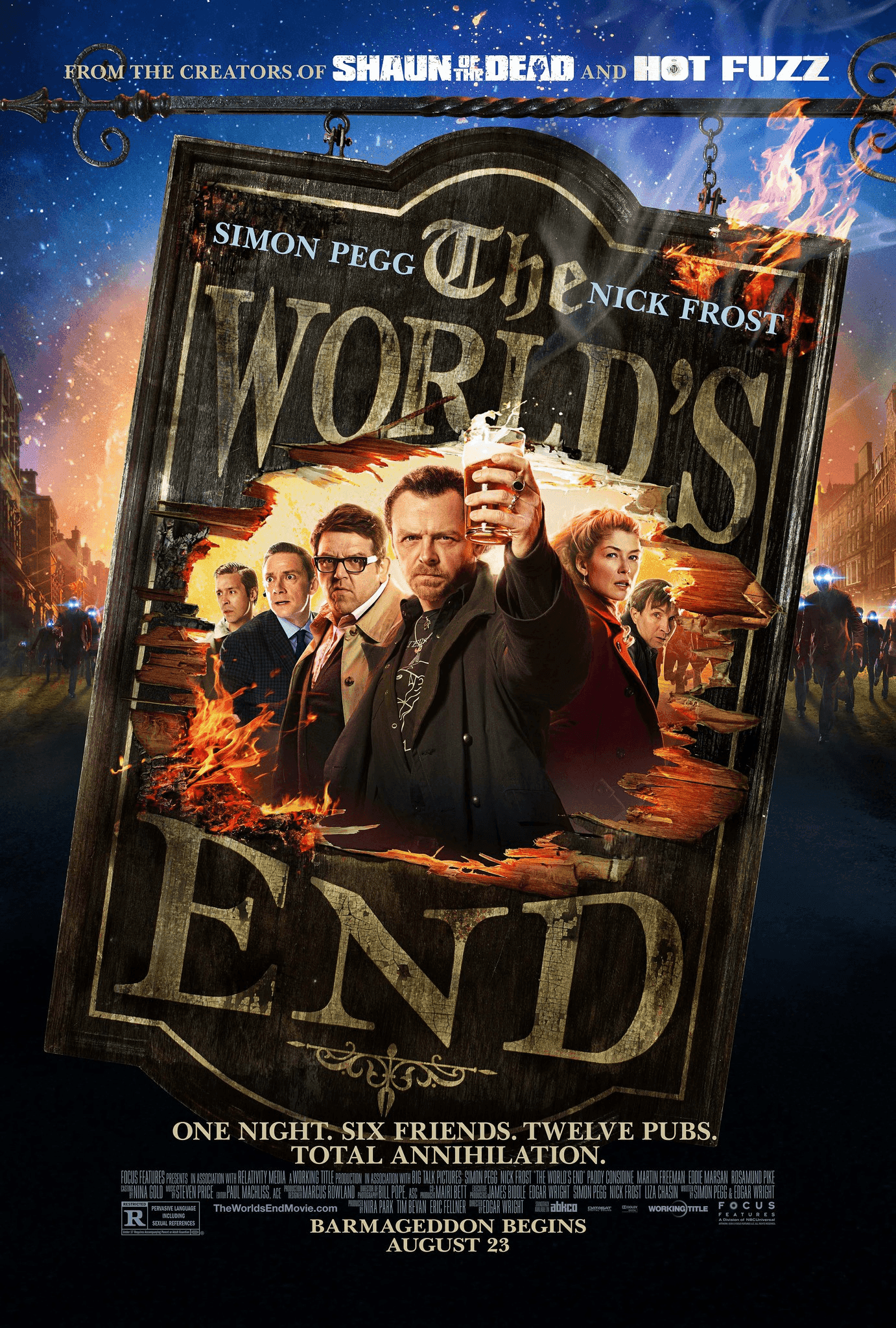
Twenty years after their legendary failed pub crawl, five friends are reunited by their charismatic, hard-drinking ringleader to finally complete the Golden Mile, a twelve-pub circuit ending at the eponymous tavern. As the night escalates, the men discover that their sleepy hometown has been quietly invaded by alien replicants, and finishing the crawl becomes a fight for human autonomy.
What Is the Budget of The World's End (2013)?
The World's End (2013), directed by Edgar Wright and distributed by Focus Features in North America and Universal Pictures internationally, was produced on a budget of $20,000,000. Nira Park produced through Big Talk Productions, with Tim Bevan and Eric Fellner producing through Working Title Films. The film was the third entry in Wright, Simon Pegg, and Nick Frost's Three Flavours Cornetto Trilogy, following Shaun of the Dead (2004) and Hot Fuzz (2007).
The budget reflected a meaningful step up from Hot Fuzz's $16M and Shaun of the Dead's $6M, driven by expanded VFX requirements for the alien-replicant sequences, choreographed action set pieces in multiple pubs, and the established commercial scale that the trilogy's first two entries had built. The math required the film to clear roughly $50,000,000 worldwide to break even after marketing, a target the film cleared just barely as it built on the trilogy's established audience.
Key Budget Allocation Categories
The World's End's $20,000,000 budget was distributed across several core production areas:
- Above-the-Line Talent: Simon Pegg and Nick Frost led the cast at mid-tier comedy-lead fees built on the trilogy's established scale, with Martin Freeman (then mid-Hobbit-trilogy), Paddy Considine, Eddie Marsan, and Rosamund Pike filling out the principal ensemble at standard supporting-tier rates. Edgar Wright commanded a feature-director fee appropriate to the trilogy's established commercial track record.
- Hertfordshire and Letchworth Location Shoot: Principal photography took place across multiple Hertfordshire towns and Letchworth Garden City, which doubled for the fictional Newton Haven of the film. The county's mix of preserved town squares, period-pub interiors, and suburban housing provided practical backdrops that supported the film's Golden Mile pub-crawl conceit without requiring extensive set construction.
- Fight Choreography: Stunt coordinator Bradley James Allan, a longtime Jackie Chan collaborator and Hong Kong-trained choreographer, designed the film's elaborate pub-fight sequences. The "Blanks" combat staging required extensive pre-production rehearsal time, multi-take coverage to capture each beat-by-beat sequence, and the principal cast's extended training to bring their on-screen work to a credible action-comedy level.
- Visual Effects: The alien-replicant transformations, dismemberment gags, and the climactic Bechdel-tunnel sequence required substantial digital VFX coverage. Double Negative handled the bulk of the effects work, with practical-replacement prosthetic effects supplementing the digital pipeline. The VFX budget line was meaningfully larger than Hot Fuzz's, reflecting the more complex creature integration.
- Production Design and Pub Set Construction: Production designer Marcus Rowland (Scott Pilgrim, Hot Fuzz) built or dressed twelve distinct pub interiors that the principal cast traversed across the Golden Mile. Each pub required a distinct visual identity, with thematic naming and design choices ('The First Post,' 'The Trusty Servant,' 'The Cross Hands,' and others) that tracked the film's underlying narrative structure.
- Music Licensing: The film's needle-drop heavy soundtrack featured Britpop and early-1990s alternative-rock tracks central to the film's nostalgic emotional architecture. The Stone Roses, Pulp, The Sundays, Blur, Suede, and Primal Scream all appeared, with licensing fees driving a music line larger than typical for a $20M comedy.
How Does The World's End's Budget Compare to Similar Films?
At $20,000,000, The World's End sits in the typical range for early-2010s mid-budget genre comedies. The comparison set illustrates how the cycle's commercial outcomes scaled with established franchise recognition:
- Shaun of the Dead (2004): Budget $6,000,000 | Worldwide $30,039,392. The trilogy's first entry cost less than a third of The World's End and earned roughly two thirds of its worldwide gross on much lower marketing exposure, the trilogy's strongest ROI.
- Hot Fuzz (2007): Budget $16,000,000 | Worldwide $80,573,774. The trilogy's middle entry cost $4M less than The World's End and earned $34M more worldwide, the trilogy's commercial peak.
- Scott Pilgrim vs. the World (2010): Budget $60,000,000 | Worldwide $47,664,559. Edgar Wright's preceding studio feature cost three times The World's End and earned roughly the same worldwide gross, the cycle's clearest commercial disappointment relative to budget.
- This Is the End (2013): Budget $32,000,000 | Worldwide $126,037,945. The Seth Rogen-Evan Goldberg same-year apocalypse comedy cost $12M more than The World's End and earned nearly three times its worldwide gross, the cycle's strongest 2013 commercial result.
- Paul (2011): Budget $40,000,000 | Worldwide $97,531,567. Greg Mottola's Pegg-Frost-led alien comedy outside the Cornetto Trilogy cost twice The World's End and earned more than twice its worldwide gross, illustrating the studio-comedy scale that the trilogy itself never quite achieved.
The World's End Box Office Performance
The World's End opened in the United Kingdom on July 19, 2013, debuting to £2,000,000 in its opening weekend. The North American release followed on August 23, 2013, debuting to $8,803,945 in its opening weekend across 1,553 theaters, finishing fifth on the United States chart. The opening was below tracking projections that had targeted a $10M to $12M debut on the strength of the trilogy's established critical credibility and the Pegg-Frost-Wright brand.
Against a $20,000,000 production budget, The World's End needed roughly $50,000,000 in worldwide gross to reach profitability when accounting for marketing and distribution costs. Here is the financial breakdown:
Box Office Breakdown
The World's End (2013)

The World's End returned approximately $0.97 in theatrical revenue for every $1 invested when measured against total estimated production and marketing spend, placing it at near-break-even at the theatrical level. The domestic share of the gross was $26,004,851 against an international share of $20,084,495, a 56/44 split that demonstrated balanced English-language global pickup, though with the United Kingdom share concentrated in the international total.
Focus Features and Universal Pictures recouped the modest theatrical shortfall through robust home entertainment, the trilogy's strong catalog status, and subsequent streaming licensing. The Cornetto Trilogy's combined critical reputation and the rapidly growing cult status of all three films through the 2010s made the home-entertainment afterlife particularly long-tailed, with each entry remaining a consistent catalog seller across DVD, Blu-ray, and digital platforms.
The World's End Production History
Development on the trilogy's third entry began in 2007, immediately after Hot Fuzz, with Edgar Wright and Simon Pegg conceiving the project as a science-fiction body-snatcher narrative anchored by the long-running joke of a 22-year-old failed pub crawl. The screenplay went through extensive drafting, with Wright and Pegg explicitly framing the film as the trilogy's emotional capstone: Shaun of the Dead's romantic-comedy-as-zombie-film, Hot Fuzz's buddy-cop-as-action-comedy, and The World's End's pub-crawl-as-apocalypse-comedy.
Casting was completed in 2012, with Simon Pegg returning as the ringleader Gary King, Nick Frost as Andy Knightley (a deliberate inversion of their earlier Cornetto Trilogy pairings, with Frost as the responsible adult and Pegg as the destructive man-child). Martin Freeman, Paddy Considine, and Eddie Marsan rounded out the male ensemble, with Rosamund Pike, Pierce Brosnan, and David Bradley adding featured supporting roles.
Principal photography ran from September to November 2012 across multiple Hertfordshire towns, with Letchworth Garden City serving as the principal Newton Haven location. The pub-crawl structure required extensive multi-pub coverage, with the production company traversing twelve distinct pub locations over the course of the shoot. Bradley James Allan's fight choreography required extended pre-production rehearsal time at a dedicated training space, with the principal cast working through the elaborate combat staging weeks before the camera rolled.
Post-production wrapped in mid-2013, with Focus Features and Universal positioning the film for a July UK release and August North American release. The marketing campaign explicitly framed the film as the Cornetto Trilogy's conclusion, with key art and trailers emphasizing the connection to Shaun of the Dead and Hot Fuzz. The trilogy framing successfully positioned the film with the established Wright-Pegg-Frost audience, even as the broader theatrical commercial result fell below projections.
Awards and Recognition
The World's End received limited industry awards recognition. It was not nominated at the Academy Awards or Golden Globes.
The film received four British Independent Film Award nominations including Best Screenplay (Edgar Wright, Simon Pegg) and Best Production Design (Marcus Rowland), winning Best Production Design. The Empire Awards recognized the film with three nominations including Best British Film, Best Comedy, and Best Director (Edgar Wright). The British Academy of Film and Television Arts (BAFTA) ultimately did not nominate the film in feature categories. At the Saturn Awards for genre filmmaking, the film received nominations for Best Science Fiction Film and Best Supporting Actor (Nick Frost). The Cornetto Trilogy's combined critical and cultural standing has continued to grow through the 2010s and 2020s, with The World's End regularly appearing on retrospective best-of-decade lists.
Critical Reception
The World's End received broadly positive reviews. The film holds an 89% approval rating on Rotten Tomatoes based on 245 critic reviews, with a critical consensus that praised it as a smart, emotionally rich franchise capstone. On Metacritic, the film scored 81 out of 100, indicating universal acclaim. Audiences surveyed by CinemaScore gave the film a B-, a notably lower audience score than the critical reception suggested, reflecting some audience confusion about the film's more melancholic emotional register relative to Hot Fuzz's broader comic appeal.
Critics broadly praised Edgar Wright's direction, the Wright-Pegg screenplay's blend of comedy and middle-aged regret, the fight choreography by Bradley James Allan, the production design by Marcus Rowland, and Simon Pegg's surprisingly raw central performance as the spiraling Gary King. The Guardian's Peter Bradshaw awarded four stars, calling it "a brilliantly funny film with a melancholy heart." Variety's Justin Chang wrote that "The World's End is the rare comedy that earns its emotional weight while never sacrificing its laugh quotient."
Comparative critical assessment against the trilogy's earlier entries has generated meaningful retrospective conversation. Some critics rank The World's End as the trilogy's emotional peak (the BFI's later canonical assessments), while others maintain Hot Fuzz as the trilogy's strongest comedic work. The Wright-Pegg framing of Gary King as the trilogy's most damaged protagonist gave the film a tragic undercurrent that several reviewers identified as its most distinctive contribution to the trilogy. The strong critical reception, combined with the trilogy's growing cult status, has cemented The World's End as both a respected franchise capstone and a regularly cited example of how genre comedy can sustain emotional weight without sacrificing its tonal commitments.
Frequently Asked Questions
How much did it cost to make The World's End (2013)?
The production budget was $20,000,000. The film was produced by Working Title Films and Big Talk Productions, with Focus Features distributing in North America and Universal Pictures internationally.
How much did The World's End earn at the box office?
The film grossed $26,004,851 domestically and $20,084,495 internationally, for a worldwide total of $46,089,346. It opened in the United Kingdom on July 19, 2013, then in North America on August 23, 2013 to $8,803,945 across 1,553 theaters.
Was The World's End profitable?
The theatrical run came in roughly at break-even, posting a small $4M loss to $1M profit against $45M to $50M total investment. Focus Features and Universal recouped the modest shortfall through robust home entertainment and the trilogy's strong catalog status, with the film maintaining consistent long-tail demand.
What is the Cornetto Trilogy?
The Cornetto Trilogy (also called the Three Flavours Cornetto Trilogy) is the Edgar Wright-Simon Pegg-Nick Frost collaboration of Shaun of the Dead (2004), Hot Fuzz (2007), and The World's End (2013). The trilogy name references the Cornetto ice cream brand, with each film featuring a flavor that thematically aligns with its genre (strawberry/zombie blood, original/police blue, mint/sci-fi green).
Who directed The World's End?
Edgar Wright directed the film and co-wrote the screenplay with Simon Pegg. Wright had previously directed Shaun of the Dead (2004), Hot Fuzz (2007), and Scott Pilgrim vs. the World (2010), and he would later direct Baby Driver (2017) and Last Night in Soho (2021).
Where was The World's End filmed?
Principal photography ran from September to November 2012 across multiple Hertfordshire towns, with Letchworth Garden City serving as the principal Newton Haven location. The pub-crawl structure required extensive multi-pub coverage, with the production traversing twelve distinct pub locations over the course of the shoot.
Who stars in The World's End?
Simon Pegg stars as the ringleader Gary King and Nick Frost as Andy Knightley, a deliberate inversion of their earlier Cornetto Trilogy pairings. Martin Freeman, Paddy Considine, and Eddie Marsan round out the male ensemble, with Rosamund Pike, Pierce Brosnan, and David Bradley in featured supporting roles.
How does The World's End compare to Shaun of the Dead and Hot Fuzz?
Shaun of the Dead (2004) cost $6M and earned $30M worldwide. Hot Fuzz (2007) cost $16M and earned $80.6M worldwide, the trilogy's commercial peak. The World's End cost $20M and earned $46M worldwide, the trilogy's most expensive entry but with the weakest box-office ROI.
Is The World's End the end of the Cornetto Trilogy?
Yes. The Edgar Wright-Simon Pegg-Nick Frost collaboration was explicitly conceived as a trilogy, and The World's End was deliberately framed as the trilogy's emotional capstone. No further Cornetto Trilogy entries have been announced or developed, though the principal collaborators have continued working together on separate projects.
What did critics think of The World's End?
The film holds an 89% approval rating on Rotten Tomatoes (245 reviews) and scored 81 out of 100 on Metacritic. The Guardian's Peter Bradshaw awarded four stars, calling it "a brilliantly funny film with a melancholy heart." Variety's Justin Chang wrote that the film "earns its emotional weight while never sacrificing its laugh quotient."
Filmmakers
The World's End (2013)

Build budgets like this one in Saturation
Start from an industry-standard feature film template, import the schedule and rates you already have, and let the cost report keep itself current as you spend. Real-time collaboration, no spreadsheets.