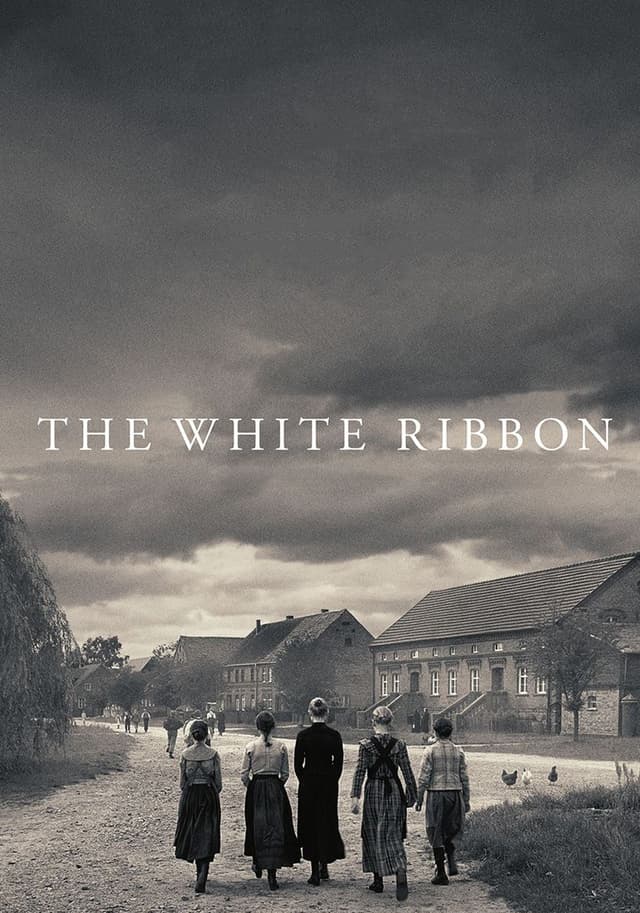
The White Ribbon Budget
 DramaMystery2h 24m
Updated
Synopsis
An aged tailor recalls his life as the schoolteacher of a small village in Northern Germany that was struck by a series of strange events in the year leading up to WWI.
What Is the Budget of The White Ribbon?
The White Ribbon (Das weisse Band) was produced on an estimated budget of $12 million. Financed as a four-country European co-production between Austria, Germany, France, and Italy, the film pooled resources from X-Filme Creative Pool, Wega Film, Les Films du Losange, and Lucky Red. Additional backing came from public funding bodies including the Austrian Film Institute, Medienboard Berlin-Brandenburg, and Eurimages. This co-production model allowed writer-director Michael Haneke to achieve a period production with substantial cast, locations, and post-production requirements while keeping the budget modest by international standards.
Key Budget Allocation Categories
- Period Production Design The film recreates a northern German village in 1913 and 1914, requiring historically accurate sets, interiors, costumes, and props spanning rural Protestant life at the edge of the First World War. Production designer Christoph Kanter built and dressed practical locations across Germany and Romania to achieve the look.
- Black-and-White Cinematography Christian Berger shot the film in color on 35mm and then desaturated it in post-production to achieve a controlled monochrome palette. This approach demanded careful lighting design on set and a specialized digital intermediate process to preserve the tonal richness Haneke and Berger wanted.
- Cast and Ensemble The film features a large ensemble of professional and non-professional actors, including children who carry central roles. The casting process spanned months, with nationwide auditions to find young performers who could handle the material. Adult leads included Susanne Lothar, Ulrich Tukur, and Burghart Klaussner.
- Location Filming Principal photography took place in rural locations across northern Germany and Romania, with additional interiors constructed on soundstages. Transporting the cast and crew across multiple countries, housing them for the extended shoot, and managing child labor regulations added to production logistics.
- Post-Production and Sound Design The black-and-white conversion was only one element of a meticulous post-production process. Sound design played a significant role in establishing the oppressive atmosphere, and the restrained editing style required careful pacing work across the film's 144-minute runtime.
- Multi-Territory Financing and Legal Coordinating four national funding bodies, each with distinct contractual obligations around spend, crew hiring, and distribution windows, required legal and administrative overhead typical of large European co-productions.
How Does The White Ribbon's Budget Compare to Similar Films?
- Amour (2012) Budget $8.9M | Worldwide $68M. Haneke's subsequent Palme d'Or winner was a smaller-scale domestic drama that cost less but earned significantly more at the global box office, illustrating how Haneke's brand value grew after The White Ribbon.
- The Lives of Others (2006) Budget $2M | Worldwide $77M. Florian Henckel von Donnersmarck's German-language period drama about Stasi surveillance achieved a far larger commercial return on a much smaller budget, partly due to its wider audience appeal and Oscar win.
- A Hidden Life (2019) Budget $11M | Worldwide $5.5M. Terrence Malick's period film about Austrian conscientious objector Franz Jagerstatter cost roughly the same as The White Ribbon but struggled commercially, showing how art-house period films carry real financial risk regardless of director reputation.
- Ida (2013) Budget $1.5M | Worldwide $3.8M. Pawel Pawlikowski's black-and-white Polish drama won the Best Foreign Language Film Oscar on a fraction of the budget, demonstrating that monochrome period filmmaking does not require large budgets to succeed critically.
- The Pianist (2002) Budget $35M | Worldwide $120M. Roman Polanski's wartime European drama operated at nearly three times the budget due to its larger scale of destruction and action sequences, but shared the same European co-production financing model.
The White Ribbon Box Office Performance
The White Ribbon earned $2,222,732 at the domestic (US) box office through its limited Sony Pictures Classics release, and approximately $18 million worldwide. For a $12 million production, the break-even threshold (accounting for prints and advertising, typically estimated at roughly twice the production budget) would sit around $24 million. By that measure, the film fell short of profitability through theatrical revenue alone.
The ROI calculation on theatrical gross: ($18M - $12M) / $12M x 100 = approximately 50%. However, this does not account for P&A spending, which would push the real return below break-even on a purely theatrical basis.
That said, the film's financial picture improved significantly through ancillary revenue. Strong DVD and Blu-ray sales in European markets (particularly Germany, France, and Austria), television licensing deals across multiple territories, and long-tail educational and institutional licensing contributed additional income. The Palme d'Or win at Cannes also elevated its profile for festival screenings and repertory bookings that continued for years after release.
Box Office Breakdown
The White Ribbon

The White Ribbon Production History
Michael Haneke developed the screenplay for The White Ribbon over several years, drawing on his long-standing interest in the origins of ideological extremism. The script explored how systematic cruelty and authoritarianism could take root in a seemingly ordered community, using a fictional northern German village in the years immediately before the First World War as its setting. Haneke initially conceived the project as a television miniseries before reworking it into a feature film.
The financing came together through a partnership between Stefan Arndt's X-Filme Creative Pool in Germany, Veit Heiduschka's Wega Film in Austria, Margaret Menegoz's Les Films du Losange in France, and Lucky Red in Italy. Each partner brought national funding from their respective film institutes, a structure that shaped decisions about where to shoot and which crew members to hire from each country.
Casting the children proved one of the most demanding aspects of pre-production. Haneke and his casting team auditioned thousands of young performers across Germany and Austria, looking for naturalistic presence rather than trained acting ability. The final ensemble blended these discoveries with established German-language actors including Susanne Lothar, Ulrich Tukur, Josef Bierbichler, and Burghart Klaussner.
Principal photography took place over approximately eleven weeks in 2008, filming in villages across Mecklenburg-Vorpommern in northern Germany as well as locations in Romania that could double for early twentieth-century rural architecture. Christian Berger, Haneke's regular cinematographer, shot on 35mm color negative with the intention of converting to black and white in post-production, a technique that gave him more control over contrast and tonal values than shooting on black-and-white stock directly.
The film premiered in competition at the 2009 Cannes Film Festival in May, where it won the Palme d'Or. Sony Pictures Classics acquired US distribution rights and released the film in a platform strategy starting in December 2009, expanding slowly through early 2010 to build word of mouth among art-house audiences.
Awards and Recognition
The White Ribbon received major recognition across the international awards circuit. Its most prominent honor was the Palme d'Or at the 2009 Cannes Film Festival, the top prize at the world's most prestigious film event. The jury, presided over by Isabelle Huppert, selected it from a competition lineup that included films by Quentin Tarantino, Ang Lee, and Pedro Almodovar.
At the 67th Golden Globe Awards, The White Ribbon won Best Foreign Language Film. It went on to receive two Academy Award nominations: Best Foreign Language Film and Best Cinematography for Christian Berger's black-and-white work. The cinematography nomination was notable as one of the rare instances of a non-English-language film competing in that category at the Oscars.
The film also won the FIPRESCI Prize at Cannes, Best Film at the European Film Awards, and numerous national film awards in Austria and Germany. It appeared on dozens of year-end best-of lists from major critics and publications worldwide.
Critical Reception
The White Ribbon holds an 84% approval rating on Rotten Tomatoes, reflecting widespread critical admiration tempered by the divisive reactions that Haneke's work typically provokes. The critical consensus praised the film's formal precision, atmospheric control, and thematic ambition while acknowledging that its deliberate pacing and refusal to provide easy answers could frustrate some viewers.
A.O. Scott of The New York Times called it a work of "icy brilliance" and praised Haneke's ability to sustain tension through restraint rather than spectacle. Roger Ebert awarded it four stars, describing the film as a masterwork of craft and purpose that used its period setting to interrogate timeless questions about obedience and cruelty. Peter Bradshaw in The Guardian hailed it as Haneke's finest achievement, noting the way the black-and-white photography lent the village an austere, almost fairy-tale quality that made the underlying violence more disturbing.
Some critics found the allegorical framework too schematic, arguing that Haneke's thesis about the roots of fascism in authoritarian child-rearing was presented too neatly. Others questioned whether the film's narrator, a village schoolteacher reflecting decades later, added ambiguity or simply distance. Despite these reservations, the overwhelming critical consensus placed The White Ribbon among the most significant European films of the 2000s and a career landmark for Haneke.
Frequently Asked Questions
How much did it cost to make The White Ribbon (2009)?
The production budget was $21,555,450, covering principal photography, cast and crew salaries, locations, sets, post-production, and music. Marketing and distribution (P&A) costs are estimated at an additional $10,777,725 - $17,244,360, bringing the total studio investment to approximately $32,333,175 - $38,799,810.
How much did The White Ribbon (2009) earn at the box office?
The White Ribbon grossed $2,222,862 domestic, $9,429,295 international, totaling $11,652,157 worldwide.
Was The White Ribbon (2009) profitable?
The film did not break even theatrically, earning $11,652,157 against an estimated $53,888,625 needed. Ancillary revenue may have improved the picture.
What were the biggest costs in producing The White Ribbon?
The primary cost drivers were above-the-line talent (Christian Friedel, Ernst Jacobi, Leonie Benesch); talent compensation, authentic period production design, and meticulous post-production; international production across Italy, Germany, Austria, France.
How does The White Ribbon's budget compare to similar drama films?
At $21,555,450, The White Ribbon is classified as a low-budget production. The median budget for wide-release drama films in the 2000s ranges from $30 - 80M for mid-budget to $150M+ for tentpoles. Comparable budgets: My Fellow Americans (1996, $21,500,000); Crocodile Dundee in Los Angeles (2001, $21,150,000); 12 Rounds (2009, $22,000,000).
Did The White Ribbon (2009) go over budget?
There are no widely reported accounts of significant budget overruns for this production. However, studios rarely disclose precise budget overrun figures publicly. The reported production budget reflects the final estimated cost.
What was the return on investment (ROI) for The White Ribbon?
The theatrical ROI was -45.9%, calculated as ($11,652,157 − $21,555,450) ÷ $21,555,450 × 100. This measures gross revenue against production budget only - it does not account for P&A or exhibitor shares.
What awards did The White Ribbon (2009) win?
Nominated for 2 Oscars. 62 wins & 49 nominations total.
Who directed The White Ribbon and who were the key crew members?
Directed by Michael Haneke, written by Michael Haneke, shot by Christian Berger, edited by Monika Willi.
Where was The White Ribbon filmed?
The White Ribbon was filmed in Italy, Germany, Austria, France.
Filmmakers
The White Ribbon

Official Trailer
Build budgets like this one in Saturation
Start from an industry-standard feature film template, import the schedule and rates you already have, and let the cost report keep itself current as you spend. Real-time collaboration, no spreadsheets.